The Quick Answer for Anglers
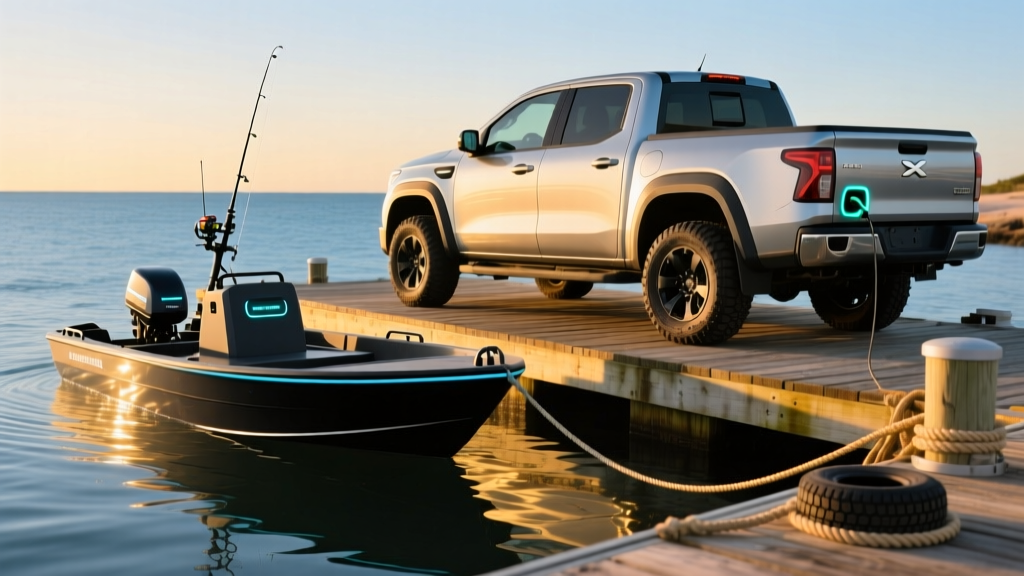
If you're researching a small electric fishing boat, know this: the marine market in 2026 offers electric pontoons and skiffs from brands like Arc, X Shore, and Flux Marine — typically priced between $25,000 and $70,000+, with battery capacities around 20–60 kWh and runtimes of 2–5 hours depending on throttle use. However, AutoEdgeView specializes in electric vehicles, not marine craft. What we can help you decide is whether pairing an electric fishing boat with an EV truck for towing makes financial and practical sense — or whether a gas/hybrid tow rig still wins for weekend anglers. Below, we break down the real costs, range, and charging logistics of the EV-truck-plus-electric-boat equation.
Electric Fishing Boats in 2026: The Market Snapshot
The small electric fishing boat segment has grown but remains niche. Key models available or taking orders include:
- Arc One (electric runabout/sportfish): ~120 kWh battery, ~$90,000+ starting — more cruiser than skiff.
- Flux Marine outboards: Electric outboard motors (15–100 HP equivalent) you can mount on existing hulls; pricing from ~$5,000–$20,000.
- X Shore Eelex 8000: Premium electric dayboat, ~125 kWh, priced north of $300,000 — not a "small" fishing boat.
- Aftermarket trolling motors (Minn Kota, Garmin Force): 24V–36V lithium setups, $2,000–$5,000, effectively electrifying a conventional aluminum jon boat for quiet freshwater fishing.
The honest takeaway: true all-electric fishing boats under $30,000 remain rare. Most anglers "go electric" by retrofitting a gas-hull jon boat or skiff with a lithium trolling motor system.
The Towing Question: Can an EV Truck Haul Your Boat?
This is where our EV expertise matters most. If you're buying a small electric fishing boat (or a gas hull with an electric trolling motor), you need a tow vehicle. Here's how 2026's leading EV trucks stack up against gas equivalents for boat towing:
| Spec | Ford F-150 Lightning (Extended Range) | Ford F-150 3.5L EcoBoost (Gas) | Rivian R1T Dual-Motor Max |
|---|---|---|---|
| Max Towing Capacity | 10,000 lbs | 14,000 lbs | 11,000 lbs |
| EPA Range (unloaded) | 320 mi | ~480 mi (36-gal tank) | 410 mi |
| Real-World Range Towing 4,000 lbs | ~150–180 mi | ~300 mi | ~180–210 mi |
| Battery / Tank | 131 kWh usable (NMC) | 36 gal gasoline | 149 kWh usable (NMC) |
| Peak DC Fast Charge | 150 kW (10-80% ~41 min) | 5 min at pump | 220 kW (10-80% ~30 min) |
| Base MSRP (2026) | ~$62,000 | ~$48,000 | ~$88,000 |
| §30D Federal Tax Credit | Up to $7,500 (income/sourcing rules apply) | None | Up to $7,500 (income/sourcing rules apply) |
Real-world towing range is the critical number. Towing a 4,000-lb boat-and-trailer combo cuts EV range roughly 50–60%. A 320-mile EPA rating becomes ~150–180 real miles at highway speeds. That's sufficient for lake trips within 75 miles of home — but it means a 200-mile drive to a coastal ramp requires a DC fast-charge stop (and you cannot charge while the boat is hitched on most chargers).
Full Cost Breakdown: EV Truck + Electric Boat Ownership
| Cost Category | F-150 Lightning XLT | F-150 EcoBoost XLT (Gas) |
|---|---|---|
| Purchase Price (MSRP) | $62,000 | $48,000 |
| Federal Tax Credit (§30D) | -$7,500 (if eligible) | $0 |
| Net Purchase | $54,500 | $48,000 |
| Fuel/Energy (5 yrs, mixed driving + towing) | ~$6,200 (home L2 + some DCFC) | ~$14,500 (gas @ $3.40/gal avg) |
| Maintenance (5 yrs) | ~$1,800 (no oil, fewer brakes w/ regen) | ~$4,200 (oil, filters, plugs, brakes) |
| Insurance (5 yrs avg) | ~$12,500 | ~$10,800 |
| Estimated Depreciation (5 yrs) | ~$24,000 | ~$18,000 |
| Total 5-Year Cost | ~$99,000 | ~$95,500 |
The EV truck breaks close to even over five years despite a higher sticker, primarily through fuel and maintenance savings. But depreciation remains a wildcard — IRS §30D credit eligibility depends on your modified adjusted gross income (≤$150K single / ≤$300K joint), the truck's MSRP (≤$80K for trucks), and battery critical-mineral sourcing. Verify with a tax professional before banking on the credit.
Home Charging Access: The Make-or-Break Factor
Not every angler has a garage with a 240V outlet. Here's what charging looks like in practice:
- Level 1 (120V standard outlet): ~1.4 kW — adds roughly 3–4 miles per hour. An overnight charge yields ~40 miles. Not viable as your primary strategy if you tow frequently.
- Level 2 (240V, 48A home charger): ~11.5 kW — adds ~25–30 miles per hour. Full overnight recharge. Installation runs $800–$2,500 depending on panel capacity and conduit length (hire a licensed electrician to assess your panel).
- DC Fast Charging (public): 150–350 kW — 10-80% in 20–45 minutes depending on the truck. But towing-range recovery on the road means unhitching the boat at most stations, which is impractical at crowded ramps.
Decision Framework: Should You Tow Your Boat with an EV Truck?
- Choose EV if: Your boat + trailer weighs under 6,000 lbs, your lake is within 75 miles of home, you have Level 2 home charging, and you qualify for §30D.
- Choose gas/hybrid if: You regularly tow 200+ miles to coastal ramps, your boat rig exceeds 7,000 lbs, you lack home charging access, or you boat in extreme cold (below 20°F) where battery range drops an additional 20–30%.
- Choose a PHEV truck (if available in your segment): For mixed daily commuting on electric and weekend towing on gas — best of both worlds, though 2026 PHEV truck options remain very limited in the US market.
Electric Boat Battery vs EV Truck Battery: Key Differences
If you're investing in both an electric fishing boat and an EV truck, understand the battery distinctions:
| Myth | Fact |
|---|---|
| "Electric boat batteries last as long as car batteries." | Marine batteries face constant moisture, vibration, and full-discharge cycles. Expect 5–10 year lifespans vs 12–15+ years for a well-managed EV NMC pack with active thermal management. |
| "I can charge my electric boat at a car charger." | Most electric boats use proprietary marine connectors or standard shore-power (30A/50A AC). You cannot plug a boat into a NACS or CCS stall. |
| "Electric trolling motors don't need much battery." | A 36V Minn Kota running at high thrust can drain a 100Ah lithium pack in 2–3 hours. Serious anglers need 200Ah+ lithium setups ($3,000–$6,000) for all-day fishing. |
| "EV truck batteries degrade fast when towing." | Towing increases cycle count but modern thermal management limits degradation. Expect ~10–15% capacity loss over 150,000 miles even with regular towing — covered under most 8-year/100,000-mile battery warranties. |
Cold-Weather and Coastal Reality Check
Two scenarios where the EV-truck-plus-electric-boat combo faces stress:
- Winter ice fishing or cold-water bass trips (sub-30°F): Your EV truck loses ~20–30% range in cold weather even before towing. A 320-mile EPA Lightning might deliver only ~110–130 real miles towing in January. Preconditioning the battery (using the truck's app while plugged in at home) recovers some efficiency but doesn't eliminate the physics of cold NMC chemistry.
- Saltwater coastal ramps: EV trucks handle salt air fine mechanically (no exhaust corrosion), but charging infrastructure near remote coastal boat ramps is often sparse. Plan your route with apps like PlugShare or A Better Routeplanner and confirm charger availability before the trip.
First-Time EV Buyer Checklist (Boat Owners)
If the electric fishing boat lifestyle is pulling you toward your first EV purchase, verify these before signing:
- ✅ Confirm your home electrical panel has capacity for a 60A circuit (for a 48A Level 2 charger). Budget $1,500–$3,500 if a panel upgrade is needed.
- ✅ Check the truck's payload rating, not just towing — tongue weight + gear + passengers can max out payload before you hit the tow limit.
- ✅ Verify §30D eligibility at irs.gov — income caps, MSRP caps ($80K for trucks), and critical-mineral sourcing rules all apply.
- ✅ Test-tow before buying. Many dealers won't allow this, so seek EV owner groups or rental programs (e.g., Hertz EV rentals) to validate real-world towing range on your actual route.
- ✅ Budget for higher insurance premiums — EV trucks typically cost 15–25% more to insure than gas equivalents (IIHS and insurer data confirm this trend).
Frequently Asked Questions
Are there any affordable small electric fishing boats under $20,000?
Not as complete factory-built boats in 2026. The affordable path is a used aluminum jon boat ($3,000–$8,000) paired with a lithium-powered trolling motor system ($3,000–$6,000) — total under $15,000 and effectively electric for calm-water fishing.
Can I use the §30D federal tax credit on an electric boat?
No. The IRS §30D clean vehicle credit applies to qualified plug-in electric motor vehicles for road use — cars, trucks, SUVs, and motorcycles. Electric boats do not qualify. Some states offer separate marine electrification incentives; check your state energy office.
How far can an EV truck really tow a small fishing boat?
A 4,000-lb boat-and-trailer combo behind an F-150 Lightning Extended Range yields roughly 150–180 real-world miles at 65 mph in moderate weather. Cold weather or hilly terrain reduces this further. Plan conservatively at 130 miles between charge stops.
Is an electric trolling motor enough to replace a gas outboard?
For calm lakes, rivers, and reservoirs under 10 mph — yes. For coastal runs, rough water, or distances requiring 25+ mph speeds — no. Current electric outboard technology (Flux, ePropulsion) tops out at roughly 20–25 HP equivalent for consumer models, suitable for skiffs but not offshore fishing.
Does towing a boat void my EV truck's battery warranty?
No. Towing within the manufacturer's rated capacity is normal use. The standard 8-year/100,000-mile battery warranty (federal mandate) covers defects and excessive degradation (typically below 70% capacity retention). Check your specific warranty terms for capacity-retention thresholds.