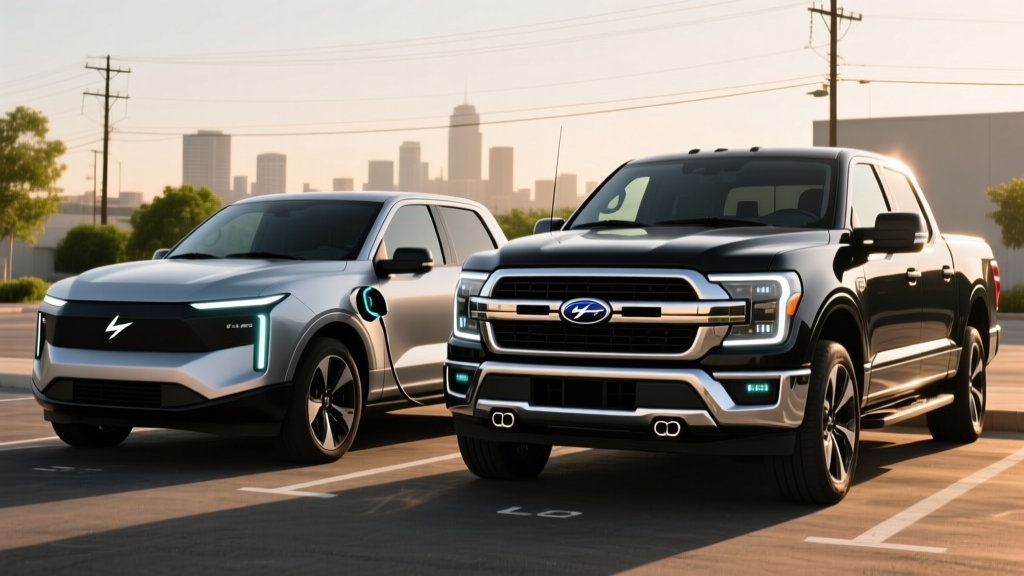
If you're searching for an electric F-150 and wondering whether the Lightning actually saves money versus the gas F-150, here's the short answer: the Lightning wins on per-mile fueling cost and maintenance, but the gas F-150 still holds the edge on total range, towing distance, and upfront price. A 2026 F-150 Lightning XLT starts around $54,995 (before incentives) with an EPA-estimated 240–320 miles of range depending on battery pack, while a comparably equipped gas F-150 XLT with the 3.5L EcoBoost V6 starts near $49,000. After the federal §30D tax credit (up to $7,500 for eligible buyers), the Lightning's effective price drops to roughly $47,495, narrowing the gap considerably. The right choice depends on your daily mileage, home charging access, towing needs, and whether you qualify for incentives.
Quick Verdict: Electric F-150 vs Gas F-150
Choose the Lightning if: You drive under 250 miles/day, have Level 2 home charging, rarely tow over long distances, and qualify for the §30D credit.
Choose the gas F-150 if: You regularly tow heavy loads on highways, live in an apartment without charging access, or frequently drive in extreme cold where range loss can hit 25–30%.
F-150 Lightning vs Gas F-150: Spec-for-Spec Comparison
Before we get into costs, here's how the 2026 F-150 Lightning stacks up against its gas counterpart in the numbers that matter for truck buyers.
| Spec | 2026 F-150 Lightning (Extended Range) | 2026 F-150 Gas (3.5L EcoBoost) |
|---|---|---|
| EPA Range / Tank Range | 320 mi (EPA); ~260 mi real-world highway | ~530 mi (26-gal tank, 20 mpg combined) |
| Usable Battery / Fuel Capacity | 131 kWh (NMC lithium-ion) | 26 gal gasoline |
| Horsepower / Torque | 580 hp / 775 lb-ft | 400 hp / 500 lb-ft |
| 0–60 mph | ~3.8 seconds | ~5.5 seconds |
| Max Towing Capacity | 10,000 lbs | 14,000 lbs |
| Max Payload | 2,235 lbs | 3,325 lbs |
| MPGe / MPG Combined | 70 MPGe (2.0 kWh/mi) | 20 mpg combined |
| DC Fast Charge (Peak kW) | 150 kW (10–80% in ~41 min) | N/A — refill in ~5 min |
| Level 2 Home Charge Rate | 19.2 kW (80A) — ~30 mi/hr | N/A |
| Starting MSRP (XLT trim) | $54,995 (Std Range) / $69,995 (Ext Range) | ~$49,000 (XLT 3.5L EcoBoost) |
| Powertrain Warranty | 8 yr / 100,000 mi (battery) | 5 yr / 60,000 mi (powertrain) |
Sources: fueleconomy.gov, Ford F-150 Lightning specs.
Real-World Range: What the EPA Sticker Doesn't Tell You
The EPA rates the F-150 Lightning Extended Range at 320 miles. In real-world driving, expect to see 260–280 miles at highway speeds (70–75 mph) in moderate temperatures. Cold weather (below 32°F) can reduce range by 20–30%, bringing effective highway range down to roughly 180–210 miles. That's a meaningful reduction for truck owners who use their vehicles for long work-site commutes or rural routes.
Towing is the Lightning's biggest range liability. When pulling a 6,000–8,000 lb trailer, expect range to drop to 100–140 miles depending on trailer aerodynamics and terrain. By contrast, the gas F-150 towing the same load still manages 250–300 miles before refueling. If you tow frequently over long distances, the gas F-150 remains the more practical choice until DC fast-charging infrastructure catches up along rural highway corridors.
Real-World Range Expectations: F-150 Lightning Extended Range
- EPA Sticker: 320 miles
- City/suburban (moderate climate): 290–310 miles
- Highway (70 mph, 65°F): 260–280 miles
- Highway (70 mph, 20°F): 190–220 miles
- Towing 7,000 lb trailer: 100–140 miles
Charging at Home vs Public: What F-150 Lightning Owners Need to Know
Home charging is the backbone of Lightning ownership. The truck supports up to 19.2 kW Level 2 charging using Ford's Charge Station Pro on an 80-amp circuit. That adds roughly 30 miles of range per hour — enough to fully replenish the 131 kWh Extended Range battery in about 8 hours overnight. Most owners wake up to a full "tank" every morning, which eliminates range stress for daily driving under 200 miles.
Installation costs for a dedicated 80A/240V circuit typically run $800–$2,500 depending on panel capacity and conduit distance. If your home has a 100-amp electrical panel, you may need a panel upgrade ($1,500–$3,000) to support the charger alongside other large loads. Always have a licensed electrician assess your panel before purchasing equipment.
| Item | Estimated Cost |
|---|---|
| Ford Charge Station Pro (80A hardware) | $1,000–$1,200 |
| Electrician labor (80A circuit install) | $600–$1,800 |
| Permit & inspection | $100–$300 |
| Panel upgrade (if needed, 100A → 200A) | $1,500–$3,000 |
| Total typical install | $1,700–$6,300 |
On the road, the Lightning's 150 kW peak DC fast-charging rate is slower than competitors like the Hyundai Ioniq 5 (350 kW peak). A 10–80% charge takes roughly 41 minutes at a properly rated station. The charge curve tapers significantly above 80% SoC — topping from 80–100% can add another 25–30 minutes. For road trips, plan stops around 10–80% to minimize time at the charger.
5-Year Total Cost of Ownership: Lightning vs Gas F-150
This is where the Lightning can make a compelling financial case — but only if you qualify for incentives and charge primarily at home. Below is a 5-year/75,000-mile TCO estimate based on national averages for electricity ($0.16/kWh) and gasoline ($3.40/gal).
| Cost Category | F-150 Lightning XLT (Std Range) | F-150 Gas XLT (3.5L EcoBoost) |
|---|---|---|
| Purchase Price (MSRP) | $54,995 | $49,000 |
| Federal §30D Tax Credit | −$7,500 (if eligible) | $0 |
| Effective Purchase Price | $47,495 | $49,000 |
| Fuel/Energy (75,000 mi) | $4,800 (home charging avg) | $12,750 (20 mpg, $3.40/gal) |
| Maintenance (5 yr) | $1,800 (no oil, fewer brake jobs) | $4,200 (oil, filters, brakes, belts) |
| Insurance (5 yr avg) | $10,500 ($2,100/yr avg) | $8,500 ($1,700/yr avg) |
| Home Charger Install | $2,500 (amortized) | $0 |
| Estimated 5-Year TCO | $67,095 | $74,450 |
Key takeaway: With the §30D credit and home charging, the Lightning saves roughly $7,355 over 5 years despite a higher sticker price. Without the credit, the savings shrink to near zero due to higher insurance premiums. Insurance for the Lightning runs 15–25% higher than the gas F-150, driven by higher repair costs for battery and structural components.
The §30D credit is not guaranteed for every buyer. Current IRS rules cap eligibility based on buyer modified adjusted gross income ($150K single / $300K joint), vehicle MSRP limits ($80,000 for trucks/SUVs), and battery critical-mineral and component sourcing requirements that change annually. The credit can now be transferred to the dealer at point of sale, reducing your out-of-pocket cost at purchase. Always verify eligibility with a tax professional and the IRS before relying on the credit in your budget.
Towing, Payload, and Work-Site Reality
The Lightning delivers 580 hp and 775 lb-ft of instant torque — more than enough to move heavy loads with authority. The 0–60 time of ~3.8 seconds is remarkable for a full-size truck. But raw acceleration doesn't tell the whole story for work use.
Max towing is 10,000 lbs (Extended Range, Max Trailer Tow Package) versus 14,000 lbs for the gas F-150 with the same package. Payload tops out at 2,235 lbs versus 3,325 lbs for gas. If your work involves towing equipment trailers over 10,000 lbs or loading the bed near capacity daily, the gas F-150 remains the more capable platform.
One advantage the Lightning holds: the Pro Power Onboard system, which provides up to 9.6 kW of exportable 240V power from the truck's battery. This turns the Lightning into a mobile generator for job sites — running saws, compressors, and lights without a separate gas generator. For contractors and tradespeople, this feature alone can justify the purchase.
Common Misconceptions About the Electric F-150
| Myth | Fact |
|---|---|
| "The Lightning can't tow anything useful." | It tows up to 10,000 lbs — enough for most boat, horse, and equipment trailers. Range while towing drops sharply, but capability is real. |
| "You'll be stranded by a dead battery." | The 131 kWh Extended Range pack provides 260+ real-world highway miles. With home charging, most owners never visit a public charger for daily use. |
| "Battery replacement costs $30,000." | Ford's battery warranty covers 8 years/100,000 miles against degradation below 70% capacity. Out-of-warranty replacement is estimated at $15,000–$22,000 (declining yearly), but most packs outlast 200,000 miles with gradual degradation. |
| "The Lightning is slower to charge than every other EV." | At 150 kW peak, it's slower than cars built on 800V platforms, but 10–80% in ~41 minutes is practical for road-trip stops when paired with route planning. |
| "EVs are worse in winter." | Range drops 20–30% in extreme cold — a real limitation. But the Lightning's thermal management and heat pump mitigate this, and preconditioning while plugged in preserves range. |
Decision Framework: Should You Buy the Electric F-150?
Choose the F-150 Lightning if:
- Your daily driving is under 250 miles (covers 90%+ of truck owners).
- You have access to Level 2 home charging (garage or driveway with 240V outlet).
- You value instant torque, near-silent operation, and Pro Power Onboard for job-site use.
- You qualify for the §30D tax credit (income and sourcing requirements met).
- You rarely tow heavy loads over distances exceeding 120 miles one-way.
- You live in a moderate or warm climate where cold-weather range loss is minimal.
Choose the Gas F-150 if:
- You regularly tow 8,000+ lbs over long highway distances.
- You live in an apartment or home without the ability to install a Level 2 charger.
- You frequently drive in sub-freezing temperatures where range loss compounds with towing.
- You don't qualify for the §30D credit due to income limits or battery-sourcing rules.
- Maximum payload capacity (3,300+ lbs) is a daily requirement for your work.
Consider the F-150 PowerBoost Hybrid (PHEV alternative) if:
- You want better fuel economy (24 mpg combined) without range or charging concerns.
- You need towing capacity closer to the gas model (12,700 lbs) with onboard generator capability (7.2 kW Pro Power).
- You're not ready to commit to full electric but want electrified efficiency gains.
Frequently Asked Questions
Does the F-150 Lightning qualify for the $7,500 federal tax credit in 2026?
The Lightning is eligible for up to $7,500 under IRS §30D, but eligibility depends on your income (≤$150K single / ≤$300K joint MAGI), the truck's MSRP (must be under $80,000 for trucks), and battery critical-mineral and component sourcing requirements that tighten each year. The credit can be applied at point of sale as a down-payment reduction. Verify current-year eligibility at fueleconomy.gov and with your tax advisor.
How long does the Lightning's battery last before it needs replacement?
Ford warranties the battery for 8 years/100,000 miles against degradation below 70% of original capacity. Real-world data from early Lightning owners and similar NMC-pack EVs suggest 10–15% degradation over 100,000 miles under normal use. Full replacement is rarely needed before 200,000 miles. The pack uses NMC (nickel manganese cobalt) chemistry, which offers high energy density but slightly faster degradation than LFP chemistry if routinely charged to 100%. Ford recommends daily charging to 90% for longevity, reserving 100% for road trips.
Can I use the F-150 Lightning to power my home during an outage?
Yes — with the Ford Charge Station Pro and the Home Integration System (an additional ~$3,900 installed), the Lightning supports vehicle-to-home (V2H) bidirectional charging at up to 9.6 kW. The 131 kWh Extended Range battery can power an average home (roughly 30 kWh/day) for approximately 3–4 days during an outage. This is a genuine advantage over the gas F-150, which cannot backfeed a home without a separate transfer switch and generator.
Is the Lightning more expensive to insure than the gas F-150?
Yes, typically 15–25% more. Average annual premiums for the Lightning run $2,000–$2,400 depending on state, driving record, and coverage level, versus $1,600–$1,800 for the gas F-150. Higher repair costs for battery packs and aluminum-intensive body structures drive the difference. Shop quotes from multiple insurers — some now offer EV-specific discounts that narrow the gap.
How does charging cost compare to gasoline per mile?
At the national average electricity rate of $0.16/kWh and the Lightning's efficiency of ~2.0 kWh/mile, home charging costs roughly $0.32 per mile. Gasoline at $3.40/gal and 20 mpg combined works out to $0.17 per mile... wait — that math favors gas at first glance, but the Lightning's MPGe rating accounts for energy equivalence. In dollar terms: charging the full 131 kWh battery at home costs ~$21 for 320 EPA miles. Filling the 26-gallon gas tank costs ~$88 for ~520 miles. Per-mile, that's $0.065/mi for the Lightning versus $0.17/mi for gas — the Lightning is roughly 60% cheaper per mile to fuel at home.