Quick Answer: Is There an Electric F1 Race Car?
As of 2026, Formula 1 does not run fully electric race cars — it uses advanced plug-in hybrid powertrains with a dramatically upsized electric component (a 350 kW MGU-K motor paired with a 1.6L turbo V6). Fully electric single-seater racing lives in Formula E, whose Gen3 Evo cars produce up to 350 kW (469 hp) from a 47 kWh battery pack. The real story for road-car buyers: the battery chemistry, inverter design, thermal management, and regenerative braking algorithms developed for these electric F1-style race cars now directly influence the EVs you can buy at a dealership — from the Porsche Taycan's 800-volt architecture to the Mercedes-AMG EQE's axial-flux motor lineage.
If you searched for "electric F1 race car" because you're curious how top-tier motorsport technology connects to the EV in your driveway (or the one you're about to buy), you're in the right place. This guide bridges the gap between the racetrack and the showroom — with real numbers, real costs, and a practical framework for how race-bred EV tech should factor into your next purchase.
Formula 1 vs. Formula E: The 2026 Powertrain Reality
A common misconception is that Formula 1 has gone fully electric. It hasn't — and the distinction matters for understanding what tech actually reaches consumer EVs.
| Specification | Formula 1 (2026 Regs) | Formula E Gen3 Evo |
|---|---|---|
| Powertrain Type | Plug-in hybrid (ICE + electric) | Fully electric (BEV) |
| Electric Motor Output | 350 kW (469 hp) MGU-K | 350 kW (469 hp) peak |
| Internal Combustion | 1.6L turbo V6 (~400 kW) | None |
| Battery Capacity | Not publicly disclosed (est. 5-6 kWh) | 47 kWh (usable) |
| Voltage System | ~800V | ~900V |
| Regen Braking Power | 350 kW | 600 kW |
| 0-100 km/h (0-62 mph) | ~2.4 seconds | ~2.8 seconds |
| Top Speed | ~370 km/h (230 mph) | ~322 km/h (200 mph) |
| Race Distance | ~305 km (varies by circuit) | ~165 km (E-Prix format) |
The 2026 F1 regulations represent the most electric-heavy hybrid formula in the sport's history. Nearly 50% of total powertrain output now comes from the electric motor — up from roughly 20% in the 2014-2025 hybrid era. That shift forced F1 engine manufacturers (Mercedes, Ferrari, Honda, Audi, and Red Bull/Ford) to invest heavily in electric motor efficiency, power electronics, and energy recovery systems — all of which have direct road-car applications.
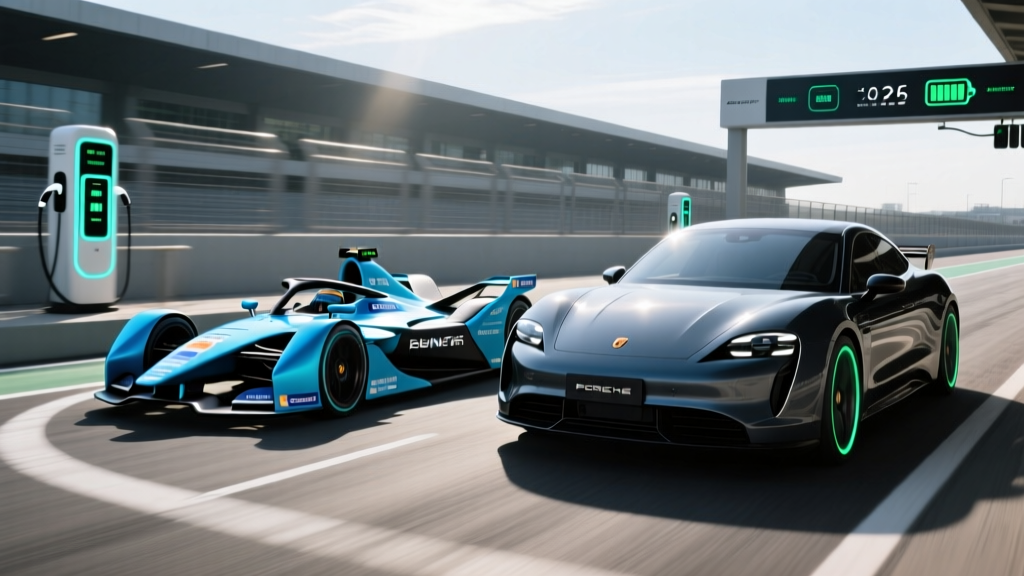
Formula E, meanwhile, operates as the true all-electric F1 equivalent. The Gen3 Evo car, introduced for the 2024-25 season and continuing through 2026, is the most efficient electric race car ever built: over 90% of the energy consumed during a race comes from the battery and regenerative braking, with virtually zero energy wasted as heat compared to combustion engines.
Race-to-Road Tech Transfer: What's Actually in Your EV
The connection between electric F1 race car programs and consumer EVs isn't marketing fluff — it's engineering lineage. Here's where the technology transfer is most concrete:
800-Volt and High-Voltage Architectures
Formula E's ~900V system and F1's ~800V hybrid architecture accelerated the automotive industry's shift from 400V to 800V battery systems. The Porsche Taycan was the first production EV to adopt an 800V architecture in 2019, directly leveraging knowledge from Porsche's LMP1 hybrid racing program. By 2026, 800V systems are available in the Hyundai Ioniq 5, Kia EV6, Audi e-tron GT, Lucid Air, and the latest Porsche Macan Electric — enabling DC fast charging at 250-350 kW and 10-80% charge times in 18 minutes or less.
Silicon Carbide (SiC) Inverters
Formula E mandated silicon carbide inverters for Gen3 cars, achieving inverter efficiency above 98%. This pushed SiC adoption into production EVs. Tesla's Model 3 was an early adopter; by 2026, SiC inverters are standard in most premium EVs and increasingly in mainstream models like the Chevrolet Equinox EV and Hyundai Ioniq 5. The result: 2-4% more range from the same battery, because less energy is lost as heat during power delivery.
Regenerative Braking Algorithms
Formula E's 600 kW regen capability — recovering energy at a rate far exceeding what the friction brakes handle — forced teams to develop sophisticated brake-by-wire blending algorithms. These same algorithms now enable one-pedal driving in production EVs, where lifting off the accelerator recovers up to 0.3g of deceleration. The Nissan Ariya, BMW iX, and all Tesla models use race-derived blending logic to seamlessly transition between regenerative and friction braking.
Thermal Management and Battery Preconditioning
Race cars must manage extreme thermal loads — a Formula E car's battery can see discharge rates exceeding 7C during acceleration and charge rates above 4C during regen. The thermal management strategies developed for these conditions (multi-loop cooling circuits, predictive thermal modeling, active coolant flow control) are now standard in high-performance road EVs. When you precondition your Tesla or Porsche for a Supercharger or DC fast-charging stop, you're using a direct descendant of race-car thermal strategy software.
Performance Comparison: Race-Bred EVs vs. Gas Sports Cars
How do the consumer EVs benefiting from electric F1 race car technology stack up against comparable gas-powered sports cars? Here's a data-driven comparison of 2026 models:
| Metric | Porsche Taycan Turbo GT (EV) | Porsche 911 Turbo S (Gas) | Tesla Model S Plaid (EV) |
|---|---|---|---|
| 0-60 mph | 2.1 sec | 2.6 sec | 1.99 sec |
| Horsepower | 1,019 hp | 640 hp | 1,020 hp |
| EPA Range | 269 mi | N/A (~340 mi tank) | 396 mi |
| Top Speed | 190 mph | 205 mph | 200 mph |
| Battery / Fuel | 105 kWh (NMC, 800V) | 17.9 gal tank | 100 kWh (NMC) |
| Max DC Charge Rate | 320 kW (10-80% ~18 min) | N/A | 250 kW (10-80% ~27 min) |
| Curb Weight | 5,004 lbs | 3,636 lbs | |
| Base MSRP (2026) | $236,395 | $230,700 | |
| EPA Efficiency / MPG | 67 MPGe | 18 MPG combined | |
| Fuel/Energy Cost per 1,000 mi | ~$44 (at $0.15/kWh) | ~$211 (at $3.80/gal) |
The performance parity is striking. The Taycan Turbo GT and Model S Plaid both out-accelerate the 911 Turbo S — and they do it while costing roughly one-fifth as much per mile to "fuel." The tradeoff is weight (EVs carry 1,300-1,500 lbs more due to the battery pack) and refueling time on road trips (18-27 minutes at a DC fast charger vs. 3 minutes at a gas pump).
For context on real-world range: expect the Taycan Turbo GT to deliver approximately 220-240 miles at sustained highway speeds (75-80 mph), and closer to 180-200 miles in cold weather (below 32°F). The Model S Plaid's larger battery provides a buffer, with real-world highway range around 320-340 miles in moderate temperatures.
Cost Breakdown: Race-Tech EVs vs. Gas Equivalents
Let's run a 5-year total cost of ownership comparison for the more accessible end of the race-tech EV market — the Hyundai Ioniq 5 N (a performance EV directly developed by Hyundai's N motorsport division, which also runs TCR touring cars) versus a comparable gas hot hatch.
| Cost Category (5 Years / 75,000 mi) | Hyundai Ioniq 5 N (EV) | VW Golf R (Gas) |
|---|---|---|
| Purchase Price (MSRP) | $67,495 | $47,990 |
| Federal Tax Credit (§30D) | $0 (exceeds MSRP cap / sourcing rules) | $0 |
| Estimated Insurance (5 yr) | $14,500 | $10,200 |
| Fuel / Electricity (75k mi) | $3,375 (home charging avg) | $10,690 (premium fuel) |
| Maintenance (5 yr) | $1,800 | $4,500 |
| Estimated Depreciation | $28,000 | $19,000 |
| Total 5-Year Cost | $115,170 | $92,380 |
| Cost per Mile | $1.54 | $1.23 |
The EV's higher purchase price and insurance premiums outweigh the fuel and maintenance savings over five years in this performance segment. However, the Ioniq 5 N delivers 640 hp (with N Grin Boost), adaptive dampers, and simulated gear shifts that no Golf R can match. The cost premium is real — but the performance delta is larger.
Maintenance note: EVs eliminate oil changes, spark plugs, transmission fluid, and exhaust system repairs. Brake pad life is typically 2-3x longer due to regenerative braking handling most deceleration. The Ioniq 5 N's battery and drive unit carry Hyundai's 10-year/100,000-mile warranty, which covers battery capacity retention above 70% of original capacity — per fueleconomy.gov data, most modern NMC batteries retain 88-92% capacity at 100,000 miles under normal use.
Myths vs. Facts: Electric Race Cars and Your EV Purchase
| Myth | Fact |
|---|---|
| "F1 is already fully electric" | F1 uses a plug-in hybrid with a 350 kW electric motor + 1.6L turbo V6. Formula E is the fully electric single-seater series. |
| "Race EV tech doesn't reach road cars" | 800V architectures, SiC inverters, and thermal preconditioning all came from motorsport R&D and are in 2026 production EVs. |
| "Electric race cars have no range" | Formula E Gen3 cars complete ~165 km races with 47 kWh batteries and 600 kW regen. Production EVs with larger batteries (75-100 kWh) achieve 250-400+ EPA miles. |
| "EV batteries degrade quickly like race car batteries" | Race batteries are designed for maximum power density over 1-2 season lifespans. Road EV batteries prioritize energy density and longevity — most are warrantied for 8 years/100,000 miles with 70%+ capacity retention. |
| "Performance EVs can't handle track use" | The Porsche Taycan set a Nürburgring lap record for production EVs (6:59.2), and the Ioniq 5 N includes dedicated track modes with enhanced cooling — though sustained track use will thermally limit any EV without the active cooling capacity of a purpose-built race car. |
First-Time EV Buyer's Guide: Race-Tech or Road-Tech?
If the electric F1 race car world inspired your EV interest, here's a practical framework for translating that enthusiasm into a smart purchase decision:
Decision Framework: Which EV Should You Buy?
- If you want race-bred performance and have a $60K+ budget: Look at the Porsche Taycan (800V, 320 kW charging), Hyundai Ioniq 5 N (640 hp, track-capable), or Tesla Model S Plaid (1,020 hp, 396 mi range). These cars directly inherit motorsport engineering.
- If you want race-derived efficiency on a mainstream budget ($35K-$50K): The Hyundai Ioniq 5, Kia EV6, and Chevrolet Equinox EV all use 800V or advanced SiC inverter technology developed through motorsport programs. Expect 250-320 EPA miles and 10-80% DC charging in 18-25 minutes.
- If you want maximum range over performance: The Lucid Air Grand Touring (512 EPA miles, 900V+ architecture derived from Formula E supplier relationships) or Tesla Model 3 Long Range (363 EPA miles) prioritize efficiency over outright power.
- If you don't have home charging access: Prioritize 800V-capable EVs (Taycan, Ioniq 5, EV6, Macan Electric) that charge fastest on public DC infrastructure. A 350 kW Electrify America or Tesla Supercharger stall can add 150+ miles in 15 minutes.
- If you live in a cold climate (frequent sub-32°F winters): Choose an EV with a heat pump (standard on most 2026 Hyundai/Kia/Tesla models) and expect 20-30% range reduction from the EPA sticker. A 300-mile EPA EV may deliver 210-240 miles in freezing highway driving.
What First-Time Buyers Must Know
- kW vs. kWh: kW measures power (how fast you charge or accelerate); kWh measures energy (your battery's total capacity, like gallons in a tank). A 77 kWh battery charging at 250 kW is like filling a 20-gallon tank at a high-flow pump.
- EPA range is a best-case estimate. Highway driving at 75+ mph, cold weather, and aggressive acceleration all reduce range. Budget 15-30% below the sticker for real-world planning.
- Home charging is the game-changer. Level 2 home charging (7-11 kW, 240V) adds 25-45 miles per hour of charging and costs roughly $0.12-$0.18/kWh depending on your utility — equating to $3-$5 per 100 miles. Public DC fast charging costs $0.30-$0.55/kWh, narrowing the gap with gas. Installation of a Level 2 home charger typically runs $500-$2,000 depending on panel capacity and wiring distance.
- Federal tax credits have strict rules. The §30D credit offers up to $7,500 for qualifying new EVs, but eligibility depends on MSRP caps ($55,000 for sedans, $80,000 for SUVs/trucks), buyer income limits ($150K single / $300K joint AGI), and battery component/critical mineral sourcing requirements. Check current rules at irs.gov before purchasing. Point-of-sale transfer is available at participating dealers.
- Battery warranties protect you. Federal law mandates a minimum 8-year/100,000-mile warranty on EV batteries (10 years/150,000 miles in CARB states like California). This covers capacity loss below 70% of original — and most batteries outperform this threshold significantly.
Looking Ahead: Formula 1's Electric Future and What It Means for Buyers
F1's 2026 regulations already push the hybrid-electric ratio to near 50%, and the FIA has signaled that fully electric F1 cars could arrive by the early 2030s — contingent on battery energy density reaching approximately 400 Wh/kg at the cell level (current road EV cells sit at 250-300 Wh/kg, while solid-state prototypes from Toyota and Samsung SDI target 350-500 Wh/kg by 2028-2030).
For buyers, the trajectory is clear: every generation of racing powertrain regulation accelerates the efficiency, charging speed, and thermal management capability of the EVs that follow 3-5 years later. The 2026 F1 hybrid's 350 kW electric motor and 800V system are already previewing what will be standard in $40,000 EVs by 2030.
Frequently Asked Questions
Is Formula 1 going fully electric?
Not yet. As of 2026, F1 uses a plug-in hybrid powertrain combining a 1.6L turbo V6 with a 350 kW electric motor (MGU-K). The electric portion now provides nearly 50% of total power output — a massive increase from the previous hybrid era. A fully electric F1 car is technically possible but would require battery energy density roughly double current levels, likely not achievable until the early 2030s.
What is the electric equivalent of F1?
Formula E is the fully electric single-seater racing series sanctioned by the FIA (the same governing body as F1). The current Gen3 Evo car produces 350 kW (469 hp), weighs under 840 kg, and races on street circuits in major cities worldwide. The series serves as a direct R&D platform for EV manufacturers including Porsche, Jaguar, Maserati, and Nissan.
Does Formula E technology end up in road cars?
Yes. Jaguar's Formula E program directly informed the powertrain and thermal management of the I-PACE and subsequent EVs. Porsche's Formula E team shares engineering staff with its road-car EV division. Mahindra Racing's involvement feeds into the company's growing EV lineup in India and global markets. Specific transfers include SiC inverter design, motor winding techniques, and battery management system (BMS) algorithms.
How much does a Formula E car cost?
A Formula E Gen3 Evo car costs approximately €2-3 million per chassis (not including team operations, logistics, and engineering staff). For comparison, a Formula 1 car costs roughly $15-20 million. These costs are orders of magnitude above any production EV, but the R&D investment per car is amortized across millions of road vehicles.
What's the fastest electric race car?
In single-seater racing, Formula 1's hybrid cars (with their combined ~800+ hp output) are faster around most circuits than Formula E's all-electric cars. However, the Volkswagen ID.R — a purpose-built electric hillclimb prototype — holds the absolute EV lap record at the Nürburgring (6:05.336) and Pikes Peak (7:57.148), producing 500 kW (670 hp) from a 44 kWh battery. It is not a series race car but demonstrates the ceiling of electric race car performance.
Should I wait for solid-state batteries before buying an EV?
Probably not. Solid-state batteries promise higher energy density (350-500 Wh/kg vs. current 250-300 Wh/kg), faster charging, and improved safety — but volume production for consumer EVs is not expected before 2028-2030, and initial availability will be limited to premium models at high prices. Current NMC and LFP batteries already deliver 250-400+ miles of range, 10-80% charging in 18-30 minutes, and 8-10 year warranties. Waiting 3-5 years for solid-state means missing years of EV ownership savings and maturing charging infrastructure.
Sources: FIA Formula E technical regulations, FIA Formula 1 2026 powertrain regulations, fueleconomy.gov for EPA range and MPGe data, irs.gov for §30D tax credit rules, manufacturer specification pages for Porsche, Hyundai, and Tesla.