The Short Answer: E-Foils and EVs Share Battery DNA, But Serve Very Different Lives
An electric e-foil (electric hydrofoil surfboard) is a battery-powered personal watercraft that lifts above the water on a submerged wing, typically costing $8,000–$15,000 with a 1.5–2.5 kWh battery delivering 60–90 minutes of ride time. A battery-electric vehicle (BEV) like the 2026 Tesla Model 3 or Hyundai IONIQ 6 costs $38,000–$52,000 (before incentives) with a 60–84 kWh battery providing 270–360 miles of EPA range. Both use lithium-ion cells and charge from standard AC or DC power — but an e-foil is a recreational toy with no federal tax credit, while an EV is a daily-driver eligible for up to $7,500 under IRS §30D (with income, MSRP, and sourcing limits). If you're researching "electric e-foil" because you're weighing electrified purchases, this guide breaks down exactly how they compare on cost, charging, battery longevity, and ownership reality.
What Is an Electric E-Foil, Exactly?
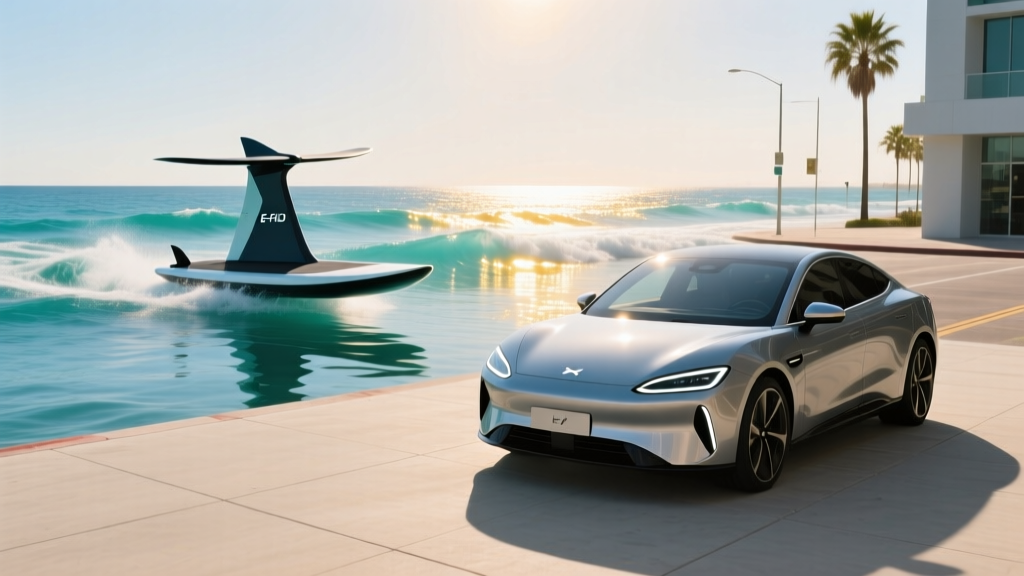
An electric e-foil pairs a surfboard-style hull with a mast, hydrofoil wing, and an electric motor (typically 3–6 kW peak output) powered by a removable lithium-ion battery pack. The rider uses a handheld wireless throttle to control speed, and once sufficient velocity is reached (usually around 3–5 mph), the board lifts above the water surface, reducing drag dramatically and enabling a smooth, silent glide. Leading brands in 2026 include Lift Foils, Fliteboard, and Awake, with complete setups ranging from entry-level models around $7,500 to premium carbon-fiber builds exceeding $16,000.
From a battery-technology standpoint, e-foils use the same fundamental cell chemistry found in EVs — predominantly NMC (nickel manganese cobalt) for its high energy density, since weight matters enormously when the entire powertrain must be carried under a rider's feet. A typical e-foil battery is 1.5–2.6 kWh, weighing 6–10 lbs, compared to the 750–1,200 lb, 60–100 kWh packs in passenger EVs.
Side-by-Side: Electric E-Foil vs. Battery-Electric Vehicle
The table below compares a representative 2026 e-foil setup (Fliteboard Ultra L) against a mainstream 2026 BEV (Hyundai IONIQ 6 SE Long Range) across the metrics that matter to any electrified-vehicle buyer.
| Attribute | E-Foil (Fliteboard Ultra L) | 2026 Hyundai IONIQ 6 SE LR |
|---|---|---|
| Battery Capacity | 2.1 kWh (NMC) | 77.4 kWh usable (NMC) |
| Motor Output | ~4.5 kW peak | 168 kW (225 hp) |
| Range / Runtime | ~75 min ride time | 361 mi EPA (~300 mi real-world hwy) |
| Top Speed | ~28 mph | 115 mph (electronically limited) |
| Charge Time (0–100%) | ~90 min (dedicated AC charger) | ~18 min 10–80% at 240 kW DC; ~7 hr Level 2 |
| Base Price | ~$12,500 | $42,750 MSRP |
| Federal Tax Credit (§30D) | Not eligible (not a motor vehicle) | Up to $7,500 (subject to IRS sourcing/income rules) |
| Warranty (Battery) | 1 year | 8 yr / 100,000 mi (≥70% capacity retention) |
| Annual Insurance | $200–$500 (specialty marine) | $1,800–$2,600 (varies by state/driver) |
| Maintenance | Rinse, prop inspection, cell balancing | Tire rotation, cabin filter, brake fluid, coolant |
Sources: fueleconomy.gov (IONIQ 6 EPA data), Fliteboard 2026 spec sheet, irs.gov (§30D rules).
Real Cost of Ownership: E-Foil vs. EV Over 3 Years
Neither purchase is cheap, but the cost structures diverge sharply. Below is a realistic 3-year ownership projection for each, assuming moderate use.
| Cost Category | E-Foil (3 yrs) | IONIQ 6 SE LR (3 yrs) |
|---|---|---|
| Purchase Price | $12,500 | $42,750 |
| Tax Credit / Incentive | $0 | –$7,500 (if eligible; point-of-sale) |
| Net Acquisition | $12,500 | $35,250 |
| Charging / Fuel (3 yrs) | $90 (home AC, ~$0.15/kWh) | $2,100 (home + public, avg $0.16/kWh) |
| Insurance (3 yrs) | $1,050 | $6,600 |
| Maintenance (3 yrs) | $300 (seals, impeller, balancing) | $900 (tires, filters, fluid) |
| Depreciation (est.) | –$5,000 (40% over 3 yrs) | –$14,000 (~40% over 3 yrs) |
| Total 3-Yr Cost | $8,940 | $30,850 |
The e-foil's operating cost is negligible — a full 2.1 kWh charge costs about $0.32 on a standard US residential rate. The IONIQ 6's electricity cost is higher in absolute terms but still dramatically below the ~$4,800 a comparable gas sedan would burn over the same period at 28 mpg combined and $3.50/gal.
Charging Reality: Shared Principles, Different Scale
Both platforms charge via AC-to-DC conversion and store energy in lithium-ion cells, but the infrastructure is entirely different.
- E-Foil charging: Proprietary desktop charger (included), plugs into any 120V household outlet. A 2.1 kWh pack charges fully in ~90 minutes. No electrician, no permit, no panel upgrade needed. You can charge at the dock, in a garage, or at a campsite.
- EV Level 1 (120V): Adds ~3–5 miles of range per hour. A full charge of a 77 kWh pack from empty takes 20+ hours. Fine for overnight top-ups if daily driving is under 30 miles.
- EV Level 2 (240V): Typical home installation costs $800–$2,500 (equipment + licensed electrician + permit). Delivers 7–11 kW, adding 25–44 miles per hour. Full overnight charge in 7–10 hours.
- EV DC Fast Charging: The IONIQ 6 peaks at ~240 kW on a 350 kW-capable station (Electrify America, Tesla Supercharger with NACS adapter), achieving 10–80% in approximately 18 minutes. Charge rate tapers significantly above 80% to protect cell health — expect 80–100% to take an additional 12–15 minutes.
A key misconception: peak charge kW is not sustained kW. The IONIQ 6's 240 kW peak holds only between roughly 10–55% state of charge, then steps down. Average charge power over a 10–80% session is closer to 160–180 kW. E-foil chargers, by contrast, deliver a flat ~1.5 kW throughout — simple but slow by EV standards.
Battery Longevity: What E-Foil Buyers Should Steal from EV Playbooks
EV manufacturers warranty their batteries for 8 years / 100,000 miles with a minimum 70% capacity retention threshold. E-foil makers typically offer 1 year on the battery with no published capacity-retention guarantee. However, the same lithium-ion degradation physics apply to both:
- Calendar aging: NMC cells degrade 2–3% per year even when unused, accelerated by heat and high state-of-charge storage.
- Cycle aging: A typical NMC cell is rated for 800–1,200 full charge cycles before hitting 80% capacity. For an e-foil used 50 times per year, that's 16–24 years of cycle life — calendar aging will likely end the battery's useful life first.
- Storage best practice (both platforms): Store at 50–60% state of charge in a cool, dry place. Never leave at 100% for extended periods. EV owners can set charge limits in-car; e-foil owners must manually unplug.
- Replacement cost: An e-foil battery replacement runs $1,500–$2,500 in 2026. An EV battery replacement (out of warranty) ranges from $8,000–$18,000 depending on the pack, though full replacements remain rare — most EV batteries outlast the vehicle.
Common Misconceptions, Corrected
| Myth | Fact |
|---|---|
| "E-foils qualify for the EV tax credit." | No. IRS §30D applies only to qualified plug-in electric motor vehicles with ≥4 wheels, per irs.gov. E-foils are classified as recreational watercraft. |
| "E-foil batteries are the same as Tesla batteries." | Both use NMC lithium-ion cells, but e-foil packs are smaller (2 kWh vs. 60–100 kWh), lack active thermal management (liquid cooling/heating), and use consumer-grade BMS systems. They share chemistry, not engineering parity. |
| "You need a special electrical outlet to charge an e-foil." | Standard 120V/15A household outlets are sufficient. The charger draws ~1.5 kW, well within a typical circuit's capacity. |
| "An e-foil is a practical commuter vehicle." | E-foils are recreational. They have no cargo capacity, require open water access, are restricted in many waterways, and offer no weather protection. They complement an EV lifestyle but don't replace transportation. |
| "EV range is exactly what the EPA sticker says." | EPA range is measured under controlled conditions. Real-world highway driving at 70+ mph reduces range 15–25%. Cold weather (below 32°F) can reduce range an additional 20–30% due to cabin heating and slower electrochemistry. A 361-mile EPA IONIQ 6 may deliver ~250 miles on a 75°F highway trip and ~200 miles in 20°F conditions. |
Decision Framework: Should You Buy an E-Foil, an EV, or Both?
Choose an electric e-foil if:
- You have regular access to calm, open water (lake, bay, or ocean) where e-foils are legally permitted.
- You already have reliable daily transportation and want a high-end recreational upgrade.
- You're budgeting $8,000–$15,000 for a hobby and accept that there's no tax incentive or resale-value guarantee.
- You can store and charge the board in a dry, temperature-controlled space.
Choose a battery-electric vehicle if:
- You need daily transportation and want to reduce fuel and maintenance costs.
- You have (or can install) Level 2 home charging — the single biggest predictor of EV satisfaction.
- You meet IRS §30D eligibility: modified adjusted gross income ≤$150K (single) / $300K (joint), vehicle MSRP ≤$55K (sedan) or $80K (SUV/truck), and the specific model meets battery-sourcing requirements.
- You drive 200+ miles per week, where electricity savings over gas compound fastest.
Choose both if:
- You've already committed to an EV for daily driving and have $10K+ in discretionary recreation budget.
- Your EV's Level 2 charger and the e-foil's 120V charger can share your garage without a panel upgrade (they almost always can — combined draw is under 12 kW).
Frequently Asked Questions
Can I charge my electric e-foil from my EV's charger?
No. E-foil chargers use proprietary connectors and communicate with the battery's BMS via a specific protocol. You cannot plug an e-foil into a J1772, NACS, or CCS connector. However, both charge from standard AC wall power, so they can share the same garage circuits.
How long does an e-foil battery last before needing replacement?
Expect 4–7 years of usable life with proper storage (50–60% SoC, cool environment). Calendar degradation will reduce capacity to roughly 80% within 5–6 years even with moderate use. Replacement packs cost $1,500–$2,500 depending on the brand and capacity.
Is an e-foil safe in saltwater?
Most premium e-foils (Fliteboard, Lift, Awake) are rated for saltwater use with sealed motor housings and corrosion-resistant components. However, post-ride freshwater rinsing of the mast, fuselage, and battery contacts is mandatory to prevent galvanic corrosion. Budget 10–15 minutes of maintenance per saltwater session.
Does an e-foil require registration or a boating license?
Regulations vary by state and waterway. In most US jurisdictions, e-foils are classified as motorized vessels and require registration if the motor exceeds a certain wattage (typically 3–5 kW, which most e-foils do). Some states require a boater education card. Check your state's wildlife or parks agency before riding. This is an area where e-foil ownership diverges sharply from EV ownership — you're navigating maritime law, not DOT regulations.
What's the real cost per hour of riding an e-foil vs. driving an EV?
An e-foil consumes roughly 1.5–2.1 kWh per hour of riding, costing $0.23–$0.32 at average US electricity rates ($0.15/kWh). An EV consumes roughly 25–30 kWh per 100 miles of driving, costing $3.75–$4.50 per 100 miles, or about $1.50–$1.80 per hour of highway driving at 65 mph. Per-hour energy cost, the EV is actually more expensive — but it's transporting you 65 miles in that hour, while the e-foil is a closed-loop recreational experience.