Quick Answer: Electric drones and electric vehicles share the same lithium-based battery DNA, but their ownership realities diverge sharply. A consumer drone like the DJI Air 3S uses a ~45 Wh (0.045 kWh) battery delivering 30–40 minutes of flight for ~$1,000–$1,300, while a 2026 Tesla Model Y Long Range packs an 82 kWh usable NMC battery, delivers 310+ EPA miles, and starts around $44,990 before federal tax credits. This guide breaks down what drone batteries teach us about EV ownership — and where the comparison falls apart — so you can make smarter electrified-vehicle purchasing decisions.
Why Electric Drones Matter to EV Buyers
If you've searched "electric drones" while researching an EV purchase, you're not alone. Both categories ride the same wave of lithium-ion advancement, and drone owners often become EV buyers — or vice versa. The battery-management lessons from drones (thermal limits, cycle-life degradation, charge-rate tapering) map directly onto EV ownership. But the scale, cost, and regulatory environments are worlds apart.
A drone pilot who swaps a 45 Wh pack every 350 cycles at $65 per battery understands degradation viscerally. An EV owner watching their 82 kWh pack lose 8–12% capacity over five years faces the same physics at 1,800× the energy scale. Let's put real numbers on both sides.
Battery Tech: Wh vs kWh — Same Chemistry, Different World
The single most important distinction in EV ownership is kW (power) vs kWh (energy). A kilowatt is a rate — how fast energy flows. A kilowatt-hour is a quantity — how much energy is stored. Drones use watt-hours (Wh); EVs use kilowatt-hours (kWh). One kWh equals 1,000 Wh.
| Spec | Consumer Drone (e.g., DJI Air 3S) | 2026 Tesla Model Y LR AWD | 2026 Toyota RAV4 Hybrid (Gas Baseline) |
|---|---|---|---|
| Battery Capacity | ~45 Wh (0.045 kWh), NMC | ~82 kWh usable, NMC | ~1.6 kWh, NiMH (traction assist) |
| Energy Source | Lithium-polymer pack | Lithium-ion pack | 14.5-gal gasoline tank |
| Range / Flight Time | ~34 min flight / ~12 mi max | 320 mi EPA (expect ~270–290 mi highway) | ~580 mi combined (41 MPG) |
| Charge / Refuel Time | ~75 min (0–100%) | ~25 min (10–80% at 250 kW DCFC) | ~5 min at gas station |
| Peak Power | ~600 W (0.6 kW) motors | 346 hp (~258 kW) system | 219 hp (~163 kW) system |
| Starting Price | ~$1,099 (drone only) | $44,990 MSRP | $33,575 MSRP |
| Battery Warranty | None (consumer replaceable) | 8 yr / 120,000 mi (min 70% retention) | 10 yr / 150,000 mi (hybrid battery) |
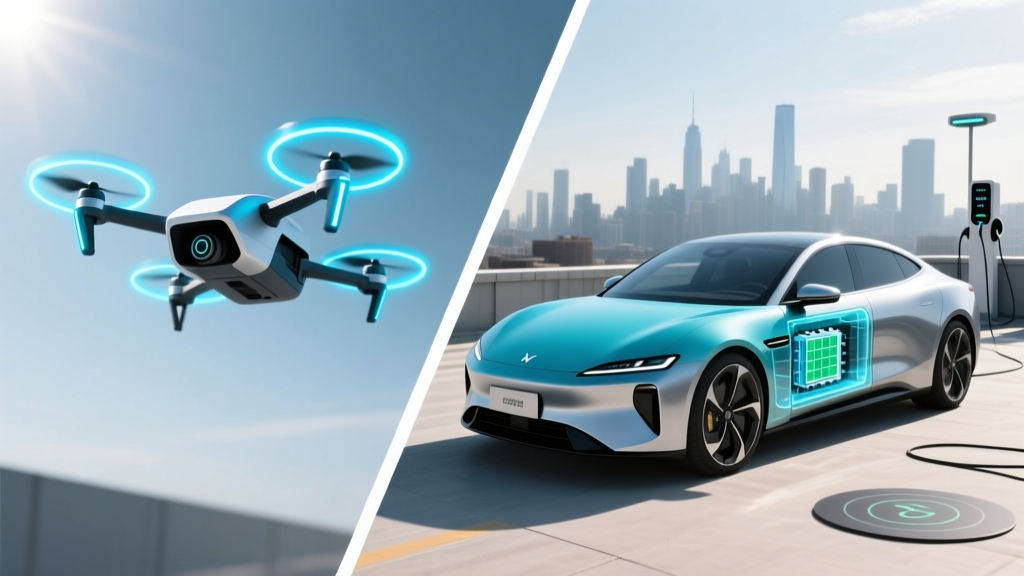
The drone's battery is roughly the size of a large laptop cell. The Model Y's pack contains the energy equivalent of about 1,800 drone batteries. Both use nickel-manganese-cobalt (NMC) chemistry optimized for energy density, but EV packs add sophisticated liquid thermal management that drones simply don't need at 45 Wh.
Real Costs: Drone Ownership vs EV Ownership
Drone owners know the pain of consumable batteries. Here's how the five-year economics stack up when you scale that thinking to a vehicle.
| Cost Category (5-Year) | Electric Drone (Hobby Use) | 2026 Tesla Model Y LR | 2026 RAV4 Hybrid |
|---|---|---|---|
| Purchase Price | $1,099 | $44,990 | $33,575 |
| Federal Tax Credit (§30D) | $0 | Up to $7,500 (see eligibility below) | $0 |
| Energy / Fuel Cost | ~$30 (electricity for ~250 flights) | ~$2,900 (electricity, 12k mi/yr at $0.14/kWh) | ~$7,500 (gasoline, 12k mi/yr at $3.40/gal) |
| Battery Replacement | ~$260 (4 packs × $65) | $0 (under warranty; $12,000–$18,000 if out of warranty) | $0 (under warranty; ~$3,500 if needed) |
| Maintenance | ~$100 (props, firmware) | ~$1,200 (tires, cabin filter, brake fluid) | ~$3,500 (oil, filters, brakes, belts) |
| Insurance | ~$300 (hobby liability) | ~$9,500 (avg $1,900/yr) | ~$7,500 (avg $1,500/yr) |
| 5-Year Total (est.) | ~$1,789 | ~$51,090 – $58,590 | ~$52,075 |
The EV's energy savings over gas are real — roughly $4,600 over five years at current prices — but insurance and higher purchase cost eat into that advantage. The drone comparison makes one thing clear: battery replacement at scale is expensive. A drone pilot replacing $65 packs barely notices; an EV owner facing a $15,000 pack swap out of warranty absolutely does.
Degradation Lessons Drones Teach EV Owners
Fly a drone hard in cold weather and watch the voltage sag in real time. That same physics applies to your EV, just buffered by better thermal management.
| Myth | Fact |
|---|---|
| "EV batteries die in 3 years like drone batteries." | Drone packs endure extreme C-rates (discharging in 25 min) and no thermal management. EV packs use liquid cooling and conservative BMS limits. Expect 8–12% degradation over 5 years for NMC, less for LFP. (fueleconomy.gov) |
| "Fast charging destroys the battery." | Occasional DC fast charging is fine. Sustained daily DCFC at peak rates (250 kW+) accelerates degradation slightly. Home Level 2 (7–11 kW) is optimal for daily use. |
| "Cold weather kills range permanently." | Cold reduces range temporarily by 15–30% due to battery resistance and cabin heating. Range recovers when temperatures rise. Preconditioning mitigates this. |
| "I'll need a new battery soon." | Federal warranty mandates 8 years/100,000 miles minimum (some states 10/150,000). Most NMC packs retain 80–90% capacity at 100k miles. (IRS §30D rules) |
Federal Tax Credit: What EV Buyers Need to Know in 2026
Unlike drones (which carry zero federal incentive), qualifying new EVs can receive up to $7,500 via the IRS §30D clean vehicle credit, available as a point-of-sale price reduction at the dealer. But eligibility is strict and changes annually.
- MSRP caps: Vans, SUVs, and pickups ≤ $80,000; sedans ≤ $55,000
- Buyer income limits: AGI ≤ $150,000 (single) / $225,000 (head of household) / $300,000 (joint)
- Battery sourcing: Increasing percentages of critical minerals and battery components must come from the U.S. or FTA partners — this tightens each year
- Assembly: Final assembly must occur in North America
- Point-of-sale transfer: You can transfer the credit to the dealer for an immediate price reduction, even if you owe less than $7,500 in taxes
Always verify current-year rules at irs.gov and consult a tax professional. Eligibility varies by vehicle VIN, battery supplier, and your personal tax situation.
Decision Framework: Should You Buy an EV?
Choose an EV (like the Model Y, Ioniq 5, or Equinox EV) if:
- You have access to home Level 2 charging (240V, 32–48A) — this is the single biggest ownership satisfaction factor
- Your daily driving is under 80 miles round-trip (covers 95% of American commutes)
- You qualify for the §30D credit, bringing effective price below a comparable hybrid
- You want minimal maintenance and lower per-mile energy cost (~$0.04/mi vs ~$0.12/mi gas)
- You live in a mild-to-moderate climate or can precondition your battery
Choose a PHEV (like the RAV4 Prime or Tucson PHEV) if:
- You lack reliable home charging but want some electric-only driving (30–42 mi EPA electric range)
- You regularly take 400+ mile road trips through areas with sparse DC fast-charging
- You want EV-like daily commuting with gas-engine range security
Stick with a hybrid (HEV) if:
- You have zero charging access at home or work
- Your budget is under $30,000 and you need proven reliability
- You live in extreme cold (below 0°F regularly) where EV range loss is most pronounced
What First-Time EV Buyers Must Know
The leap from drone batteries to EV batteries isn't just about size — it's about infrastructure. Here's what actually determines EV satisfaction:
Home charging is non-negotiable for most owners. A Level 2 home charger (7.2–11.5 kW) adds 25–44 miles of range per hour of charging. Installation costs $500–$2,000 if your panel has capacity, or $2,500–$5,000+ if you need a panel upgrade from 100A to 200A service. Without home charging, public DCFC dependency becomes expensive ($0.30–$0.50/kWh vs $0.10–$0.16/kWh at home) and time-consuming.
Real-world range ≠ EPA range. A 320-mile EPA rating might deliver 260–280 miles at 75 mph in 40°F weather with heat on. Plan road trips around 200-mile legs to stay comfortable and avoid the steep charge-curve taper above 80% State of Charge.
Insurance costs more. EV insurance premiums run 15–25% higher than equivalent gas cars due to repair complexity and battery replacement costs. Get quotes before purchasing.
Charging speed matters more than peak kW marketing. A vehicle that peaks at 250 kW but sustains 180 kW from 10–80% will beat one that peaks at 350 kW but drops to 100 kW within minutes. Look for 10–80% charge times, not peak numbers.
Frequently Asked Questions
Can drone battery technology transfer to EVs?
Indirectly, yes. Both use lithium-ion chemistries (NMC, increasingly LFP). Drone innovation in high-discharge-rate cells informs EV performance applications, but EVs prioritize cycle life and energy density over the extreme power-to-weight ratios drones need. Solid-state batteries, when they reach production scale, will benefit both categories.
How does charging a drone compare to charging an EV?
A drone charges at roughly 60W (0.06 kW) over ~75 minutes. An EV on a Level 2 home charger pulls 7.2–11.5 kW over 6–10 hours. On a DC fast charger, an EV pulls 50–250 kW for 20–40 minutes. The physics are identical; the scale differs by a factor of thousands.
Do electric drones qualify for any tax credits?
No. The IRS §30D credit applies only to on-road four-wheeled vehicles meeting specific battery-sourcing and assembly requirements. Consumer and commercial drones are not eligible for any federal EV incentive.
What's the biggest mistake first-time EV buyers make?
Buying an EV without confirming home charging feasibility. Before purchasing, have an electrician assess your panel capacity and run a quote for a 240V/48A circuit. Without overnight Level 2 charging, EV ownership becomes significantly more expensive and time-consuming than advertised.
Is an EV cheaper than a gas car over 5 years?
It depends. With home charging, a federal tax credit, and moderate mileage, a 2026 Model Y can match or beat a RAV4 Hybrid on five-year total cost despite a higher sticker price. Without the credit or home charging, the hybrid usually wins on economics. Run your own numbers using your local electricity rate, annual mileage, and insurance quotes.