Quick Answer: Electric Drift Board vs. Full EV
An electric drift board is a compact, battery-powered personal mobility device (typically 1–3 kWh battery, 15–30 mile range, $800–$2,500 MSRP) designed for recreation and short-distance travel. It is not a substitute for a full electric vehicle (EV), which offers 250–400+ miles of EPA range, highway capability, and daily practicality at $30,000–$60,000+. If your goal is a fun weekend toy or a last-mile commuter for flat, warm-weather urban routes under 10 miles, a drift board can work. If you need all-weather, highway-capable, multi-passenger transportation, a full EV or PHEV is the correct purchase. They occupy entirely different categories — here's the data to prove it.
What Exactly Is an Electric Drift Board?
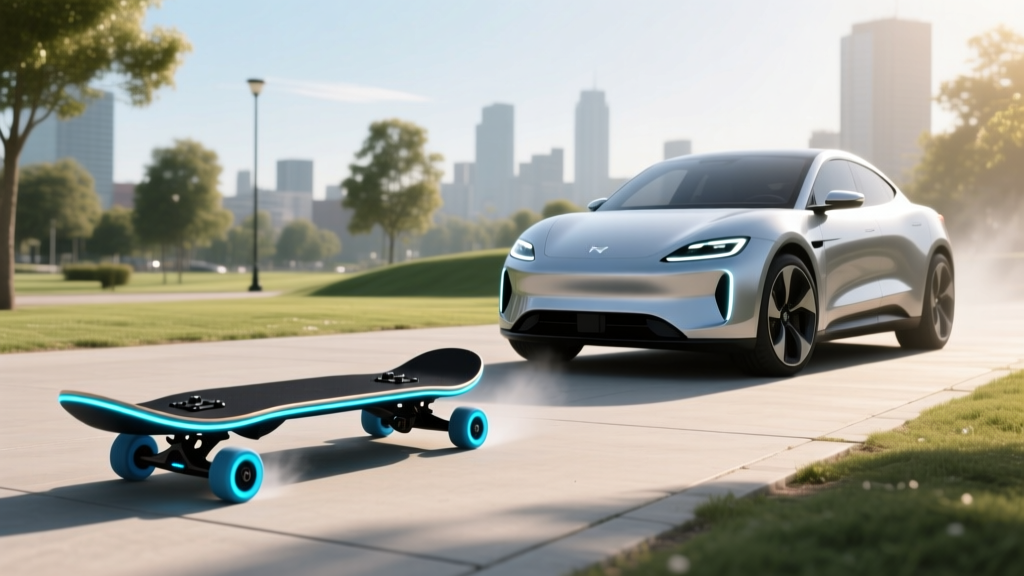
An electric drift board is a low-slung, motorized platform — often resembling a motorized skateboard or a miniature electric go-kart — designed for controlled sliding ("drifting") and recreational riding. In 2026, the market includes models from brands like Razor, Jetson, and various direct-to-consumer manufacturers, with specs that cluster in a narrow band:
- Battery capacity: 0.5–3.0 kWh (lithium-ion, typically NMC pouch cells)
- Motor output: 250W–1,500W (roughly 0.3–2.0 horsepower)
- Top speed: 10–25 mph
- Range per charge: 8–30 miles (heavily dependent on rider weight, terrain, and throttle use)
- Charge time (0–100%): 2–5 hours on a standard 120V household outlet
- Weight: 25–65 lbs
- MSRP: $800–$2,500 (most popular models cluster around $1,200–$1,800)
These devices are classified as recreational vehicles or low-speed personal transporters in most U.S. jurisdictions. They are not street-legal for highway use, generally lack NHTSA safety certification, and are not eligible for the federal §30D EV tax credit, which applies only to qualified four-wheeled motor vehicles meeting specific battery-sourcing and MSRP requirements (IRS §30D rules).
Side-by-Side: Electric Drift Board vs. Battery Electric Vehicle
The table below compares a representative 2026 electric drift board (mid-range model, ~$1,500) against a 2026 Chevrolet Equinox EV 2LT (a mainstream, affordable EV starting at approximately $33,600 before destination, with EPA-estimated range up to 319 miles). Data sourced from fueleconomy.gov and manufacturer specifications.
| Attribute | Electric Drift Board (Mid-Range) | 2026 Chevrolet Equinox EV 2LT |
|---|---|---|
| MSRP | $1,200–$1,800 | $33,600 (before incentives) |
| Battery Capacity | ~1.5 kWh (NMC) | 85 kWh usable (NMC) |
| EPA Range | N/A (no EPA rating; ~15–20 mi real-world) | 319 mi (EPA est.) |
| Real-World Range | 10–18 mi (varies with rider weight/throttle) | ~260–290 mi highway; ~220 mi in cold weather |
| Top Speed | 15–20 mph | 115+ mph (electronically limited) |
| Motor Power | 500W–1,000W (~0.7–1.3 HP) | 213 HP (FWD) / 288 HP (AWD) |
| Charge Time (0–100%) | 3–4 hours (120V Level 1 only) | ~9.5 hours (Level 2, 11.5 kW); ~10–80% in 20 min (DCFC 150 kW) |
| Charging Cost (Full) | ~$0.20–$0.25 (at $0.16/kWh national avg) | ~$13.60 (at $0.16/kWh national avg) |
| Passengers | 1 (rider only) | 5 |
| Cargo | None (backpack max) | 26.4 cu ft (rear seats up) / 57.2 cu ft (folded) |
| Weather Protection | None | Full climate control, heat pump available |
| Safety Certification | None (CPSC consumer product standards only) | NHTSA 5-star, IIHS Top Safety Pick eligible |
| Federal Tax Credit | Not eligible | Up to $7,500 (§30D, subject to income/MSRP/sourcing rules) |
| Street Legal (Highway) | No | Yes |
| Warranty | 90 days–1 year limited | 8 yr / 100,000 mi battery & powertrain |
Real Costs: Drift Board vs. EV Ownership Over 3 Years
Let's model a realistic 3-year ownership scenario. We'll assume the drift board is used for a 6-mile daily round-trip commute (flat terrain, fair weather, 200 riding days/year) and the EV is used for a 30-mile daily round-trip commute (all weather, 250 driving days/year, plus weekend trips totaling 4,000 miles/year).
| Cost Category | Electric Drift Board (3 Years) | 2026 Equinox EV 2LT (3 Years) |
|---|---|---|
| Purchase Price | $1,500 | $33,600 |
| Federal Tax Credit | $0 | –$7,500 (if eligible; point-of-sale transfer available) |
| Net Purchase | $1,500 | $26,100 |
| Energy Cost (3 years) | $24 (1,200 mi/yr × 3 yr ÷ 20 mi/kWh × $0.16/kWh) | $1,368 (11,500 mi/yr × 3 yr ÷ 3.2 mi/kWh × $0.16/kWh) |
| Maintenance | $150 (tire replacement, bearing service) | $450 (cabin filter, tire rotation, wiper fluid — no oil changes) |
| Insurance | $0 (typically uninsured; homeowner's/renter's may cover theft) | $5,400 (~$1,800/yr avg; EV premiums run 15–25% above ICE equivalent) |
| Depreciation (est.) | $1,050 (~70% over 3 years; poor resale) | $10,440 (~40% over 3 years) |
| Total 3-Year Cost | $2,724 | $43,758 |
| Cost Per Mile | $0.76/mi | $1.27/mi |
Key takeaway: The drift board's total cost is dramatically lower in absolute terms, but its cost per mile is competitive only because the mileage is so low. On a per-mile basis, the EV actually delivers more value — you get climate control, safety systems, cargo space, and highway capability for $1.27/mile, which is still below the AAA-reported average of $1.30–$1.50/mile for a comparable gas-powered compact SUV.
Charging Reality: What Both Actually Require
One advantage the drift board holds is charging simplicity. Its small battery (1–2 kWh) charges from any standard 120V household outlet in 3–4 hours. You don't need a dedicated circuit, a panel upgrade, or a Level 2 home charger. Total electricity cost per full charge: roughly $0.20–$0.30 at the 2026 U.S. residential average of ~$0.16/kWh (EIA).
A full EV like the Equinox EV requires more infrastructure planning:
- Level 1 (120V): Adds ~3–4 miles of range per hour. A full charge from empty takes 24+ hours — impractical for daily use.
- Level 2 (240V, 32–48A): Adds ~25–35 miles per hour. Full charge in ~9–10 hours. Installation costs $800–$2,500 (equipment + licensed electrician + permit), potentially $3,000–$5,000 if a panel upgrade from 100A to 200A service is needed.
- DC Fast Charging (150–350 kW): 10–80% in ~20 minutes at a public station. Costs $0.30–$0.50/kWh at networks like Electrify America or EVgo — roughly 2–3× the cost of home charging.
Real-world note: If you live in an apartment without charging access, an EV requires reliance on public charging infrastructure, which adds time and cost. A drift board, by contrast, can charge anywhere you have a wall outlet — a genuine advantage for renters and dorm residents.
Common Misconceptions: Fact vs. Fiction
| Myth | Fact |
|---|---|
| "An electric drift board is a cheap EV alternative for commuting." | It works only for short (under 10 mi), fair-weather, flat-terrain commutes with no cargo or passenger needs. Rain, snow, extreme heat, hills, and darkness all severely limit practicality. |
| "Drift boards qualify for the $7,500 EV tax credit." | They do not. The §30D credit applies only to qualified four-wheeled vehicles with at least four wheels, a gross vehicle weight under 14,000 lbs, and specific battery sourcing and MSRP requirements. |
| "The range is basically what the box says." | Advertised drift board ranges (often "up to 25 miles") assume optimal conditions: 150-lb rider, flat terrain, moderate throttle, 70°F. Real-world range with a 200-lb rider on hills with aggressive throttle can drop 40–50%. |
| "EVs are too expensive compared to any electric micro-mobility device." | Comparing a $1,500 drift board to a $33,600 EV is a category error. The correct comparison is EV vs. gas car of equivalent capability. A 2026 Equinox EV at ~$26,100 after the tax credit competes directly with a $28,000–$32,000 gas SUV — and has lower fuel and maintenance costs over time. |
| "I can ride a drift board on the road legally." | Most U.S. states classify motorized boards as neither bicycles nor motor vehicles, placing them in a legal gray area. They're generally restricted to private property, bike paths (where permitted), and closed lots. Riding on public roads often violates local traffic codes. |
Battery Longevity and Replacement
Drift board batteries are small NMC lithium-ion packs with an expected lifespan of 300–500 full charge cycles before degrading to ~80% of original capacity. At one full cycle per day (200 riding days/year), expect noticeable range loss by year 2–3. Replacement batteries cost $200–$500 depending on the model — representing 15–35% of the original purchase price.
Full EV batteries, by contrast, are engineered for 1,500–3,000+ cycles and carry federally mandated warranties of at least 8 years / 100,000 miles (10 years / 150,000 miles in CARB states). The Equinox EV's 85 kWh pack is warrantied to retain at least 70% capacity over that period. Real-world degradation data from similar GM Ultium-platform vehicles suggests ~5–8% capacity loss over the first 3 years under normal use — far less impactful on a 319-mile range than on a 20-mile drift board.
Decision Framework: Which Should You Buy?
Buy an Electric Drift Board If:
- Your commute is under 10 miles round-trip on flat, paved terrain
- You live in a warm, dry climate (or only ride in fair weather)
- You rent and lack access to EV charging infrastructure
- You want a recreational toy for parking lots, boardwalks, or private property
- Your budget is under $2,500 and you need something today
- You already own or have access to a car for longer trips, bad weather, and cargo hauling
Buy a Full Electric Vehicle If:
- You need all-weather, year-round transportation
- Your commute exceeds 15 miles or includes highway driving
- You carry passengers or cargo regularly
- You have access to Level 2 home charging (garage, driveway, or workplace)
- You qualify for the §30D tax credit (single filer AGI under $150K, head of household under $225K, joint under $300K; vehicle MSRP under $55K for sedans / $80K for SUVs/trucks)
- You want to reduce per-mile fuel and maintenance costs over a 5–10 year ownership period
Buy a PHEV (Plug-In Hybrid) If:
- You want electric-only commuting (25–50 miles) but need gas-engine range for road trips
- You have Level 2 charging at home but live in an area with sparse DC fast-charging infrastructure
- Cold-weather range loss is a major concern (the gas engine eliminates range anxiety below 20°F)
Frequently Asked Questions
Is an electric drift board street legal?
In most U.S. jurisdictions, no. Electric drift boards fall into a regulatory gap — they're motorized but don't meet Federal Motor Vehicle Safety Standards (FMVSS) for road vehicles, and they exceed the speed/power limits for e-bike classifications in many states. Check your local municipal code before riding on any public surface.
Can I charge a drift board and an EV on the same household circuit?
Yes, but not simultaneously on the same 15A or 20A circuit. A drift board charger draws ~150–300W (negligible). A Level 2 EV charger draws 7,680–11,520W (32–48A at 240V) and requires a dedicated circuit installed by a licensed electrician. They operate on entirely different electrical systems.
Does an electric drift board qualify for any tax incentives?
Not the federal §30D clean vehicle credit. Some states or municipalities may offer micro-mobility rebates (typically $100–$300) through local clean-air or transit programs, but these are uncommon and vary by jurisdiction. Check your state energy office for current programs.
How does cold weather affect drift board range?
Significantly. Lithium-ion batteries lose 20–40% of usable capacity below 32°F, and the increased rolling resistance of cold, stiff tires compounds the loss. A drift board rated for 20 miles at 70°F may deliver only 10–14 miles at 25°F. Full EVs mitigate this with active thermal management systems and heat pumps — drift boards have neither.
What's the actual cost per mile of a drift board vs. an EV vs. a gas car?
Energy-only cost per mile: drift board ~$0.01/mi; EV ~$0.05/mi (home charging at $0.16/kWh); gas car (28 MPG combined at $3.30/gallon) ~$0.12/mi. However, when you factor in purchase price, insurance, depreciation, and maintenance, the drift board's cost-per-mile rises to ~$0.76/mi over 3 years (due to low total mileage), while the EV lands around $1.27/mi and a comparable gas SUV around $1.40/mi.
Can a drift board replace a car for a college student on campus?
For on-campus travel only (dorm to class, dining hall, library), a drift board or electric skateboard can work well if the campus is flat, compact, and permits motorized boards on paths. You'll still need a car, rideshare, or transit for grocery runs, off-campus appointments, travel home, and inclement weather. Think of it as a supplement, not a replacement.