The Short Answer: There Is No Fully Electric Honda CR-V
As of the 2026 model year, Honda does not sell a battery-electric CR-V. The CR-V lineup is available as a conventional hybrid (HEV) across all trims, but there is no plug-in hybrid (PHEV) or battery-electric (BEV) version in the U.S. market. If you want a Honda EV, the Honda Prologue (built on GM's Ultium platform, EPA range up to 296 miles) is the closest equivalent in size and price. If you want the CR-V's cargo space and driving feel with maximum efficiency, the 2026 CR-V Hybrid delivers an EPA-estimated 40 MPG combined.
Why Honda Hasn't Made an Electric CR-V (Yet)
Honda's electrification strategy has prioritized the hybrid route for its highest-volume nameplates. The CR-V, Civic, and Accord all received hybrid powertrains before any BEV variants. Honda's first dedicated EVs for the U.S. — the Prologue SUV and Acura ZDX — were co-developed with General Motors using the Ultium battery platform rather than Honda's own architecture.
Honda has announced a next-generation EV lineup on its own dedicated platform, expected to debut globally around 2026–2027. However, no electric CR-V variant has been officially confirmed for the U.S. market with a firm on-sale date. Any speculation about a "CR-V e:FCEV" or "CR-V Electric" remains in the announced/preliminary category.
For buyers specifically searching for an electric CR-V, the practical decision is: buy the CR-V Hybrid now, cross-shop a comparable electric SUV, or wait. Here's the data to decide.
2026 Honda CR-V Hybrid: Specs and Real-World Numbers
The 2026 CR-V Hybrid pairs a 2.0-liter Atkinson-cycle four-cylinder engine with a two-motor hybrid system producing a combined 204 horsepower and 247 lb-ft of torque. It uses a lithium-ion battery pack (approximately 1.1 kWh usable) that assists the engine but cannot drive the vehicle on electric power alone for meaningful distances.
| Specification | 2026 CR-V Hybrid (AWD) |
|---|---|
| Powertrain | 2.0L I4 + 2-motor hybrid (HEV) |
| Combined Horsepower | 204 hp |
| Combined Torque | 247 lb-ft |
| EPA City / Hwy / Combined | 40 / 34 / 37 MPG (AWD e:FWD is 43/36/40) |
| Battery Capacity | ~1.1 kWh (lithium-ion, non-plug-in) |
| Electric-Only Range | Not applicable (no plug, no EV mode) |
| Fuel Tank | 14.0 gallons |
| Total Range | ~518 miles (AWD combined) |
| 0–60 mph | ~7.6 seconds (est.) |
| Cargo Volume | 36.3 cu ft (rear seats up) / 76.5 cu ft (folded) |
| Starting MSRP | ~$36,395 (Sport Hybrid AWD) |
| Powertrain Warranty | 5 years / 60,000 miles |
| Hybrid Battery Warranty | 8 years / 100,000 miles |
Real-world fuel economy caveat: The EPA combined figure of 37 MPG (AWD) is achievable in mixed suburban driving. Expect 32–34 MPG on sustained highway trips at 70+ mph, and 35–38 MPG in city-heavy commuting where the hybrid system recovers the most energy through regenerative braking. Cold-weather fuel economy typically drops 5–10% due to engine warm-up cycles and cabin heating demands.
EV Alternatives: What to Cross-Shop Instead
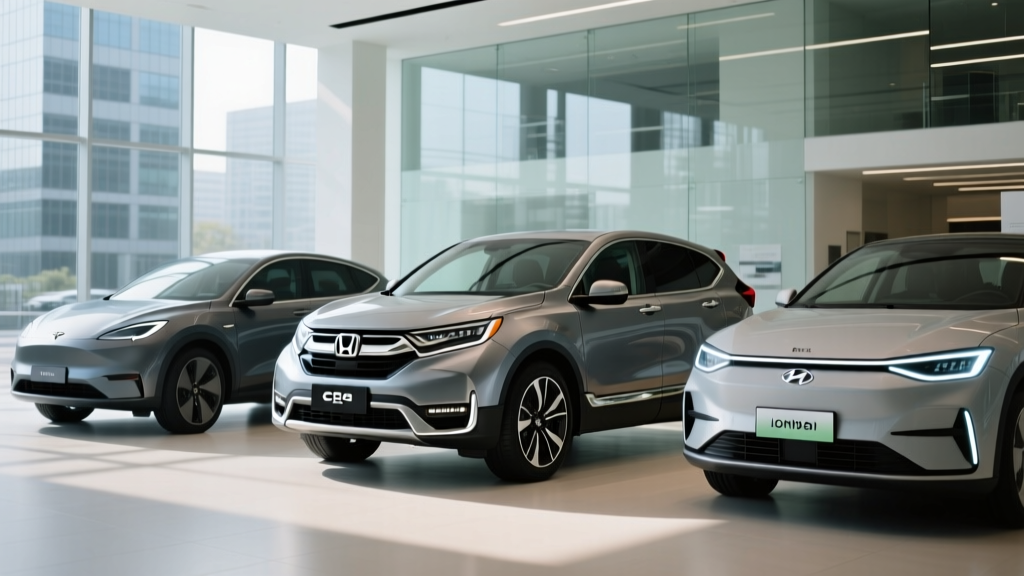
If you want a fully electric compact crossover that matches the CR-V's footprint, cargo practicality, and price range, these are the direct competitors:
| Model | Type | EPA Range | Battery | Peak DC Charge | 10–80% Time | 0–60 mph | Base MSRP |
|---|---|---|---|---|---|---|---|
| Honda Prologue (AWD) | BEV | 281 mi | 85 kWh (NMC) | 150 kW | ~32 min | 6.0 sec | $48,795 |
| Hyundai Ioniq 5 (Std Range RWD) | BEV | 245 mi | 58 kWh (NMC) | 180 kW | ~18 min | 7.4 sec | $42,600 |
| Tesla Model Y (Long Range AWD) | BEV | 308 mi | ~75 kWh (NMC) | 250 kW | ~20 min | 4.8 sec | $44,990 |
| Kia EV6 (GT-Line RWD) | BEV | 310 mi | 77.4 kWh (NMC) | 240 kW | ~18 min | 7.2 sec | $43,700 |
| Honda CR-V Hybrid (AWD) | HEV | ~518 mi (gas) | ~1.1 kWh | N/A | N/A | 7.6 sec | $36,395 |
Key takeaway: The CR-V Hybrid starts roughly $6,000–$12,000 less than comparable BEVs before any tax credits. However, eligible buyers can reduce EV pricing significantly through the federal §30D credit.
Real Cost Comparison: CR-V Hybrid vs. Electric SUV
Purchase price is only part of ownership cost. Here's a 5-year / 75,000-mile cost breakdown comparing the CR-V Hybrid AWD against a typical electric compact SUV (represented by the Hyundai Ioniq 5 for this exercise).
| Cost Category | CR-V Hybrid (AWD) | EV SUV (Ioniq 5 RWD est.) |
|---|---|---|
| Base MSRP | $36,395 | $42,600 |
| Federal Tax Credit (§30D) | $0 (not a plug-in) | Up to $7,500 (if eligible) |
| Effective Purchase Price | $36,395 | $35,100 |
| Fuel / Energy (75,000 mi) | $6,757 (gas at $3.50/gal, 37 MPG) | $2,625 (electric at $0.14/kWh, 3.5 mi/kWh) |
| Maintenance (5 yr) | $2,800 (oil changes, filters, brakes) | $1,200 (cabin filter, tire rotation, wiper fluid) |
| Insurance (5 yr avg.) | $7,500 | $8,500 (EV premium ~10–15%) |
| Estimated Depreciation (5 yr) | $14,500 | $17,000 |
| 5-Year Total Cost | $67,952 | $64,425 |
Analysis: With the full $7,500 federal tax credit applied at point of sale, the EV crossover breaks even or slightly beats the CR-V Hybrid on 5-year total cost despite a higher sticker price. The EV's fuel and maintenance savings — roughly $5,700 combined over five years — are the primary driver. However, this calculation assumes:
- You qualify for the full §30D credit (income caps, MSRP caps, battery sourcing requirements apply — see IRS guidelines)
- You have reliable home Level 2 charging (if relying solely on DC fast charging at $0.35–$0.50/kWh, the EV fuel cost roughly doubles)
- Insurance premiums for EVs remain 10–15% higher on average
Federal Tax Credit: What You Need to Know for 2026
The §30D Clean Vehicle Credit offers up to $7,500 for qualifying new EVs, but eligibility is layered:
- MSRP cap: SUVs must be priced at or below $80,000; sedans at $55,000
- Buyer income cap: AGI must not exceed $150,000 (single), $225,000 (head of household), or $300,000 (joint)
- Battery sourcing: A percentage of critical minerals and battery components must meet North American sourcing thresholds (requirements tighten annually through 2029)
- Point-of-sale transfer: Eligible buyers can apply the credit as an immediate dealer discount rather than waiting for tax filing
- CR-V Hybrid: Does NOT qualify — it is not a plug-in vehicle. Only BEVs and PHEVs with ≥7 kWh battery capacity are eligible
Always verify current eligibility at fueleconomy.gov and consult a tax professional, as battery sourcing rules and eligible model lists change throughout the year.
Real-World Ownership: Which Fits Your Driving Life?
Decision Framework: CR-V Hybrid vs. Electric SUV
Choose the CR-V Hybrid if:
- You cannot install a Level 2 home charger (apartment, street parking, landlord restrictions)
- You regularly drive 400+ miles in a single day (road trips, rural routes) and don't want to plan around charging stops
- You live in an area with limited DC fast-charging infrastructure
- You want the lowest upfront purchase price with no credit-eligibility complexity
- You frequently tow (CR-V Hybrid: 1,500 lb capacity; most compact EVs: 1,500–2,300 lb but with significant range reduction while towing)
Choose an electric SUV (Prologue, Ioniq 5, Model Y, EV6) if:
- You can install a Level 2 (240V, 32–48 amp) charger at home — this unlocks 80%+ of the EV ownership benefit
- Your daily commute is under 100 miles round-trip (the vast majority of U.S. drivers)
- You qualify for the §30D credit, closing the purchase-price gap
- You want lower ongoing fuel and maintenance costs
- You value instant torque and a quieter, smoother driving experience
Cold-Weather and Climate Reality
EVs lose 20–30% of their EPA range in sustained sub-freezing temperatures due to battery chemistry limitations and cabin heating energy demands. A 281-mile EPA-rated Prologue might deliver 195–225 miles in a Minnesota January. The CR-V Hybrid loses fuel efficiency in cold weather too (roughly 5–10%), but its gas tank refuels in 3 minutes regardless of temperature. If you live in a region with harsh winters and limited charging infrastructure, the hybrid's range consistency is a genuine advantage.
Home Charging: The Make-or-Break Factor
For EV ownership, home charging is not optional — it's foundational. A Level 2 home charger (7.7–11.5 kW) adds 25–40 miles of range per hour of charging, meaning an overnight session fully replenishes any daily commute. Installation costs typically range from $500–$2,500 depending on your electrical panel's capacity and the run length from panel to garage. If your home has a 200-amp panel with spare capacity, expect the lower end. A panel upgrade to 200A can add $1,500–$3,000.
Without home charging, you'll rely on public DC fast chargers (costing $0.35–$0.50/kWh vs. $0.12–$0.16/kWh at home) and Level 2 public stations, which erodes the EV's cost advantage and adds time to your routine.
Common Misconceptions About the "Electric CR-V"
| Myth | Fact |
|---|---|
| "The CR-V has a plug-in hybrid version." | Not in the U.S. Honda offers a CR-V e:PHEV in China and Europe, but it is not sold in North America as of 2026. |
| "The Honda Prologue is just an electric CR-V." | The Prologue is a separate model built on GM's Ultium platform. It's similar in size but has different styling, interior, and driving dynamics. It's closer to a Chevrolet Blazer EV underneath. |
| "Hybrids don't save much compared to EVs." | The CR-V Hybrid's 37–40 MPG combined is a 35–45% improvement over the gas-only CR-V's 28 MPG combined. That translates to roughly $500–$700/year in fuel savings at 15,000 miles driven. |
| "EV batteries need replacing every few years." | Modern NMC and LFP battery packs are warrantied for 8 years/100,000 miles with guaranteed capacity retention (typically ≥70%). Real-world data shows most packs retain 85–90% capacity at 100,000 miles. See fueleconomy.gov for rated efficiency data. |
| "I can't take an EV on a road trip." | With 250+ miles of EPA range and DC fast charging adding 150–200 miles in 20 minutes, road trips are practical — but require 10–15 minutes of planning for charging stops. The CR-V Hybrid requires zero planning. |
Frequently Asked Questions
Will Honda ever release an electric CR-V?
Honda has confirmed plans for a next-generation EV lineup on its own dedicated platform, targeting global launch around 2026–2027. A CRV-sized electric SUV is plausible, but Honda has not officially confirmed an "electric CR-V" nameplate or specifications for the U.S. market. Any details remain preliminary.
Is the Honda Prologue basically an electric CR-V?
Not exactly. The Prologue is a midsize crossover built on GM's Ultium platform (shared with the Chevrolet Blazer EV). It offers similar interior volume to the CR-V but is slightly longer, heavier, and priced approximately $12,000 higher before tax credits. The driving experience, infotainment system, and design language are distinctly different from the CR-V.
Does the CR-V Hybrid qualify for any tax credits?
No. The §30D federal Clean Vehicle Credit applies only to battery-electric vehicles (BEVs) and plug-in hybrids (PHEVs) with at least 7 kWh of battery capacity. The CR-V Hybrid is a conventional HEV with a ~1.1 kWh pack and no plug. Some states may offer minor incentives for hybrids, but the federal credit does not apply.
How does the CR-V Hybrid compare to a PHEV like the Toyota RAV4 Prime?
The RAV4 Prime (plug-in hybrid) offers 42 miles of EPA electric-only range, 94 MPGe when running on electricity, and qualifies for a partial federal tax credit (up to $7,500 depending on battery sourcing). It starts around $44,590 — roughly $8,000 more than the CR-V Hybrid. If you can charge at home and your commute is under 42 miles, the RAV4 Prime operates as an EV most days with gas-engine backup for longer trips. The CR-V Hybrid is simpler and cheaper but cannot plug in.
What's the cheapest way to get an electric SUV with CR-V-like cargo space?
The Tesla Model Y Long Range AWD starts at approximately $44,990 and offers 308 miles of EPA range, 76.2 cu ft of cargo volume (seats folded), and eligibility for the $7,500 federal credit (verify current sourcing compliance at irs.gov). After the credit, effective pricing drops to ~$37,490 — close to the CR-V Hybrid's MSRP. The Hyundai Ioniq 5 and Kia EV6 also offer competitive cargo space and pricing in the $42,000–$44,000 range.
Is the CR-V Hybrid's battery expensive to replace?
Honda warranties the CR-V Hybrid's lithium-ion battery pack for 8 years or 100,000 miles. Out-of-warranty replacement costs are estimated at $2,000–$4,000 based on current hybrid battery pricing — significantly less than a full EV traction battery replacement ($8,000–$18,000). Hybrid battery failures before 150,000 miles are uncommon based on long-term ownership data from earlier Honda hybrid models.
Sources: EPA fuel economy data via fueleconomy.gov; Honda Newsroom for 2026 CR-V Hybrid specifications; IRS §30D credit rules at irs.gov.