The Quick Answer
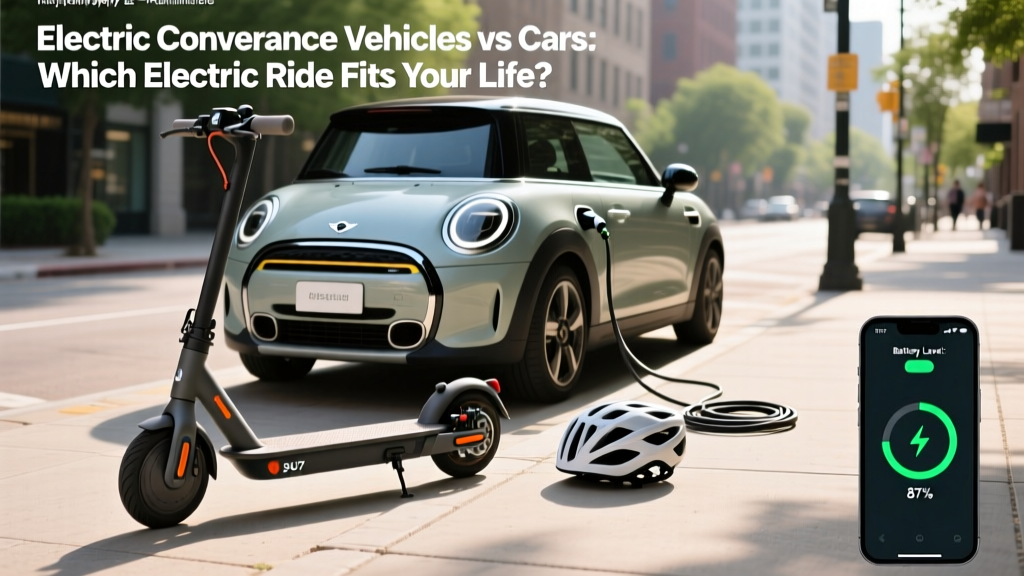
Electric conveyance vehicles is a broad term that includes any electric-powered device used to transport people or goods — from full-size battery-electric cars (BEVs) to e-bikes, electric scooters, electric skateboards, and neighborhood electric vehicles (NEVs). For most US buyers researching this term, the real question is: Do I need a full EV, or would a smaller electric conveyance vehicle handle my daily needs at a fraction of the cost?
If your commute is under 15 miles round-trip, you have secure storage, and you live in a moderate climate, a Class 2 e-bike ($1,200–$2,500) or electric scooter ($500–$1,200) can replace most car trips for pennies per charge. If you need highway capability, cargo space, passenger seating, all-weather comfort, or trips beyond 30 miles, a full EV like the Chevrolet Equinox EV (EPA 319 mi, starting ~$33,600) or Hyundai Ioniq 5 (EPA 318 mi, starting ~$42,600) is the right move. Read on for the numbers.
What Counts as an Electric Conveyance Vehicle?
The term "electric conveyance vehicle" isn't a regulatory category — it's a practical umbrella. It covers anything with an electric motor that moves a person from point A to point B. Here's how the main categories break down in real ownership terms:
| Category | Typical Price | Range | Top Speed | License/Registration |
|---|---|---|---|---|
| Electric Scooter (kick) | $500–$1,200 | 15–30 mi | 15–25 mph | None (varies by state) |
| Class 1–2 E-Bike | $1,200–$3,500 | 25–60 mi (pedal assist) | 20 mph motor assist | None in most states |
| Class 3 E-Bike | $2,000–$5,000 | 25–50 mi | 28 mph motor assist | None (some local restrictions) |
| Neighborhood EV (NEV/LSV) | $10,000–$20,000 | 30–60 mi | 25 mph (federally capped) | Yes — registration required |
| Full BEV (e.g., Equinox EV) | $33,600–$55,000+ | 250–350 mi EPA | 100–130+ mph | Yes — full registration/insurance |
For the purposes of this guide, we focus on where most readers actually land: the decision between a smaller electric conveyance vehicle (e-bike or scooter) and a full battery-electric car. The right answer depends on your commute distance, climate, cargo needs, and whether you have safe storage.
Real Costs: Smaller Electric Conveyance Vehicles vs Full EVs
The upfront price gap is enormous, but the total cost of ownership picture is where the real insight lies. Below is a 3-year cost breakdown comparing three realistic options for a commuter covering 10 miles round-trip, 250 days per year (2,500 miles/year).
| Cost Factor | Class 2 E-Bike | Compact BEV (e.g., Nissan Leaf SV Plus) | Gas Compact (e.g., Honda Civic) |
|---|---|---|---|
| Purchase Price | $2,000 | $36,000 (before credits) | $28,000 |
| Federal Tax Credit (§30D) | $0 | Up to $7,500 (eligibility varies) | $0 |
| Effective Purchase | $2,000 | ~$28,500 (if full credit applies) | $28,000 |
| Fuel/Energy (3 yr) | ~$60 ($0.008/mi) | ~$975 ($0.13/mi at $0.16/kWh) | ~$2,810 ($0.37/mi at $3.30/gal, 30 MPG) |
| Maintenance (3 yr) | ~$300 (tires, brake pads, chain) | ~$450 (cabin filter, tire rotation, wipers) | ~$1,800 (oil, filters, brakes, fluids) |
| Insurance (3 yr) | $0–$360 (optional, varies) | ~$5,400 ($150/mo avg for EVs) | ~$4,200 ($117/mo avg) |
| 3-Year Total Cost | ~$2,660 | ~$35,325 | ~$36,810 |
Key takeaway: An e-bike used as a primary commuter can save over $30,000 across three years versus any car, electric or gas. A full EV and a gas car are increasingly close on total cost — the EV wins on fuel and maintenance, but higher insurance premiums and upfront price can narrow the gap. According to fueleconomy.gov, the 2025 Nissan Leaf SV Plus achieves 114 MPGe combined, translating to roughly $0.12–$0.14 per mile on average US electricity rates.
Range, Charging, and Practical Limitations
This is where the rubber meets the road — and where most buyers underestimate real-world constraints.
E-Bike and Scooter Reality
Manufacturer-stated range for e-bikes (25–60 miles) assumes pedal-assist mode, a 165-lb rider, flat terrain, and moderate temperatures. In practice:
- Throttle-only riding (Class 2): Expect 40–60% of stated range — a "40-mile" battery delivers 16–24 miles on throttle alone.
- Cold weather (below 40°F): Lithium-ion batteries lose 15–30% capacity in cold. A 40-mile summer range becomes 25–30 miles in January.
- Hills and headwinds: Can cut range by another 20–30%.
- Charging time: Most e-bike batteries (400–700 Wh) charge in 3–6 hours on a standard 120V outlet — essentially free infrastructure.
Full EV Reality
Full EVs face similar real-world adjustments, but with far greater baseline range. Take the 2025 Hyundai Ioniq 5 (Long Range AWD):
- EPA range: 290 miles (AWD), 318 miles (RWD)
- Highway driving at 75 mph: Expect ~240–260 miles (RWD) — EVs are less efficient at sustained highway speed than in city stop-and-go where regenerative braking recaptures energy.
- Cold weather (20°F): Expect ~200–230 miles — battery chemistry and cabin heating draw significant energy. Models with a heat pump (standard on Ioniq 5, Tesla Model Y) lose less than those with resistive heaters.
- DC fast charging: The Ioniq 5 peaks at ~235 kW on an 800V charger, adding 10–80% in roughly 18 minutes. However, that peak rate only holds between ~10–55% state of charge; above 80%, the charge curve tapers sharply to protect the battery. A realistic 10–90% stop takes closer to 28–32 minutes.
- Home Level 2 charging (11.5 kW / 48A): Adds roughly 36–40 miles per hour — a full overnight charge from 20% to 100% takes about 6–7 hours.
For a full breakdown of home charging installation costs, see our Level 2 home charger guide. Budget $800–$2,500 for a professional 240V installation depending on your panel capacity and run distance.
How Do Electric Conveyance Vehicles Compare to Hybrids?
If your concern is range flexibility without full EV commitment, a plug-in hybrid (PHEV) splits the difference. A PHEV like the Toyota RAV4 Prime offers 42 miles of electric-only range on a full charge, then operates as a conventional hybrid achieving 38 MPG combined once the battery depletes. This eliminates range anxiety entirely.
However, compare the use cases honestly:
| Scenario | Best Electric Conveyance Vehicle | Why |
|---|---|---|
| 5-mile urban commute, bike lanes available | Class 2 E-Bike | $2K total, no parking, no insurance, zero traffic |
| 12-mile suburban commute, no bike infrastructure | Compact BEV or PHEV | Safety, weather protection, highway capability required |
| 300-mile road trips monthly | Full BEV (300+ mi EPA) or PHEV | E-bikes/scooters are not viable; charging network access matters |
| Grocery runs and school drop-off (8 mi/day) | E-Bike with cargo trailer or BEV | Cargo e-bikes handle 100+ lb payloads; BEV if weather is harsh |
| Apartment living, no home charging | E-Bike (charge indoors) or PHEV | Full EV without home charging is inconvenient; PHEV can gas up anywhere |
Common Misconceptions — Fact-Checked
| Myth | Fact |
|---|---|
| "E-bikes don't count as real transportation" | In the Netherlands, e-bikes have overtaken cars for commutes under 10 km. In US cities with bike infrastructure (Portland, Minneapolis, DC), e-bike commuting has grown 35%+ year-over-year since 2022. |
| "Full EVs are always cheaper to own than gas cars" | Not always. Higher insurance (15–25% above comparable gas models), higher upfront cost, and potential home charger installation ($800–$2,500) can mean a full EV takes 5–7 years to break even on total cost versus a fuel-efficient gas car — especially for low-mileage drivers. |
| "Electric conveyance vehicles don't need insurance" | E-bikes and scooters are generally not legally required to carry insurance, but theft is common (e-bikes are a top theft target in major cities). A $20/month renter's or specialty e-bike policy is wise. NEVs and full EVs always require auto insurance. |
| "The $7,500 federal EV tax credit applies to every EV" | Under current IRS §30D rules, eligibility depends on MSRP caps ($55,000 for sedans, $80,000 for SUVs/trucks), buyer income limits ($150K single / $300K joint AGI), and battery critical-mineral and component sourcing requirements that tighten yearly. Always verify on the IRS Clean Vehicle credit page and confirm with a tax professional before purchasing. |
| "EV batteries need replacing every 5 years" | Modern NMC and LFP batteries in full EVs are warrantied for 8 years / 100,000 miles minimum (federal mandate) at 70% capacity retention. Real-world data from Tesla, Hyundai, and others shows most packs retain 85–92% capacity at 100,000 miles. Replacement is rarely needed within a typical ownership cycle. |
Your Decision Framework: Which Electric Conveyance Vehicle Do You Actually Need?
Follow This Flow
Step 1 — What's your daily round-trip distance?
- Under 15 miles: Continue to Step 2.
- 15–40 miles: A Class 3 e-bike is viable if you have safe routes. Otherwise, consider a full EV or PHEV.
- Over 40 miles: A full EV (250+ mi EPA range) or PHEV is your realistic option.
Step 2 — Do you have secure, weather-protected storage with a standard outlet?
- Yes: E-bike or scooter is practical — you can charge overnight indoors.
- No (street parking only): Theft risk and weather exposure make e-bikes impractical as a primary vehicle. Lean toward a full EV or PHEV.
Step 3 — What's your climate?
- Mild (rarely below 35°F, low snow): E-bikes and scooters are viable year-round.
- Cold winters, frequent rain/snow: Smaller electric conveyance vehicles become seasonal. You'll need a car (EV, PHEV, or gas) for 4–5 months of the year regardless.
Step 4 — Do you regularly carry passengers or cargo beyond a backpack?
- Passengers: Only a full vehicle (EV, PHEV, or gas) is legal and safe.
- Cargo under 50 lb: A cargo e-bike with rear rack or front basket handles this well.
- Cargo over 50 lb or bulky items: You need a car.
Step 5 — What's your budget?
- Under $3,000: A quality Class 2 e-bike (Rad Power, Aventon, Lectric) covers most commuting needs.
- $25,000–$35,000 after credits: The Chevrolet Equinox EV LT (EPA 319 mi, ~$33,600 MSRP, potentially eligible for full §30D credit) is the current value leader for full EVs.
- $35,000–$50,000: The Hyundai Ioniq 5, Tesla Model Y, and Ford Mustang Mach-E offer the best balance of range, charging speed, and technology.
First-Time EV Buyer Essentials
If your decision framework points to a full battery-electric car, here's what to know before signing:
- Charge where you park. The single biggest predictor of EV satisfaction is reliable home charging. If you can install a Level 2 (240V) charger at home, EV ownership is effortless — you start every morning with a full "tank." If you can't, public charging alone is manageable but adds friction and cost (DC fast charging costs $0.30–$0.50/kWh vs. $0.12–$0.18/kWh at home).
- Understand kW vs. kWh. kW (kilowatts) measures power — how fast energy flows, like water pressure. kWh (kilowatt-hours) measures energy — how much the battery holds, like tank size. A 77 kWh battery charged at 11.5 kW takes roughly 6.7 hours from empty to full.
- Real range ≠ EPA range. Budget 15–20% below the EPA sticker for highway-heavy driving, and 20–30% below in cold weather. A 300-mile EPA rating means ~240–255 real highway miles in winter.
- Tax credits are not guaranteed. Check the IRS Clean Vehicle Credit page for the current list of eligible models. Battery sourcing requirements have disqualified several popular models in recent years. Point-of-sale transfer is now available, letting you apply the credit as a down payment reduction at the dealer — but only if you meet all income and sourcing criteria.
- Insurance costs more. EV insurance premiums run 15–25% higher than comparable gas vehicles due to higher repair costs and battery replacement expenses. Get a quote before purchasing to avoid surprises.
- Test the charging experience. Before buying, download the Electrify America, EVgo, and ChargePoint apps. Drive to a nearby DC fast charger and observe how the process works. Familiarity eliminates anxiety.
Frequently Asked Questions
Are electric conveyance vehicles like e-bikes street-legal?
Yes, but regulations vary by state and locality. Class 1 and 2 e-bikes (motor assist up to 20 mph) are legal on most roads and bike paths nationwide. Class 3 e-bikes (up to 28 mph) may be restricted from certain bike paths. Electric scooters are legal in most states but may require riders to be 16+. Always check your local DMV or transportation authority for current rules.
Can I claim the federal EV tax credit on an e-bike?
No. The IRS §30D Clean Vehicle Credit applies only to four-wheeled plug-in electric vehicles meeting specific battery capacity, sourcing, MSRP, and buyer income requirements. E-bikes and scooters do not qualify. Some states and local utilities offer separate e-bike rebates — check your state energy office or local utility for current programs.
What's the cheapest full EV I can buy new in 2025–2026?
The Chevrolet Equinox EV LT starts at approximately $33,600 (before destination) and offers an EPA-estimated 319 miles of range. If you qualify for the full $7,500 §30D credit (verify income, MSRP, and sourcing eligibility on irs.gov), the effective price drops to roughly $26,100 — making it the most affordable long-range EV on the US market. The Nissan Leaf S starts lower (~$28,140) but offers only 149 miles of EPA range and uses the older CHAdeMO charging standard, limiting DC fast-charging access.
Is an e-bike practical in winter?
In mild winters (above 35°F, dry roads), yes — with proper clothing and studded or winter tires. In regions with heavy snow, ice, or sustained sub-freezing temperatures, e-bikes become impractical and unsafe for daily commuting from roughly December through February. Battery range also drops 15–30% in cold weather. Many year-round e-bike commuters in cold climates treat their e-bike as a three-season vehicle and keep a car (or use transit) for winter months.
How long do e-bike batteries last compared to EV batteries?
E-bike batteries (typically 400–700 Wh, lithium-ion) are rated for 500–1,000 full charge cycles before degrading to 80% capacity — roughly 3–5 years of daily use. Replacement batteries cost $400–$800. Full EV batteries (60–100 kWh, NMC or LFP chemistry) are rated for 1,500–3,000+ cycles and warrantied for 8 years / 100,000 miles at 70% capacity retention. Real-world data shows most EV packs retain 85–92% at 100,000 miles. The difference comes down to thermal management: full EVs have active liquid cooling/heating systems; e-bike batteries are passively cooled.