The Short Answer
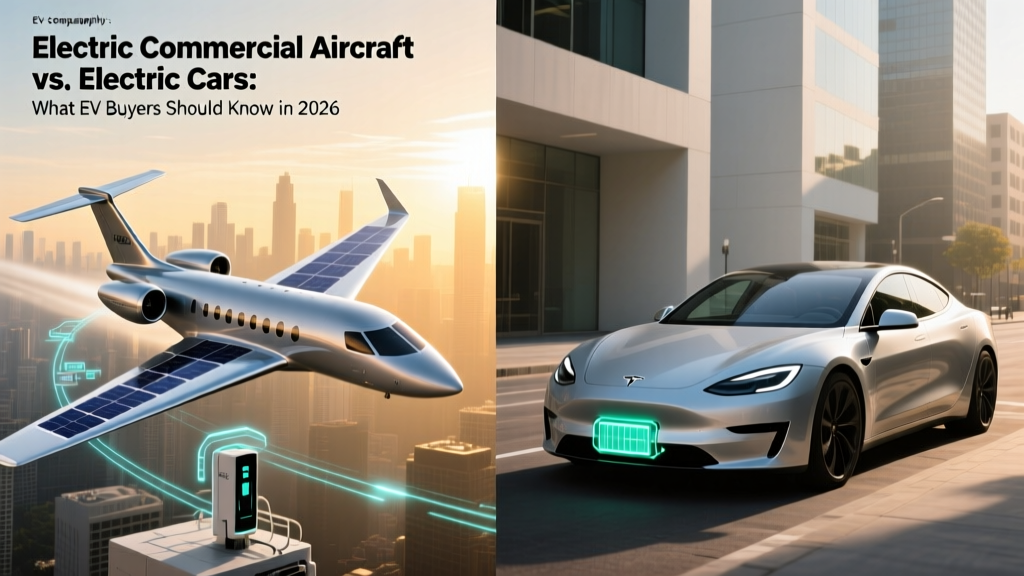
If you searched for electric commercial aircraft while researching your next EV purchase, here's the practical takeaway: as of 2026, fully electric commercial airliners do not yet carry fare-paying passengers on scheduled routes. What does exist are small electric trainer aircraft (like the Pipistrel Velis Electro), regional hybrid-electric prototypes in testing, and battery supply-chain developments that directly affect the EV you're about to buy. The lithium-sulfur and solid-state cells being developed for aviation are 3–5 years away from reaching automotive production. For now, your EV buying decision should be based on today's proven NMC and LFP battery tech, not aviation promises.
Why an EV Buyer Should Care About Electric Aviation
At first glance, electric commercial aircraft and your next electric car seem to have nothing in common. But they share the same fundamental engineering constraint: energy density. A Boeing 737 carries roughly 20,000 gallons of Jet-A fuel, which at 135,000 BTU/gallon and ~40% engine efficiency delivers about 2.7 megawatt-hours of usable energy. Replicating that with today's best lithium-ion cells (~250 Wh/kg at the pack level) would require a battery weighing over 10,000 kg — heavier than the aircraft's maximum payload.
This physics problem is exactly why your EV uses a 75–100 kWh battery pack weighing 400–600 kg instead of a 5,000 kWh pack. Automotive engineers have already solved the energy-density tradeoff for ground transport. Aviation engineers haven't — yet. But the R&D dollars pouring into aviation batteries are accelerating the same cell chemistries that will eventually appear in your next EV.
Electric Aircraft vs. Electric Cars: The Numbers Compared
| Metric | Electric Car (2026 Tesla Model Y LR) | Electric Trainer Aircraft (Pipistrel Velis Electro) | Regional Jet (Embraer E175, Jet-A) |
|---|---|---|---|
| Battery / Fuel Capacity | 75 kWh usable (NMC) | 34.5 kWh (two 17.25 kWh packs) | ~2,200 gal Jet-A (~24,000 kWh thermal) |
| Range | 320 mi EPA (~270 mi highway real-world) | 50 min flight (~80 mi) | ~2,000 nautical miles |
| Energy Density (pack level) | ~160 Wh/kg | ~145 Wh/kg | ~12,000 Wh/kg (effective, after engine efficiency) |
| "Refuel" Time | 10–80% in ~25 min at 250 kW DCFC | 0–100% in ~2 hours (Level 2 AC) | ~30 min (Jet-A truck) |
| Energy Cost per Mile | $0.04–$0.08/mi (home L2, $0.13/kWh avg) | ~$0.12/mi (electricity + battery depreciation) | ~$0.18–$0.25/mi (Jet-A at ~$6/gal) |
| Current Price | $44,990 MSRP (before credits) | ~$140,000 (certified aircraft) | ~$50M+ (airframe) |
The table makes one thing clear: electric propulsion works beautifully for cars because the energy-per-mile requirement is manageable. A Model Y consumes roughly 28 kWh per 100 miles. A regional jet would need thousands of kWh per flight hour — far beyond what current batteries can deliver without exceeding structural weight limits.
What Aviation Battery R&D Means for Your Next EV
The battery technologies being developed for electric commercial aircraft will eventually trickle down to cars. Here's the timeline as it stands in 2026:
Solid-State Batteries
Companies like QuantumScape and Toyota are targeting solid-state cells with energy densities of 400–500 Wh/kg — roughly double today's NMC packs. Aviation is a primary motivator because the weight savings are transformative at altitude. For cars, solid-state could mean 500+ mile EPA ranges in mid-size sedans. Toyota has announced a 2027–2028 production timeline for solid-state EVs, but these will debut in limited, premium models. Expect mainstream availability by 2030–2032.
Lithium-Sulfur (Li-S) Cells
Li-S chemistry promises 500+ Wh/kg at the cell level and uses no cobalt or nickel — a significant supply-chain advantage. However, cycle life remains the barrier: current Li-S prototypes degrade after 100–300 cycles, far short of the 1,500+ cycles needed for automotive use. Aviation applications (fewer cycles, strict maintenance schedules) may adopt Li-S first.
Faster Charging Architectures
Electric aircraft require extremely rapid turnaround charging. The 800V+ architectures being tested for aviation ground support are similar to what Hyundai/Kia and Porsche already use in production EVs. Expect aviation-driven charging standards to push public DCFC infrastructure toward 350–500 kW capable stations by the end of the decade.
The Real Cost Equation: EV Ownership in 2026
While electric commercial aircraft remain a future technology, your EV purchase decision is happening now. Here's what the actual economics look like for a typical 2026 EV buyer.
| Cost Category | 2026 EV (e.g., Hyundai Ioniq 5 SEL, $45,500 MSRP) | 2026 Gas Car (e.g., Toyota RAV4 XLE, $32,000 MSRP) | 2026 Hybrid (e.g., RAV4 Hybrid XLE, $35,500 MSRP) |
|---|---|---|---|
| Purchase Price (after §30D credit) | $38,000 (if eligible for full $7,500) | $32,000 | $35,500 (PHEV may qualify for partial credit) |
| Fuel/Energy (5 yrs, 60,000 mi) | $2,700 (home L2 at $0.13/kWh, 3.5 mi/kWh) | $9,000 ($3.50/gal, 28 MPG combined) | $5,250 ($3.50/gal, 40 MPG combined) |
| Maintenance (5 yrs) | $1,500 (tires, cabin filter, wipers, brake fluid) | $4,500 (oil, filters, brakes, spark plugs, transmission fluid) | $3,800 (oil changes + EV-style brake savings) |
| Insurance (5 yrs avg) | $10,500 ($2,100/yr avg, EV surcharge) | $8,000 ($1,600/yr avg) | $8,500 ($1,700/yr avg) |
| Depreciation (5 yrs) | $18,000 (~47% retained value) | $14,000 (~56% retained value) | $15,500 (~56% retained value) |
| Total 5-Year Cost | $70,700 | $67,500 | $68,550 |
| Cost Per Mile | $1.18/mi | $1.13/mi | $1.14/mi |
Source: fueleconomy.gov for efficiency data; IRS §30D for credit rules. Insurance estimates based on industry averages; actual premiums vary by driver, state, and model. Depreciation figures from Kelley Blue Book and Edmunds 2025–2026 data.
The EV wins on fuel and maintenance but loses on depreciation and insurance. If you qualify for the full §30D federal tax credit — which requires meeting MSRP caps ($55,000 for sedans, $80,000 for SUVs/trucks), buyer income limits ($150K single / $300K joint), and battery-sourcing requirements — the EV's 5-year cost drops to roughly $63,200, making it the cheapest option by a meaningful margin.
Common Misconceptions About Electric Aviation and EVs
| Myth | Fact |
|---|---|
| "Electric planes are here, so EV batteries must be ready for anything." | The only FAA-certified electric aircraft in 2026 is the Pipistrel Velis Electro, a 2-seat trainer with 50 minutes of endurance. No electric airliner exists. Aviation certification takes 5–10 years. |
| "If planes can't go electric, EVs must be a dead end too." | Cars need ~0.3 kWh per mile; jets need ~50+ kWh per mile. The physics are fundamentally different. EVs are already proven for ground transport at current energy densities. |
| "Aviation battery breakthroughs will make my EV obsolete in 2 years." | New cell chemistries take 5–8 years from lab to mass automotive production. Your current EV's NMC or LFP battery will remain competitive through at least 2035. |
| "EV batteries degrade like phone batteries and need replacing." | Modern EV battery packs are warrantied for 8 years/100,000 miles at 70% capacity retention (some manufacturers guarantee 80%). Real-world data from Tesla and Hyundai shows ~10–12% degradation at 150,000 miles. Replacement costs $8,000–$18,000 but is rarely needed within typical ownership. |
| "I need a home charger to own an EV." | Home Level 2 charging is ideal (adding ~25–30 miles per hour of charging), but apartment dwellers successfully use workplace charging, public Level 2 networks, and weekly DC fast-charging sessions. Budget 30–45 minutes for a 10–80% DCFC stop at a 150+ kW station. |
First-Time EV Buyer: What You Actually Need to Know
Charging at Home
A Level 2 home charger (240V, 32–48 amps) delivers 7.7–11.5 kW, adding roughly 25–44 miles of range per hour. Installation costs range from $500–$1,500 if your electrical panel has spare capacity, or $2,000–$4,500 if you need a panel upgrade to 200A. Equipment (the charger itself) runs $300–$700 for a quality unit like the ChargePoint Home Flex or Emporia Level 2. Always hire a licensed electrician and pull a permit — unpermitted work can void homeowner's insurance.
Public Charging Reality
The U.S. had over 200,000 public charging ports as of early 2026, but reliability varies. Tesla Superchargers consistently deliver 95%+ uptime. Electrify America and EVgo have improved but still average 80–88% uptime. Non-Tesla EVs now access Superchargers via NACS adapters (Ford, Rivian, GM) or built-in NACS ports (2025+ models). If your EV has a CCS1 port, check adapter compatibility before relying on Supercharger access.
Cold Weather and Highway Range
EPA range is measured under moderate conditions. In real-world use:
- Highway driving at 75 mph: expect 80–85% of EPA range
- Cold weather (below 30°F): expect 60–75% of EPA range, depending on whether the vehicle has a heat pump
- Cold + highway combined: expect 55–65% of EPA range
A 320-mile EPA rated EV might deliver 180–200 miles in a freezing January highway drive. Plan accordingly.
Decision Framework: Should You Buy an EV, Hybrid, or Wait?
Choose a Battery EV (BEV) If:
- You have access to home Level 2 charging or reliable workplace charging
- Your daily driving is under 80 miles round-trip
- You qualify for the §30D tax credit (check income limits and vehicle eligibility at irs.gov)
- You want the lowest per-mile energy cost ($0.04–$0.08/mi at home)
- You're willing to plan road-trip charging stops (15–25 min every 200–250 miles)
Choose a Plug-In Hybrid (PHEV) If:
- You lack reliable home charging but want some electric-only driving
- You frequently take road trips over 300 miles and don't want to plan DCFC stops
- Your daily commute is under 30 miles (most PHEVs offer 25–42 miles of electric range)
- You live in an area with limited public DCFC infrastructure
Choose a Conventional Hybrid (HEV) If:
- You have zero charging access and no plans to install it
- You want better fuel economy (35–50 MPG combined) without any behavior change
- You're buying on a tighter budget and don't qualify for EV tax credits
Wait If:
- You're holding out for solid-state batteries — they won't reach mainstream pricing until 2030–2032
- Your current vehicle is paid off, reliable, and under 100,000 miles
- You live in a charging desert with no planned infrastructure investment nearby
The Bottom Line for EV Buyers Watching Aviation
Electric commercial aircraft are a legitimate engineering pursuit — United Airlines has signed conditional purchase agreements with Heart Aerospace for the ES-30 hybrid-electric regional plane, and Airbus continues its ZEROe hydrogen-electric research program. But none of this changes what you should buy today.
The EV market in 2026 offers proven vehicles with 250–400 miles of EPA range, 10–80% DC fast charging in 18–30 minutes, and total ownership costs that match or beat gas cars when tax credits apply. Aviation battery breakthroughs will eventually improve automotive cells, but that timeline is measured in years, not months. Buy based on today's technology, not tomorrow's press releases.
Are there any fully electric commercial airliners flying passengers in 2026?
No. The only FAA/EASA-certified electric aircraft is the Pipistrel Velis Electro, a two-seat flight-training airplane with roughly 50 minutes of endurance. Regional hybrid-electric prototypes from companies like Heart Aerospace and Eviation are in testing, but no airline operates a fully electric passenger service as of 2026.
Will electric aviation technology make EV batteries better?
Eventually, yes. Solid-state and lithium-sulfur cells being developed for aviation will reach automotive production, but the timeline is 2028–2032 for initial adoption and 2033+ for mainstream pricing. Today's NMC and LFP batteries are mature, reliable, and sufficient for current EV needs.
How much does it cost to charge an EV at home vs. fueling a gas car?
At the U.S. average residential electricity rate of ~$0.16/kWh (2026), charging an EV with 3.5 mi/kWh efficiency costs about $0.046 per mile. A gas car at 28 MPG combined with $3.50/gallon fuel costs $0.125 per mile. Over 60,000 miles, that's a $4,740 fuel savings for the EV.
Do I need a special electrical panel for a home EV charger?
Not always. A Level 2 charger requires a 240V circuit (typically 40–60 amps). If your home's electrical panel has sufficient spare capacity (most 200A panels do), installation costs $500–$1,500. If you need a panel upgrade from 100A to 200A, expect $2,000–$4,500 total. A licensed electrician should evaluate your panel before purchase.
What is the §30D federal EV tax credit and who qualifies?
The §30D credit provides up to $7,500 for new EVs meeting battery-sourcing and critical-mineral requirements. Buyer income must not exceed $150,000 (single) or $300,000 (joint). Vehicle MSRP must be under $55,000 for sedans and $80,000 for SUVs, vans, and trucks. The credit can be transferred to the dealer as a point-of-sale discount. Eligibility changes as sourcing rules tighten — verify current requirements at irs.gov before purchasing.