The Short Answer: There Is No Electric Chevy Colorado (Yet)
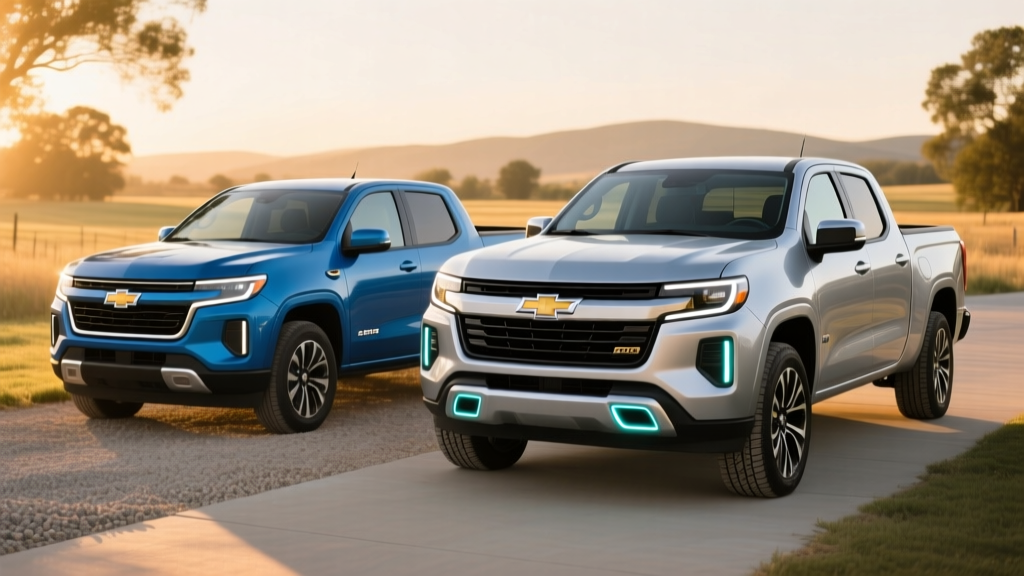
If you're searching for an electric Chevy Colorado, here's the reality as of 2026: Chevrolet does not currently produce a fully electric Colorado midsize pickup. GM's electric truck strategy centers on the full-size Chevrolet Silverado EV (built on the Ultium platform) and the compact Chevrolet Montana (sold in South America, not the US). For buyers committed to a midsize electric truck from the GM family, the closest option is the Silverado EV, which starts larger and heavier than the Colorado but delivers comparable utility with zero tailpipe emissions. An electric Colorado remains a possibility for future model years, but GM has not announced a production timeline.
What Chevy Actually Offers: The Silverado EV Lineup
Since no electric Chevy Colorado exists in showrooms, the Silverado EV is the practical alternative for buyers who want a battery-electric Chevrolet truck. For the 2026 model year, Chevy offers the Silverado EV in Work Truck (WT), LT, and RST trims, with two battery configurations.
| Spec | Silverado EV WT (Standard Range) | Silverado EV RST (Max Range) |
|---|---|---|
| EPA Range | ~280 miles | ~440 miles |
| Battery (usable) | ~100 kWh (NMC) | ~200 kWh (NMC) |
| Peak DC Fast Charge | 200 kW | 350 kW |
| 10–80% Charge Time | ~32 min | ~30 min |
| Level 2 Rate | 11.5 kW (up to 19.2 kW opt.) | 19.2 kW |
| Horsepower | 510 hp | 664 hp |
| 0–60 mph | ~5.0 sec | ~4.5 sec |
| Max Towing | 10,000 lbs | 10,000 lbs (12,000 opt.) |
| Payload | 1,400 lbs | 1,300 lbs |
| Base MSRP | ~$55,000 | ~$87,000 |
| Battery/Powertrain Warranty | 8 years / 100,000 miles | |
Real-world range caveat: The 440-mile EPA figure on the RST Max Range is achieved under mixed driving at moderate speeds. In sustained 75 mph highway driving, expect roughly 340–370 miles. In freezing temperatures (below 32°F), range drops 20–30%, meaning a winter highway trip may yield 240–280 usable miles before you need to stop. The 200 kWh battery pack is massive and heavy, which also impacts efficiency under load.
Silverado EV vs. Gas Colorado: Cost & Capability Compared
The gas-powered 2026 Chevy Colorado starts around $31,000 for a WT crew cab and tops out near $47,000 for a fully loaded ZR2 Bison. The Silverado EV is substantially more expensive upfront — but fuel and maintenance savings narrow the gap over time. Here's a five-year comparison assuming 15,000 miles per year.
| Cost Factor (5 Years) | Gas Colorado 4WD LT (~$40k) | Silverado EV WT (~$55k) |
|---|---|---|
| Purchase Price (before incentives) | $40,000 | $55,000 |
| Federal Tax Credit (§30D) | $0 | Up to $7,500* |
| Fuel / Electricity (5 yr) | $12,500 (21 MPG, $3.50/gal) | $3,800 (home charging @ $0.14/kWh) |
| Maintenance (5 yr) | $3,200 | $1,200 |
| Insurance (5 yr est.) | $7,500 | $9,500 |
| Estimated Depreciation | $16,000 | $22,000 |
| 5-Year Total Cost | $79,200 | $89,500 |
*§30D credit eligibility depends on buyer income caps ($150k single / $300k joint), vehicle MSRP caps ($80k for trucks), and battery component/critical mineral sourcing requirements. The Silverado EV WT may qualify; verify current eligibility at IRS.gov. Point-of-sale transfer is available from participating dealers.
Efficiency & Driving Economics
| Metric | Gas Colorado 4WD | Silverado EV WT |
|---|---|---|
| EPA Combined | 21 MPG | ~68 MPGe |
| Energy Cost per Mile | $0.167 | $0.051 (home) |
| DC Fast Charge Cost per Mile | N/A | $0.12–$0.18 (varies by network) |
| Oil Changes per Year | 2–3 | 0 |
| Regenerative Braking Pad Life | N/A | Brakes often last 100k+ mi |
The electric truck wins decisively on per-mile energy cost when charging at home. If you rely heavily on public DC fast charging ( Electrify America, EVgo), the per-mile cost roughly doubles to $0.10–$0.12, still below gasoline but less compelling. The key takeaway: home charging access is the single biggest variable in whether an electric Chevy truck saves you money.
Real-World Ownership: What First-Time EV Truck Buyers Must Know
Home Charging Setup Is Non-Negotiable for Truck Owners
The Silverado EV's 100–200 kWh battery makes Level 1 (120V) charging impractical — a full charge would take 4–7 days on a standard outlet. You need a Level 2 home charger (240V) to make daily ownership work.
| Item | Typical Cost Range |
|---|---|
| Level 2 Charger (40–48A, hardwired) | $400–$700 |
| Electrician Labor (40–60 ft run) | $800–$2,000 |
| Permit & Inspection | $100–$300 |
| Panel Upgrade (if needed, 200A service) | $1,500–$3,500 |
| Total (no panel upgrade) | $1,300–$3,000 |
| Total (with panel upgrade) | $2,800–$6,500 |
Important: The Silverado EV's optional 19.2 kW onboard charger requires a 100A circuit and an 80A+ charger. Most homes need a panel upgrade for this. The standard 11.5 kW charger works with a 60A circuit — far more common in existing homes. Budget for a licensed electrician to assess your panel before purchase.
Towing and Payload: The EV Truck Penalty
Towing with any electric truck dramatically reduces range. In real-world testing by multiple outlets, towing a 5,000–7,000 lb trailer cuts Silverado EV range by 40–50%. That 280-mile WT becomes a 140–170 mile truck with a loaded car hauler behind it. If you tow frequently over long distances, plan charging stops carefully — DC fast chargers along interstate corridors are improving, but gaps remain in rural areas.
The Silverado EV's 10,000-lb max towing rating is competitive with the gas Colorado's 7,700-lb rating, but the gas truck doesn't lose half its range while towing. For buyers who tow weekly, a gas or diesel Colorado remains the pragmatic choice. For occasional towing with daily commuting, the EV works well.
Cold-Weather Reality
Lithium-ion batteries lose efficiency in cold temperatures. The Silverado EV's liquid thermal management system helps, but owners in northern states should plan for 20–30% range reduction below freezing. The heat pump (standard on LT and RST trims) reduces cabin-heating energy draw compared to resistive heaters, but it doesn't eliminate the cold-weather penalty. Preconditioning the battery while plugged in before departure recovers some range and improves charge speeds.
Common Misconceptions About Electric Chevy Trucks
| Myth | Fact |
|---|---|
| "The electric Colorado is available now." | No electric Colorado exists as of 2026. GM's electric truck is the Silverado EV, a full-size platform. |
| "Electric trucks can't tow." | The Silverado EV tows up to 12,000 lbs. However, towing cuts range roughly in half — plan accordingly. |
| "Everyone gets the $7,500 tax credit." | §30D credit requires meeting income caps, MSRP caps ($80k for trucks), and battery sourcing rules. Not all trims qualify, and not all buyers qualify. Check IRS guidance. |
| "EV batteries need replacing every few years." | GM's Ultium battery warranty covers 8 years/100,000 miles against degradation below 70% capacity. Real-world data from GM's fleet shows most packs retain 85–90% after 100k miles. |
| "Public charging is unreliable everywhere." | Network reliability varies. Tesla Superchargers (now open to GM EVs via NACS adapter) consistently deliver 95%+ uptime. Electrify America and EVgo are improving but have more variability. Plan routes using PlugShare or A Better Routeplanner. |
| "An electric truck will power my house." | The Silverado EV offers available ProPower Onboard-style V2L (vehicle-to-load) for job-site tools and camping, but full V2H (vehicle-to-home) requires specific equipment and utility compatibility that is not yet widely deployed. |
Decision Framework: Should You Wait for an Electric Colorado or Buy Now?
Choose the Silverado EV Now If:
- You have Level 2 home charging (or can install it)
- Your daily driving is under 150 miles round-trip
- You tow occasionally (not weekly long-distance)
- You're comfortable with a full-size truck footprint
- You qualify for the §30D tax credit or your state offers EV incentives
- You want the lowest per-mile operating cost for commuting and light hauling
Stick With the Gas Colorado If:
- You live in an apartment or lack home charging access
- You regularly tow heavy trailers over 200+ miles
- You drive in remote areas with sparse DC fast-charging infrastructure
- You prefer a midsize truck footprint for trails and tight job sites
- Your budget tops out around $45,000
Wait for a Potential Electric Colorado If:
- You specifically need a midsize electric truck (no current option exists from any US automaker as of 2026 — the closest competitor is the upcoming next-gen Rivian R2 or a possible GM midsize EV pickup on a smaller Ultium platform)
- You're 1–2 years out from purchasing and can monitor announcements
Charging Infrastructure: Where Can You Actually Plug In a Silverado EV?
The 2026 Silverado EV uses the NACS (North American Charging Standard) connector natively, meaning direct access to Tesla's Supercharger network — the most reliable DC fast-charging infrastructure in the US with over 25,000 stalls. This is a major advantage over CCS-only vehicles.
| Level | Power | Miles Added per Hour | Use Case |
|---|---|---|---|
| Level 1 (120V) | 1.4 kW | ~4 mi/hr | Emergency only (impractical for this battery) |
| Level 2 (240V, 48A) | 11.5 kW | ~33 mi/hr | Daily home charging — full overnight refill |
| Level 2 (240V, 80A) | 19.2 kW | ~55 mi/hr | Faster home/work charging (requires panel capacity) |
| DC Fast (WT) | Up to 200 kW | ~580 mi/hr (peak) | Road trips; 10–80% in ~32 min |
| DC Fast (RST Max) | Up to 350 kW | ~1,000 mi/hr (peak) | Road trips; 10–80% in ~30 min (350 kW stall required) |
Charge curve reality: Peak kW rates are not sustained. The Silverado EV RST hits 350 kW only between roughly 10–30% State of Charge, then tapers progressively. The 10–80% time of ~30 minutes already accounts for this taper. Don't expect a sustained 350 kW for the entire session — no production EV delivers that. Also, 350 kW chargers remain uncommon outside major metro corridors; most public DC stalls deliver 150–200 kW in practice.
What a First-Time EV Truck Buyer Should Budget For
Beyond the sticker price, here's what new EV truck owners frequently underestimate:
- Home charger installation: $1,300–$6,500 depending on panel capacity
- Insurance premium increase: EV trucks typically cost 15–25% more to insure than gas equivalents due to higher repair costs and battery replacement risk. Get quotes before purchasing.
- Tire replacement: EV trucks are heavy (Silverado EV WT: ~8,400 lbs curb weight) and produce instant torque. Expect tire wear 15–20% faster than a gas truck. Budget $1,200–$1,800 for a set of EV-rated tires every 30,000–40,000 miles.
- Registration fees: Many states now impose additional EV registration fees ($50–$225/year) to offset lost gas tax revenue.
- Public charging costs: If you can't charge at home, DC fast charging at $0.35–$0.50/kWh brings per-mile cost to $0.12–$0.18 — still below gas, but no longer a dramatic savings.
Frequently Asked Questions
Will Chevy ever make an electric Colorado?
GM has not announced an electric Colorado as of 2026. The company has signaled interest in expanding its Ultium-based EV truck lineup, and a midsize electric pickup is a logical future product. However, no timeline, specs, or pricing have been released. If announced, expect it to be 12–18 months from reveal to showroom availability.
Is the Silverado EV too big to replace a Colorado?
It depends on your use case. The Silverado EV is a full-size truck at 233+ inches long with a 145-inch wheelbase — significantly larger than the Colorado (212 inches, 128-inch wheelbase). For tight trails, urban parking, and compact job sites, the Colorado's midsize footprint matters. For highway commuting, open-road towing, and bed capacity, the Silverado EV's size is an asset.
Can the Silverado EV qualify for the full $7,500 federal tax credit?
Potentially, but it depends on the trim and your personal tax situation. The WT trim (MSRP ~$55,000) falls under the $80,000 truck cap, but the RST Max Range (~$87,000) exceeds it and would not qualify. You must also meet income caps ($150,000 single / $300,000 joint modified AGI) and the vehicle must satisfy battery component and critical mineral sourcing requirements that change annually. Confirm eligibility via fueleconomy.gov and consult a tax professional.
How does the Silverado EV handle off-road compared to the Colorado ZR2?
The Colorado ZR2 with Multimatic DSSV dampers and front/rear locking differentials remains the more capable dedicated off-roader due to its lighter weight (4,800 lbs vs. 8,400+ lbs), shorter overhangs, and proven trail hardware. The Silverado EV's Trail Boss trim adds some off-road equipment, but the EV's weight works against it in sand, mud, and rock crawling. For serious off-road use, the gas Colorado ZR2 is still the tool for the job.
What happens if the Silverado EV battery degrades?
GM warrants the Ultium battery for 8 years/100,000 miles, covering defects and capacity loss below approximately 70% of original capacity. Real-world data from GM's commercial fleet (BrightDrop vans using the same Ultium architecture) suggests typical degradation of 5–10% over the first 100,000 miles. Out-of-warranty replacement for a 200 kWh pack would be extremely expensive — likely $20,000–$30,000+ — though prices are expected to decline as battery manufacturing scales. Most owners will trade or sell the truck before reaching this point.
Is an electric truck practical for a one-truck household?
It can be, with caveats. If your household has only one vehicle and you regularly take 400+ mile trips, tow heavy trailers long distances, or drive in areas with limited charging infrastructure, a gas truck (or a PHEV if one becomes available in the midsize segment) provides more flexibility. If your daily routine is predictable and within the truck's real-world range, and you can charge at home, an electric truck works well as a sole vehicle — but plan road trips around charging infrastructure using tools like A Better Routeplanner.