Quick Answer: Should You Buy an Electric Cat Boat?
If you're searching for an electric cat boat — an electrically powered catamaran — know this: the marine EV market in 2026 remains niche, expensive, and fundamentally different from buying an electric car. While a mainstream EV like the Tesla Model Y or Hyundai Ioniq 5 offers 270–320 miles of EPA range, DC fast charging in under 20 minutes, and a starting price around $40,000–$47,000, electric catamaran boats typically start above $150,000, deliver 20–60 nautical miles of range depending on speed, and rely on slow marina-based charging with no standardized fast-charging network. An electric cat boat is a compelling choice for calm-water day cruising, lake living, or eco-conscious waterfront homeowners with private dock charging — but it is not a practical replacement for a gas-powered boat if you need long offshore range, high speeds, or trailering flexibility.
At AutoEdgeView, we test and review electric vehicles — cars, SUVs, trucks, and occasionally the fringes of electrified transport. The "electric cat boat" keyword brings a unique crossover audience: EV-curious boaters and boat-curious EV owners wondering whether marine electrification has caught up to automotive electrification. The honest answer is that it hasn't — not yet. But there are specific use cases where an electric catamaran makes sense, and understanding those requires the same data-driven approach we apply to every EV we evaluate.
What Exactly Is an Electric Cat Boat?
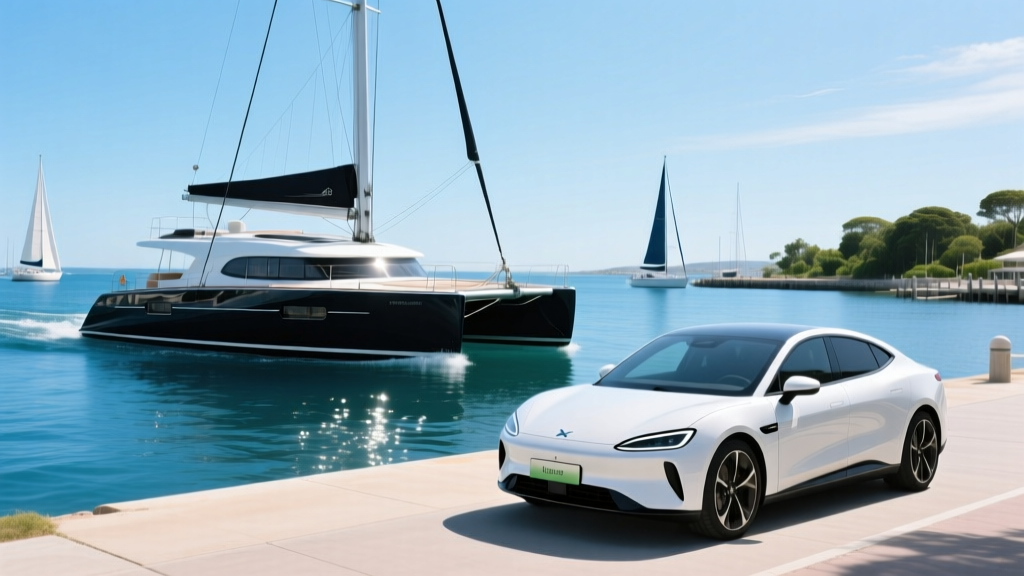
An electric cat boat (or electric catamaran) is a twin-hull watercraft powered by battery-electric motors rather than internal combustion engines. The catamaran hull design offers inherent stability, shallow draft, and wide deck space — characteristics that pair well with electric propulsion's quiet operation, zero direct emissions, and low vibration.
In 2026, the electric catamaran market includes several categories:
- Small day-cruisers (20–30 ft): Brands like Rand, Soel, and emerging Chinese manufacturers offer models starting around $80,000–$180,000, typically with 20–40 kWh battery packs and 5–15 kW electric motors.
- Luxury solar-assisted catamarans (40–60 ft): Builders like Silent Yachts produce solar-electric catamarans with 100–400 kWh battery banks, solar arrays generating 5–17 kW, and prices from $1.5M to over $5M.
- Electric ferry and water-taxi catamarans: Commercial operators in cities like Copenhagen, Sydney, and Vancouver have deployed electric cat ferries, but these are fleet purchases, not consumer products.
Unlike the automotive EV market, where the EPA tests and publishes standardized range and efficiency figures on fueleconomy.gov, there is no universal marine equivalent. Range claims from boat manufacturers are typically based on optimal conditions at low cruising speed and can drop dramatically with headwinds, current, payload, or higher throttle inputs.
Electric Cat Boat vs. Electric Car: A Numbers-First Comparison
The table below compares a representative 2026 electric catamaran day-cruiser against a mainstream 2026 electric SUV and a comparable gas-powered boat. The goal is to ground expectations in real data.
| Attribute | Electric Cat Boat (~28 ft) | 2026 Tesla Model Y LR (AWD) | Gas Pontoon Boat (~28 ft, 200 HP) |
|---|---|---|---|
| Starting Price | $120,000–$180,000 | ~$44,990 | $55,000–$75,000 |
| Energy Storage | 30–60 kWh (NMC lithium) | ~75 kWh usable (NMC) | ~60–80 gal gasoline (~2,000–2,700 kWh chemical energy) |
| Range | 20–50 nmi at 5–7 knots | 320 mi EPA (~270 mi real-world highway) | 150–250 nmi at cruising speed |
| Top Speed | 12–18 knots | 135 mph | 35–45 mph (~30–39 knots) |
| "Refuel" Time | 6–10 hrs (AC shore power, 3.3–7 kW) | ~18 min (10–80% at 250 kW DC) | 5 min (gas dock) |
| Energy Cost per Hour Cruising | $1.50–$4.00 (at $0.15/kWh) | N/A (road vehicle) | $15–$30 (at $4.00/gal marine gas) |
| Federal Tax Credit (§30D) | Not eligible (marine vessels excluded) | Up to $7,500 (subject to income, MSRP, and sourcing rules per IRS §30D) | Not eligible |
| Annual Maintenance | $500–$1,500 (bottom paint, systems check) | $300–$600 (tire rotation, cabin filter, fluid top-off) | $1,500–$3,000 (engine service, impeller, lower unit, winterization) |
The data makes the gap clear: electric catamarans cost 3–4x more than a comparable gas boat upfront, deliver a fraction of the range, and take hours to recharge. However, the per-hour operating cost is dramatically lower — roughly 80–90% cheaper on energy alone — and maintenance is minimal because electric motors have far fewer moving parts than marine gasoline or diesel engines.
Real-World Ownership: What Marine EV Life Actually Looks Like
Buying an electric cat boat in 2026 is nothing like buying a Tesla or a Ford F-150 Lightning. The infrastructure, support ecosystem, and daily realities are fundamentally different.
Charging Access Is Your Dock or Nothing
There is no marine equivalent of the Tesla Supercharger network or Electrify America. Charging an electric catamaran almost exclusively happens at your private dock or marina slip via standard AC shore power (typically 30-amp or 50-amp, 120V or 240V). At 240V/50A, you can pull roughly 7–10 kW, which will recharge a 40 kWh battery pack in 4–6 hours. At a standard 120V/30A dock outlet, expect 10–14 hours for the same pack.
If you don't own waterfront property with a private dock and electrical service, owning an electric catamaran is logistically impractical in 2026. Some forward-thinking marinas in places like Newport, RI, Miami, and Seattle are beginning to install higher-power shore connections, but DC fast charging for boats does not exist in any meaningful consumer-facing network.
Range Reality: Speed Kills Battery Life on Water
Just as highway driving at 80 mph slashes an EV car's range compared to the EPA city cycle, pushing an electric cat boat above its efficient displacement speed (typically 5–7 knots) causes energy consumption to spike exponentially. Water resistance increases with the cube of speed — doubling your speed requires roughly eight times the power.
A catamaran rated for 50 nautical miles at 5 knots might deliver only 15–20 nautical miles at 12 knots. Headwinds, current, and heavy passenger loads further reduce range. This physics reality is the marine equivalent of cold-weather range loss in EV cars — it's not a defect, it's the environment.
Climate and Seasonality
Battery chemistry matters on the water just as it does on the road. Most electric catamarans use NMC (nickel manganese cobalt) lithium cells, which experience reduced capacity and slower charge acceptance in cold water and air temperatures. If you boat in northern latitudes (the Great Lakes, New England, the Pacific Northwest), expect 15–25% range reduction in shoulder-season conditions (water temps below 50°F / 10°C). LFP (lithium iron phosphate) batteries — popular in some EVs like the base Tesla Model 3 for their longevity — are less common in marine applications due to their lower energy density, which matters more when weight and space are constrained on a boat.
The Real Costs: Purchase, Charging, Maintenance, and Insurance
Let's build a realistic 5-year ownership cost model for an electric cat boat versus a gas pontoon boat, assuming 100 hours of use per year (typical for a recreational boater).
| Cost Category (5-Year) | Electric Cat Boat (~28 ft, $150K) | Gas Pontoon (~28 ft, $65K) |
|---|---|---|
| Purchase Price | $150,000 | $65,000 |
| Federal Tax Credit | $0 (not eligible) | $0 |
| Energy/Fuel (100 hrs/yr × 5 yrs) | $1,250 (avg $2.50/hr electricity) | $11,250 (avg $22.50/hr gas) |
| Maintenance | $4,000 (bottom paint, system checks) | $12,500 (engine service, winterization, impeller, etc.) |
| Insurance (estimated) | $12,500 ($2,500/yr, specialty marine EV) | $7,500 ($1,500/yr) |
| Dock/Mooring (same for both) | $15,000 | $15,000 |
| Estimated Resale Value (Year 5) | –$60,000 (limited used market, battery health factor) | –$30,000 |
| Total 5-Year Net Cost | ~$122,750 | ~$81,250 |
The electric catamaran saves roughly $10,000 in energy and maintenance over five years, but the $85,000 higher purchase price and steeper depreciation (driven by a thin used market and buyer uncertainty about marine battery longevity) make the total cost of ownership significantly higher. This mirrors the early days of electric cars — the operating economics are favorable, but the upfront premium dominates the equation for most buyers.
One important note: marine insurance for electric boats is still evolving. Specialty underwriters may charge premiums 30–60% higher than equivalent gas boats due to limited actuarial data on marine battery replacement costs and repair complexity. Always get an insurance quote before purchasing.
Common Misconceptions About Electric Catamarans
| Myth | Fact |
|---|---|
| "Electric boats are silent, so they're better for wildlife." | True at low speeds, but electric cat boats still produce hull noise, wake, and propeller cavitation. The benefit is real but modest — primarily the elimination of exhaust and engine vibration in calm anchorages. |
| "Solar panels on the roof make it self-charging." | Solar-assisted catamarans (like Silent Yachts) typically generate 3–17 kW from roof arrays. That adds 5–15 nautical miles of range per sunny day at low speed — useful for extending range but far from self-sufficient for active cruising. |
| "The battery will need replacing like a phone." | Marine-grade NMC battery packs are designed for 3,000–5,000 charge cycles before degrading to ~80% capacity. With typical recreational use (50–100 cycles/year), that's 30–50 years of service before significant degradation. However, replacement cost if needed is $20,000–$50,000+. |
| "I can charge at any marina." | Most marinas offer 30A or 50A shore power intended for onboard AC and battery tenders, not full traction-battery recharges. You'll need a dedicated, properly wired connection and the marina's permission to draw sustained high current. |
| "Electric boats qualify for the $7,500 EV tax credit." | They do not. The IRS §30D clean vehicle credit applies to on-road motor vehicles meeting specific MSRP, income, and battery-sourcing requirements. Marine vessels are excluded. |
Decision Framework: Is an Electric Cat Boat Right for You?
Choose an Electric Catamaran If:
- You own waterfront property with a private dock and can install a dedicated 240V/50A shore-power connection.
- Your typical outing is under 30 nautical miles round-trip at displacement speed (5–7 knots) — day cruising, lake loops, or harbor hopping.
- You value quiet, vibration-free operation and zero exhaust emissions at anchor or in sensitive waterways.
- You have a budget above $120,000 and view the boat as a lifestyle investment rather than a cost-optimized purchase.
- You boat in warm or temperate climates where battery cold-weather losses are minimal.
Stick With a Gas or Diesel Boat If:
- You need range over 50 nautical miles or cruise at planing speeds (20+ knots) regularly.
- You trailer your boat to different launch ramps — electric catamarans are heavy and charging at a ramp parking lot is not feasible.
- You boat in remote areas without reliable shore-power infrastructure.
- Your budget is under $80,000 — the gas or diesel market offers far more options at this price point.
- You need high speed for water sports — wakeboarding, skiing, or fast offshore runs demand the energy density of liquid fuel.
Consider a Hybrid or Solar-Assisted Catamaran If:
- You want some electric-only capability for quiet anchoring and harbor maneuvering but need a diesel or gasoline generator for extended range. Some builders offer series-hybrid catamarans with a diesel range extender — the marine equivalent of a BMW i3 REx or a Chevrolet Volt's architecture.
What First-Time EV Buyers (Car or Boat) Should Know
Whether you're evaluating your first electric car or your first electric catamaran, the foundational principles of EV ownership are the same:
- kW vs. kWh — know the difference. kW (kilowatts) measures power — how fast you can charge or how strong the motor is. kWh (kilowatt-hours) measures energy — how much the battery holds. A 40 kWh battery charged at 5 kW takes 8 hours to fill. Confusing these two is the single most common mistake new EV owners make.
- Sticker range is not real-world range. Whether it's an EPA estimate on a car or a manufacturer claim on a boat, expect to lose 15–30% of rated range in demanding conditions (high speed, cold weather, headwinds, heavy load). Plan your trips around 70% of the stated range for a safety margin.
- Home charging access is non-negotiable. For cars, a Level 2 home charger (240V, 32–48A, $500–$2,000 installed) makes daily EV ownership effortless. For boats, a dedicated shore-power connection at your dock is the equivalent. Without it, ownership becomes a chore.
- Battery warranties matter. Automotive EVs typically carry 8-year/100,000-mile battery warranties guaranteeing 70%+ capacity retention. Marine battery warranties are less standardized — some builders offer 2–5 years on the battery pack. Get the warranty terms in writing and understand what capacity threshold triggers a claim.
- The used market is thin. Just as early EVs like the Nissan Leaf suffered steep depreciation due to battery degradation fears, used electric boats have an extremely limited resale market in 2026. If you plan to sell in 3–5 years, budget for significant depreciation.
Frequently Asked Questions
Can I get a federal tax credit for buying an electric cat boat?
No. The IRS §30D Clean Vehicle Credit applies only to qualifying on-road motor vehicles (cars, trucks, SUVs, vans) that meet MSRP caps ($55,000 for sedans, $80,000 for SUVs/trucks/vans), buyer income limits ($150K single / $300K joint for new vehicles), and battery component/critical mineral sourcing requirements. Marine vessels are explicitly outside the scope of this credit. Some states or local clean-water initiatives may offer rebates for electric marine equipment — check with your state energy office.
How long do electric catamaran batteries last?
Marine-grade NMC lithium battery packs are typically rated for 3,000–5,000 full charge cycles to 80% state of health. At recreational use levels (50–100 cycles per year), that translates to 30+ years before significant capacity loss. However, calendar aging, thermal exposure, and improper storage (leaving the battery at 100% or 0% state of charge for extended periods) can accelerate degradation. Store your electric cat boat's battery at approximately 50% state of charge during off-season layup.
What happens if I run out of battery on the water?
Unlike a gas boat that can receive a fuel delivery from a tow boat, an electric catamaran with a depleted battery must be physically towed back to a charging source. Marine assistance services (like Sea Tow or BoatUS) can tow you, but it's an expensive inconvenience. Always maintain a 20–30% battery reserve — the same "buffer" discipline EV car drivers use to avoid stranding.
Are electric cat boats faster or slower than gas boats?
Significantly slower in most cases. Electric catamarans are optimized for efficiency at displacement speeds (5–8 knots). While some performance-oriented electric boats exist, the energy density of batteries (roughly 250 Wh/kg for NMC cells) is vastly lower than gasoline (~12,000 Wh/kg effective), making high-speed planing impractical without enormous, heavy, and expensive battery packs.
Should I wait for better electric catamaran technology?
The marine EV sector is advancing, but slowly compared to automotive. Solid-state batteries (promising 2x energy density) remain in development and are not expected in marine applications before 2028–2030 at the earliest. If your use case fits today's electric catamarans — short, quiet, clean day cruising from a private dock — the current generation is capable. If you need more range or speed, waiting or choosing a hybrid system is the pragmatic move.