Quick Answer: Electric Bikes vs Electric Cars for Adults
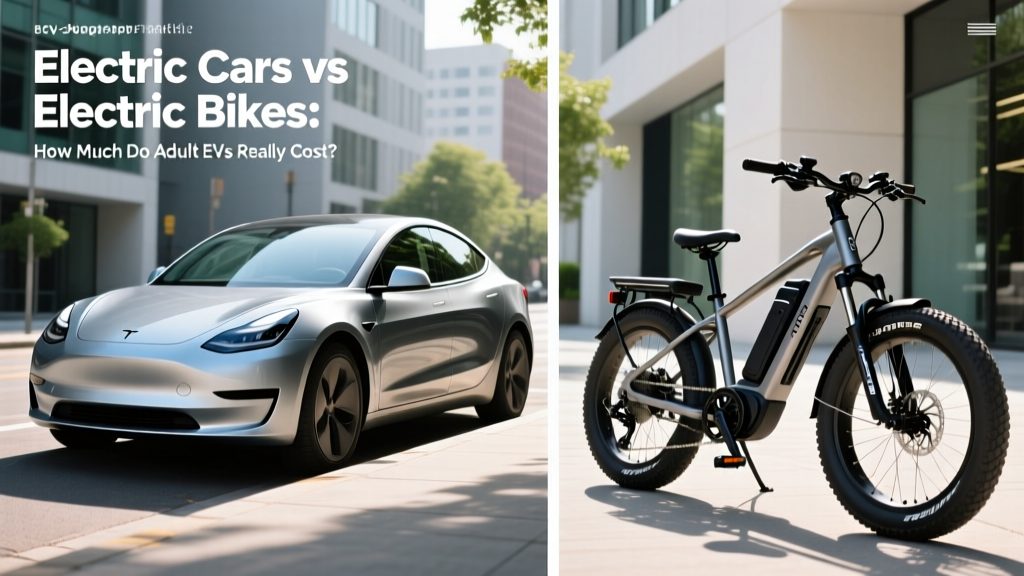
If you searched "how much are electric bikes for adults," here's the short version: a quality adult e-bike costs $1,200–$4,500 upfront, with annual operating costs around $50–$150. A new electric car in 2026 starts around $29,000–$38,000 before incentives, with annual electricity costs of $500–$900 for typical driving. But comparing the two isn't apples-to-apples — they solve different transportation problems. Below, we break down the real numbers so you can decide which electrified option fits your commute, budget, and lifestyle.
Why This Comparison Matters in 2026
AutoEdgeView focuses on electric and smart vehicles — and while our core expertise is EVs and PHEVs, we know many readers researching their first electrified purchase land on e-bikes as a potential alternative or complement to a car. The e-bike market has exploded, with U.S. e-bike sales surpassing electric car sales by unit volume since 2022. So let's put the numbers side by side honestly, including where an e-bike wins, where it falls short, and where an EV is the only practical choice.
Upfront Purchase Costs: E-Bike vs EV
| Category | Adult E-Bike (2026) | Compact EV (2026) |
|---|---|---|
| Budget Tier | $800–$1,500 | $29,000–$33,000 (e.g., Nissan LEAF, Chevy Equinox EV base) |
| Mid-Range | $1,500–$3,000 | $35,000–$45,000 (e.g., Tesla Model 3 RWD, Hyundai Ioniq 5) |
| Premium | $3,000–$8,000+ | $50,000–$80,000+ (e.g., BMW iX, Rivian R1S) |
| Federal Tax Credit | Not eligible (§30D applies to 4-wheeled MVs only) | Up to $7,500 via IRS §30D — subject to MSRP, income, and battery-sourcing caps |
| State/Local Incentives | Some cities offer $300–$1,500 e-bike rebates | Varies by state (check AFDC state incentive database) |
| Sales Tax (avg ~7%) | $84–$315 on a $1,200–$4,500 bike | $2,030–$2,660 on a $29,000–$38,000 EV |
Critical note on the §30D credit: As of 2026, the IRS clean vehicle credit requires the vehicle to have four wheels, meet MSRP caps ($55,000 for sedans, $80,000 for SUVs/trucks), buyer income limits ($150K single / $300K joint), and critical-mineral/battery-component sourcing thresholds. E-bikes do not qualify. Always confirm eligibility with a tax professional before purchasing.
Operating Costs: Electricity, Maintenance, and Insurance
| Annual Cost Factor | Adult E-Bike | Compact EV | Comparable Gas Car |
|---|---|---|---|
| Energy/Fuel (10,000 mi/yr equivalent) | $30–$80 (0.5–1.5 kWh/mi at $0.16/kWh avg) | $480–$720 (3–4 mi/kWh × $0.16/kWh) | $1,200–$1,600 (28 MPG avg × $3.50/gal) |
| Maintenance | $100–$250 (tires, brake pads, chain, tune-up) | $300–$500 (tire rotation, cabin filter, wipers, brake fluid) | $600–$1,000 (oil changes, filters, belts, brakes) |
| Insurance | $0–$300 (optional; often covered under homeowner's/renter's) | $1,400–$2,200 (EV premiums run ~15–25% higher than gas equivalents) | $1,100–$1,700 |
| Registration/Licensing | $0 (Class 1–3 e-bikes require no registration in most states) | $100–$400/year (varies by state; some states reduce EV registration fees) | $100–$400/year |
| Parking | $0 (bike racks, indoor storage) | $0–$2,400+ (urban garage/parking costs) | $0–$2,400+ |
| Estimated Annual Total | $130–$630 | $2,280–$5,820 | $3,000–$6,100 |
The e-bike's operating cost advantage is massive — but only for trips it can actually replace. If your commute is 8 miles round-trip on bike-friendly roads, an e-bike can realistically replace 70–80% of car trips. If you commute 40 miles each way on a highway, it can't replace any of them.
Range and Practicality: Where Each Option Fits
Real-World Range Reality Check
E-Bike (500 Wh battery): Manufacturer claims of 40–60 miles per charge assume flat terrain, light pedal assist, and a 150-lb rider. Real-world range with throttle-heavy riding, hills, cargo, or cold weather: 20–35 miles.
Compact EV (60–75 kWh battery): EPA-rated 250–320 miles. Real-world highway driving at 70+ mph: 200–260 miles. Cold weather (below 30°F): expect a further 15–30% reduction, dropping to 150–220 miles.
This is where the comparison becomes about use-case, not just price:
- E-bike excels at: Urban/suburban commutes under 15 miles, grocery runs with panniers or cargo racks, avoiding traffic and parking, fitness with assist, last-mile transit connections
- EV excels at: Highway commuting, trips over 20 miles, passenger transport (kids, carpool), cargo (furniture, large groceries), extreme weather, long-distance road trips, towing
5-Year Total Cost of Ownership
| 5-Year Cost | E-Bike (Mid-Range $2,500) | Compact EV ($36,000 MSRP, $7,500 credit) | Gas Car ($30,000 MSRP) |
|---|---|---|---|
| Purchase (after incentives) | $2,500 | $28,500 | $30,000 |
| Energy/Fuel (5 yrs) | $275 | $3,000 | $7,000 |
| Maintenance (5 yrs) | $875 | $2,000 | $4,000 |
| Insurance (5 yrs) | $750 | $9,000 | $7,000 |
| Registration (5 yrs) | $0 | $1,250 | $1,250 |
| Battery Replacement Reserve | $400–$800 (replacement at year 4–6) | Covered under 8-yr/100,000-mi federal warranty | N/A |
| 5-Year Total | ~$4,800 | ~$43,750 | ~$49,250 |
| Cost Per Mile (50,000 mi) | ~$0.10/mi (for miles actually ridden) | ~$0.88/mi | ~$0.99/mi |
The e-bike's total cost is dramatically lower — but notice the caveat: "for miles actually ridden." An e-bike can't accumulate 50,000 miles of utility in the same way a car can. If you still need a car for weekend trips, bad weather, and hauling, the e-bike becomes a supplement, not a replacement, and you'll still own or lease a vehicle alongside it.
Common Misconceptions: E-Bikes and EVs
| Myth | Fact |
|---|---|
| "E-bikes don't need charging infrastructure" | True for most — you charge from any standard 120V outlet (Level 1 equivalent). A full charge on a 500 Wh battery takes 3–5 hours. But apartment dwellers without indoor storage or outlet access face real challenges. |
| "An e-bike can fully replace my car" | For ~15% of U.S. households with short, flat, bikeable commutes and no kids/cargo needs — maybe. For most, it replaces 30–60% of trips. Plan accordingly. |
| "EVs are too expensive for regular people" | With the §30D credit (up to $7,500), point-of-sale transfer, and models like the 2026 Chevy Equinox EV starting at ~$33,000, effective prices can drop below $26,000 — competitive with gas equivalents once fuel savings are factored in. |
| "E-bike batteries last forever" | Most e-bike lithium-ion batteries degrade noticeably after 500–800 charge cycles (roughly 3–5 years of daily use). Replacement costs $400–$900. EV traction batteries are far more durable — most are warrantied for 8 years/100,000 miles at 70%+ capacity retention. |
| "Charging an EV takes too long" | Home Level 2 charging (7–11 kW) adds 25–44 miles per hour of charging — most owners wake up to a full battery every morning. DC fast charging at 150–250 kW can take a pack from 10–80% in 18–30 minutes on modern platforms. |
Decision Framework: E-Bike, EV, or Both?
Choose an E-Bike (as your primary vehicle) IF:
- Your daily round-trip commute is under 20 miles on bike-friendly roads
- You live in a mild climate (few days below 30°F or above 95°F)
- You have no children requiring car seats or school drop-offs
- You have secure indoor storage with access to a standard outlet
- Your total household budget for transportation is under $5,000
- You already have access to a car (car-share, partner's vehicle) for the 20–30% of trips an e-bike can't handle
Choose an EV IF:
- Your commute exceeds 20 miles round-trip or involves highways
- You regularly carry passengers or large cargo
- You live in an area with harsh winters, extreme heat, or frequent rain
- You take road trips of 100+ miles more than a few times per year
- You have (or can install) home Level 2 charging — a 240V/40A circuit costs $500–$2,000 to install depending on panel capacity and run length
- You qualify for the §30D credit, bringing effective pricing close to gas-car equivalents
Choose BOTH (e-bike + EV) IF:
- You want to minimize car wear, parking stress, and fuel costs for daily short trips
- You have a two-car household and can replace one gas car with an e-bike while replacing the other with an EV
- Your city has protected bike lanes and secure workplace bike parking
- You want the combined 5-year cost to remain under $50,000 total for both vehicles
What First-Time Electrified Buyers Should Know
If you're buying an e-bike:
- Motor type matters: Mid-drive motors ($2,000+) handle hills better than hub motors (common under $1,500).
- Battery Wh (watt-hours) = range: A 400 Wh battery gives ~20–30 real miles; a 700 Wh battery gives ~35–50 real miles.
- Class 1 vs Class 2 vs Class 3: Class 1 (pedal-assist to 20 mph) and Class 2 (throttle to 20 mph) are legal on most bike paths. Class 3 (assist to 28 mph) may be restricted from some paths — check local regulations.
- Budget for security: A quality U-lock and/or GPS tracker ($50–$200) is non-negotiable. E-bike theft is rampant.
If you're buying an EV:
- Home charging is the foundation: 80%+ of EV charging happens at home. Budget $500–$2,000 for a Level 2 charger installation (240V, 40–48A circuit). If your electrical panel is at capacity, a panel upgrade adds $1,500–$3,500 — get a licensed electrician's quote before buying.
- EPA range vs real-world: Always plan around 75–85% of the EPA sticker for highway driving, and 60–70% in freezing temperatures. A 300-mile EPA rating means ~225 real highway miles in winter.
- Charging speed (kW) determines road-trip viability: Vehicles with peak DC fast-charge rates of 150+ kW (10–80% in ~25 min) make road trips practical. Below 100 kW peak, expect 35–45 minute stops.
- Verify §30D eligibility before committing: Check the fueleconomy.gov tax credit database for your specific model and trim, and confirm your income, the vehicle's MSRP, and battery-sourcing compliance.
Frequently Asked Questions
How much does it cost to charge an e-bike per month?
At the U.S. average electricity rate of ~$0.16/kWh (per EIA data), charging a 500 Wh e-bike battery daily costs about $2.40/month. Even with daily commuting, annual e-bike electricity costs typically stay under $80.
How much does it cost to charge an EV per month?
Driving 1,000 miles/month in an EV averaging 3.5 mi/kWh requires ~286 kWh. At $0.16/kWh (home charging), that's ~$46/month. Public DC fast charging is more expensive — typically $0.30–$0.50/kWh, raising costs to $85–$143/month if you rely exclusively on public chargers.
Can I use a regular outlet to charge an EV?
Yes — Level 1 charging on a standard 120V/15A outlet adds roughly 3–5 miles of range per hour. For a 300-mile battery, a full charge takes 60–100 hours. It works for overnight top-ups if you drive under 30 miles/day, but Level 2 (240V) is strongly recommended for practical daily ownership.
Do e-bikes qualify for any tax credits?
Not at the federal level — the §30D clean vehicle credit applies only to four-wheeled motor vehicles. However, some states and municipalities offer e-bike purchase rebates (typically $300–$1,500). Check your local transportation authority or AFDC state incentive database.
How long do e-bike and EV batteries last before replacement?
E-bike batteries typically show noticeable degradation after 500–800 full charge cycles (3–5 years of daily use), with replacement costing $400–$900. EV traction batteries are engineered for far greater longevity — most manufacturers warranty them for 8 years or 100,000 miles at 70%+ capacity retention, and real-world data shows many lasting 150,000–200,000+ miles before needing replacement. EV battery replacement costs range from $5,000–$20,000 depending on the pack, but this is rarely needed within typical ownership periods.
Is an e-bike or EV better for the environment?
Both dramatically reduce tailpipe emissions compared to gas vehicles. An e-bike's smaller battery (0.4–0.7 kWh) requires far fewer raw materials to manufacture and uses ~95% less electricity per mile than an EV. However, an EV replacing a gas car eliminates 4–5 tons of CO₂ annually for a typical driver. The biggest environmental win is replacing gas-powered trips with any electric option — whether that's an e-bike for your 5-mile commute or an EV for your 40-mile one.
Sources: fueleconomy.gov (EPA range/efficiency data), IRS §30D clean vehicle credit guidelines, Alternative Fuels Data Center (state incentive data), U.S. EIA electricity pricing.