The Quick Answer on Electric Cars Efficiency
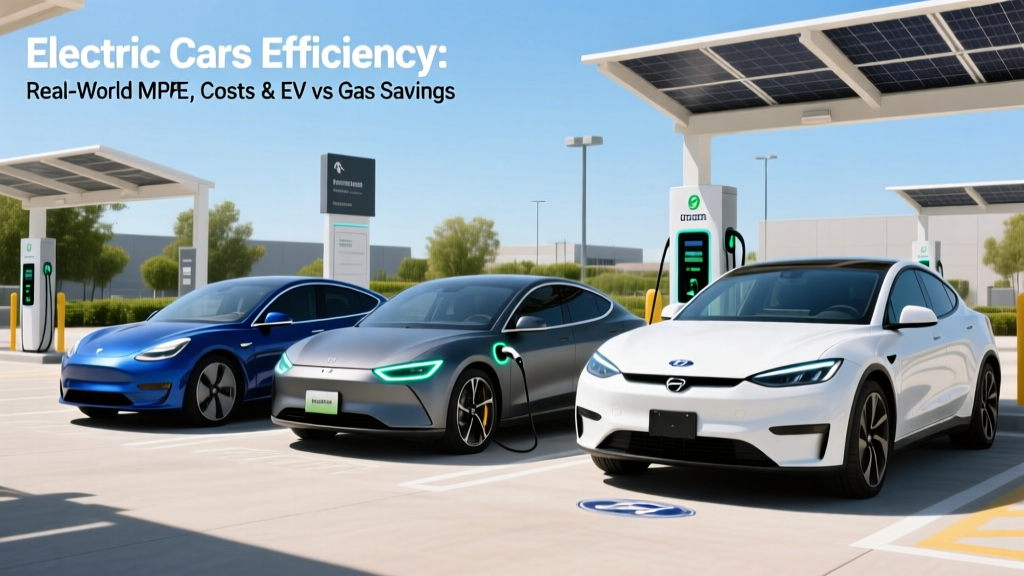
Electric cars efficiency is measured in MPGe (miles per gallon equivalent) and kWh/100mi. The most efficient 2026 EVs — like the Hyundai Ioniq 6 (140 MPGe combined, 25 kWh/100mi) and Tesla Model 3 Rear-Wheel Drive (132 MPGe combined, 25 kWh/100mi) — convert roughly 85–90% of battery energy to forward motion, compared to just 20–30% for gasoline engines. In real terms, an efficient EV costs $0.04–$0.06 per mile on home Level 2 charging versus $0.12–$0.16 per mile for a 28 MPG gas car at $3.50/gallon. Efficiency determines not just range but your daily operating cost — and it varies dramatically by model, driving style, and climate.
How MPGe and kWh/100mi Actually Work
MPGe is the EPA's translation layer: it equates 33.7 kWh of electricity to one gallon of gasoline, letting you compare EVs and gas cars on a familiar scale. But kWh/100mi is the more useful metric for EV owners because it directly tells you what you'll pay to drive. Lower kWh/100mi means better efficiency — just like higher MPG in a gas car.
For example, a vehicle rated at 25 kWh/100mi consuming electricity at the U.S. average residential rate of $0.165/kWh (U.S. EIA, 2025 data) costs $4.13 per 100 miles. A 30 kWh/100mi vehicle costs $4.95 per 100 miles. Over 15,000 annual miles, that's a $123/year gap between the two — modest, but it compounds over ownership.
| Vehicle | Powertrain | MPGe / MPG Combined | kWh/100mi or gal/100mi | Cost per 100 mi* |
|---|---|---|---|---|
| Hyundai Ioniq 6 SE LR | BEV | 140 MPGe | 25 kWh/100mi | $4.13 |
| Tesla Model 3 RWD | BEV | 132 MPGe | 25 kWh/100mi | $4.13 |
| Lucid Air Pure | BEV | 137 MPGe | 25 kWh/100mi | $4.13 |
| Chevrolet Equinox EV 2LT | BEV | 112 MPGe | 31 kWh/100mi | $5.12 |
| Ford F-150 Lightning XLT | BEV | 70 MPGe | 49 kWh/100mi | $8.09 |
| Toyota Camry LE (gas) | ICE | 32 MPG | 3.13 gal/100mi | $10.96 |
| Toyota RAV4 (gas AWD) | ICE | 30 MPG | 3.33 gal/100mi | $11.66 |
*EV cost based on $0.165/kWh U.S. residential average; gas cost based on $3.50/gal. Actual costs vary by utility rate and local fuel prices. Source: fueleconomy.gov
What Determines Real-World EV Efficiency
The EPA sticker is a starting point. Your actual kWh/100mi depends on five variables that can swing efficiency by 20–40%:
Speed and Aerodynamic Drag
EVs lose efficiency steeply at highway speeds because aerodynamic drag increases with the square of velocity. An Ioniq 6 rated at 25 kWh/100mi combined might see 28–30 kWh/100mi at a sustained 75 MPH, but only 20–22 kWh/100mi in city driving where regen braking recovers energy. This is the opposite of gas cars, which typically achieve better MPG on the highway.
Cold Weather Impact
Battery chemistry slows in cold temperatures, and cabin heating draws significant power. Expect 20–35% efficiency loss at 20°F compared to 70°F ambient. A vehicle rated at 25 kWh/100mi can climb to 32–34 kWh/100mi in deep winter. EVs with heat pumps — standard on most 2026 Hyundai, Kia, and Tesla models — recover some of this loss by moving heat rather than generating it resistively, typically limiting the penalty to 15–25%.
Tire Selection and Pressure
Low-rolling-resistance (LRR) tires can improve efficiency by 3–7% over all-terrain or performance summer tires. Tire pressure matters too: every 5 PSI below recommended can cost 1–2% in efficiency. This is a frequently overlooked ownership variable.
Payload and Towing
EV trucks like the F-150 Lightning see efficiency plummet under load. Unladen, the Lightning posts roughly 49 kWh/100mi (70 MPGe). Towing a 5,000-lb trailer can push that to 80–100 kWh/100mi, effectively halving range. This is a critical consideration for truck buyers.
Driving Style and Regen Usage
Aggressive acceleration and heavy braking waste energy. Drivers who use one-pedal driving and regen braking effectively in city traffic can beat EPA estimates by 5–10%, while lead-foot highway drivers can undershoot by 15% or more.
Common EV Efficiency Misconceptions
| Myth | Fact |
|---|---|
| "All EVs are equally efficient — they're all electric." | Efficiency varies by 2x across the market. The Ioniq 6 uses 25 kWh/100mi; the GMC Hummer EV uses 53+ kWh/100mi. Weight, aero, and powertrain design matter enormously. |
| "Highway driving gives the best range." | The opposite is true for EVs. City driving with regen braking is more efficient. Highway driving at 70+ MPH is where EVs lose the most efficiency relative to their EPA rating. |
| "MPGe tells me what I'll spend." | MPGe is a comparison tool. To calculate actual cost, use kWh/100mi × your local electricity rate. MPGe doesn't account for regional utility pricing differences. |
| "EVs are always cheaper to fuel than gas cars." | On home charging at average rates, yes — typically 50–65% cheaper per mile. On DC fast charging at $0.40–$0.55/kWh, an inefficient EV can cost as much or more per mile than a 35 MPG gas car. Home charging access is the economic linchpin. |
| "Cold weather destroys EVs." | Cold reduces range 20–35%, but preconditioning (warming the battery while plugged in) and heat pumps mitigate this. Most 2026 EVs handle winter well with planning — the range loss is real but manageable for daily commutes. |
The Real Cost of Ownership: EV vs. Gas
Efficiency only matters in the context of total cost. Here's a 5-year breakdown comparing a 2026 Tesla Model 3 RWD ($38,990 MSRP before incentives) against a comparably equipped 2026 Toyota Camry LE ($29,995 MSRP), assuming 15,000 miles/year and a mix of 80% home / 20% public charging:
| Cost Category | Tesla Model 3 RWD | Toyota Camry LE |
|---|---|---|
| MSRP (base) | $38,990 | $29,995 |
| Federal tax credit (§30D, if eligible) | −$7,500 (point-of-sale) | $0 |
| Effective purchase price | $31,490 | $29,995 |
| 5-year fuel/energy cost | $3,300 (home + public mix) | $8,250 (at 32 MPG, $3.50/gal) |
| 5-year maintenance | ~$1,200 (cabin filter, wipers, brake fluid) | ~$3,500 (oil, filters, brakes, trans fluid) |
| 5-year insurance (national avg.) | ~$9,500 | ~$7,200 |
| Estimated 5-year depreciation | ~$14,000 | ~$11,000 |
| 5-Year Total | $60,490 | $59,945 |
Notes: Tax credit eligibility depends on income caps ($150K single / $300K joint), MSRP caps ($55K sedans), and battery sourcing requirements per IRS §30D rules. Insurance premiums vary significantly by driver, state, and insurer. Depreciation estimates based on current market trends. Actual costs vary.
The takeaway: even with higher insurance and depreciation, the Model 3 nearly matches the Camry on 5-year total cost — and delivers dramatically better performance (0-60 in 5.8 seconds vs. 7.6), lower emissions, and a quieter, tech-forward cabin. The efficiency gap drives the energy-cost advantage: the Model 3 at 25 kWh/100mi saves roughly $4,950 in fuel over five years compared to the Camry at 32 MPG.
When EV Efficiency Translates to Real Savings
Not every buyer benefits equally. Your savings depend on three structural factors:
Home Charging Access
This is the single biggest variable. Home Level 2 charging at $0.12–$0.20/kWh delivers 50–65% savings over gasoline. Without home charging and relying entirely on DC fast charging at $0.40–$0.55/kWh, the per-mile cost can equal or exceed a fuel-efficient gas car. If you can install a Level 2 home charger (typically $500–$1,800 including equipment and electrician), the economics strongly favor an EV.
Annual Mileage
Higher mileage amplifies the efficiency advantage. At 20,000+ miles/year, the fuel savings can reach $2,000–$3,000 annually versus a 28 MPG gas car. At 8,000 miles/year, the savings drop to $600–$900/year — still meaningful, but it takes longer to offset any price premium.
Climate Zone
Mild climates (California coast, Southeast) let EVs operate near peak efficiency year-round. In cold regions (Upper Midwest, Northeast), the 20–35% winter efficiency penalty reduces annual savings. A heat-pump-equipped EV in Minnesota might average 29 kWh/100mi annually versus 25 kWh/100mi in San Diego — still cheaper than gas, but the gap narrows.
EV vs. Hybrid vs. Gas: Decision Framework
Efficiency alone doesn't dictate the right powertrain. Use this framework:
Choose a BEV (Full Electric) If:
- You have reliable home Level 2 charging (or can install it)
- Your daily driving is under 250 miles (well within one-charge range of most 2026 EVs)
- You want the lowest per-mile operating cost and minimal maintenance
- You drive 12,000+ miles/year (higher mileage = faster payback on the EV premium)
- Examples: Tesla Model 3 (132 MPGe, 363 mi EPA), Hyundai Ioniq 6 (140 MPGe, 361 mi EPA)
Choose a PHEV (Plug-In Hybrid) If:
- You have home charging but also take frequent 300+ mile road trips
- You want electric-only commuting (25–45 mi range) without range anxiety
- Your household has only one vehicle and needs maximum flexibility
- Examples: Toyota RAV4 Prime (38 mi electric, 94 MPGe / 38 MPG gas), Jeep Wrangler 4xe (22 mi electric)
Choose a Gas HEV (Standard Hybrid) If:
- You cannot install home charging (apartment, street parking)
- You want maximum efficiency without any plug-in behavior change
- You live in an area with sparse public charging infrastructure
- Examples: Toyota Prius (57 MPG combined), Honda Accord Hybrid (48 MPG combined)
Stick with Gas (ICE) If:
- You drive under 8,000 miles/year (savings won't offset an EV premium)
- You need heavy towing capacity regularly (EV trucks lose range dramatically under load)
- You live in a remote area with no DC fast charging access and no home charging option
First-Time EV Buyer: What to Know About Efficiency
If you're transitioning from a gas car, these are the practical efficiency realities that spec sheets don't emphasize:
Plan for 75–80% of EPA range on highway road trips. The EPA test cycle includes city driving with regen. At 70+ MPH sustained, expect an efficient sedan to deliver 80–85% of its sticker range, and an SUV or truck closer to 70–75%. A Model 3 with 363 mi EPA will realistically deliver 290–310 mi on a highway trip at 75 MPH in moderate weather.
Charging speed matters more than peak range for road trips. A car with 300 mi range that charges at 250 kW (10–80% in ~18 min) is more practical for road-tripping than a 400 mi range car limited to 150 kW (10–80% in ~32 min). The Hyundai Ioniq 5 and Kia EV6, with their 800V architecture and 240+ kW peak charging, exemplify this — slightly less range than some competitors but meaningfully faster stops.
Preconditioning is not optional for fast charging. Most 2026 EVs will warm the battery when you navigate to a DC fast charger, enabling peak charge rates. Without preconditioning, a cold battery might accept only 50–80 kW instead of its rated 200+ kW, doubling your charge time. Always use the car's built-in navigation to route through chargers.
The charge curve tapers hard above 80%. That 250 kW peak rate typically sustains only between 10–50% State of Charge. From 80–100%, speeds can drop to 20–40 kW. On road trips, charge to 80% and go — the last 20% takes as long as the first 60%.
Frequently Asked Questions
What is the most efficient electric car in 2026?
The Hyundai Ioniq 6 SE Long Range leads at 140 MPGe combined (25 kWh/100mi), followed closely by the Lucid Air Pure at 137 MPGe and the Tesla Model 3 RWD at 132 MPGe. All three achieve roughly 25 kWh/100mi, meaning they use about $4.13 per 100 miles at the national average electricity rate.
Do electric cars lose efficiency over time as the battery degrades?
No — battery degradation reduces total capacity (kWh stored), which reduces range, but the car's efficiency (kWh/100mi) stays largely constant. A 5-year-old EV with 8% battery degradation will have 8% less range but will still convert energy to miles at the same rate. Typical degradation for NMC batteries is 10–15% over 8 years; LFP batteries (used in Tesla Model 3 RWD, some BYD models) degrade more slowly at 5–10% over the same period.
Is it more efficient to charge an EV at home or at a public DC fast charger?
Home Level 2 charging is slightly more efficient because DC fast charging involves AC-to-DC conversion losses at the charger (typically 5–10% energy lost as heat) plus battery thermal management overhead. Home Level 2 charging is also 60–80% cheaper per kWh. For both efficiency and cost, home charging is superior — use DC fast charging for road trips and occasional top-ups, not as your primary method.
How does EV efficiency compare to a hybrid like the Prius?
A 2026 Toyota Prius achieves 57 MPG combined, which translates to roughly $6.14 per 100 miles at $3.50/gallon. An efficient EV at 25 kWh/100mi costs $4.13 per 100 miles on home charging — about 33% cheaper. However, the Prius requires no charging infrastructure and delivers consistent efficiency regardless of climate or charging access. For apartment dwellers without home charging, the Prius hybrid may be the more practical efficiency choice.
Does the federal tax credit change the efficiency cost equation?
The §30D credit doesn't change efficiency, but it dramatically changes the purchase economics. A $7,500 point-of-sale credit on a $38,990 Model 3 effectively reduces the purchase price to $31,490 — competitive with a mid-trim Camry. Combined with 5-year fuel savings of ~$4,950, the credit can make an EV the cheaper option overall. Eligibility depends on buyer income (≤$150K single / $300K joint AGI), vehicle MSRP (≤$55K for sedans, ≤$80K for SUVs/trucks), and battery critical-mineral and component sourcing rules. Check current rules at irs.gov or consult a tax professional, as sourcing requirements tighten annually.
Are heavier EVs like trucks and large SUVs still efficient?
Relative to gas equivalents, yes — but absolute efficiency drops sharply. The Ford F-150 Lightning posts 70 MPGe (49 kWh/100mi), which is far worse than a sedan but still cheaper per mile than a gas F-150 at 20 MPG ($17.50 per 100 mi). The Rivian R1S and Cadillac Escalade IQ, as heavy luxury vehicles, sit in the 55–70 MPGe range. If efficiency and operating cost are your top priorities, lighter sedans and compact crossovers will always outperform trucks and large SUVs regardless of powertrain.