The Short Answer
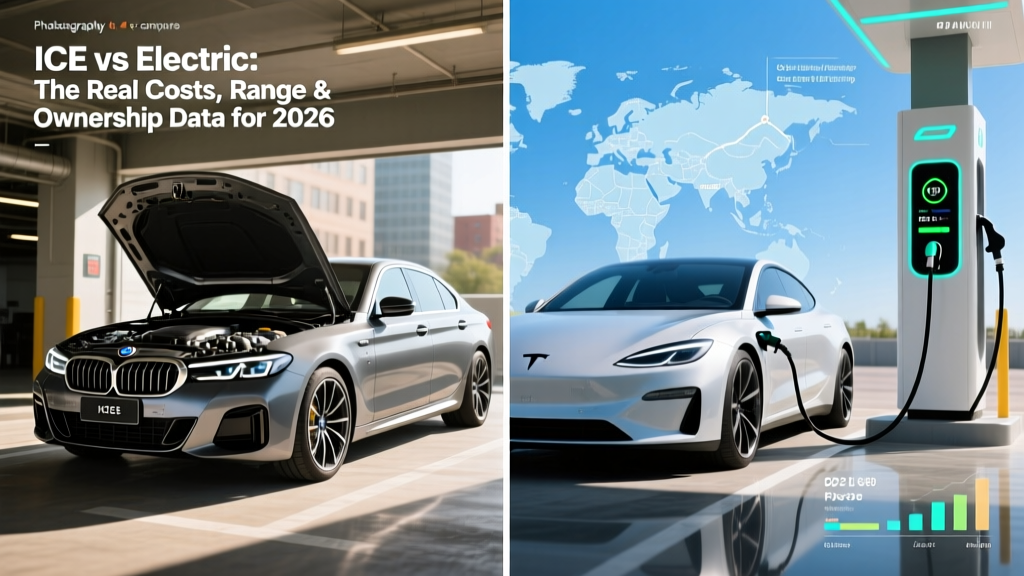
Are electric cars better than gas cars? For most buyers who can charge at home and drive under 250 miles daily, an EV delivers lower 5-year ownership costs, stronger acceleration, and less maintenance. A typical midsize EV saves $4,000–$7,000 over five years versus a comparable gas car, primarily through fuel and maintenance reductions. However, if you lack home charging, frequently drive in extreme cold, or regularly tow heavy loads over long distances, a hybrid (HEV or PHEV) may serve you better today. The "better" choice depends on your charging access, climate, and driving patterns — not the badge on the hood.
The Real Cost of Ownership: EV vs Gas in 2026
The purchase price of EVs has dropped significantly. The 2026 Chevrolet Equinox EV starts at $33,600 (EPA range up to 319 miles), while the 2026 Hyundai Ioniq 5 begins at $42,600 with a 318-mile EPA range. Compare that to a well-equipped 2026 Toyota RAV4 gas model at roughly $32,000 with a combined 30 MPG. The upfront gap has narrowed to just a few thousand dollars — and the federal §30D tax credit can erase it entirely for eligible buyers.
But purchase price is only the beginning. Total cost of ownership (TCO) factors in fuel, maintenance, insurance, depreciation, and incentives. Here's how a representative midsize EV stacks up against a comparable gas SUV over five years and 75,000 miles:
| Cost Category | 2026 EV (e.g., Ioniq 5) | 2026 Gas SUV (e.g., RAV4) |
|---|---|---|
| Base MSRP | $42,600 | $32,000 |
| Federal Tax Credit (§30D) | –$7,500 (if eligible) | $0 |
| Effective Purchase Price | $35,100 | $32,000 |
| Fuel/Energy (75k mi) | $3,200 (home L2 @ $0.14/kWh) | $8,750 (30 MPG @ $3.50/gal) |
| Maintenance (5 yr) | $1,200 | $3,500 |
| Insurance (5 yr avg) | $9,500 | $7,800 |
| Estimated Depreciation | $16,000 | $13,500 |
| 5-Year Total Cost | $65,000 | $65,550 |
Note: §30D eligibility requires meeting MSRP caps ($55,000 for cars, $80,000 for SUVs/trucks), buyer income limits ($150k single / $300k joint), and battery critical-mineral and component sourcing rules. Always verify current-year rules at IRS.gov and consult a tax professional. Point-of-sale transfer is available at participating dealers.
The EV's fuel savings alone — roughly $5,500 over five years — nearly offset its higher insurance and depreciation. Add the maintenance gap (no oil changes, fewer brake replacements thanks to regenerative braking, no transmission fluid), and the EV pulls ahead for most owners who charge primarily at home.
Range, Charging, and Refueling: Where Gas Still Has an Edge
This is where honest numbers matter. The EPA posts laboratory range estimates, but real-world results depend on speed, temperature, terrain, and climate control use.
| Metric | 2026 EV (Ioniq 5 Long Range) | 2026 Gas SUV (RAV4 AWD) |
|---|---|---|
| EPA Range / Tank | 318 mi (77.4 kWh usable, NMC) | 425 mi (14.5 gal × 29 combined MPG) |
| Real-World Highway (70 mph) | ~260–280 mi | ~390–410 mi |
| Cold-Weather Range (20°F) | ~210–240 mi (20–30% loss) | ~370 mi (minimal loss) |
| Refuel/Recharge Time | 10–80% in ~18 min (peak 240 kW DC) | ~5 min at any gas station |
| Home "Refuel" (Level 2, 11.5 kW) | 0–100% in ~7 hours (overnight) | N/A |
| Infrastructure Density | Growing but uneven; NACS expanding | Ubiquitous |
On a 500-mile road trip, the gas SUV still wins on convenience: two quick fuel stops versus one or two DC fast-charging sessions, each potentially 20–30 minutes when you factor in charge-curve taper above 80% State of Charge (SoC). The Ioniq 5 peaks at 240 kW but sustains that rate only briefly — average power from 10–80% is closer to 160–180 kW. Above 80%, charging slows dramatically to protect battery health, so road-trip strategy means charging to 80% and moving on.
For daily driving, though, the equation flips. If you charge at home on a Level 2 (240V) charger, you start every morning with a "full tank." At 11.5 kW, a typical home charger adds roughly 35–40 miles of range per hour. Overnight charging easily replenishes 200+ miles. According to fueleconomy.gov, the average American drives about 37 miles per day — well within any modern EV's real-world range.
Maintenance, Reliability, and Longevity
EVs have far fewer moving parts than internal-combustion vehicles. There's no engine oil, no spark plugs, no timing belt, no exhaust system, and no multi-speed transmission. Brake pads last significantly longer because regenerative braking handles most deceleration — many EV owners report original brake pads at 80,000+ miles.
The main long-term concern is battery degradation. Modern NMC and LFP (lithium iron phosphate) battery packs are engineered for longevity. Most manufacturers warranty the battery for 8 years or 100,000 miles against capacity loss below 70% of original. Real-world data from fleets and high-mileage owners suggests typical degradation of 8–12% over the first 100,000 miles — meaning a 318-mile EV might deliver 280–290 miles after a decade of use.
Battery replacement, should it be needed out of warranty, currently costs $8,000–$16,000 depending on pack size and chemistry. However, complete pack failures are rare; individual module replacement is often possible at lower cost. LFP chemistry, used in base-trim vehicles like the Tesla Model 3 RWD, tends to degrade even more slowly and tolerates regular 100% charging — a practical advantage for daily drivers.
Performance and Driving Experience
Electric motors deliver maximum torque from zero RPM, which translates to strong, instant acceleration without the lag of turbo spool-up or transmission downshifts. The Ioniq 5 Long Range AWD produces 320 HP and hits 0–60 mph in approximately 5.0 seconds. A similarly priced RAV4 with its 203 HP 2.5L four-cylinder manages 0–60 in about 8.2 seconds.
The driving experience differs in other ways. EVs are quieter at all speeds, with no engine vibration at idle. The low-mounted battery pack creates a low center of gravity, improving handling composure. One-pedal driving — using regenerative braking to slow the car when lifting the accelerator — reduces brake-pedal use in stop-and-go traffic and becomes intuitive within a few days.
However, EVs are heavier. The Ioniq 5 weighs roughly 4,400 lbs versus the RAV4's ~3,600 lbs. That extra mass increases tire wear and can extend braking distances. It also means EVs consume more energy at highway speeds, where aerodynamic drag and rolling resistance dominate.
Common Misconceptions: Myths vs. Facts
| Myth | Fact (with Data) |
|---|---|
| "EVs have worse range than advertised" | EPA range is a lab estimate. Expect ~80–90% in real-world highway driving, and 65–75% in extreme cold (below 20°F). A 318-mi EPA EV typically delivers 260–280 mi highway in moderate weather. |
| "EV batteries need replacing every few years" | Federal law mandates battery warranties of 8 yr/100,000 mi minimum. Most packs retain 88–92% capacity at 100k miles. Full replacement is rare and typically only needed after severe damage or extreme age. |
| "The electric grid can't support EVs" | Most charging happens overnight during off-peak hours. DOE studies project manageable grid impact through 2030 with current infrastructure investments, especially with smart/managed charging. |
| "EVs are worse for the environment because of electricity generation" | Even on coal-heavy grids, EVs produce fewer lifetime emissions than gas cars (Union of Concerned Scientists data). As grids add renewables, the gap widens further every year. |
| "You can't take an EV on a road trip" | The DC fast-charging network (Tesla Supercharger, Electrify America, EVgo) covers major US highways. Plan 20–30 min stops every 200–250 miles. Apps like A Better Routeplanner optimize charging stops. |
| "EVs cost more to insure" | True — EV premiums average 15–25% higher than comparable gas cars due to higher repair costs and battery replacement expenses. Shop quotes before buying. |
Home Charging: The Make-or-Break Factor
Home charging access is the single biggest determinant of EV satisfaction. Owners with a Level 2 (240V) home charger report dramatically higher satisfaction than those relying on public charging. Here's what installation typically involves:
- Level 1 (120V standard outlet): Adds 3–5 miles of range per hour. Fine for PHEVs or low-mileage BEV drivers. No installation cost beyond the included cord.
- Level 2 (240V, 32–48 amp): Adds 25–40 miles per hour. Requires a dedicated circuit and professional installation. Typical cost: $500–$1,500 for the charger unit plus $800–$2,500 for electrician labor, depending on panel capacity and run distance. Total: $1,300–$4,000 in most homes.
- Electrical panel upgrade: If your home has a 100-amp panel and you're adding a 40-amp EV circuit, you may need a 200-amp upgrade — adding $1,500–$3,500. A licensed electrician must assess this.
If you live in an apartment, condo, or street-parking situation without charging access, a PHEV (plug-in hybrid) like the 2026 Toyota RAV4 Prime (42 miles electric-only, then 38 MPG hybrid) or a conventional HEV may be more practical. Public-only EV charging is expensive ($0.35–$0.55/kWh at DC fast chargers), time-consuming, and inconsistent in reliability.
The Decision Framework: Which Should You Buy?
Choose a Battery Electric Vehicle (BEV) If:
- You can install a Level 2 charger at home or have reliable workplace charging
- Your daily driving is under 200 miles round-trip
- You want the lowest per-mile "fuel" cost ($0.04–$0.06/mi at home vs $0.12–$0.16/mi for gas)
- You qualify for the §30D tax credit (check income, MSRP, and sourcing rules)
- You value quiet, smooth, responsive acceleration
Choose a Plug-In Hybrid (PHEV) If:
- You can charge at home but also take frequent 400+ mile road trips
- You want electric-only commuting (25–45 mi) with gas-engine backup
- Your area has limited DC fast-charging infrastructure
- You regularly tow or carry heavy loads over long distances
Choose a Conventional Hybrid (HEV) or Gas Car If:
- You have no access to home or workplace charging
- You drive in extreme cold (–10°F or below) for extended periods
- You need maximum range flexibility with zero planning
- Your budget is strictly under $28,000 and you can't wait for used-EV deals
Frequently Asked Questions
Do EVs really save money compared to gas cars?
Over five years and 75,000 miles, a typical midsize EV saves $4,000–$7,000 in total cost of ownership versus a comparable gas car — primarily through fuel savings ($5,500+ less) and reduced maintenance ($2,000+ less). These savings are largest when you charge at home on residential electricity rates ($0.10–$0.18/kWh). Public DC fast charging at $0.40+/kWh narrows the gap significantly.
How long do EV batteries actually last?
Most modern EV batteries are warranted for 8 years or 100,000 miles with a minimum 70% capacity retention. Real-world data shows 8–12% degradation at 100,000 miles for NMC chemistry and 5–8% for LFP. Many high-mileage EVs exceed 150,000 miles on the original pack. Avoid routinely charging to 100% on NMC batteries (80% daily is ideal); LFP batteries tolerate 100% daily charging without significant harm.
Are electric cars worse in cold weather?
Yes, but the impact is manageable. At 20°F, expect 20–30% range reduction due to battery chemistry and cabin heating demands. A 318-mile EPA EV may deliver 210–240 real-world miles in deep cold. Preconditioning the battery while plugged in (warming it before driving) recovers some range and improves regenerative braking. Vehicles with heat pumps — standard on the Ioniq 5 and many 2026 models — reduce heating energy consumption by 30–40% versus resistive heaters.
What should a first-time EV buyer know before purchasing?
First, confirm your home electrical panel can support a Level 2 charger — get a quote from a licensed electrician before buying the car. Second, check your §30D tax credit eligibility at IRS.gov: income caps, MSRP limits, and battery sourcing requirements all apply. Third, understand that DC fast-charging speed is measured in kW (power), while battery capacity is measured in kWh (energy) — a 77.4 kWh battery charging at a sustained 150 kW takes roughly 30 minutes from 10–80%. Fourth, test-drive in conditions that match your daily commute, including highway speeds where efficiency drops.
Is insurance really more expensive for EVs?
On average, yes — EV insurance premiums run 15–25% higher than equivalent gas vehicles. This reflects higher repair costs (specialized body shops, battery safety protocols) and greater total-loss risk if the battery pack is damaged. However, some insurers now offer EV-specific discounts. Always get quotes from at least three carriers before finalizing your purchase, as rates vary dramatically by model, driver profile, and state.
How does the EV tax credit actually work in 2026?
The §30D Clean Vehicle Credit offers up to $7,500 for new qualifying EVs, split into two halves: $3,750 for meeting critical-mineral sourcing requirements and $3,750 for battery-component sourcing. Additional rules include buyer adjusted gross income limits ($150,000 single / $225,000 head of household / $300,000 joint), vehicle MSRP caps ($55,000 for sedans, $80,000 for SUVs and trucks), and final assembly in North America. Eligible buyers can transfer the credit to the dealer at point of sale for an immediate price reduction. Rules are subject to change — verify current requirements at IRS.gov and consider consulting a tax professional.
Bottom Line: Better for Whom?
Electric cars are better than gas cars for specific use cases — namely, drivers with home charging access, moderate daily mileage, and access to current tax incentives. They deliver lower running costs, smoother performance, and reduced maintenance. They are not universally better for apartment dwellers without charging, extreme-cold commuters, or buyers who need 500+ miles of range without planning.
The gap narrows every year as battery costs fall, charging networks expand (the NACS standard is opening Tesla Superchargers to most brands), and real-world ranges exceed 300 miles on mainstream models. If your situation fits the BEV profile above, the math strongly favors going electric in 2026. If it doesn't yet, a PHEV offers a compelling bridge — electric commuting today, gas flexibility for road trips, and no charging-infrastructure dependency.
Run your own numbers: check your utility rate, calculate your daily miles, get a home-charger installation quote, and verify your tax credit eligibility. The data — not the hype — will tell you which powertrain is better for you.