The Short Answer
Electric cars in the 1970s were experimental conversions with lead-acid batteries, delivering roughly 30–50 miles of range at speeds under 45 mph, costing the equivalent of $25,000–$40,000 in today's dollars. In 2026, a mainstream EV like the Chevrolet Equinox EV offers 319 miles of EPA range, 150 kW DC fast charging, and a starting MSRP around $33,600—before a potential $7,500 federal tax credit under IRS §30D. The gap between the two eras is not incremental; it is a difference in fundamental chemistry, power electronics, and manufacturing scale.
Why Electric Cars in the 1970s Failed to Catch On
The 1973 oil embargo sparked genuine interest in alternatives to gasoline, and several small manufacturers—along with tinkerers at major automakers—produced electric prototypes and limited-run vehicles. Models like the CitiCar (produced by Sebring-Vanguard), the AMC Amitron (a concept that never reached production), and various converted Volkswagen Beetles and Renault Dauphines represented the era's EV ambitions.
The limitations were severe and physics-bound:
- Battery chemistry: Lead-acid batteries weighed 1,000–1,500 lbs and stored roughly 10–15 kWh of usable energy. That's less than a single module in a modern EV pack.
- Range: Most 1970s EVs managed 30–50 miles under ideal conditions. Cold weather or hills cut that by 30–50%.
- Top speed: 40–60 mph was typical. Highway merging was dangerous or impossible.
- Charging: Standard 120V household outlets were the only option, requiring 8–14 hours for a full charge. No public infrastructure existed.
- Weight efficiency: Lead-acid batteries have an energy density of roughly 30–40 Wh/kg, compared to modern lithium-ion NMC cells at 220–270 Wh/kg and LFP cells at 160–200 Wh/kg.
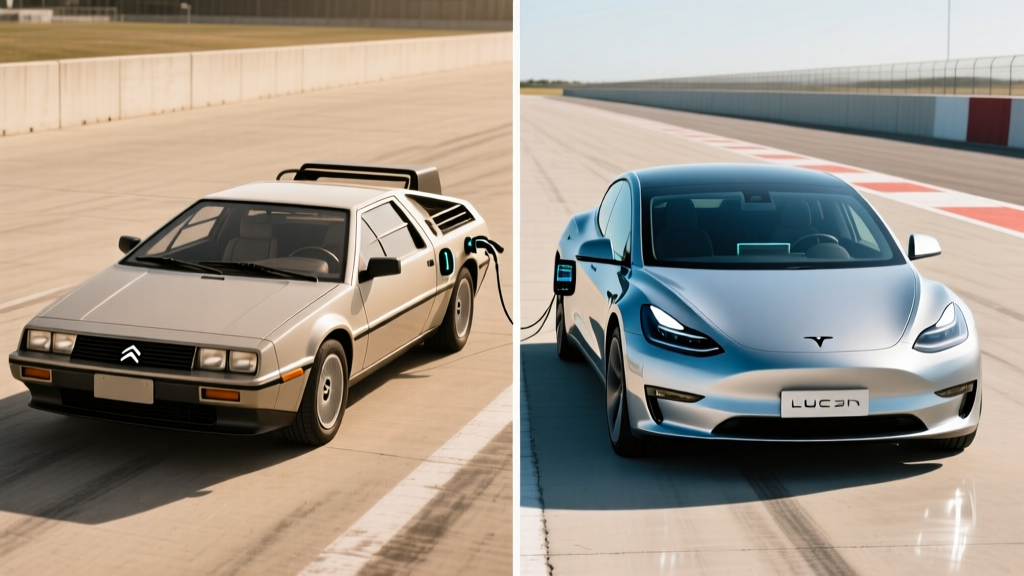
The CitiCar, the most commercially successful American EV of the decade, sold roughly 2,500 units between 1974 and 1977. It had a 3.5 hp motor, a top speed of 38 mph, and a range of about 35 miles. Its MSRP was approximately $3,000 (roughly $17,000 in 2026 dollars)—not cheap for a two-seat vehicle that couldn't leave a neighborhood road.
Side-by-Side: 1970s EVs vs. 2026 EVs
| Specification | 1974 CitiCar (Typical 1970s EV) | 2026 Chevrolet Equinox EV 2LT | 2026 Tesla Model Y Long Range |
|---|---|---|---|
| Battery Chemistry | Lead-acid | NMC (Nickel Manganese Cobalt) | NMC / LFP variant available |
| Battery Capacity (usable) | ~10 kWh | ~85 kWh | ~75 kWh |
| EPA Range | N/A (est. 30–40 mi) | 319 mi | 320 mi |
| Real-World Highway Range | ~20 mi | ~260–280 mi | ~270–290 mi |
| Top Speed | 38 mph | 115 mph | 130 mph |
| 0–60 mph | Not achievable | ~7.9 sec | ~5.0 sec |
| Peak DC Charge Rate | N/A (no DC fast charging) | 150 kW | 250 kW |
| 10–80% Charge Time | 8–14 hours (120V only) | ~28 min | ~18 min |
| Motor Power | 3.5 hp (2.6 kW) | 213 hp (159 kW) | 384 hp (286 kW) dual motor |
| Vehicle Weight | ~1,250 lbs | ~4,500 lbs | ~4,400 lbs |
| Base MSRP (2026 dollars) | ~$17,000 (adjusted) | $33,600 | $44,990 |
| Federal Tax Credit Eligibility | None existed | Up to $7,500 (§30D) | Up to $7,500 (§30D) |
| Battery Warranty | None | 8 yr / 100,000 mi | 8 yr / 120,000 mi |
Sources: fueleconomy.gov (EPA data), Chevrolet Equinox EV specs, Tesla Model Y specs.
What Changed: The Five Breakthroughs That Made Modern EVs Possible
The difference between electric cars in the 1970s and those on dealer lots in 2026 isn't one invention—it's the convergence of five technology leaps.
1. Lithium-Ion Battery Chemistry
Modern NMC and LFP cells store 5–7x more energy per kilogram than lead-acid. A 2026 EV battery pack weighing 900 lbs can hold 85 kWh; a lead-acid pack of the same weight would hold roughly 12–15 kWh. Chemistry also dictates cycle life: modern packs are warrantied to retain 70–80% of original capacity after 100,000–150,000 miles, whereas lead-acid batteries degraded noticeably within 1–2 years of daily cycling.
2. Power Electronics and Motor Efficiency
The 1970s EV used brushed DC motors with crude resistor-based speed control, wasting energy as heat. Today's permanent-magnet synchronous motors and silicon-carbide inverters convert over 95% of battery energy into motion. That efficiency gap alone roughly doubles effective range for the same battery size.
3. Thermal Management
1970s EVs had no battery thermal management. Modern liquid-cooled packs precondition for fast charging, maintain optimal temperature during operation, and protect against degradation. This is why a 2026 EV can sustain a 150 kW charge rate for 20+ minutes while a lead-acid pack would overheat and off-gas at far lower charge rates.
4. Regenerative Braking
Recapturing kinetic energy during deceleration was theoretically understood in the 1970s but impractical with lead-acid batteries (which can't accept charge quickly). Modern lithium-ion cells handle regen currents of 50–100 kW routinely, recovering 15–25% of energy that would otherwise be lost to friction brakes.
5. Charging Infrastructure
The most critical difference. A 1970s EV owner was tethered to a 120V household outlet. In 2026, the U.S. has over 200,000 public charging ports, including tens of thousands of DC fast chargers at 150–350 kW. The adoption of the NACS (North American Charging Standard) connector across most automakers means access to Tesla's Supercharger network—over 25,000 stalls—via adapter or native port on 2025+ models.
Real Ownership Costs: Then vs. Now
| Cost Factor | 1970s EV (Estimated) | 2026 EV (e.g., Equinox EV) | 2026 Gas Compact SUV (Baseline) |
|---|---|---|---|
| Purchase Price | ~$17,000 (adj.) | $33,600 (before credit) | $28,000 |
| Federal Tax Credit | $0 | Up to $7,500 | $0 |
| Effective Purchase Price | ~$17,000 | ~$26,100 | $28,000 |
| "Fuel" Cost per Mile | $0.015 (1970s electricity) | $0.04–$0.06 (home L2) | $0.12–$0.16 (gas at $3.20/gal, 28 MPG) |
| Annual Fuel/Energy (12,000 mi) | ~$180 | $480–$720 | $1,440–$1,920 |
| Annual Maintenance | $200–$500 (battery replacement frequent) | $300–$500 | $800–$1,200 |
| Battery Replacement | Every 2–4 years, $1,500–$3,000 | Rarely needed; 8-yr/100k-mi warranty | N/A |
| Insurance (Annual) | Minimal (low-speed, low-value) | $1,800–$2,600 | $1,400–$2,000 |
| 5-Year Total Cost of Ownership (est.) | ~$28,000–$35,000 | ~$40,000–$48,000 | ~$42,000–$50,000 |
The 2026 EV is dramatically more capable, more reliable, and in many scenarios cheaper to own over five years—especially when the §30D federal tax credit applies. The credit has MSRP caps ($80,000 for SUVs, $55,000 for sedans), buyer income limits ($300,000 joint / $150,000 single), and battery sourcing requirements that vary by model year. Always verify eligibility at the IRS site or with a tax professional before purchase.
Common Misconceptions About Early and Modern EVs
| Myth | Fact |
|---|---|
| "EVs are a new invention from the 2010s." | Electric cars predate gasoline cars. They were common in the 1900s, declined after 1920, and saw revived interest during the 1970s oil crisis. The technology simply wasn't viable until lithium-ion batteries matured. |
| "EV batteries need replacing every few years, just like in the 1970s." | Lead-acid batteries degraded rapidly. Modern NMC and LFP packs routinely last 150,000–200,000+ miles with less than 15% degradation. They are warrantied for 8 years/100,000 miles minimum. Full replacements cost $8,000–$18,000 but are rarely needed within the vehicle's life. |
| "EVs are only practical in warm climates." | Cold weather does reduce range by 15–30% due to battery chemistry and cabin heating demands. However, a 2026 EV with 300+ miles of EPA range still delivers 210–255 miles in freezing conditions—far exceeding daily driving needs for 95% of Americans. Heat pumps (standard on many 2026 models) recover significant efficiency. |
| "You can't take an EV on a road trip." | A 2026 EV charging at 150–250 kW adds 150–250 miles in 15–25 minutes. Planning around DC fast chargers adds roughly 15–30 minutes per stop on a 500-mile trip—comparable to gas stops when you factor in food and rest breaks. |
| "Charging at home is too expensive to install." | A basic Level 2 home charger (240V, 32–48A) costs $300–$700 for the unit plus $500–$2,000 for electrician installation, depending on panel capacity and run length. Most homeowners spend $1,000–$2,500 total. A 200A panel is usually sufficient; older homes with 100A service may need a $1,500–$3,000 upgrade. |
Real-World Ownership: What a First-Time EV Buyer Should Know
If you're researching EVs today and stumbled onto the history of electric cars in the 1970s, here's what matters for an actual purchase decision in 2026:
Home Charging Access Is the Single Biggest Factor
Over 80% of EV charging happens at home. If you have a garage or dedicated parking spot with access to a 240V outlet (or can install one), an EV is extraordinarily convenient—you wake up every morning with a "full tank." If you rely exclusively on public charging, your experience depends heavily on your local infrastructure. Apartments, street parking, and rural areas remain pain points.
Real-World Range vs. EPA Sticker
The EPA range estimate is a useful baseline, but expect to see 15–20% less on sustained highway driving at 70+ mph, and 20–30% less in sub-freezing temperatures. A 300-mile EPA rating translates to roughly 240–260 miles of real-world highway range in moderate weather. This is still ample for most daily driving and manageable on road trips with basic planning.
Charging Speeds: The Curve Matters More Than Peak kW
A vehicle that "charges at 150 kW" does not sustain that rate for the entire session. DC fast charging follows a curve: peak rate is achieved between roughly 10–40% State of Charge (SoC), then tapers progressively. The 10–80% time is the practical metric. A 150 kW-capable vehicle typically takes 25–35 minutes for that range; a 250 kW vehicle takes 15–22 minutes. Above 80%, charging slows dramatically to protect battery health—plan to charge to 80% on road trips and move on.
Tax Credits and Incentives
The federal §30D credit can reduce your effective purchase price by up to $7,500, but eligibility depends on your income, the vehicle's MSRP, and where battery minerals and components are sourced. Many popular 2026 models qualify for the full amount; others qualify for $3,750 or nothing. Some states layer on additional credits ($1,000–$5,000). The credit can now be transferred to the dealer at point of sale, reducing your out-of-pocket cost immediately rather than waiting for a tax refund.
Decision Framework: Is a 2026 EV Right for You?
Choose a battery-electric vehicle (BEV) if:
- You have home or workplace Level 2 charging access
- Your daily commute is under 80 miles round-trip
- You take road trips fewer than 6 times per year (or are willing to plan charging stops)
- You want to minimize fuel and maintenance costs over 5+ years of ownership
- You qualify for the §30D federal tax credit or state incentives
Choose a plug-in hybrid (PHEV) if:
- You lack reliable home charging but want some electric-only driving (20–40 miles on most PHEVs)
- You frequently drive 300+ miles in a day through areas with sparse charging infrastructure
- You want to reduce fuel consumption without range-anxiety concerns
Choose a conventional hybrid (HEV) if:
- You have zero charging access at home or work
- You want maximum fuel efficiency with no behavioral changes (no plugging in)
- Your budget is under $30,000 and you want proven reliability with minimal upfront cost
Stick with a gas vehicle if:
- You tow heavy loads frequently (over 5,000 lbs) in cold climates where EV range loss compounds
- You live in a charging desert with no realistic near-term infrastructure plans
- Your annual mileage is very low (under 5,000 miles), making the fuel savings negligible against the EV price premium
Frequently Asked Questions
Were electric cars in the 1970s actually sold to consumers?
Yes, but in very small numbers. The CitiCar (1974–1977) was the most commercially successful, with roughly 2,500 units sold. Several other companies produced electric conversions of existing gas cars or purpose-built neighborhood electric vehicles. None approached mass-market scale due to battery limitations, low speed, and high cost relative to capability.
Why did interest in EVs surge during the 1970s?
The 1973 OPEC oil embargo caused gasoline shortages, price spikes, and long lines at gas stations across the U.S. This prompted both government research funding and private-sector experimentation with electric alternatives. The interest faded in the early 1980s as oil prices stabilized and the fundamental battery limitations remained unsolved.
How does the energy density of 1970s batteries compare to 2026 batteries?
Lead-acid batteries of the 1970s offered roughly 30–40 Wh/kg. Modern NMC lithium-ion cells deliver 220–270 Wh/kg, and LFP cells deliver 160–200 Wh/kg. That's a 5x to 7x improvement in energy per unit of weight, which directly translates to more range without proportionally increasing vehicle mass.
What would a 1970s EV cost to build today with modern batteries?
If you retrofitted a CitiCar-style vehicle with a modern 30 kWh LFP pack, a 50 kW motor, and basic power electronics, the drivetrain components alone would cost roughly $5,000–$8,000. The vehicle would gain 80–100 miles of range and reach highway speeds—illustrating how dramatically battery and motor technology have improved independent of vehicle design.
What's the cheapest new EV available in 2026?
The Chevrolet Equinox EV starts around $33,600, and with the full $7,500 federal credit, the effective price drops to roughly $26,100—making it one of the most affordable new EVs in the U.S. market. The Nissan Leaf (if still in production for 2026) historically started around $28,000 but with less range and older CHAdeMO charging. Always check current MSRP and credit eligibility at the time of purchase.
Do modern EVs have the same battery replacement problem as 1970s EVs?
No. Lead-acid batteries in 1970s EVs required replacement every 2–4 years at significant cost. Modern lithium-ion packs are engineered for 1,500–3,000 charge cycles before significant degradation, which translates to 150,000–300,000+ miles. Federal regulations mandate battery warranties of at least 8 years/100,000 miles (10 years/150,000 miles in CARB states). Most owners will never need a battery replacement.