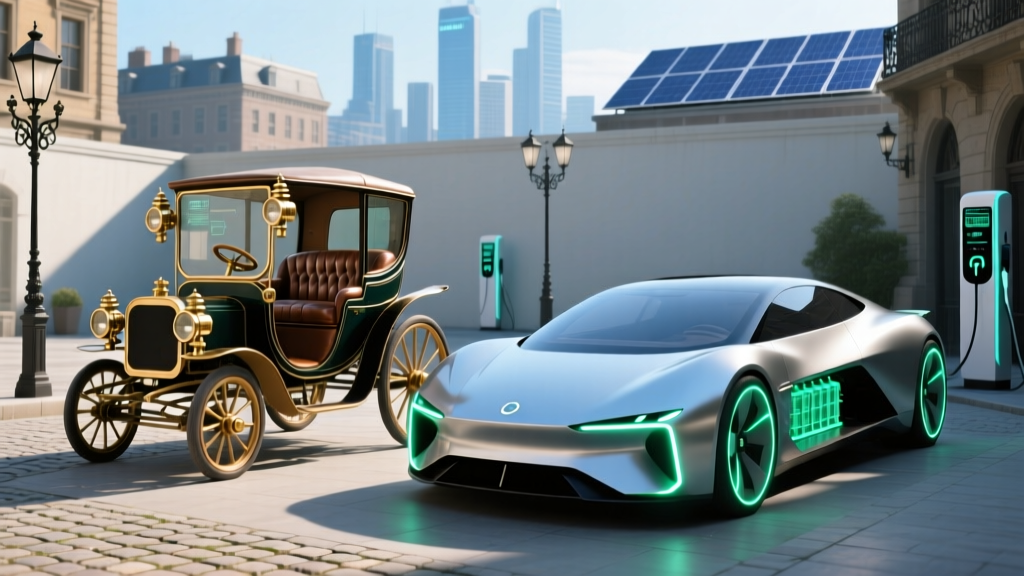
The Short Answer: Electric Cars in the 1900s vs. Today
Electric cars in the 1900s were real, practical vehicles — not a modern invention. In 1900, roughly 28% of all cars on American roads were electric, outselling gasoline vehicles. Early EVs like the Baker Electric and Detroit Electric offered 50–80 miles of range on lead-acid batteries, with top speeds around 15–20 mph. They were quiet, easy to operate, and popular among urban drivers — especially women — because they required no hand-cranking to start.
By 1912, cheap gasoline from Texas oil fields, the mass-produced Model T ($650 vs. $1,750 for a Detroit Electric), and the electric starter for gas engines killed the first EV era. It took nearly a century — until the 2010s and the lithium-ion revolution — for electric cars to return at scale.
Today's EVs deliver 250–400+ miles of EPA range, charge at up to 350 kW (adding ~200 miles in 15 minutes), and cost as little as $29,990 before federal tax credits. Here's exactly how far the technology has come — and what it means for your buying decision right now.
Electric Cars in the 1900s: The First EV Boom (1897–1912)
Most people assume EVs are a 21st-century phenomenon. The reality is that electric vehicles predate gasoline cars. In 1897, the first commercial electric taxi fleet launched in New York City, operated by the Electric Carriage and Wagon Company with a fleet of 62 EVs. By 1900, the U.S. produced more electric cars than gasoline cars.
Key 1900s-era electric vehicles included:
- Detroit Electric (1907–1939): Offered up to 80 miles of range at 20 mph on Edison nickel-iron or lead-acid batteries. Priced at $1,750–$3,000 (roughly $55,000–$95,000 in 2026 dollars). Clara Ford, wife of Henry Ford, drove one.
- Baker Electric (1899–1915): The best-selling EV of its era, with models ranging from runabouts to broughams. Range of approximately 50 miles, top speed of 14 mph.
- Columbia Electric (1897–1913): One of the earliest mass-produced EVs, with a phaeton model achieving roughly 40 miles per charge.
These vehicles used lead-acid batteries — heavy, slow to charge, and limited in energy density to roughly 30–40 Wh/kg. For comparison, modern lithium-ion NMC cells achieve 250–300 Wh/kg, and LFP cells around 160–180 Wh/kg. That's a 6x to 8x improvement in energy storage per pound of battery.
Why Electric Cars Disappeared After 1912
Three factors converged to kill the early EV market:
- Cheap gasoline: The Spindletop oil discovery in Texas (1901) made fuel abundant and inexpensive, dropping gas prices dramatically.
- The Model T: Ford's assembly-line production brought the Model T down to $650 by 1912 — less than half the price of any electric car.
- The electric starter: Charles Kettering's invention eliminated the dangerous hand-crank that made gas cars difficult and risky to start, removing a major EV selling point.
By 1920, electric car production had essentially ceased in the U.S. The internal combustion engine dominated for the next 90 years.
1900s EVs vs. 2026 EVs: A Data-Driven Comparison
The table below compares a representative 1910-era electric car against three popular 2026 models to illustrate how dramatically the technology has advanced:
| Specification | Detroit Electric (c. 1910) | Tesla Model Y LR (2026) | Chevrolet Equinox EV (2026) | Hyundai Ioniq 5 (2026) |
|---|---|---|---|---|
| EPA Range | ~80 mi (at 20 mph) | 320 mi | 315 mi | 310 mi |
| Battery Chemistry | Lead-acid | NMC lithium-ion | NMC lithium-ion | NMC lithium-ion |
| Battery Capacity | ~8 kWh (est.) | ~75 kWh usable | 85 kWh usable | 77.4 kWh usable |
| Energy Density | ~35 Wh/kg | ~260 Wh/kg | ~260 Wh/kg | ~260 Wh/kg |
| Top Speed | 20 mph | 135 mph | 120 mph | 115 mph |
| 0-60 mph | Did not reach 60 | 4.8 sec | 7.9 sec | 5.1 sec |
| Charge Time (full) | 8+ hours (120V) | ~15 min (10-80% at 250 kW) | ~25 min (10-80% at 190 kW) | ~18 min (10-80% at 240 kW) |
| Horsepower | ~4 hp | 384 hp | 288 hp | 320 hp |
| Price (then-current $) | $1,750 | $44,990 | $33,600 | $42,600 |
| Price (2026 adjusted) | ~$57,000 | $44,990 | $33,600 | $42,600 |
Sources: Manufacturer spec sheets; fueleconomy.gov for EPA data. 1910 Detroit Electric figures are estimates based on historical records.
Real-World Range Note: The 2026 EPA range figures above assume moderate temperatures and mixed driving. In real-world highway driving at 75+ mph, expect 250–280 miles from the Model Y LR, ~260 from the Equinox EV, and ~255 from the Ioniq 5. In freezing weather (below 32°F), range drops an additional 15–30% depending on whether the vehicle uses a heat pump (the Ioniq 5 and Model Y both include one; the Equinox EV uses resistive heating on some trims).
The Modern Cost Equation: EV vs. Gas in 2026
One thing the 1900s EV buyer and the 2026 EV buyer share in common: the purchase decision comes down to economics. Here's how a modern EV stacks up against a comparable gas vehicle over five years of ownership.
| Cost Category (5-Year) | 2026 Chevy Equinox EV 2LT ($33,600) | 2026 Chevy Equinox Gas LT ($28,400) |
|---|---|---|
| Purchase Price (after §30D credit) | $26,100* | $28,400 |
| Fuel / Electricity (75,000 mi) | $4,200 (at $0.14/kWh avg) | $8,100 (at $3.40/gal, 28 MPG avg) |
| Maintenance | $1,800 | $3,600 |
| Insurance (avg) | $7,500 | $6,200 |
| Depreciation (est.) | $10,500 | $9,900 |
| Total 5-Year Cost | $50,100 | $56,200 |
*Assumes eligibility for the full $7,500 §30D federal tax credit via point-of-sale transfer. Eligibility depends on MSRP caps ($55,000 for SUVs), buyer income limits ($150K single / $300K joint), and battery critical-mineral sourcing requirements. Consult a tax professional.
The EV saves roughly $6,100 over five years in this scenario, driven primarily by fuel and maintenance savings. The key variables that shift this equation:
- Home charging access: If you can install a Level 2 charger (240V, $500–$2,000 including equipment and electrician), your per-mile electricity cost stays low. Exclusive reliance on DC fast charging at $0.35–$0.50/kWh can erase the fuel savings.
- Local electricity rates: At $0.10/kWh (Pacific Northwest), 75,000 miles costs ~$2,250. At $0.30/kWh (parts of California), it's ~$6,750.
- Insurance premiums: EVs typically cost 15–25% more to insure due to higher repair costs and battery replacement risk. Shop quotes before buying.
- Tax credit eligibility: Not all buyers qualify. Battery sourcing rules tightened in 2024–2025, disqualifying several previously eligible models. Check the current IRS list before committing.
Common Misconceptions About EVs — Then and Now
| Myth | Fact |
|---|---|
| "EVs are a new, unproven technology" | Electric cars were the dominant vehicle type in 1900. Modern lithium-ion EVs have been in mass production since 2010 (Nissan Leaf, Chevy Volt). The Tesla Model 3 alone has accumulated billions of real-world miles. |
| "Batteries won't last and cost a fortune to replace" | Federal law mandates EV battery warranties of at least 8 years / 100,000 miles. Real-world data from fueleconomy.gov and fleet operators shows average degradation of 8–12% over 150,000 miles for NMC chemistries and 5–8% for LFP. Full replacements run $5,000–$20,000 depending on the model, but are rarely needed within typical ownership periods. |
| "EVs have worse range than the 1900s models" | The 1910 Detroit Electric managed ~80 miles at 20 mph. A 2026 Hyundai Ioniq 5 delivers 310 miles EPA at highway-capable speeds — nearly 4x the range at 3–4x the speed. |
| "You can't road-trip in an EV" | The U.S. now has over 70,000 public charging ports, including 30,000+ DC fast chargers. Tesla's Supercharger network (now open to NACS-equipped non-Tesla EVs) covers major highway corridors coast-to-coast. A 600-mile trip typically adds 30–45 minutes of charging time total. |
| "EVs are worse for the environment because of electricity generation" | Even on the dirtiest U.S. grids (coal-heavy regions), an EV produces fewer lifecycle emissions than a comparable gas car over its lifetime, per Argonne National Laboratory analysis. On clean grids (hydro, wind, solar), the advantage is dramatic. |
What a First-Time EV Buyer in 2026 Must Know
If you're considering your first EV, the buying landscape has shifted significantly from even two years ago. Here are the practical realities that matter:
Charging Infrastructure Is Real — But Uneven
Home charging remains the backbone of EV ownership. A Level 2 home charger (7.2–11.5 kW, 240V) adds 25–44 miles of range per hour of charging, meaning an overnight session fully replenishes any daily commute. Installation costs range from $300 (simple outlet near the panel) to $2,500+ (panel upgrade, long conduit runs).
Public DC fast charging has improved but varies by network. Electrify America, EVgo, and Tesla Superchargers are the most reliable. Expect peak charge rates of 150–350 kW at modern stations, with a typical 10–80% session taking 18–30 minutes. Important: advertised peak kW is not sustained — charge curves taper significantly above 80% SoC, which is why manufacturers quote 10–80% times rather than 0–100%.
Battery Chemistry Matters
Most 2026 EVs use one of two lithium-ion chemistries:
- NMC (Nickel Manganese Cobalt): Higher energy density (~260 Wh/kg), better cold-weather performance, but slightly faster degradation and higher cost. Used in most long-range models (Tesla Model Y, Ioniq 5, Equinox EV).
- LFP (Lithium Iron Phosphate): Lower energy density (~170 Wh/kg) but longer cycle life, no cobalt, and can be charged to 100% daily without degradation concerns. Used in Tesla Model 3 RWD, standard-range Ford Mustang Mach-E, and some base trims. Better suited for buyers who charge at home nightly and want maximum longevity.
The Tax Credit Is Not Guaranteed
The §30D federal EV tax credit offers up to $7,500, but eligibility is a three-part test:
- MSRP caps: $55,000 for sedans, $80,000 for SUVs/trucks
- Buyer income limits: $150,000 single / $225,000 head of household / $300,000 joint
- Battery sourcing: Critical minerals and battery components must meet escalating domestic/free-trade-partner thresholds — rules that tightened significantly through 2024–2026, disqualifying some previously eligible vehicles
As of 2026, the credit can be transferred to the dealer at point of sale, reducing your purchase price directly rather than waiting for a tax refund. Always verify current eligibility on irs.gov before signing a purchase agreement.
Decision Framework: Is an EV Right for You in 2026?
Choose a battery-electric vehicle (BEV) if:
- You can install a Level 2 charger at home or have reliable access to one at work
- Your daily driving is under 80 miles (covers 90%+ of U.S. commutes)
- You want the lowest per-mile operating cost and minimal maintenance
- You qualify for the §30D tax credit, bringing effective purchase price below a comparable gas car
- You live in a moderate climate or choose a model with a heat pump
Choose a plug-in hybrid (PHEV) if:
- You lack home charging access but want some electric-only driving (typically 25–45 miles)
- You frequently take road trips exceeding 300+ miles and don't want to plan around chargers
- You live in a region with extreme cold (below 0°F) where EV range loss is significant
- Your budget is tighter and you want a lower entry price with partial electrification
Stick with gas or a conventional hybrid (HEV) if:
- You live in an apartment or street-park with zero charging access
- You regularly tow heavy loads (trailers, boats) where EV range drops 40–50%
- You drive 300+ miles daily for work in areas with sparse charging infrastructure
- Your local grid electricity costs exceed $0.25/kWh with no off-peak discount
The Arc From 1900s Electric Cars to the 2026 EV Market
The electric cars of the 1900s failed not because the concept was flawed, but because the energy storage technology wasn't ready. Lead-acid batteries simply couldn't compete with cheap Texas crude and assembly-line gasoline engines. It took the development of lithium-ion cells — first commercialized by Sony in 1991 and gradually scaled for automotive use through the 2010s — to make electric vehicles practical at highway speeds, real-world ranges, and mass-market prices.
Today's EV buyer gets a vehicle that would have been science fiction to a 1910 Detroit Electric owner: 300+ miles of range, 15-minute fast charging, over-the-air software updates, and advanced driver assistance (SAE Level 2 — still requiring active supervision). The price gap with gas vehicles has nearly closed, and for many buyers factoring in the §30D credit and fuel savings, EVs are already the cheaper option over a typical ownership cycle.
The question is no longer whether electric cars work — that was answered in 1897. The question is whether an EV fits your specific driving pattern, charging situation, and budget. With the data above, you can answer that precisely.
Were electric cars actually common in the 1900s?
Yes. In 1900, approximately 28% of all automobiles on U.S. roads were electric, 22% were gasoline-powered, and the rest were steam-powered. Electric cars outsold gas cars in 1899 and 1900. Their popularity declined after 1912 due to cheap gasoline, the Model T's low price, and the invention of the electric starter for gas engines.
What was the range of a 1900s electric car?
Most 1900s-era electric cars achieved 40–80 miles of range at speeds of 12–20 mph, using heavy lead-acid batteries with energy densities around 35 Wh/kg. For context, a modern EV battery achieves 250+ Wh/kg — roughly 7x more energy per pound.
Why did it take 100 years for EVs to come back?
The core bottleneck was battery technology. Lead-acid, nickel-iron, and nickel-cadmium batteries were too heavy and energy-poor for highway-capable vehicles. Lithium-ion batteries, commercialized in 1991 and gradually improved through the 2000s, finally crossed the threshold where an EV could deliver 200+ miles of range at a competitive price. The Tesla Roadster (2008) and Nissan Leaf (2010) were the first modern production EVs to prove viability.
How much does it cost to charge a modern EV compared to fueling a gas car?
At the U.S. average electricity rate of ~$0.14/kWh and average EV efficiency of 3.5 miles/kWh, driving costs about $0.04 per mile. A gas car averaging 28 MPG at $3.40/gallon costs about $0.12 per mile. Over 15,000 miles annually, that's $600 for electricity vs. $1,821 for gasoline — a savings of ~$1,200 per year. Actual savings vary with local rates, driving habits, and whether you use home or public charging.
Do modern EV batteries degrade like old lead-acid batteries did?
Modern lithium-ion EV batteries degrade much more slowly than lead-acid. Typical NMC batteries lose 8–12% capacity over 150,000 miles. LFP chemistry degrades even less — roughly 5–8% over the same distance. All new EVs sold in the U.S. carry a federally mandated battery warranty of at least 8 years or 100,000 miles, covering capacity below 70% of original. Catastrophic battery failure within the warranty period is rare.