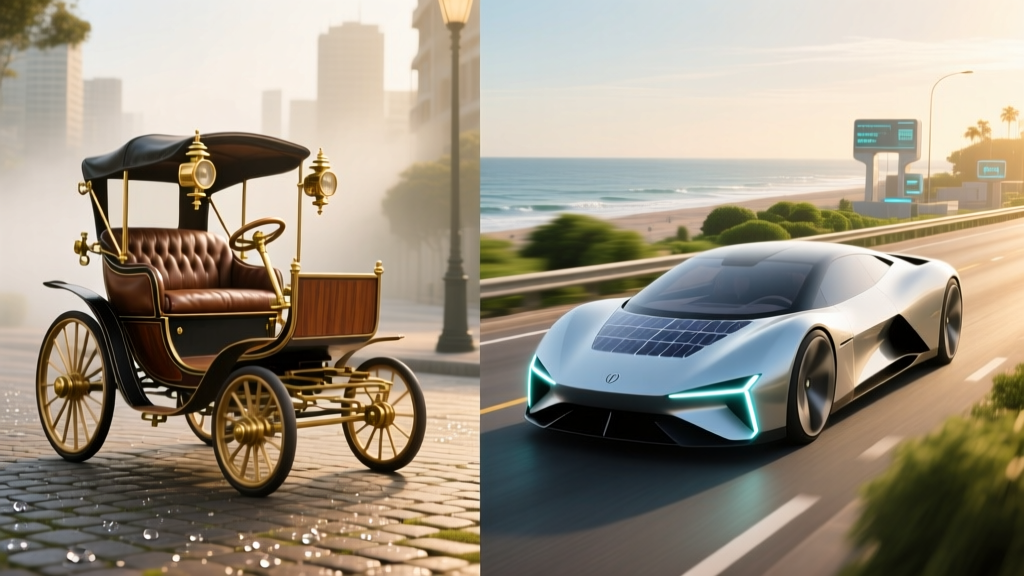
Quick Answer: Electric cars in 1900 actually outsold gasoline vehicles in the United States, with models like the Baker Electric and Columbia offering 20–40 miles of range at speeds up to 14 mph. They were quiet, clean, and popular among urban drivers — but limited by lead-acid batteries, slow recharging, and a lack of electrical infrastructure outside cities. By 1912, cheap gasoline and the electric starter killed the first EV era. Today's 2026 EVs deliver 250–400+ EPA-rated miles, DC fast-charge in under 20 minutes, and cost roughly $0.04–$0.12 per mile to fuel, making the comparison between 1900 and now one of the most dramatic technology shifts in transportation history.
Why Electric Cars Dominated in 1900
At the turn of the 20th century, the American automobile market was split three ways: steam, gasoline, and electric. According to the Library of Congress, electric cars in 1900 accounted for roughly 38% of all automobiles on US roads, while steam held 40% and gasoline just 22%.
The appeal was straightforward. Early electric cars required no hand-cranking (a dangerous and physically demanding process for gas engines), produced no exhaust fumes, and operated almost silently. For city dwellers — particularly women, who were a primary marketing target — electric runabouts were ideal for short errands and social calls.
Key 1900-Era EV Specs
| Specification | 1900-Era Electric Car |
|---|---|
| Battery Chemistry | Lead-acid |
| Range | 20–50 miles (depending on speed and terrain) |
| Top Speed | 12–20 mph |
| Battery Weight | 800–1,600 lbs (often over half the vehicle weight) |
| Recharge Time | 8–12+ hours (where electricity was available) |
| Price (then) | $850–$3,000 (~$30,000–$100,000 in 2026 dollars) |
| Notable Models | Baker Electric, Columbia, Detroit Electric, Riker |
The Detroit Electric, produced starting in 1907, became one of the longest-lived early EV brands. Thomas Edison and Clara Ford (wife of Henry Ford) both owned Detroit Electrics. Clara reportedly preferred her electric car well into the 1910s because it didn't require cranking.
What Killed the First Electric Car Era
Three converging forces ended the dominance of electric cars by roughly 1915:
- The electric starter (1912): Cadillac introduced the electric starter motor, eliminating the dangerous hand-crank that had been gas cars' biggest usability disadvantage.
- Mass production of the Model T: Henry Ford's assembly line drove the price of a gasoline Model T down to roughly $260 by the mid-1920s — far below any electric car's price.
- Rural electrification gaps: Outside major cities, electrical infrastructure barely existed. Gasoline could be delivered anywhere and stored in tanks. Electricity could not.
By 1920, electric vehicle production in the US had effectively collapsed. The internal combustion engine would dominate for the next century.
1900 vs 2026: The Side-by-Side Comparison
To understand how far battery-electric technology has come, here's a direct comparison between a representative 1900-era EV and a 2026 Tesla Model Y Long Range — one of the best-selling EVs in America.
| Attribute | 1900 Baker Electric (approx.) | 2026 Tesla Model Y Long Range | Improvement Factor |
|---|---|---|---|
| Battery Chemistry | Lead-acid | NMC (Nickel Manganese Cobalt) | ~4x energy density |
| Usable Battery Capacity | ~6–10 kWh (equivalent) | ~75 kWh usable | ~8–12x |
| EPA Range | ~30 miles | 320 miles (EPA est.) | ~10x |
| Real-World Highway Range | ~20 miles at top speed | ~260–280 miles (75 mph, moderate temps) | ~13x |
| Top Speed | 14 mph | 125 mph (electronically limited) | ~9x |
| 0–60 mph | Not achievable | 4.8 seconds | N/A |
| DC Fast Charge (10–80%) | Not possible | ~250 kW peak; ~22 minutes | N/A |
| Home Charge Time (full) | 8–12 hours | ~8–10 hours at 11.5 kW (Level 2, 48A) | Comparable |
| Vehicle Weight | ~2,500 lbs | ~4,398 lbs | Heavier, but 10x range |
| Price (2026 dollars) | ~$30,000–$60,000 | ~$44,990 MSRP (before incentives) | Similar; far more car |
| Production Volume | ~1,000/year (peak) | ~400,000+/year (Model Y globally) | ~400x |
The most telling comparison is energy density. A 1900-era lead-acid battery pack stored roughly 30–40 watt-hours per kilogram. Modern NMC cells achieve 250–300 Wh/kg — and LFP (lithium iron phosphate) cells, used in vehicles like the Tesla Model 3 RWD and many BYD models, offer 160–180 Wh/kg with longer cycle life and lower cost.
What a Modern EV Actually Costs to Own
The 1900 EV buyer worried about electricity cost and battery replacement. The 2026 EV buyer has the same concerns — but the math looks dramatically different.
| Cost Category | 2026 EV (e.g., Hyundai Ioniq 5 SE, ~$42,500 MSRP) | 2026 Gas Equivalent (e.g., Toyota RAV4 LE, ~$30,000 MSRP) |
|---|---|---|
| Purchase Price | $42,500 | $30,000 |
| Federal Tax Credit (§30D, if eligible) | Up to $7,500 (income/MSRP/sourcing rules apply — see IRS §30D guidelines) | $0 |
| Effective Purchase Price | ~$35,000 (with full credit) | $30,000 |
| Fuel/Energy Cost per Year (12,000 mi) | ~$540 (home charging at $0.15/kWh, 3.5 mi/kWh) | ~$1,370 (28 MPG combined at $3.20/gal) |
| Maintenance per Year | ~$300 (no oil changes, fewer brake replacements due to regen) | ~$700 (oil, filters, brake wear) |
| Insurance per Year (avg.) | ~$1,800–$2,400 (EV premiums typically 15–25% higher) | ~$1,500–$1,900 |
| 5-Year Total Operating Cost | ~$13,200–$16,500 | ~$13,350–$16,500 |
The numbers reveal a critical insight: when a buyer qualifies for the full §30D credit, the five-year total cost of a mid-range EV closely matches or beats a comparable gas vehicle — with the added benefit of zero tailpipe emissions and far less routine maintenance. The US Department of Energy's fueleconomy.gov calculator allows direct side-by-side comparisons for specific models and local electricity rates.
Important §30D caveats for 2026: The federal clean vehicle credit has strict eligibility requirements including buyer income caps ($150,000 single / $300,000 joint AGI), MSRP caps ($55,000 for sedans, $80,000 for SUVs/trucks), and battery critical-mineral and component sourcing rules that change annually. Always verify current-year eligibility on IRS.gov or with a tax professional. The credit can now be transferred to the dealer at point of sale as an upfront discount.
What Killed Early EVs — and Why It Won't Happen Again
The limitations that killed electric cars in 1900 have been systematically solved:
| 1900 Limitation | 2026 Status |
|---|---|
| Range too short (20–40 miles) | Most 2026 EVs: 250–400+ EPA miles. The Chevy Equinox EV offers 319 miles at ~$33,000 (before credit). |
| No charging infrastructure | Over 200,000 public charging ports in the US (Level 2 + DC fast). NACS adoption has unified the Tesla Supercharger network with Ford, GM, Rivian, Hyundai/Kia, and others. |
| Recharge takes overnight | DC fast charging at 150–350 kW adds 100–200+ miles in 15–25 minutes. Home Level 2 still takes 8–10 hours for a full charge — but most owners start each day with a "full tank." |
| Batteries are too heavy | Battery packs still add 800–1,500 lbs, but the energy density per kg is 8–12x better. Vehicle weight is managed through aluminum/carbon construction and low center of gravity. |
| Too expensive | Several 2026 EVs start under $35,000 after incentives. Battery pack costs have fallen from >$1,000/kWh in 2010 to roughly $110–$130/kWh in 2026. |
Real-World Ownership Considerations for 2026 Buyers
The history of electric cars in 1900 teaches one lesson that still applies: an EV is only as practical as the infrastructure supporting it. Here's what modern buyers need to evaluate honestly.
Home Charging Access
Over 80% of EV charging happens at home. If you have a garage or dedicated parking spot with access to a 240V circuit (or the ability to install one), EV ownership is remarkably convenient — you start every morning with a full battery. A typical Level 2 home charger installation (48A hardwired unit on a 60A breaker) costs $500–$2,500 depending on panel proximity and local electrician rates. If your home has a 200A electrical panel with spare capacity, expect the lower end. Older homes with 100A panels may need a $2,000–$5,000 panel upgrade.
If you live in an apartment, condo, or street-parking situation without charging access, EV ownership is still possible but requires reliance on public charging — which costs $0.30–$0.60/kWh at DC fast stations and adds time to your routine. Consider a PHEV (plug-in hybrid) instead, which offers 25–45 miles of electric-only range for daily commuting with a gas engine for longer trips.
Climate and Range Loss
Modern EV batteries are far more resilient than 1900-era lead-acid, but physics still applies. In freezing temperatures (below 20°F), expect 15–30% range reduction depending on the vehicle's thermal management system. EVs with heat pumps (standard on most 2026 Hyundai/Kia, Tesla, and BMW models) mitigate this loss significantly. Highway driving at 75–80 mph also reduces range by 10–20% compared to the EPA combined estimate, which blends city and highway cycles.
Driving Patterns
If your daily driving is under 80 miles round-trip (as it is for roughly 70% of US commuters), even a modest-range EV like the Nissan Leaf (149 miles EPA) or Chevy Equinox EV will handle daily needs easily with overnight home charging. For frequent road-trippers (300+ mile one-way trips multiple times per month), prioritize vehicles with 300+ mile range and 200+ kW DC fast charging to minimize stops.
Decision Framework: Should You Buy an EV, PHEV, or Gas Car?
Choose a full BEV (battery electric vehicle) if:
- You have reliable home charging (garage, driveway, or workplace Level 2)
- Your daily driving is under 150 miles
- You want the lowest per-mile fuel cost ($0.04–$0.08/mile on home electricity)
- You qualify for the §30D federal credit or state incentives
- You're willing to plan charging on long road trips
Choose a PHEV (plug-in hybrid) if:
- You lack reliable home charging but want electric commuting
- You frequently drive 300+ miles with no time for charging stops
- You want electric-only range (25–45 miles) for daily errands with gas-engine backup
- You live in a region with extreme cold and limited charging infrastructure
Choose a gas vehicle (or HEV hybrid) if:
- You have zero access to any charging (home, work, or public)
- Your budget is strictly under $25,000 and you're buying used
- You regularly tow heavy loads over long distances in remote areas
- You drive fewer than 5,000 miles per year (fuel savings won't offset EV premium)
What a First-Time EV Buyer Must Know
If the 126-year journey from the electric cars of 1900 to today's EVs has produced any practical wisdom, it's this: preparation matters more than the vehicle itself.
- kW vs kWh: Kilowatts (kW) measure power — how fast energy flows (like water pressure). Kilowatt-hours (kWh) measure energy capacity — how much is stored (like tank size). A 75 kWh battery charged at 11.5 kW takes about 6.5 hours from empty.
- Charge curve reality: A "250 kW peak" DC fast charger does not deliver 250 kW for the entire session. Charging speed tapers significantly above 80% state of charge. That's why manufacturers quote 10–80% times (typically 18–28 minutes) rather than 0–100%.
- Battery degradation: Modern EV batteries lose roughly 5–10% capacity over the first 100,000 miles, then degrade more slowly. Federal law requires battery warranties of at least 8 years/100,000 miles, and most manufacturers guarantee 70% capacity retention at that point.
- Preconditioning matters: Most 2026 EVs allow you to precondition (warm or cool) the battery before fast charging or departure. This optimizes charge speed and range. Use your vehicle's scheduled departure feature or precondition manually via the app.
- Insurance is higher: EV insurance premiums run 15–25% above comparable gas vehicles due to higher repair costs and battery replacement risk. Get quotes before purchasing.
FAQ: Electric Cars — Then and Now
Why were electric cars popular in 1900?
Electric cars in 1900 were popular because they were quiet, easy to operate (no hand-cranking), produced no fumes, and were well-suited to short urban trips. They appealed especially to city dwellers and women drivers who found gas cars difficult and unpleasant to start.
How much range did early electric cars have?
Most 1900-era electric cars offered 20–50 miles of range, depending on speed and terrain. The Detroit Electric Model 47 (circa 1914) claimed up to 80 miles on a single charge under ideal conditions — but at speeds well under 20 mph.
What battery chemistry did 1900 electric cars use?
Lead-acid batteries, the same chemistry still used for 12V starter batteries in modern cars. These were extremely heavy (often 800–1,600 lbs), offered very low energy density (~30–40 Wh/kg), and had limited cycle life compared to modern lithium-ion cells (250–300 Wh/kg for NMC, 160–180 Wh/kg for LFP).
Is it cheaper to run an EV or a gas car in 2026?
On a per-mile basis, EVs are significantly cheaper to fuel. At a national average residential electricity rate of ~$0.16/kWh and an average efficiency of 3.5 miles/kWh, an EV costs roughly $0.046/mile to fuel at home. A gas car averaging 28 MPG at $3.20/gallon costs ~$0.114/mile. Over 12,000 miles/year, that's ~$552 for the EV versus ~$1,371 for gas — a savings of ~$819/year. However, EV insurance premiums are typically 15–25% higher, and the upfront purchase price (before incentives) is often $5,000–$15,000 more.
Do modern EV batteries last as long as the car?
Generally yes. Data from Tesla, Hyundai, and independent fleet studies show most modern NMC and LFP batteries retain 85–92% capacity after 100,000 miles. Federal warranty requirements mandate at least 8 years/100,000 miles of coverage with a minimum 70% capacity retention guarantee. Many batteries outlast 200,000 miles before falling below 70% state of health.