Quick Answer: Electric cargo ships use massive LFP and NMC battery banks (often 1,000–10,000+ kWh) to cover short coastal and inland routes, while passenger EVs use 50–150 kWh packs for 250–400 miles of range. The core engineering challenges — energy density, charging infrastructure, cold-weather performance, and total cost of ownership — are nearly identical across both domains. For EV buyers in 2026, the maritime sector's rapid adoption of LFP chemistry and megawatt-scale charging previews the technology heading to your next car or truck.
Why Electric Cargo Ships Matter to EV Buyers
At first glance, a 200-ton battery-powered container vessel on the Yangtze River has nothing to do with your commute in a Tesla Model Y or Ford F-150 Lightning. But the electrification of maritime shipping is running on the same battery supply chains, charging physics, and ownership economics that determine whether your next EV purchase makes financial sense.
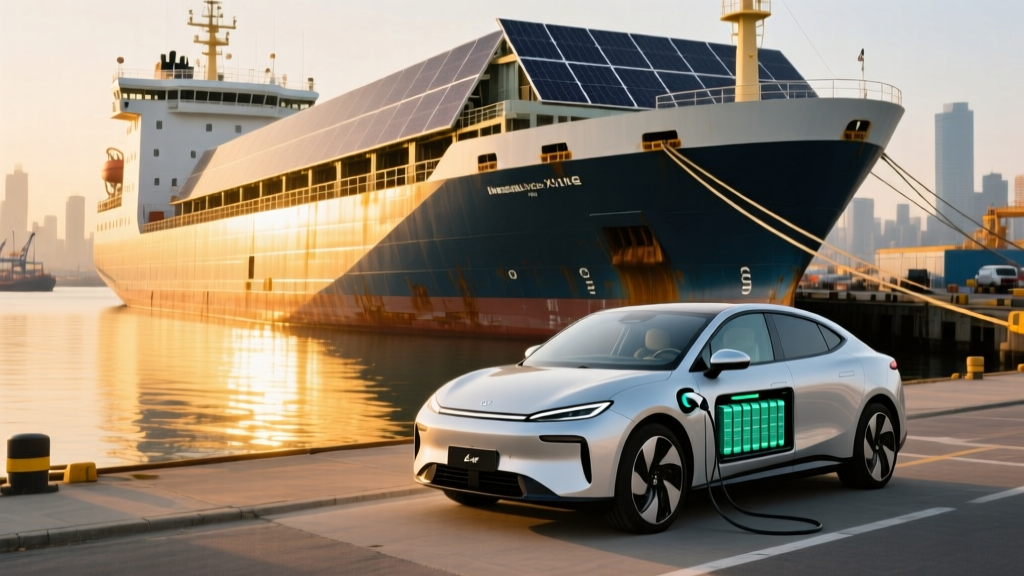
The global fleet of electric cargo ships has grown from a handful of pilot vessels in 2022 to over 50 operational battery-electric and hybrid-electric cargo ships by early 2026, according to maritime industry tracker DNV's alternative-fueled vessel database. These ships face the same fundamental question every EV buyer asks: Can batteries deliver enough range at a cost that beats fossil fuels?
The answer, in both sectors, depends on your route, your climate, and how you do the math.
Scale Comparison: Ship Batteries vs. Car Batteries
The numbers are dramatically different, but the engineering trade-offs are the same.
| Metric | Electric Cargo Ship (Coastal) | 2026 Tesla Model Y LR | 2026 Ford F-150 Lightning Ext. Range |
|---|---|---|---|
| Battery Capacity | 2,000–7,500 kWh (LFP) | 81 kWh (NMC) | 131 kWh (NMC) |
| Range | 60–200 nautical miles | 320 miles EPA (~275 real-world hwy) | 320 miles EPA (~270 real-world hwy) |
| Charge Power | 1.5–6 MW (shore power) | 250 kW peak DC | 150 kW peak DC |
| 10–80% Charge Time | 2–4 hours at berth | ~25 minutes | ~41 minutes |
| Battery Chemistry | LFP (dominant) | NMC | NMC |
| Approx. Battery Cost | $400,000–$1.5M | ~$12,000–$15,000 | ~$18,000–$22,000 |
| Warranty / Lifecycle | 10-year / 8,000+ cycles | 8 yr / 120,000 mi | 8 yr / 100,000 mi |
The key takeaway: cargo ship operators have overwhelmingly chosen LFP (lithium iron phosphate) chemistry for its longer cycle life, thermal stability, and lower cost per kWh — even though it sacrifices some energy density. That same trade-off is now playing out in consumer EVs. Tesla's standard-range Model 3 and Model Y already use LFP packs, and BYD's entire lineup is LFP-based. If you're choosing between an LFP and NMC pack in a 2026 EV, maritime operators' experience validates LFP for high-cycle, daily-use applications.
Cost Breakdown: Electric vs. Diesel — Ships and Cars
The ownership math for electric cargo ships mirrors what EV buyers calculate when comparing a battery-electric vehicle against a gas or diesel alternative.
| Cost Factor | Electric Cargo Ship | Diesel Cargo Ship | 2026 EV (Avg) | 2026 Gas Car (Avg) |
|---|---|---|---|---|
| Upfront Premium | +25–40% over diesel | Baseline | +15–30% over gas equivalent | Baseline |
| Energy Cost per Mile | $0.12–$0.20/mi (shore electricity) | $0.35–$0.55/mi (marine diesel) | $0.04–$0.06/mi (home L2) | $0.12–$0.18/mi (gasoline) |
| Annual Maintenance | ~60% less than diesel | Baseline | ~40% less than ICE | Baseline |
| Payback Period | 4–7 years | N/A | 3–6 years (w/ home charging) | N/A |
| Major Replacement Risk | Battery at 10–15 yr ($400K+) | Engine overhaul at 15–20 yr | Battery at 15+ yr ($8K–$20K) | Transmission/engine at 12+ yr |
The pattern is identical: higher upfront cost, dramatically lower operating cost, and a payback period that depends heavily on utilization. A cargo ship running daily 100-nautical-mile routes saves on fuel fast. An EV driver with a 40-mile daily commute and home Level 2 charging saves similarly. The economics break down for both when utilization is low or when you must rely on expensive public charging (or, for ships, diesel backup generators at ports without shore power).
Charging Infrastructure: The Shared Bottleneck
Electric cargo ships face an infrastructure problem that should feel familiar to any EV owner who has pulled up to a broken Electrify America stall: the charging network is growing, but it's inconsistent and capital-intensive.
For ships, "charging" means connecting to shore-side electrical infrastructure rated at 1.5 to 6 megawatts — the equivalent of 15 to 60 Tesla Superchargers running simultaneously. Most ports simply don't have this capacity yet. The Port of Los Angeles and Port of Rotterdam are among early adopters building megawatt shore-power systems, but the global rollout is slow.
For EV buyers, the parallel is the public DC fast-charging network: expanding rapidly through the NEVI program and Tesla's NACS opening, but still plagued by reliability gaps in rural corridors. In both cases, the solution is the same — plan your route around confirmed infrastructure, not optimistic maps.
Common Misconceptions: Ships and Cars
| Myth | Fact |
|---|---|
| "Electric ships can't cross oceans." | True for now. Battery-electric cargo ships serve short coastal/inland routes (60–200 nm). Transoceanic shipping requires ammonia, hydrogen, or hybrid solutions — just as long-haul trucking may need hydrogen before batteries scale. |
| "Ship batteries are too heavy to be practical." | A 7,500 kWh LFP pack weighs ~75 tons on a ship that displaces 5,000+ tons. Weight matters less at sea than on roads. For EVs, pack weight (1,000–2,000 lbs) reduces efficiency by ~5–10% vs. gas equivalents but improves center of gravity. |
| "LFP batteries don't last as long." | The opposite. LFP cells typically deliver 3,000–6,000+ cycles vs. 1,000–2,000 for NMC. Cargo ships chose LFP specifically for cycle longevity. For cars, LFP means less degradation over 100K+ miles — but with ~10–15% less range per kWh. |
| "EVs and electric ships are zero-emission." | Both are only as clean as their electricity source. A ship charging from a coal-heavy grid or an EV charging from the same reduces emissions but doesn't eliminate them. See EPA grid emissions data for your region. |
Real-World Ownership Considerations
Whether you're a port operator deciding on an electric tugboat or a suburban driver choosing a 2026 EV, these real-world factors determine satisfaction:
Climate and Temperature
Cold water and cold air both sap battery performance. LFP packs — dominant in cargo ships — lose roughly 20–30% of usable capacity at freezing temperatures compared to 15–25% for NMC. EV buyers in northern states should factor in winter range loss regardless of chemistry. Preconditioning your battery before DC fast charging (a feature on most 2026 EVs) mitigates slow charging in cold weather, just as ships pre-heat battery systems before shore-power connection.
Daily Route Predictability
Electric cargo ships thrive on fixed, short routes — the same way EVs thrive for commuters with predictable daily mileage under 80 miles. The math breaks down for both when routes are unpredictable or exceed single-charge range. For ships, that means hybrid-electric or conventional diesel for long-haul. For cars, it might mean a PHEV (plug-in hybrid) like the Toyota RAV4 Prime with 42 miles of electric range plus a gas engine for road trips.
Charging Access at "Home"
A cargo ship needs a dedicated berth with shore power. An EV needs a garage or driveway with at least a 120V outlet (Level 1, adding ~4 miles/hour) or ideally a 240V Level 2 circuit (adding 25–44 miles/hour). Neither works well without dedicated infrastructure. Apartment dwellers and ships at unequipped ports face the same constraint: you're dependent on public or shared infrastructure that may not be available when you need it.
Decision Framework: What EV Buyers Should Take Away
If-Then Guide for 2026 EV Buyers
- If you drive under 60 miles/day with home charging access: Any current EV works. Prioritize LFP chemistry (Tesla Model 3 RWD, BYD models) for longest battery life. The same logic cargo ship operators use for daily short routes.
- If you regularly drive 200+ miles on highways: Choose NMC chemistry with 300+ EPA miles (Hyundai Ioniq 6, Chevy Equinox EV). Expect 250–275 real-world highway miles. Plan DC fast stops — peak charge rates of 200–350 kW mean 10–80% in 18–30 minutes, but tapering above 80% adds time.
- If you live in an apartment without charging: A PHEV (Toyota Prius Prime, Jeep Wrangler 4xe) or rely exclusively on workplace/public charging. Budget for higher per-kWh costs at public chargers ($0.30–$0.60/kWh vs. $0.12–$0.16 home).
- If cold winters are your norm: Add 20–30% to your range buffer. A vehicle rated at 300 EPA miles will deliver ~210–240 in sub-freezing highway driving. Heat pumps (standard on most 2026 Hyundai/Kia/Tesla models) reduce this penalty.
- If you tow frequently: Expect 40–50% range loss at highway speeds with a loaded trailer. The Ford F-150 Lightning's 320-mile EPA range drops to ~160–190 miles towing. This mirrors cargo ships that sacrifice range for payload.
Federal Tax Credit: Current Rules for 2026
The IRS §30D Clean Vehicle Credit remains available for qualifying new EVs in 2026, but eligibility is strict:
- Maximum credit: Up to $7,500 ($3,750 for meeting critical-minerals requirements + $3,750 for battery-component requirements)
- MSRP caps: $55,000 for sedans; $80,000 for SUVs, vans, and trucks
- Buyer income caps: $150,000 single / $225,000 head of household / $300,000 married filing jointly (modified AGI)
- Battery sourcing: Increasing percentages of critical minerals and battery components must be sourced from the US or FTA partners — rules that tighten annually
- Point-of-sale transfer: You can transfer the credit to the dealer at purchase for an immediate price reduction rather than waiting for tax filing
Always verify current eligibility on the IRS website or with a tax professional before assuming you'll receive the credit. Sourcing requirements have disqualified several popular models in prior years.
Frequently Asked Questions
Are there fully electric cargo ships crossing oceans today?
No. As of 2026, battery-electric cargo ships operate on short coastal, inland, and port routes — typically under 200 nautical miles. Transoceanic shipping is exploring green ammonia, methanol, and hydrogen fuel cells, but battery-electric is not viable for 5,000+ mile crossings due to energy-density limits. This parallels why battery-electric long-haul trucks (Class 8) remain limited to regional drayage rather than cross-country freight.
What battery chemistry do electric cargo ships use, and should I care as a car buyer?
Most electric cargo ships use LFP (lithium iron phosphate) cells because they prioritize cycle life (5,000+ cycles) and safety over energy density. As a car buyer, this matters: LFP-equipped EVs (Tesla Model 3 Standard Range, BYD Atto 3, some Ford models) tend to degrade more slowly over time and can be charged to 100% regularly without harm — unlike NMC packs, which benefit from an 80% daily charge limit. The trade-off is that LFP packs are heavier per kWh and offer slightly less range in the same physical space.
How does charging an electric cargo ship compare to charging an EV?
Both follow the same physics: higher power (kW) fills the battery faster, but the charge curve tapers as the battery approaches full capacity. A ship connecting to 3 MW shore power charges its 3,000 kWh bank in roughly 2 hours for a 10–80% session. Your EV at a 250 kW DC fast charger fills an 80 kWh pack in roughly 25 minutes for the same 10–80% window. The ratio is similar — about 1C charge rate — but ships charge at berth during cargo loading, while EVs charge during a rest stop.
Will electric cargo ship technology make EV batteries cheaper?
Yes, indirectly. The maritime sector's demand for LFP cells and large-format battery modules is driving economies of scale in the same supply chains that feed automakers. As CATL, BYD, and other cell manufacturers scale production for both ships and cars, per-kWh costs continue to decline. Industry analysts project average pack costs below $90/kWh by 2027, down from roughly $130/kWh in 2024 — benefiting both sectors.
What's the total cost of ownership for a typical EV in 2026?
For a mid-size EV like the Hyundai Ioniq 5 (starting ~$42,000 MSRP), a 5-year ownership estimate with 12,000 miles/year and home charging at $0.14/kWh looks like: ~$5,800 in electricity (vs. ~$9,500 in gasoline for a comparable gas car), ~$2,200 in maintenance (vs. ~$4,000 for ICE), and ~$7,500 in insurance (typically 15–25% higher than gas equivalents). Net savings of $4,000–$6,000 over 5 years are typical for home-charging owners, before any federal or state incentives. Without home charging, public DC costs ($0.35–$0.55/kWh) can erase much of the fuel savings.
The electrification of cargo shipping and personal transportation are two branches of the same tree. The battery chemistry choices, infrastructure gaps, ownership economics, and cold-weather realities that port operators navigate daily are the same factors you'll weigh when choosing your next EV. Understanding how industrial operators solve these problems at scale gives you a clearer picture of what works — and what doesn't — in your driveway.