The Short Answer
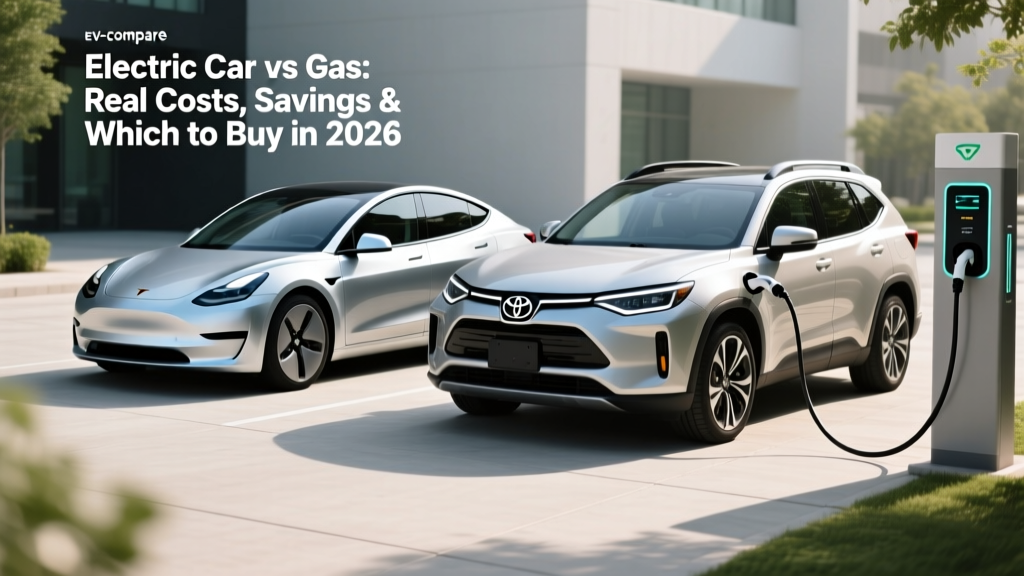
An electric car costs less to operate than a gas car in most U.S. markets — typically saving $800–$1,500 per year on fuel and maintenance — but the upfront purchase price remains higher. After applying the federal §30D tax credit (up to $7,500 for qualifying new EVs) and accounting for lower per-mile energy costs, many EVs reach cost parity with comparable gas vehicles within 3–5 years. The right choice depends on your home charging access, daily mileage, climate, and whether you qualify for incentives. If you can install a Level 2 home charger and drive 10,000–15,000 miles annually, an EV almost always wins on total cost of ownership. If you rely solely on public charging or live in an apartment without charging access, a hybrid or efficient gas car may be the smarter financial move.
The Upfront Cost Gap: What You Actually Pay
The sticker-price gap between electric and gas vehicles has narrowed significantly by 2026, but it hasn't disappeared. A well-equipped compact EV like the Chevrolet Equinox EV starts around $33,000 MSRP, while a comparably trimmed gas-powered Equinox starts near $28,600. That's roughly a $4,400 premium before incentives.
Here's where the federal §30D clean vehicle credit changes the math. Qualifying buyers can receive up to $7,500 — applied at the point of sale — which can flip the EV into the cheaper option at signing. But eligibility is far from universal:
§30D Credit Requirements (2026 Tax Year)
- MSRP caps: Vans, SUVs, and trucks must be under $80,000; sedans under $55,000
- Buyer income limits: $150,000 single / $225,000 head of household / $300,000 joint MAGI
- Battery sourcing: Critical minerals and battery components must meet escalating North American content thresholds — many imported EVs are partially or fully disqualified
- Final assembly: Vehicle must be assembled in North America
- Point-of-sale transfer: You can apply the credit as a down-payment reduction at the dealer, regardless of tax liability
Source: IRS.gov — rules subject to change. Consult a tax professional for your specific situation.
The used-EV market offers another path. The §25E credit provides up to $4,000 (or 30% of the sale price, whichever is lower) on used EVs priced at $25,000 or less, with lower income caps ($75,000 single / $150,000 joint). A 2–3-year-old Tesla Model 3 or Hyundai Ioniq 5 often falls within this window.
Fuel vs. Electricity: The Per-Mile Cost Reality
This is where EVs consistently win, but the margin depends heavily on how and where you charge. The U.S. average residential electricity rate sits around $0.16/kWh in early 2026, while the national average for regular gasoline hovers near $3.30/gallon.
| Vehicle Type | Efficiency | Energy/Fuel Price | Annual Cost |
|---|---|---|---|
| EV (home charging, avg. efficiency) | 3.0 mi/kWh (33 kWh/100mi) | $0.16/kWh | $640 |
| EV (home, efficient model like Hyundai Ioniq 6) | 4.0 mi/kWh (25 kWh/100mi) | $0.16/kWh | $480 |
| EV (DC fast charging only, avg. $0.40/kWh) | 3.0 mi/kWh | $0.40/kWh | $1,600 |
| Gas car (28 MPG combined) | 28 MPG | $3.30/gal | $1,414 |
| Gas car (efficient, 35 MPG combined) | 35 MPG | $3.30/gal | $1,131 |
| Hybrid (Toyota Camry Hybrid, 51 MPG) | 51 MPG | $3.30/gal | $776 |
The critical takeaway: home charging is non-negotiable for maximizing EV savings. If you're paying $0.35–$0.50/kWh at DC fast chargers exclusively, your "fuel" cost can actually exceed that of an efficient gas car. Home Level 2 charging at residential rates delivers 50–70% savings over gasoline.
Also factor in EPA efficiency ratings. An efficient EV like the Ioniq 6 (140 MPGe combined, roughly 25 kWh/100mi) will cost significantly less to operate than a heavier, less aerodynamic EV like the Ford F-150 Lightning (roughly 48 kWh/100mi), which can push home-charging costs above $900/year.
Maintenance, Insurance, and the Hidden Costs
EVs eliminate oil changes, spark plugs, timing belts, transmission fluid, and exhaust system repairs. Brake pad life extends dramatically thanks to regenerative braking — many EV owners report original brake pads lasting 80,000+ miles. Consumer data consistently shows EV maintenance costs running 30–50% lower than gas vehicles, averaging roughly $0.061/mile for an EV versus $0.101/mile for a gas car (based on AAA and DOE analyses).
At 12,000 miles/year, that's approximately $732/year for EV maintenance versus $1,212/year for gas — a $480 annual savings.
However, two cost categories often catch first-time EV buyers off guard:
Insurance: EV insurance premiums run 15–25% higher on average than comparable gas vehicles, driven by higher repair costs (specialized parts, battery-safe procedures, and ADAS sensor recalibration after collisions). A Model Y might cost $2,400/year to insure versus $1,900 for a comparably priced gas SUV. Always get quotes before purchasing.
Tires: EVs are heavier (battery weight) and deliver instant torque, accelerating tire wear by 15–30%. Budget for replacement tires every 25,000–35,000 miles rather than the 40,000–50,000 miles typical for gas cars. EV-specific tires (like Michelin's e.Primacy line) help but carry a premium.
Real-World Range, Charging, and the Ownership Experience
EPA range stickers tell only part of the story. In real-world driving, expect to see 10–20% less range than the EPA estimate under normal highway conditions (70+ mph), and 20–40% reduction in freezing temperatures. An EV rated at 300 miles EPA might realistically deliver 250 miles on a summer highway road trip and 200 miles in a 20°F winter commute.
Charging speed matters as much as range. Peak DC fast-charge rates (advertised in kW) are never sustained across the full session. A vehicle that peaks at 250 kW might only sustain that rate between 10–30% state of charge, tapering significantly above 80%. A realistic 10–80% session at a 350 kW charger for a modern 800V architecture vehicle (like the Ioniq 5 or Porsche Taycan) takes 18–22 minutes. Older 400V architectures take 28–40 minutes for the same session.
Home charging access is the single biggest predictor of EV satisfaction. A Level 2 home charger (240V, 32–48 amps / 7.7–11.5 kW) adds roughly 25–35 miles of range per hour of charging and costs $500–$2,000 to install depending on your electrical panel. Most EV owners charge overnight and start every morning with a "full tank." If you live in an apartment, condo, or street-parking situation without charging access, daily EV life becomes significantly more inconvenient and expensive.
5-Year Total Cost of Ownership: EV vs. Gas vs. Hybrid
| Category | Compact EV (e.g., Equinox EV 2LT, ~$38k MSRP) |
Compact Gas (e.g., Equinox RS, ~$32k MSRP) |
Hybrid (e.g., Toyota RAV4 Hybrid, ~$33k MSRP) |
|---|---|---|---|
| Purchase price (after incentives) | $30,500* | $32,000 | $33,000 |
| Energy/fuel (5 years) | $3,200 | $7,070 | $3,880 |
| Maintenance (5 years) | $3,660 | $6,060 | $4,800 |
| Insurance (5 years) | $12,000 | $9,500 | $9,800 |
| Home charger install | $1,200 | $0 | $0 |
| Estimated depreciation | $15,000 | $14,500 | $14,000 |
| Total 5-Year Cost | $65,560 | $69,130 | $65,480 |
*Assumes full $7,500 §30D credit eligibility. Actual costs vary by state, driving patterns, electricity rates, and insurance profile. EV depreciation remains volatile — some models depreciate faster than gas counterparts due to rapid technology cycles and price cuts.
The numbers reveal a tight race. The EV wins on energy and maintenance but gives back ground on insurance, charger installation, and depreciation. The hybrid nearly matches the EV's total cost without requiring any charging infrastructure — a compelling option for apartment dwellers or those in areas with unreliable public charging.
Common Misconceptions — Myth vs. Fact
| Myth | Fact |
|---|---|
| "EV batteries need replacing every 5 years and cost $20,000" | Modern LFP and NMC batteries are warrantied for 8 years/100,000 miles (federally mandated minimum). Real-world degradation data shows most packs retaining 85–90% capacity at 100,000 miles. Full replacement is rare and typically $8,000–$15,000, not $20,000+. |
| "EVs are worse for the environment because of battery mining" | Lifecycle analyses (including from the Union of Concerned Scientists and ICCT) consistently show EVs produce 50–70% fewer lifetime emissions than gas cars, even accounting for battery manufacturing and grid electricity sources. The grid is also getting cleaner each year. |
| "You can't take an EV on a road trip" | The U.S. now has over 200,000 public charging ports, with Tesla's Supercharger network open to NACS-equipped vehicles from Ford, GM, Rivian, and others. A 500-mile trip requires one 20–30 minute DC fast-charge stop — comparable to a gas stop with a meal break. |
| "EVs are slow in cold weather" | EVs deliver instant torque regardless of temperature — they're often faster in cold starts than gas cars. However, cold reduces range by 20–40% due to battery chemistry and cabin heating demands. A heat pump (standard on most 2026 EVs) recovers some of that loss. |
| "The electric grid can't handle millions of EVs" | Most EV charging happens overnight during off-peak hours when grid capacity is underutilized. Utilities are also deploying managed charging programs and time-of-use rates that incentivize off-peak charging. |
Decision Framework: Which Should You Buy?
Choose an Electric Car If:
- You have access to home or workplace Level 2 charging
- Your daily commute is under 80 miles round-trip (covers 90%+ of U.S. commutes)
- You qualify for the §30D federal tax credit or your state offers meaningful EV incentives
- You drive 10,000+ miles per year (higher mileage = faster payback on fuel savings)
- You want minimal maintenance and instant acceleration
- You're purchasing a second vehicle and can keep a gas car for rare long trips
Choose a Hybrid (HEV) If:
- You lack reliable home or workplace charging access
- You frequently drive 300+ miles between stops in rural areas or charging deserts
- You want EV-like fuel savings (~45–55 MPG) without any behavior change
- Your budget is tight and you want to avoid the EV price premium entirely
Choose a Plug-in Hybrid (PHEV) If:
- You have home charging but also take regular long road trips
- Your commute is under 30–40 miles (covering most PHEV electric-only ranges)
- You want to drive electric daily but keep gas flexibility — the "best of both worlds" option
- Models like the Toyota RAV4 Prime (42 miles electric-only, 38 MPG on gas) or Jeep Wrangler 4xe (22 miles electric) fit your needs
Stick with Gas (for now) If:
- You live in an apartment with no charging and public infrastructure in your area is sparse
- You tow heavy loads regularly (EV range drops 40–60% under heavy towing)
- Your budget is under $25,000 and the used-EV market in your area is limited
What First-Time EV Buyers Must Know Before Signing
1. Test the charging situation before you buy. Download apps for Electrify America, EVgo, and ChargePoint. Map out the chargers near your home, workplace, and frequent routes. If the nearest reliable DC fast charger is more than 15 minutes away and you can't charge at home, reconsider.
2. Get your electrical panel assessed. A Level 2 charger requires a 240V circuit (typically NEMA 14-50 or hardwired). Older homes with 100-amp panels may need a $1,500–$3,000 panel upgrade to 200 amps. Get a licensed electrician's quote before committing to an EV.
3. Check your insurance costs early. Call your insurer with the exact EV model and trim before purchasing. Premium differences of $400–$800/year are common and can erase your fuel savings if you're a low-mileage driver.
4. Understand the battery warranty. Federal law mandates a minimum 8-year/100,000-mile battery warranty covering defects and capacity loss below a stated threshold (usually 60–70% of original capacity). Some manufacturers offer 10-year coverage. Read the fine print — "capacity degradation" thresholds vary.
5. Learn about preconditioning. Most EVs can precondition (warm up) the battery before you arrive at a DC fast charger, which dramatically improves charge speed — especially in cold weather. Navigate to the charger using the car's built-in navigation to trigger this automatically.
Frequently Asked Questions
Is an electric car cheaper than gas over 5 years?
In most cases, yes — but the margin is narrower than headlines suggest. After accounting for higher insurance, potential home charger installation, and faster depreciation on some models, the 5-year savings typically range from $2,000–$6,000 compared to a gas equivalent. The savings widen significantly for high-mileage drivers (15,000+ miles/year) who charge at home.
Do electric cars save money on maintenance?
Yes, substantially. No oil changes ($40–$80 each, 2–3 times/year), no transmission fluid, no spark plugs, no exhaust repairs, and regenerative braking extends brake pad life to 80,000+ miles. Expect to spend roughly $700–$900/year on EV maintenance (tire rotations, cabin air filters, wiper fluid) versus $1,100–$1,400 for a gas car.
What happens if my EV battery dies out of warranty?
Full battery pack replacement costs $8,000–$15,000 depending on the vehicle, but this is uncommon. Most modern EV batteries degrade gradually — losing 10–15% capacity over 100,000 miles — rather than failing catastrophically. NHTSA and independent studies show battery failure rates under 2% within the warranty period. LFP chemistry batteries (used in base-model Tesla Model 3/Y and some Ford models) show even slower degradation and longer cycle life.
Can I charge an EV with a regular household outlet?
Yes — a standard 120V outlet (Level 1) adds roughly 3–5 miles of range per hour, or 35–50 miles overnight. This works for low-mileage drivers (under 30 miles/day) but is painfully slow for higher-mileage use. A 240V Level 2 installation is strongly recommended and adds 25–35 miles per hour of charging.
Are hybrids better than EVs for some people?
Absolutely. If you can't charge at home, drive in areas with sparse charging infrastructure, regularly tow, or simply want zero lifestyle change, a hybrid like the Toyota Prius (57 MPG combined) or RAV4 Hybrid (39 MPG) delivers excellent fuel savings with no charging required. PHEVs bridge the gap for those who want electric commuting with gas flexibility.