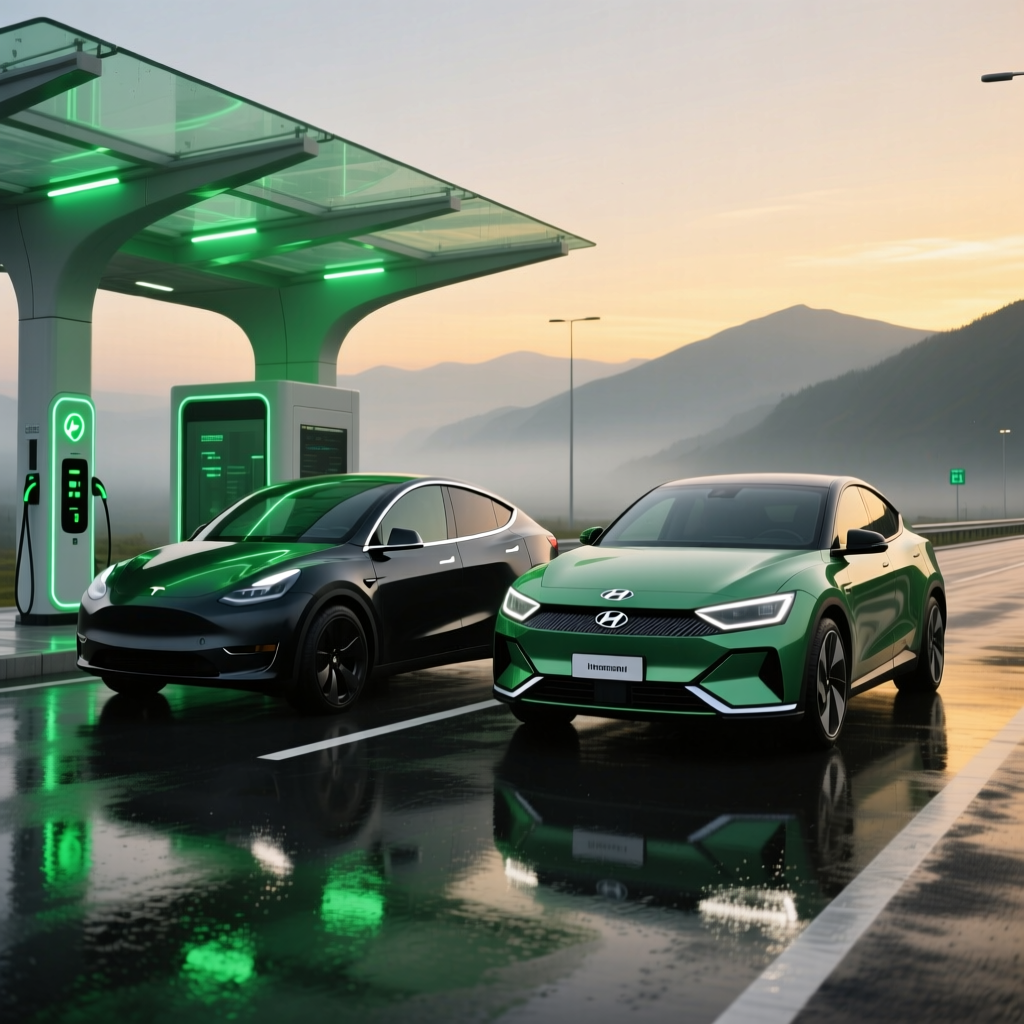
Tesla Model Y vs. Hyundai Ioniq 5: An Independent Testing & Consumer Review Deep Dive
When shoppers search for electric car reviews consumer reports and independent testing agencies consistently highlight two dominant forces in the crossover EV segment: the Tesla Model Y and the Hyundai Ioniq 5. Buying an electric vehicle is a significant investment, and relying on rigorous, unbiased data is the best way to ensure your chosen EV fits your lifestyle. In this comprehensive head-to-head comparison, we channel the meticulous methodology of top-tier consumer advocacy groups to evaluate these two industry benchmarks.
Whether you are prioritizing charging infrastructure, cutting-edge 800-volt architecture, or long-term reliability, understanding the empirical data behind these vehicles is crucial. Below, we break down the EPA ratings, independent track tests, real-world range evaluations, and ownership costs to help you decide which electric crossover deserves a spot in your driveway. For more broad rankings, be sure to check out our guide to the best electric SUVs on the market.
Vehicle Overviews
The Tesla Model Y is the undisputed sales champion of the EV world. Built on a modified version of the Model 3 platform, it offers a minimalist interior, class-leading cargo capacity, and seamless access to the Supercharger network. Tesla’s vertical integration allows for continuous over-the-air (OTA) software updates and highly efficient thermal management systems, making it a favorite among tech-forward buyers and long-distance commuters alike. You can read our full breakdown in our dedicated Tesla Model Y review.
The Hyundai Ioniq 5, on the other hand, represents a paradigm shift for legacy automakers. Built on Hyundai’s Electric Global Modular Platform (E-GMP), it features a retro-futuristic design, a spacious lounge-like cabin, and an ultra-fast 800-volt electrical architecture. It has garnered massive acclaim from automotive journalists and consumer testing groups for its ride comfort, vehicle-to-load (V2L) capabilities, and rapid charging speeds. Dive deeper into its quirks and triumphs in our Hyundai Ioniq 5 review.
Side-by-Side Spec Comparison
Before diving into the nuanced data from independent testing, let us look at the baseline specifications for the most popular dual-motor, long-range variants of both vehicles.
| Specification | Tesla Model Y (Long Range AWD) | Hyundai Ioniq 5 (Long Range AWD) |
|---|---|---|
| EPA Estimated Range | 330 miles | 290 miles |
| Battery Capacity (Usable) | ~75 kWh | 77.4 kWh |
| Peak Charging Speed | 250 kW | 350 kW (800V Architecture) |
| 0-60 MPH (Independent Test) | 4.8 seconds | 5.1 seconds |
| Cargo Space (Behind 2nd Row) | 30.2 cu ft | 27.2 cu ft |
| Frunk Capacity | 4.1 cu ft | 0.85 cu ft |
| Starting MSRP (Approx.) | $48,000 | $47,000 |
Range & Efficiency: EPA Ratings vs. Real-World Testing
Range anxiety remains a primary concern for EV adopters, making independent range testing a critical component of any thorough evaluation. According to EPA ratings, the Tesla Model Y Long Range achieves an impressive 330 miles on a single charge, while the Hyundai Ioniq 5 Long Range AWD is rated for 290 miles. However, consumer testing organizations frequently note that EPA estimates do not always reflect real-world highway driving at higher speeds.
In independent highway range tests conducted at a steady 70 mph, the Model Y consistently outperforms its EPA rating or comes remarkably close, thanks to Tesla’s industry-leading aerodynamic efficiency and the Octovalve thermal management system. The Model Y’s heat pump efficiently scavenges waste heat from the battery and motors, preserving range in colder climates—a scenario where many EVs struggle.
The Ioniq 5, while slightly behind in absolute range, offers exceptional efficiency for its boxy, retro design. Its larger 77.4 kWh battery provides a solid buffer, and independent testers have praised its predictable range degradation. However, in sub-freezing temperatures, the Model Y’s thermal management system currently holds a slight edge in preserving cabin heat without severely impacting the battery's state of charge. For buyers who frequently road-trip through varying climates, the Model Y’s efficiency profile offers a distinct advantage.
Pricing, Value & Incentives
When analyzing the financial aspect of EV ownership, base pricing only tells half the story. Both the Model Y and the Ioniq 5 are positioned in the premium mainstream crossover segment, with starting prices hovering in the high-$40,000 range before options and incentives. However, their value propositions differ significantly based on standard equipment and available tax credits.
Hyundai typically equips the Ioniq 5 with a generous list of standard features, including ventilated seats, a premium audio system, and advanced driver assistance technologies, even on lower trims. Tesla takes a more streamlined approach; the base Model Y includes almost all hardware features by default, but buyers often pay extra for enhanced paint colors, larger wheels, and the controversial Full Self-Driving (FSD) software package.
Crucially, buyers must navigate the complex landscape of federal and state EV tax incentives. Because Tesla manufactures its vehicles domestically and sources battery components in accordance with current federal guidelines, the Model Y has consistently qualified for the maximum federal point-of-sale rebate. Hyundai’s eligibility has historically fluctuated based on final assembly locations, though the opening of their North American battery plants has largely rectified this. Always consult the latest official government databases to verify current incentive eligibility before purchasing.
Charging Speed & Infrastructure
This is where the battle between legacy engineering and Silicon Valley infrastructure gets fierce. The Hyundai Ioniq 5 boasts an 800-volt electrical architecture, allowing it to accept up to 350 kW of power at compatible DC fast chargers. In independent testing, the Ioniq 5 has demonstrated the ability to charge from 10% to 80% in roughly 18 minutes under optimal conditions. This blistering speed is a game-changer for road trippers who want to minimize downtime.
The Tesla Model Y operates on a 400-volt architecture, peaking at 250 kW on V3 Superchargers. A 10% to 80% charge takes approximately 25 to 30 minutes. On paper, the Hyundai charges faster. However, the real-world advantage heavily favors Tesla due to the Supercharger network. Tesla’s proprietary network is renowned for its reliability, ease of use (plug-and-charge with no apps or RFID cards required), and widespread availability along major highways.
Hyundai owners must rely on third-party networks like Electrify America or EVgo. While these networks are expanding and improving, independent consumer reviews frequently cite issues with broken chargers, fragmented payment systems, and slower-than-advertised speeds due to station sharing. It is worth noting that Hyundai has begun adopting the North American Charging Standard (NACS) port for future models and provides adapters for current owners, bridging the gap and allowing Ioniq 5 drivers to access Tesla’s Supercharger network, effectively neutralizing Tesla’s biggest historical moat.
Performance & Driving Dynamics
Independent track testing and back-to-back driving evaluations reveal two distinctly different philosophies in vehicle dynamics. The Tesla Model Y is tuned for agility and straight-line speed. Its dual-motor setup provides instantaneous torque, and the low center of gravity—dictated by the skateboard battery pack—results in minimal body roll during aggressive cornering. Recent suspension updates from Tesla have softened the ride quality, addressing long-standing consumer complaints about harshness over rough pavement, though it still leans toward the sporty side of the spectrum.
The Hyundai Ioniq 5 prioritizes comfort and isolation. Its multi-link rear suspension and sophisticated damping system absorb bumps and road imperfections with a maturity that rivals luxury German sedans. While it is slightly slower to 60 mph than the Model Y, the Ioniq 5’s power delivery is incredibly smooth and linear. Independent testers often note that the Ioniq 5 is the superior daily driver for urban environments and poorly maintained roads, whereas the Model Y feels more at home on sweeping canyon roads and open highways.
Furthermore, the Ioniq 5 offers a unique party trick: Vehicle-to-Load (V2L) capability. Using an adapter, the Ioniq 5 can output standard household AC power, allowing you to run appliances, charge e-bikes, or even power a campsite. Tesla has introduced similar bi-directional features in select markets, but Hyundai’s implementation is widely regarded as more accessible and user-friendly for the average consumer.
Interior Space, Comfort & Build Quality
Stepping inside these two vehicles highlights the contrast between minimalist tech and retro-lounge comfort. The Model Y’s interior is famously sparse. A single 15-inch touchscreen controls nearly every function of the car, from the windshield wipers to the glovebox. While this creates a clean, airy cabin with excellent outward visibility (aided by the massive panoramic glass roof), independent consumer reviews often point out the learning curve and the potential for distraction when adjusting basic climate settings while driving.
Build quality on the Model Y has improved drastically in recent production cycles, with tighter panel gaps and improved sound deadening. However, some hard plastics remain on the lower door panels and center console. Cargo space is a massive win for Tesla; the Model Y offers a deep rear trunk, a spacious under-floor storage area, and a usable front trunk (frunk), making it the undisputed king of family hauling.
The Ioniq 5’s interior is a masterclass in packaging. Thanks to the E-GMP platform’s long wheelbase and flat floor, the rear legroom is limousine-like. Hyundai utilizes sustainable, recycled materials that feel premium and tactile. Crucially, Hyundai retains physical buttons and stalks for essential functions like climate control and turn signals, a feature heavily praised by consumer advocacy groups for reducing driver distraction. The sliding center console is a brilliant touch, allowing front passengers to exit through the opposite door in tight parking spaces. However, the Ioniq 5’s frunk is virtually non-existent, and the sloping roofline slightly compromises rear cargo height compared to the Model Y.
Technology, Safety & Warranty
Both vehicles excel in safety, frequently earning top marks from the IIHS safety tests and government crash test programs. Their battery packs are heavily reinforced, and their low centers of gravity make rollover risks exceptionally low.
In terms of Advanced Driver Assistance Systems (ADAS), Tesla’s Autopilot and Hyundai’s Highway Driving Assist (HDA) represent two different approaches. Tesla’s vision-based system is highly capable on highways but requires constant supervision and can be overly cautious or erratic in complex construction zones. Hyundai’s HDA, which utilizes a combination of radar and cameras, is less aggressive but feels more natural and predictable to the average driver, smoothly handling stop-and-go traffic and lane centering without inducing anxiety.
Warranty coverage is an area where legacy automakers typically shine. Hyundai offers an industry-leading 10-year/100,000-mile powertrain and battery warranty, providing immense peace of mind for long-term owners. Tesla’s battery and drive unit warranty is robust at 8 years or 120,000 miles (whichever comes first), but its basic vehicle limited warranty is only 4 years or 50,000 miles, which falls short of Hyundai’s comprehensive bumper-to-bumper coverage.
The Verdict: Which EV Wins?
Deciding between the Tesla Model Y and the Hyundai Ioniq 5 ultimately comes down to your specific lifestyle, driving habits, and tolerance for technological minimalism. Both vehicles are spectacular achievements in modern automotive engineering and consistently top the charts in independent electric car reviews consumer reports and automotive journalists rely on.
Choose the Tesla Model Y if:
- You prioritize maximum cargo space and frunk utility for family road trips.
- You want the most efficient real-world range and cold-weather performance.
- You prefer a minimalist, tech-forward interior and seamless software integration.
- You want native, hassle-free access to the Supercharger network (though adapters are changing this landscape).
Choose the Hyundai Ioniq 5 if:
For more tailored recommendations, explore our complete EV charging guide and our rankings of the top electric crossovers on the market today.
Frequently Asked Questions
How do independent consumer reviews rate the Tesla Model Y vs. Hyundai Ioniq 5?
Independent testing agencies generally rate both vehicles exceptionally high, but for different reasons. The Model Y is consistently praised for its efficiency, cargo capacity, and software ecosystem. The Ioniq 5 is lauded for its ride quality, charging speed, and ergonomic interior design. Consumer advocacy groups often recommend the Ioniq 5 for drivers who prefer traditional automotive ergonomics, while the Model Y is recommended for tech-savvy buyers who prioritize range and network reliability.
Which EV has better long-term reliability according to consumer data?
Historically, Tesla has faced criticism for inconsistent build quality and panel gaps, though recent manufacturing updates have vastly improved these metrics. Hyundai’s E-GMP platform has proven mechanically robust, but some early adopters reported minor software glitches and 12-volt battery drain issues. Overall, both vehicles have fewer moving parts than internal combustion engines, leading to lower long-term maintenance costs. Hyundai’s 10-year powertrain warranty provides a stronger safety net for buyers concerned about out-of-warranty repair costs.
Do these electric vehicles qualify for federal tax incentives?
Tax incentive eligibility is subject to change based on battery sourcing and final assembly requirements mandated by federal law. The Tesla Model Y has consistently qualified for the maximum federal point-of-sale rebate due to its North American manufacturing footprint. Hyundai has rapidly expanded its US-based manufacturing and battery sourcing, making many Ioniq 5 trims eligible as well. Buyers should always verify the latest VIN-specific eligibility on the official government energy website before finalizing a purchase.
How does real-world range compare to EPA estimates in independent tests?
Independent highway tests typically show that the Tesla Model Y meets or slightly exceeds its EPA range estimates, thanks to its advanced thermal management and aerodynamic profile. The Hyundai Ioniq 5, while highly efficient, sometimes falls slightly short of its EPA rating in high-speed, cold-weather testing due to its boxier shape. However, the Ioniq 5's larger battery buffer and rapid charging speeds often negate the real-world range deficit during long road trips.