Electric Car Reviews in Australia: The Ultimate Head-to-Head EV Comparison
Australia's electric vehicle market has exploded with options, making it harder than ever to choose the right EV for your lifestyle, budget, and driving habits. Whether you're commuting through Sydney's CBD, tackling the long stretches between Melbourne and Adelaide, or navigating Brisbane's suburban sprawl, finding the perfect electric car requires careful comparison of range, price, charging infrastructure compatibility, and everyday practicality.
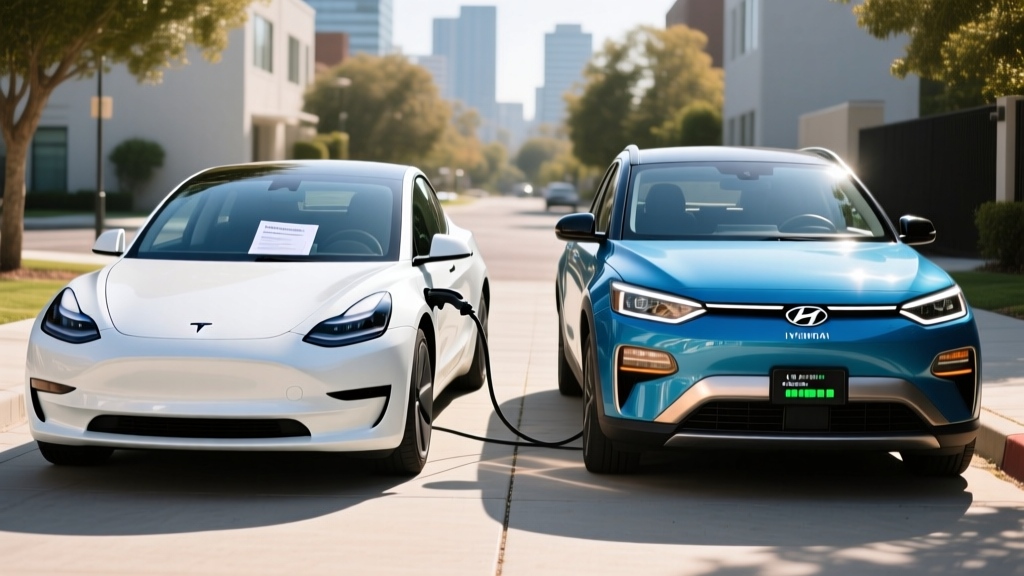
In this comprehensive head-to-head comparison, we pit two of Australia's most popular and critically acclaimed electric vehicles against each other: the Tesla Model Y and the BYD Atto 3. Both have dominated Australian EV sales charts and earned praise from reviewers across the country. But which one truly deserves your hard-earned money?
If you're new to electric vehicles, check out our beginner's guide to electric cars before diving into this comparison. For a broader look at the market, our best electric cars in Australia ranking covers every major contender.
Overview: Tesla Model Y vs BYD Atto 3
The Tesla Model Y arrived in Australia as a mid-size electric SUV that quickly became the best-selling vehicle in the country — not just the best-selling EV, but the best-selling vehicle overall. Its combination of long range, access to Tesla's Supercharger network, over-the-air updates, and strong performance credentials made it an irresistible proposition for Australian buyers transitioning from petrol and diesel vehicles.
The BYD Atto 3, meanwhile, stormed onto the Australian scene as a value-focused compact electric SUV that punched well above its weight. Backed by BYD's vertically integrated manufacturing — the company makes its own batteries, semiconductors, and components — the Atto 3 offered Australian buyers a compelling entry point into electric mobility without the premium price tag typically associated with EVs.
Both vehicles serve slightly different segments, yet they frequently cross-shop against each other. Many Australian buyers considering a Model Y also test-drive the Atto 3, drawn by the significant price difference. Conversely, Atto 3 shoppers often wonder whether stretching the budget for a Model Y is worth the premium. This comparison aims to answer that question definitively.
For individual deep dives, read our full Tesla Model Y review and our complete BYD Atto 3 review.
Side-by-Side Specification Comparison
| Specification | Tesla Model Y (Long Range AWD) | BYD Atto 3 (Extended Range) |
|---|---|---|
| Battery Capacity | 75 kWh (usable) | 60.48 kWh (usable) |
| WLTP Range | 533 km | 420 km |
| Power Output | 378 kW (combined) | 150 kW |
| Torque | 493 Nm | 310 Nm |
| 0-100 km/h | 5.0 seconds | 7.3 seconds |
| Drive Type | All-Wheel Drive (Dual Motor) | Front-Wheel Drive |
| DC Fast Charging (Max) | 250 kW | 80 kW |
| AC Charging | 11 kW (3-phase) | 7 kW (single-phase) |
| Length | 4,751 mm | 4,455 mm |
| Boot Space | 854 L (seats up) / 2,158 L (seats down) | 440 L (seats up) / 1,338 L (seats down) |
| Towing Capacity (braked) | 1,600 kg | Not rated |
| Warranty (Vehicle) | 4 years / 80,000 km | 6 years / 150,000 km |
| Battery Warranty | 8 years / 192,000 km | 8 years / 160,000 km |
Range & Real-World Efficiency
Range anxiety remains one of the biggest concerns for Australian EV buyers, and for good reason. Australia is a vast country with long distances between regional centres, and charging infrastructure outside major cities is still developing. This makes real-world range one of the most critical factors in any EV purchasing decision.
The Tesla Model Y Long Range AWD carries a 75 kWh usable battery pack and achieves a WLTP-rated range of 533 km. In independent real-world testing conducted by Australian automotive journalists and international bodies like EV Database, the Model Y typically delivers between 400 km and 480 km in mixed driving conditions. Highway cruising at 110 km/h on routes like the Hume Highway between Sydney and Melbourne will see range drop to approximately 380-420 km, depending on temperature, elevation changes, and driving style.
The BYD Atto 3 Extended Range uses a 60.48 kWh Blade battery and claims a WLTP range of 420 km. Real-world testing consistently shows the Atto 3 achieving between 320 km and 380 km in mixed conditions. On highway runs, expect approximately 300-340 km before needing to stop for a charge. This makes the Atto 3 perfectly adequate for city commuting and suburban driving, but it requires more careful planning for intercity trips.
Energy efficiency tells an interesting story. The Model Y achieves roughly 15.5-17.0 kWh/100 km in mixed driving, while the Atto 3 sits at approximately 16.0-18.5 kWh/100 km. Despite being a larger and heavier vehicle, the Tesla's superior aerodynamics and more advanced thermal management system give it a slight efficiency edge. The Model Y's heat pump comes standard and helps preserve range in cold conditions — something worth noting for buyers in Tasmania, Victoria, and the Snowy Mountains region.
For Australian drivers who regularly travel beyond city limits — think the Great Ocean Road, the drive from Perth to Margaret River, or the Pacific Highway corridor — the Model Y's range advantage becomes significant. However, if your daily commute is under 80 km round-trip and you can charge at home, the Atto 3's range is more than sufficient for daily life.
See how these models compare in our longest-range electric vehicles ranking.
Price & Value for Money
Pricing is where the BYD Atto 3 makes its most compelling argument. The Atto 3 Extended Range typically retails in Australia at a drive-away price point significantly below the Tesla Model Y, often by $15,000 to $25,000 depending on the specific variant and any applicable state or territory incentives.
The Tesla Model Y Long Range AWD commands a premium that reflects its larger battery, dual-motor all-wheel-drive system, longer range, and access to the Tesla Supercharger network. For many Australian buyers, this premium is justified by the tangible benefits: more range for road trips, faster charging speeds, better towing capacity, and a more spacious interior.
However, value isn't just about the sticker price. When you factor in running costs, the equation becomes more nuanced. Both vehicles benefit from significantly lower fuel costs compared to petrol equivalents — electricity costs roughly one-third to one-quarter of what petrol costs per kilometre in most Australian states. Home solar charging can push running costs even lower, potentially to near-zero during daylight hours for households with oversized solar systems.
Insurance costs tend to be higher for the Model Y, reflecting its higher purchase price and Tesla's historically expensive repair costs. The Atto 3 generally attracts lower insurance premiums, though this varies by insurer and driver profile. Registration discounts for EVs are available in some Australian states, and both vehicles qualify equally where these exist.
Depreciation is another critical factor. Tesla vehicles have historically experienced more volatile resale values, sometimes dropping sharply when Tesla adjusts new car pricing. BYD's resale values in Australia are still establishing themselves, making long-term depreciation harder to predict. Early indicators suggest the Atto 3 holds its value reasonably well, supported by strong demand in the used EV market.
For buyers working within a tighter budget, the Atto 3 represents outstanding value — it delivers a genuine electric SUV experience at a price point that undercuts many petrol-powered mid-size SUVs once you account for fuel savings. For buyers with more flexibility, the Model Y offers more capability for the additional investment.
Compare prices across the segment in our cheapest electric cars in Australia guide.
Charging Speed & Infrastructure
Charging speed is arguably the most impactful differentiator between these two vehicles, particularly for Australian drivers who need to rely on public fast-charging networks for road trips.
The Tesla Model Y supports DC fast charging at up to 250 kW via CCS2, and critically, it has native access to the Tesla Supercharger network — the most extensive and reliable fast-charging network in Australia. Superchargers are strategically located along major highways and in regional centres, making long-distance travel genuinely practical. A typical 10-80% charge at a V3 Supercharger takes approximately 25-30 minutes, adding roughly 300 km of range in just 15 minutes under optimal conditions.
The BYD Atto 3 supports DC fast charging at a maximum of 80 kW via CCS2. This means a 10-80% charge takes approximately 40-50 minutes at a compatible charger. While this is adequate for most scenarios — you'll typically stop for a coffee and a meal break anyway — it does mean longer wait times on road trips where every charging stop adds up.
On AC charging, the Model Y supports 11 kW three-phase charging, which can fully replenish the battery in roughly 7-8 hours from a compatible wallbox. The Atto 3 is limited to 7 kW single-phase AC charging, requiring approximately 9-10 hours for a full charge from a home wallbox. For overnight charging, both are perfectly adequate — you'll wake up to a full battery every morning regardless of which vehicle you choose.
Australia's public charging infrastructure continues to expand rapidly. Networks like Chargefox, Evie Networks, Ampol AmpCharge, and BP Pulse are adding chargers across the country. Both the Model Y and Atto 3 use the CCS2 standard, meaning they can access all of these networks. The Model Y's additional access to Superchargers gives it a meaningful advantage in coverage and reliability, particularly on popular routes like Sydney-Melbourne, Melbourne-Adelaide, and Brisbane-Gold Coast.
For home charging setup advice, read our home EV charger installation guide.
Performance & Driving Dynamics
The performance gap between these two vehicles is substantial, reflecting their different positioning in the market.
The Tesla Model Y Long Range AWD produces a combined 378 kW from its dual electric motors and hits 100 km/h from a standstill in just 5.0 seconds. This is sports-car territory from a family SUV. The instant torque delivery — a hallmark of all electric vehicles — makes the Model Y feel even quicker than its numbers suggest, particularly in urban driving where you're frequently accelerating from low speeds. The all-wheel-drive system provides excellent traction in wet conditions, and the low centre of gravity from the under-floor battery pack gives the Model Y surprisingly composed handling for a vehicle of its size.
The BYD Atto 3 sends 150 kW to the front wheels and achieves 0-100 km/h in 7.3 seconds. This is perfectly respectable and quicker than most petrol-powered compact SUVs. In daily driving, the Atto 3 feels responsive and eager, particularly in the 0-60 km/h range where electric motors excel. However, it lacks the urgency and all-weather confidence of the Model Y's dual-motor setup. On twisty roads, the Atto 3's front-wheel-drive layout and softer suspension tuning mean it prioritises comfort over cornering prowess.
Ride quality is an area where the Atto 3 surprisingly shines. Its suspension is tuned for comfort, absorbing bumps and imperfections with a suppleness that some reviewers have noted is superior to the Model Y's firmer setup. On Australia's sometimes rough suburban and regional roads, the Atto 3's compliant ride is a genuine advantage for daily comfort.
The Model Y's regenerative braking system is strong and intuitive, allowing for genuine one-pedal driving in most situations. The Atto 3 offers adjustable regenerative braking with two levels, though even the strongest setting doesn't quite achieve full one-pedal driving capability. Both vehicles offer smooth, quiet acceleration that makes petrol engines feel antiquated by comparison.
Noise, vibration, and harshness (NVH) levels are excellent in both vehicles, as expected from electric cars. The Model Y has improved significantly in this area with recent manufacturing updates from the Shanghai Gigafactory, with better sound insulation and reduced wind noise at highway speeds. The Atto 3 is also impressively quiet, with minimal road noise intrusion at speeds up to 100 km/h.
Interior Space, Comfort & Practicality
Interior space is where the physical size difference between these two vehicles becomes most apparent. The Model Y is classified as a mid-size SUV, while the Atto 3 sits in the compact SUV segment, and this translates directly to cabin and cargo dimensions.
The Tesla Model Y offers generous rear legroom and headroom, comfortably accommodating three adults across the back seat for long journeys. The panoramic glass roof creates an airy, spacious feeling throughout the cabin. Boot space is outstanding: 854 litres with the rear seats up, expanding to 2,158 litres with them folded. The Model Y also features a front trunk (frunk) with additional storage, and a deep under-floor storage area in the boot. For families, the Model Y can accommodate large prams, camping gear, and bulk grocery shops without breaking a sweat.
The BYD Atto 3 offers adequate rear seat space for two adults, though three across is tight for anything beyond short trips. Legroom is sufficient but not generous, and taller passengers may find the seating position slightly upright. Boot space is 440 litres with seats up — competitive for the compact SUV class but significantly less than the Model Y. The 1,338-litre figure with seats folded is practical for occasional large loads but trails the Tesla considerably.
Interior design philosophy differs dramatically between the two. The Model Y embraces radical minimalism: virtually all controls are accessed through the central 15-inch touchscreen, including the glovebox release, mirror adjustments, and climate controls. This approach divides opinion — some love the clean, futuristic aesthetic, while others find it frustrating for quick adjustments while driving.
The Atto 3 takes a more expressive approach with its gym-inspired interior design. Quirky touches include muscle-fibre-patterned door trim, dumbbell-shaped air vents, and guitar-string-style door pocket elastic. The 12.8-inch rotating touchscreen is a party trick that rotates between landscape and portrait orientations. Build quality in the Atto 3 is genuinely impressive for the price point, with soft-touch materials on most surfaces and solid assembly quality.
Both vehicles offer ISOFIX child seat anchors on the outboard rear seats. The Model Y's larger dimensions make installing and accessing child seats easier, while the Atto 3's higher hip point makes loading children in and out relatively straightforward despite the tighter space.
Technology, Safety & Warranty
Technology is a core part of the Tesla ownership experience. The Model Y comes with a sophisticated 15-inch touchscreen running Tesla's proprietary operating system, which includes navigation with real-time Supercharger routing, streaming music and video services, a web browser, and gaming capabilities. Over-the-air (OTA) updates regularly add new features, improve existing ones, and occasionally introduce entirely new capabilities — something Tesla does better than any other automaker.
Tesla's Autopilot driver assistance system comes standard, offering adaptive cruise control, lane-keeping assistance, and automatic emergency braking. The system is competent on Australian highways, though it requires constant driver supervision. Tesla's Enhanced Autopilot and Full Self-Driving Capability packages are available as optional extras, adding features like automatic lane changes and navigate-on-autopilot, though their capabilities in Australian conditions remain limited compared to North American performance.
The BYD Atto 3 features a 12.8-inch rotating touchscreen with Apple CarPlay and Android Auto (wired), DAB+ digital radio, Bluetooth connectivity, and satellite navigation. The infotainment system is functional and reasonably responsive, though it lacks the polish and ecosystem depth of Tesla's software. OTA updates are supported but tend to be less frequent and less transformative than Tesla's.
Safety is strong for both vehicles. The Model Y achieved a 5-star ANCAP safety rating with high scores across all crash test categories. The Atto 3 also earned a 5-star ANCAP rating, performing well in offset frontal, side impact, and whiplash tests. Both vehicles come with comprehensive active safety suites including autonomous emergency braking (AEB), blind-spot monitoring, rear cross-traffic alert, and lane departure warning.
Warranty coverage is an area where BYD holds a clear advantage. The Atto 3 comes with a 6-year/150,000 km vehicle warranty, compared to the Model Y's 4-year/80,000 km coverage. Both offer 8-year battery warranties, though Tesla's covers 192,000 km versus BYD's 160,000 km. For Australian buyers who plan to keep their vehicle long-term or drive high annual kilometres, the Atto 3's more generous vehicle warranty provides additional peace of mind.
Learn more about EV ownership in our EV maintenance costs guide and our EV battery warranty explainer.
Verdict: Which EV Is Right for You?
After extensively comparing both vehicles across every meaningful category, the right choice depends entirely on your priorities, budget, and driving patterns.
Choose the Tesla Model Y if:
- You regularly drive long distances. The Model Y's superior range and access to the Supercharger network make intercity and regional travel significantly more convenient. If you frequently drive Sydney to Melbourne, Brisbane to Cairns, or Perth to Albany, the Model Y is the clear winner.
- You need maximum cargo space. Families with large prams, active lifestyles requiring sports equipment transport, or anyone who values boot versatility will appreciate the Model Y's class-leading cargo capacity.
- Performance matters to you. The Model Y's dual-motor AWD system delivers exhilarating acceleration and confident all-weather capability that the Atto 3 simply cannot match.
- You want cutting-edge technology. Tesla's software ecosystem, OTA updates, and Supercharger integration represent the most advanced EV ownership experience available.
- You need towing capability. The Model Y's 1,600 kg braked towing rating makes it viable for small caravans and trailers — something the Atto 3 cannot offer.
Choose the BYD Atto 3 if:
- Budget is your primary concern. The Atto 3 delivers a compelling electric SUV experience at a significantly lower price point, freeing up funds for home charger installation, solar panels, or other investments.
- You primarily drive in the city and suburbs. For daily commutes under 80 km, school runs, and shopping trips, the Atto 3's range is more than adequate and you'll rarely think about its limitations.
- Comfort is more important than sportiness. The Atto 3's softer suspension and compliant ride quality make it a more relaxing daily driver on Australia's varied road surfaces.
- You want a longer vehicle warranty. BYD's 6-year/150,000 km warranty provides superior coverage for peace of mind.
- You prefer a more conventional interior. If Tesla's minimalist approach feels too stripped-back, the Atto 3's more traditional layout with physical elements and expressive design will feel more welcoming.
Both vehicles represent excellent choices in the Australian EV market. The Model Y is the more capable, more spacious, and more technologically advanced vehicle — but it costs significantly more. The Atto 3 is the smarter financial decision for urban-focused drivers who don't need the extra range and performance. Either way, you're making a strong choice for sustainable, affordable motoring in Australia.
For more options, browse our complete best electric SUVs in Australia ranking and our best EVs under $50,000 guide.
Frequently Asked Questions
Is it worth buying an electric car in Australia?
Absolutely. Electric vehicles offer dramatically lower running costs compared to petrol and diesel vehicles, with electricity costing roughly one-third to one-quarter per kilometre. Australian states and territories increasingly offer incentives including stamp duty exemptions, registration discounts, and rebates. Home solar charging can reduce your fuel costs to near zero. The main considerations are whether your typical driving distance suits current EV range capabilities and whether you have access to home or workplace charging. For the majority of Australian drivers who travel under 200 km per day and can install a home charger, an EV makes compelling financial and environmental sense.
How long do EV batteries last in Australian conditions?
Modern EV batteries are designed to last the lifetime of the vehicle. Both the Tesla Model Y and BYD Atto 3 come with 8-year battery warranties that guarantee the battery will retain at least 70% of its original capacity. In practice, most EV batteries degrade far more slowly than warranty thresholds suggest. Australia's hot climate can accelerate battery degradation slightly compared to cooler regions, but both vehicles feature active thermal management systems that protect battery health. Independent data from EV Database and long-term fleet studies suggest that well-maintained EV batteries routinely exceed 300,000 km before reaching significant degradation levels.
Can I charge an electric car at home in Australia?
Yes, and home charging is the most convenient and cost-effective way to own an EV in Australia. Most Australian EV owners charge primarily at home using either a standard 10A power point (which adds roughly 10-15 km of range per hour) or a dedicated wallbox charger (which adds 40-60 km per hour). Installing a dedicated EV wallbox typically costs between $1,500 and $3,000 including installation by a licensed electrician. Pairing home charging with rooftop solar — which over 30% of Australian homes already have — can make your daily driving essentially free. Read our home charger installation guide for detailed advice on choosing and installing the right charger for your home.
Which electric car is best for Australian road trips?
For Australian road trips, the Tesla Model Y Long Range holds a clear advantage thanks to its 533 km WLTP range, access to the extensive Supercharger network, and fast 250 kW DC charging capability. Routes like Sydney to Melbourne, Melbourne to Adelaide, and Brisbane to the Gold Coast are well-served by Superchargers, making these trips practical with minimal planning. However, the broader charging networks from Chargefox and Evie are rapidly expanding, making road trips in vehicles like the BYD Atto 3 increasingly viable — you just need to allow more time for charging stops. For outback and remote area travel, careful route planning remains essential regardless of which EV you choose.