The Short Answer: What Is an Electric Car Motor?
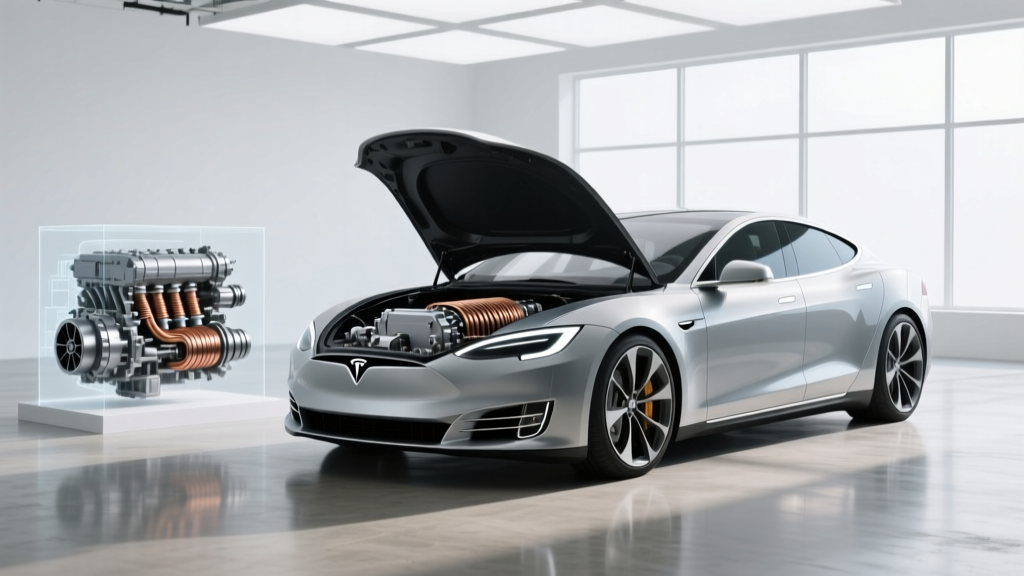
An electric car motor converts electrical energy from the battery pack into rotational force (torque) that turns the wheels. Unlike a gas engine, which requires dozens of moving parts — pistons, valves, crankshafts, timing chains — an electric motor typically has just one moving part: the rotor. This simplicity is why EVs deliver instant torque from 0 RPM, achieve 85–95% energy efficiency (versus ~20–30% for internal combustion), and require almost zero drivetrain maintenance. In 2026, most mainstream EVs use either a permanent magnet synchronous motor (PMSM) or an AC induction motor, with power outputs ranging from 147 kW (197 hp) in compact models to over 760 kW (1,020 hp) in performance variants.
How an Electric Car Motor Actually Works
At its core, an electric car motor operates on electromagnetic principles. When current from the high-voltage battery pack (typically 400V or 800V architecture in 2026 models) flows through copper wire windings in the stator, it creates a rotating magnetic field. This field either pulls a permanent-magnet rotor (in a PMSM) or induces current in a squirrel-cage rotor (in an AC induction motor), causing it to spin and deliver torque through a single-speed reduction gear to the wheels.
The inverter is the unsung hero here. It converts the battery's DC current into the AC current the motor needs, and controls motor speed by varying the frequency of that AC signal. When you lift off the accelerator, the process reverses: the motor becomes a generator, converting kinetic energy back into electrical energy to recharge the battery — this is regenerative braking, and it's why EVs can recover 15–25% of energy in stop-and-go driving that a gas car would waste as brake heat.
The Two Dominant Motor Types in 2026 EVs
| Feature | Permanent Magnet (PMSM) | AC Induction |
|---|---|---|
| Efficiency | 93–97% | 88–93% |
| Torque density | Higher (smaller motor, more torque) | Lower (larger motor needed) |
| Rare-earth dependency | Yes (neodymium magnets) | No (aluminum/copper rotor) |
| High-speed efficiency | Back-EMF limits top-end | Excels at sustained high RPM |
| Cost | Higher (magnet materials) | Lower (simpler rotor) |
| Notable 2026 users | Hyundai Ioniq 5, BMW iX, Rivian R1S (rear), most Chinese-market EVs | Tesla Model 3/Y (front motor), Audi e-tron GT (front) |
Many dual-motor AWD vehicles use a PMSM on the rear axle (for efficiency and low-speed torque) and an AC induction motor on the front (which can be fully disconnected when not needed to eliminate drag losses). Tesla pioneered this hybrid-motor approach, and it's now common across the industry.
EV Motor vs Gas Engine: Efficiency and Performance by the Numbers
The fundamental difference isn't just about fuel — it's about how much of the stored energy actually reaches the wheels.
| Metric | Electric Motor (2026 average BEV) | Gas Engine (2026 average ICE sedan) |
|---|---|---|
| Energy conversion efficiency | 85–95% (battery to wheels) | 20–30% (tank to wheels) |
| Peak torque delivery | Instant, from 0 RPM | Typically 1,500–4,500 RPM |
| Transmission | Single-speed reduction gear | 6–10 speed automatic or CVT |
| Moving parts (drivetrain) | ~5–10 | ~200+ |
| Maintenance items | Coolant check, reduction-gear fluid | Oil, filters, spark plugs, timing belt, transmission fluid, exhaust |
| Typical powertrain weight | 60–120 lbs (motor only) | 300–500 lbs (engine + transmission) |
| Energy cost per mile (US avg) | $0.04–$0.06 (home charging) | $0.12–$0.16 (gasoline at $3.20/gal, 28 MPG) |
| Expected powertrain lifespan | 300,000+ miles (motor); battery is limiting factor | 150,000–200,000 miles before major service |
According to fueleconomy.gov, electric motors convert over 85% of electrical energy into motive power, while gasoline engines waste most of their fuel energy as heat. That efficiency gap is the primary reason EVs cost roughly half as much per mile to "fuel," even in states with above-average electricity rates.
Real-World Performance Context
Take the 2026 Hyundai Ioniq 5 (Long Range RWD): its 168 kW (225 hp) PMSM delivers 258 lb-ft of torque instantly, achieving a 0–60 mph time of 7.0 seconds. A comparably priced 2026 Toyota Camry (203 hp, 184 lb-ft) needs 7.6 seconds — and that gap widens dramatically in real-world passing scenarios because the EV doesn't need to downshift. Performance EVs like the Tesla Model 3 Performance (dual motor, ~510 hp combined) hit 0–60 in 2.9 seconds, territory previously reserved for six-figure supercars.
What an Electric Car Motor Means for Ownership Costs
The motor's simplicity cascades into real savings over the life of the vehicle. Here's a five-year cost comparison using a mainstream EV versus a comparable gas sedan, both driven 12,000 miles/year.
| Cost Category (5 years) | 2026 EV (e.g., Ioniq 5 SEL, ~$44,000 MSRP) | 2026 Gas Sedan (e.g., Camry SE, ~$31,000 MSRP) |
|---|---|---|
| Purchase price (after §30D credit) | ~$36,500 (if eligible for $7,500 point-of-sale) | $31,000 |
| Fuel / electricity | $2,400 (at $0.13/kWh, 3.5 mi/kWh avg) | $6,857 (at $3.20/gal, 28 MPG combined) |
| Maintenance | $1,200 (cabin filter, tire rotation, fluid top-offs) | $3,800 (oil changes, brake pads, filters, belts) |
| Insurance (avg) | $9,500 (EVs typically 15–25% more to insure) | $7,600 |
| Estimated depreciation | $18,000 (EV depreciation has normalized post-2024) | $14,000 |
| 5-year total | ~$67,600 | ~$63,257 |
The EV still costs slightly more over five years in this scenario, primarily due to higher insurance premiums and steeper depreciation on a higher starting price. But the gap has narrowed significantly — and if you qualify for the full §30D federal tax credit (up to $7,500 via point-of-sale transfer in 2026, subject to MSRP caps of $55,000 for sedans and $80,000 for SUVs, plus buyer income limits of $150K single / $300K joint and battery-sourcing requirements), the EV can break even or come out ahead. Factor in state incentives (which vary by jurisdiction — check your local energy office) and home solar, and the math tilts further.
Critical note on the §30D credit: Not every EV qualifies. Battery critical-mineral and component sourcing requirements tighten annually. Always verify current eligibility on irs.gov or ask the dealer for the IRS-listed VIN qualification before signing.
Motor Longevity: What Actually Wears Out?
Here's a truth that surprises first-time EV buyers: the electric motor itself is essentially immortal under normal use. With only one rotating assembly riding on sealed bearings and no combustion, carbon buildup, or thermal cycling stress, EV motors routinely exceed 300,000 miles without service. Tesla's fleet data has shown drive units lasting beyond 500,000 miles in taxi and rideshare applications.
The component that limits an EV's practical lifespan is the battery pack, not the motor. Modern packs using NMC (nickel-manganese-cobalt) or LFP (lithium iron phosphate) chemistry typically retain 85–92% of original capacity after 150,000 miles. Federal warranty requirements mandate that manufacturers cover the battery for at least 8 years / 100,000 miles (10 years / 150,000 miles in CARB states like California, New York, and others) against dropping below 70% capacity. LFP packs, increasingly common in standard-range models (Tesla Model 3 RWD, Ford Mustang Mach-E Select), show even slower degradation — often losing just 5–8% over 200,000 miles in fleet data.
What Can Go Wrong with the Motor
- Bearing wear — rare before 200K miles; replacement runs $500–$1,500
- Coolant system leaks — the motor and inverter share a glycol cooling loop; hose or seal failure can cause overheating. Periodic coolant checks (every 3–5 years) are the only motor-adjacent maintenance most EVs need
- Inverter failure — the power electronics are more failure-prone than the motor itself. Replacement: $2,000–$5,000 out of warranty
- Reduction gear wear — the single-speed gearbox is simple but not maintenance-free. Some manufacturers recommend fluid changes at 60,000–100,000 miles ($150–$300)
Common Misconceptions About Electric Car Motors
| Myth | Fact |
|---|---|
| "EV motors need regular maintenance like oil changes" | False. There is no motor oil, no spark plugs, no timing belt. The motor requires zero scheduled service in most 2026 models. |
| "Electric motors lose power over time like gas engines" | False. An electric motor delivers the same torque curve at 200,000 miles as at 10. Performance degradation in an EV is almost always battery-related, not motor-related. |
| "EV motors can't handle towing or heavy loads" | False. The Ford F-150 Lightning's dual motors produce 775 lb-ft of torque and tow up to 10,000 lbs. However, towing does reduce range by 30–50% — this is a battery energy limitation, not a motor limitation. |
| "Regenerative braking wears out the motor" | False. Regen actually reduces wear on the friction brake pads (many EV owners report original brake pads at 100K+ miles). The motor is designed for bidirectional operation and handles regen cycling without measurable additional wear. |
| "All EV motors are the same" | False. Motor type (PMSM vs induction), placement (front, rear, or dual), and power output vary dramatically. A 150 kW single-motor Ioniq 5 and a 760 kW tri-motor Tesla Model S Plaid share basic physics but are entirely different engineering exercises. |
Decision Framework: Is an EV Motor Right for Your Driving Life?
Choose an EV (electric motor) if:
- You have home charging access (garage, driveway, or workplace Level 2). This is the single biggest ownership satisfaction factor. Without it, you'll rely on public DC fast charging at $0.30–$0.50/kWh — erasing most fuel savings.
- Your daily commute is under 80 miles round-trip. Even the shortest-range 2026 EVs (e.g., MINI Cooper SE at ~114 miles EPA) handle this easily, and you'll charge overnight at home for pennies.
- You drive in stop-and-go traffic regularly. This is where the electric motor's regen and instant torque shine, and where gas engines are at their least efficient.
- You want minimal maintenance. No oil changes, no transmission service, no exhaust repairs. Brake pad life is typically 2–3× longer than a gas car due to regenerative braking.
- You qualify for federal/state incentives. The §30D credit (up to $7,500), state rebates, and utility off-peak charging rates can reduce effective purchase cost by $10,000+ and ongoing costs by 50%+.
Consider a hybrid (PHEV/HEV) or wait if:
- You lack reliable home or workplace charging and live in an area with sparse public DC fast-charging infrastructure (rural routes, apartment complexes without EV provisions).
- You regularly drive 400+ miles in a single day in cold weather. A 300-mile EPA-rated EV may deliver only 200–230 miles at 75 mph in sub-30°F conditions, requiring a mid-trip fast-charge stop.
- You tow heavy loads frequently over long distances. The motor handles it fine, but range drops sharply. A PHEV like the Toyota RAV4 Prime (42 miles electric-only, then 38 MPG hybrid) may be more practical.
- Your budget is under $28,000 and you need a new vehicle. New EV pricing starts around $28,000–$30,000 (before credits) in 2026. The used EV market offers strong value, with the separate §25E used-EV credit providing up to $4,000 on vehicles priced under $25,000.
Frequently Asked Questions
How many motors does an electric car have?
It depends on the drivetrain. Single-motor EVs (typically RWD or FWD) have one motor. Dual-motor AWD models have two — one per axle. Some performance vehicles like the Tesla Model S Plaid or Rivian R1T Quad-Motor have three or four motors, one per wheel, enabling torque vectoring and extreme power outputs (1,025 hp in the Plaid's case).
Do electric car motors need oil changes?
No. The electric motor itself uses no oil. Some EVs have a separate reduction-gear fluid that may need replacement every 60,000–100,000 miles ($150–$300 at a dealer), but this is a minor service compared to the $40–$80 oil changes a gas car needs every 5,000–10,000 miles.
Can an electric car motor overheat?
Under extreme sustained loads — like repeated full-power accelerations or extended high-speed towing in hot weather — the motor and inverter can thermally throttle to protect themselves. Modern 2026 EVs use active liquid cooling (glycol loops shared with the battery thermal management system) that make this rare in normal driving. You're more likely to see thermal throttling during track use than during any road-trip scenario.
Why are electric motors rated in kW instead of horsepower?
Kilowatts (kW) are the SI unit of power and align directly with the battery's kWh energy rating, making it easy to calculate how long full-power output can be sustained. For reference, 1 kW ≈ 1.34 horsepower. A 200 kW motor produces roughly 268 hp. Manufacturers often list both.
How much does it cost to replace an electric car motor?
Out-of-warranty motor replacement typically costs $3,000–$7,000 for mainstream models and $7,000–$12,000 for high-performance units. However, motor failure is rare — the powertrain warranty (typically 8 years / 100,000 miles) covers it, and most motors outlast the vehicle. For context, a gas-engine replacement runs $4,000–$10,000 and is far more commonly needed at high mileage.
Does the electric motor affect my EV's range?
Indirectly, yes. Motor efficiency (PMSM vs induction), the number of motors (dual-motor AWD adds weight and drag losses), and driving style all impact range. A single-motor RWD EV will typically achieve 5–15% more range than its dual-motor AWD counterpart with the same battery. But the battery's usable kWh capacity and your driving speed/conditions remain the dominant range factors.