The Short Answer on Electric Car Motor DC Systems
Every modern EV you can buy in 2026 uses an AC motor (permanent-magnet synchronous or induction), not a DC motor. However, the battery stores and delivers DC (direct current), so an onboard inverter converts DC to AC to spin the wheels. When shoppers search for "electric car motor DC," they're usually asking about the DC-to-AC powertrain architecture that defines how efficiently an EV converts stored energy into motion. That architecture directly impacts your EPA range, charging speed, and long-term ownership costs — and it's the reason EVs convert roughly 77% of grid energy to wheel motion versus just 12–30% for a gas engine, per fueleconomy.gov.
How the DC-to-AC Powertrain Actually Works
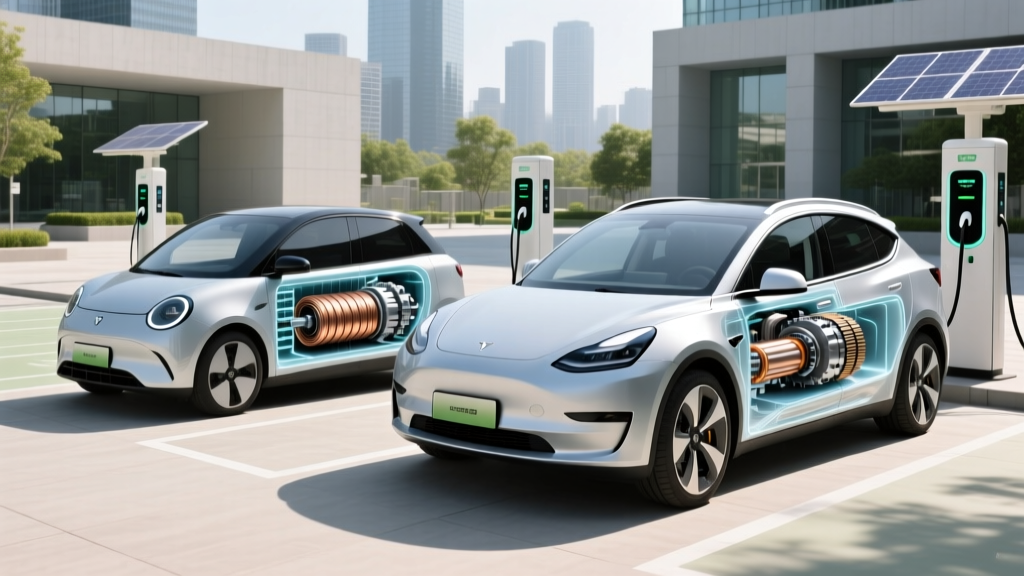
The battery pack in any 2026 EV — whether it's a Tesla Model Y, Hyundai Ioniq 5, or Ford Mustang Mach-E — stores energy as DC electricity in lithium-ion cells. Most packs are 60–100 kWh of usable capacity using either NMC (nickel-manganese-cobalt) or LFP (lithium-iron-phosphate) chemistry. That DC power flows through an inverter, which converts it to three-phase AC to drive the motor.
Two AC motor types dominate:
- Permanent-Magnet Synchronous Motor (PMSM): Higher efficiency (94–96%), used in most single-motor and rear-axle setups (e.g., Tesla Model 3 RWD, Ioniq 5 RWD).
- AC Induction Motor: Slightly lower efficiency but cheaper and no rare-earth magnets; often paired as a front-axle "boost" motor in AWD models (e.g., Model Y Long Range AWD front motor).
DC brushed motors — the kind in old golf carts and forklifts — are obsolete in passenger EVs due to maintenance-heavy brushes, lower efficiency (~80%), and poor high-RPM performance. If anyone is selling you a "DC motor EV" in 2026, it's either a low-speed neighborhood vehicle or a conversion kit, not a highway-capable car.
EV vs Gas vs Hybrid: The Real Efficiency Numbers
The DC-battery-to-AC-motor architecture is why EVs dominate energy efficiency. Here's how a typical 2026 midsize EV stacks up against comparable gas and hybrid options:
| Metric | 2026 EV (e.g., Ioniq 5 SEL) | 2026 Hybrid (e.g., Toyota RAV4 Hybrid) | 2026 Gas (e.g., Honda CR-V AWD) |
|---|---|---|---|
| Energy efficiency (tank/battery to wheels) | ~77% | ~30% | ~12–25% |
| EPA combined | 114 MPGe (2.9 kWh/mi) | 39 MPG | 29 MPG |
| Annual fuel/energy cost (15k mi) | ~$540 (at $0.13/kWh home) | ~$1,270 | ~$1,700 |
| Annual maintenance | ~$300 | ~$550 | ~$700 |
| 5-year powertrain cost | ~$4,200 | ~$9,100 | ~$12,000 |
Source: fueleconomy.gov 2026 model-year data; electricity at national average $0.13/kWh, gas at $3.20/gal.
Real Costs and Savings: 5-Year Ownership Breakdown
The motor architecture helps EVs win on operating costs, but upfront price, insurance, and charging access matter. Here's a realistic 5-year / 75,000-mile cost comparison for a midsize crossover:
| Category | EV ($45,000 MSRP) | Hybrid ($38,000 MSRP) | Gas ($35,000 MSRP) |
|---|---|---|---|
| Purchase (after §30D credit) | $37,500* | $38,000 | $35,000 |
| Fuel/energy (5 years) | $2,700 | $6,350 | $8,500 |
| Maintenance (5 years) | $1,500 | $2,750 | $3,500 |
| Insurance (5 years) | $10,500 | $8,200 | $7,800 |
| Depreciation (est.) | $19,000 | $15,500 | $14,000 |
| Total 5-yr cost | $71,200 | $70,800 | $68,800 |
*§30D credit eligibility per IRS rules: subject to MSRP caps ($55k cars / $80k trucks/SUVs), buyer income limits ($150k single / $300k joint), and battery critical-mineral sourcing. Confirm eligibility before purchase; point-of-sale transfer available.
The EV wins on fuel and maintenance but loses on insurance (~25–35% higher premiums per IIHS data) and depreciation. Breakeven vs. gas typically lands around year 4–6 depending on home charging access and mileage.
What First-Time EV Buyers Should Know
The DC battery / AC motor setup introduces ownership realities that gas-car buyers never face:
- Home charging is make-or-break. A Level 2 (240V, 7.7–11.5 kW) home charger adds ~25–40 miles per hour of charging. Installation runs $800–$2,500 including panel assessment, wiring, and permit. Without home charging, public DC fast charging costs 2–3× more per kWh and adds wear.
- Real-world range ≠ EPA sticker. Expect 10–20% range loss at sustained 75 mph highway speeds, and 20–40% loss in sub-freezing temps without a heat pump preconditioning cycle.
- DC fast charging tapers above 80%. A 240 kW peak doesn't mean sustained speed — a 10–80% charge takes ~18 minutes, but 80–100% can add another 20+ minutes. Plan stops accordingly.
- Battery warranty protects you. Federal mandate: 8 years / 100,000 miles with minimum 70% capacity retention. Most 2026 models (Tesla, Hyundai, Ford, GM) exceed this baseline.
- Connector matters. NACS (Tesla's standard) is now the dominant 2026 connector. Ford, GM, Rivian, Hyundai, and most others ship NACS-equipped. CCS1 is being phased out but still supported at many Electrify America and EVgo stations.
Common Misconceptions: Myth vs. Fact
| Myth | Fact |
|---|---|
| EVs use DC motors like golf carts | All highway-capable 2026 EVs use AC motors (PMSM or induction) fed by a DC battery via inverter |
| Battery replacement will cost $20,000 in year 5 | Warranty covers 8 yr/100k mi; real-world degradation averages 5–8% over 100k miles per Recurrent data |
| EVs are always cheaper to own | Only if you have home charging and drive 12k+ miles/yr; otherwise hybrid often wins TCO |
| DC fast charging ruins batteries | Modern thermal management limits damage; exclusive DCFC adds ~1–2% extra degradation over 100k mi vs. L2 |
| EVs don't work in cold climates | Range drops 20–40% in sub-20°F, but heat pumps (standard on most 2026 models) recover ~30% of that loss |
Decision Framework: Is an EV Right for You?
Choose a BEV if:
- You can install Level 2 home charging (garage/driveway with 240V access)
- Daily driving is under 80% of the EPA range
- You drive 12,000+ miles/year (fuel savings justify premium)
- You qualify for the §30D credit (check IRS.gov)
- You want lowest maintenance and zero tailpipe emissions
Choose a PHEV if:
- You lack reliable home charging but want some electric driving
- You frequently road-trip beyond 250 miles
- You want EV-like commuting (25–45 mi electric range) with gas flexibility
Choose a Hybrid (HEV) if:
- No charging access at all
- Budget is under $35k and you want proven reliability
- You drive less than 10,000 miles/year (fuel savings won't offset EV premium)
Frequently Asked Questions
Do any 2026 passenger EVs still use DC motors?
No. Every mainstream highway-capable EV sold in the U.S. in 2026 uses an AC motor (PMSM or induction). DC brushed motors appear only in low-speed neighborhood vehicles (LSVs) and some aftermarket conversion kits — neither suitable as a primary vehicle.
Why do EVs need an inverter if the battery is DC?
AC motors are more efficient, more powerful per pound, and require less maintenance than DC motors. The inverter converts the battery's DC into precisely timed three-phase AC to control motor speed and torque. Modern silicon-carbide (SiC) inverters operate at 97–99% efficiency.
Does regenerative braking feed DC back to the battery?
Yes. During regen, the AC motor acts as a generator producing AC, which the inverter rectifies back to DC to recharge the battery. This recovers 15–25% of highway energy and up to 50% in stop-and-go city driving.
Is a DC fast charger different from the motor's DC?
Yes. DC fast charging (DCFC) bypasses the car's onboard charger and feeds DC directly to the battery at 50–350 kW. The motor still runs on AC via the inverter. The term "DC" appears in two different contexts — battery storage and fast charging — but the motor always uses AC.
Will the motor outlast the battery?
Almost always. AC motors have one moving part (the rotor) and no brushes. They routinely exceed 300,000 miles. Battery degradation is the longevity limiting factor, and even that is modest: most 2026 packs retain 85–92% capacity at 100k miles.