The Real Math Behind an Electric Car Lease in 2026
Shoppers considering an electric car lease often hear two conflicting narratives: EVs are cheaper to own because of fuel and maintenance savings, or EVs are money pits because of insurance costs and steep depreciation. Both statements can be true — for different buyers. The difference comes down to your electricity rate, annual mileage, state incentives, and whether you lease or buy.
This guide runs the full five-year total cost of ownership (TCO) for a representative 2026 EV — the Hyundai Ioniq 5 SEL AWD — against a comparable gas-powered crossover, the Hyundai Tucson SEL AWD. We factor in purchase price, the federal §30D tax credit, charging versus gasoline, maintenance, insurance, and depreciation. We also explain exactly how leasing interacts with the federal credit, since the mechanics changed significantly under current IRS rules.
Five-Year Total Cost of Ownership: EV vs Gas Side by Side
The table below models five years and 75,000 miles of ownership. For the EV, we assume 80% home Level 2 charging at $0.14/kWh and 20% public DC fast charging at $0.40/kWh (a blended rate of ~$0.19/kWh). For the gas vehicle, we assume $3.60/gallon regular unleaded and 28 MPG combined. Your actual numbers will shift based on local utility rates, gas prices, and driving patterns.
| Cost Category | 2026 Ioniq 5 SEL AWD (EV) | 2026 Tucson SEL AWD (Gas) |
|---|---|---|
| MSRP / Negotiated Price | $49,500 | $33,500 |
| Federal Tax Credit (§30D) | −$7,500 (if eligible) | $0 |
| Effective Purchase Price | $42,000 | $33,500 |
| 5-Year Fuel / Energy (75k mi) | $5,130 | $9,643 |
| 5-Year Maintenance | $1,400 | $3,200 |
| 5-Year Insurance (avg) | $10,500 | $7,800 |
| Estimated 5-Year Depreciation | $18,900 (45%) | $13,400 (40%) |
| Total 5-Year Cost | $77,930 | $67,543 |
| Effective Cost After Credit | $70,430 | $67,543 |
The EV's operating savings — roughly $6,300 over five years in combined fuel and maintenance — do not fully close the gap with a similarly equipped gas crossover at current pricing. The federal tax credit narrows it further, but the higher insurance premiums and steeper depreciation keep the EV at a modest premium for this particular model. However, if you qualify for state rebates, drive more than 15,000 miles per year, or have access to cheap overnight electricity, the math can flip.
Federal Tax Credit: Do You Actually Qualify?
The IRS §30D Clean Vehicle Credit offers up to $7,500, but it is not a blanket discount. Current 2026 rules impose three hard gates that disqualify a significant number of buyers and vehicles:
- MSRP caps: Vans, SUVs, and pickups must have an MSRP at or below $80,000. Sedans and other body styles cap at $55,000. The Ioniq 5, classified as an SUV, clears the $80,000 threshold.
- Buyer income limits: Modified adjusted gross income (MAGI) cannot exceed $300,000 for joint filers, $225,000 for heads of household, or $150,000 for single filers. The cap applies to the lesser of the current or prior tax year.
- Battery sourcing requirements: The credit splits into two halves — $3,750 for critical-mineral sourcing and $3,750 for battery-component manufacturing. Vehicles must meet escalating percentage thresholds for both, and any battery components from a "foreign entity of concern" (FEOC) can disqualify the vehicle entirely. These thresholds tighten annually.
- Point-of-sale transfer: Since 2024, buyers can transfer the credit to the dealer at purchase, reducing the upfront cost rather than waiting for a tax-time offset. This applies to purchases only — not traditional leases (see below).
For the most current eligibility rules and qualifying vehicle lists, consult the IRS Clean Vehicle Tax Credits page and the fueleconomy.gov tax credit lookup.
How Leasing Changes the Tax Credit Equation
Here is where the electric car lease conversation gets interesting. Under the §30D rules, the federal tax credit goes to the vehicle's legal owner — which in a lease is the leasing company (the lessor), not you. This means you cannot claim the $7,500 credit on your personal tax return when you lease.
However, many automakers' captive finance arms (Hyundai Motor Finance, BMW Financial Services, etc.) apply the credit as a capitalized-cost reduction on the lease, effectively passing the savings to you through lower monthly payments. This is commonly called "pass-through" and it has become standard practice among most mainstream EV lessors.
The critical advantage of leasing: the commercial clean vehicle credit (§45W) historically allowed lessors to claim the credit even on vehicles that might not qualify under the strict §30D consumer rules — including some with battery-sourcing issues or vehicles above the MSRP cap. This "lease loophole" has been subject to regulatory scrutiny and potential phase-down, so confirm the current status with your dealer's finance desk before signing.
Buy the EV if: You qualify for the full $7,500 §30D credit on purchase, you drive high annual mileage (no lease penalties), you plan to keep the vehicle 7+ years, and you want to build equity.
Charging vs Gasoline: The Per-Mile Cost Reality
The energy-cost advantage is where EVs consistently win. Here is the exact per-mile math using the Ioniq 5 and Tucson as our comparison pair:
| Metric | Ioniq 5 AWD (EV) | Tucson AWD (Gas) |
|---|---|---|
| Energy Consumption | 30 kWh/100 mi (2.9 mi/kWh) | 28 MPG combined |
| Energy Cost Assumption | $0.19/kWh blended (home + DCFC) | $3.60/gallon regular |
| Cost Per Mile | $0.057/mile | $0.129/mile |
| Annual Cost (15,000 mi) | $855 | $1,935 |
| 5-Year Cost (75,000 mi) | $4,275 | $9,675 |
At these assumptions, the EV saves roughly $1,080 per year on energy. If you charge exclusively at home on a time-of-use plan with overnight rates around $0.08–$0.10/kWh, your cost per mile drops to $0.024–$0.030, widening the savings to over $1,500 annually. Conversely, if you rely entirely on public DC fast charging at $0.40–$0.55/kWh, your per-mile cost climbs to $0.12–$0.17 — potentially matching or exceeding gasoline.
Home charging access is the single biggest variable in EV operating economics. Without it, the fuel-cost advantage evaporates.
Maintenance Savings: Fewer Parts, Fewer Visits
EVs eliminate the maintenance categories that generate the bulk of gas-car service bills:
| Service Item | EV (Ioniq 5) | Gas (Tucson) |
|---|---|---|
| Oil Changes | None | $45–$80 × 10–15 over 75k mi |
| Transmission Fluid | Sealed reduction gear — no routine service | $150–$300 at 60k mi |
| Brake Pads | 80,000–120,000+ mi (regen braking reduces wear 60–70%) | 30,000–50,000 mi replacement cycle |
| Spark Plugs / Ignition | None | $200–$400 at 60k mi |
| Coolant | Battery thermal loop — typically 100k+ mi interval | $100–$200 at 50k–100k mi |
| Cabin Air Filter | $25–$50 every 15k–20k mi | $25–$50 every 15k–20k mi |
| Tire Rotation | $25–$50 every 7,500 mi (EVs wear tires faster due to weight and instant torque) | $25–$50 every 7,500 mi |
| Estimated 5-Year Total | ~$1,400 | ~$3,200 |
The net savings of roughly $1,800 over five years is meaningful but not transformative on its own. The real value is fewer dealer visits and less downtime. One caveat: EV tire wear tends to be 15–25% faster than on comparable gas vehicles due to higher curb weight (the Ioniq 5 AWD weighs ~4,700 lbs vs the Tucson at ~3,600 lbs) and instant torque application. Budget for one extra tire set over five years.
Insurance: The Cost Nobody Warns You About
EV insurance premiums run 15–30% higher than equivalent gas vehicles, and this is the line item that most surprises new owners. For the Ioniq 5, expect annual premiums of $1,800–$2,400 depending on your state, driving record, and coverage level — compared to $1,300–$1,800 for the Tucson.
The reasons are structural, not arbitrary:
- Higher repair costs: EV battery packs and power electronics are expensive to replace after collision damage. Even minor rear-end impacts can total an EV if the battery enclosure is compromised.
- Specialized labor: High-voltage system repairs require certified technicians, and fewer shops have this capability, driving up labor rates.
- Higher vehicle values: Collision and comprehensive premiums scale with replacement cost. A $49,500 EV costs more to insure than a $33,500 gas crossover.
- Claims data: Early EV claims data showed higher severity (cost per claim), even if frequency (number of claims) was comparable to gas vehicles.
Shop quotes from at least three insurers before purchasing or leasing. Some carriers (Geico, Progressive, State Farm) now offer specific EV discounts or bundle deals. Tesla Insurance, where available, uses real-time driving data and can undercut traditional carriers by 10–20% for clean-record drivers.
Depreciation and Resale Value Trends
EV depreciation has been volatile. Between 2022 and 2024, aggressive price cuts by Tesla and increased competition caused used EV values to drop 30–40% in some segments — far steeper than gas-car depreciation. By 2026, the market has stabilized somewhat, but EVs still depreciate faster on average.
Current five-year depreciation expectations:
- Mainstream EVs (Ioniq 5, Model Y, EV6): 40–50% over five years
- Luxury EVs (i4, EQE, Taycan): 50–60% over five years
- Comparable gas crossovers (Tucson, RAV4, CR-V): 35–45% over five years
Key depreciation factors for EVs include battery health uncertainty (buyers discount used EVs with unknown State of Health), rapid technology obsolescence (a 2026 model with 350-mile range and 250 kW charging makes a 2023 model with 240 miles and 150 kW look dated), and the phase-in of NACS connectors making older CCS-only vehicles less desirable.
This is precisely why an electric car lease can be financially rational: you shift the depreciation risk to the lessor. If residual values crater, that is the leasing company's problem, not yours. The trade-off is that you build no equity and face mileage penalties (typically $0.20–$0.30/mile over the annual limit).
Lease vs Buy Decision Framework
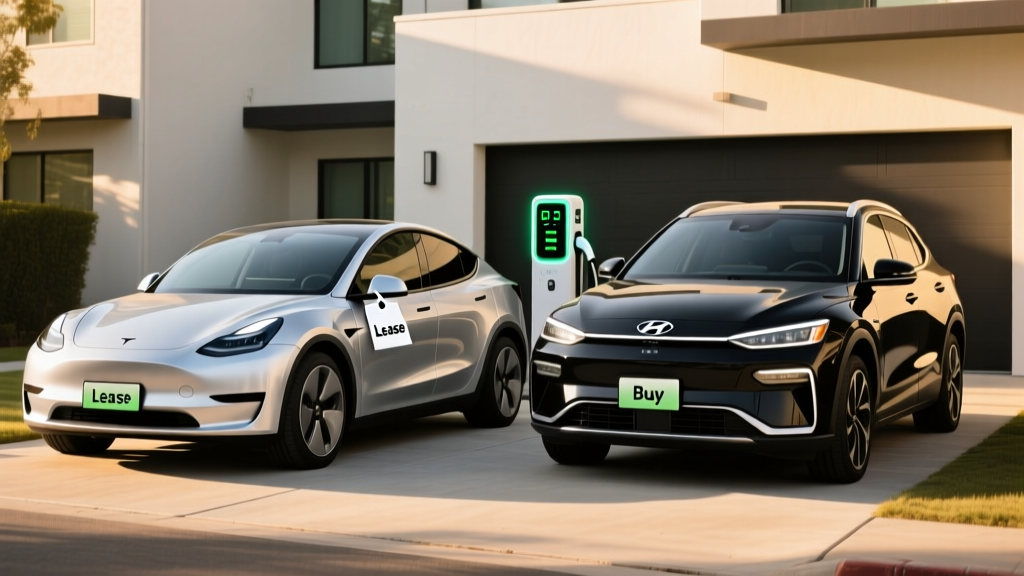
Here is a practical summary of when an electric car lease makes the most financial sense versus a purchase:
| Factor | Leans Lease | Leans Buy |
|---|---|---|
| Annual mileage | Under 12,000–15,000 mi | Over 15,000 mi |
| Tax credit eligibility | Vehicle doesn't qualify under §30D purchase rules but lessor can claim it | You qualify for full $7,500 on purchase |
| Ownership horizon | 2–3 years | 5–10 years |
| Depreciation risk tolerance | Low — prefer predictable costs | High — willing to ride out market swings |
| Home charging access | Yes (maximizes fuel savings regardless) | Yes (maximizes fuel savings regardless) |
| Upfront cash preference | Lower down payment, credit passed as cap-cost reduction | Can absorb higher down payment, credit as tax offset |
Frequently Asked Questions
How much does it really cost to own an EV over 5 years?
For a 2026 Hyundai Ioniq 5 SEL AWD at 75,000 miles, the total five-year cost is approximately $70,400 after the federal tax credit — about $2,900 more than a gas Tucson SEL AWD. However, this gap narrows or reverses with state incentives, higher annual mileage, cheap home electricity, or if the commercial credit lease loophole remains available.
Do I qualify for the federal EV tax credit?
You may qualify for up to $7,500 under §30D if: (1) the vehicle MSRP is within caps ($80,000 for SUVs, $55,000 for sedans), (2) your MAGI is under $300,000 joint / $150,000 single, and (3) the vehicle's battery meets critical-mineral and component-manufacturing sourcing thresholds. Check the current qualifying list at fueleconomy.gov before committing, as eligibility can change model-by-model and year-by-year.
How much do I save on fuel and maintenance?
Combined fuel and maintenance savings average $6,100–$6,500 over five years at 15,000 miles annually, assuming a blended electricity rate of $0.19/kWh and $3.60/gallon gas. With exclusively cheap home charging ($0.10/kWh), total savings can exceed $8,500. With exclusively expensive public DC fast charging ($0.48/kWh), savings shrink to under $2,000.
Are EVs more expensive to insure?
Yes, typically 15–30% more than comparable gas vehicles. For a mainstream EV like the Ioniq 5, budget $1,800–$2,400 per year versus $1,300–$1,800 for a gas crossover. The premium reflects higher repair costs, specialized labor requirements, and higher vehicle replacement values. Always compare quotes from multiple insurers.
How well do EVs hold their value?
EVs currently depreciate 40–50% over five years for mainstream models, compared to 35–45% for gas crossovers. Factors include battery health uncertainty, rapid tech advancement, and market saturation from price wars. This faster depreciation is a primary reason leasing can be advantageous — it transfers residual-value risk to the lessor.
Can I get the tax credit on a leased EV?
Not directly — the leasing company owns the vehicle and claims the credit. However, most automaker captive finance arms pass the credit through as a capitalized-cost reduction, lowering your monthly payment. Confirm this pass-through in writing before signing the lease agreement.