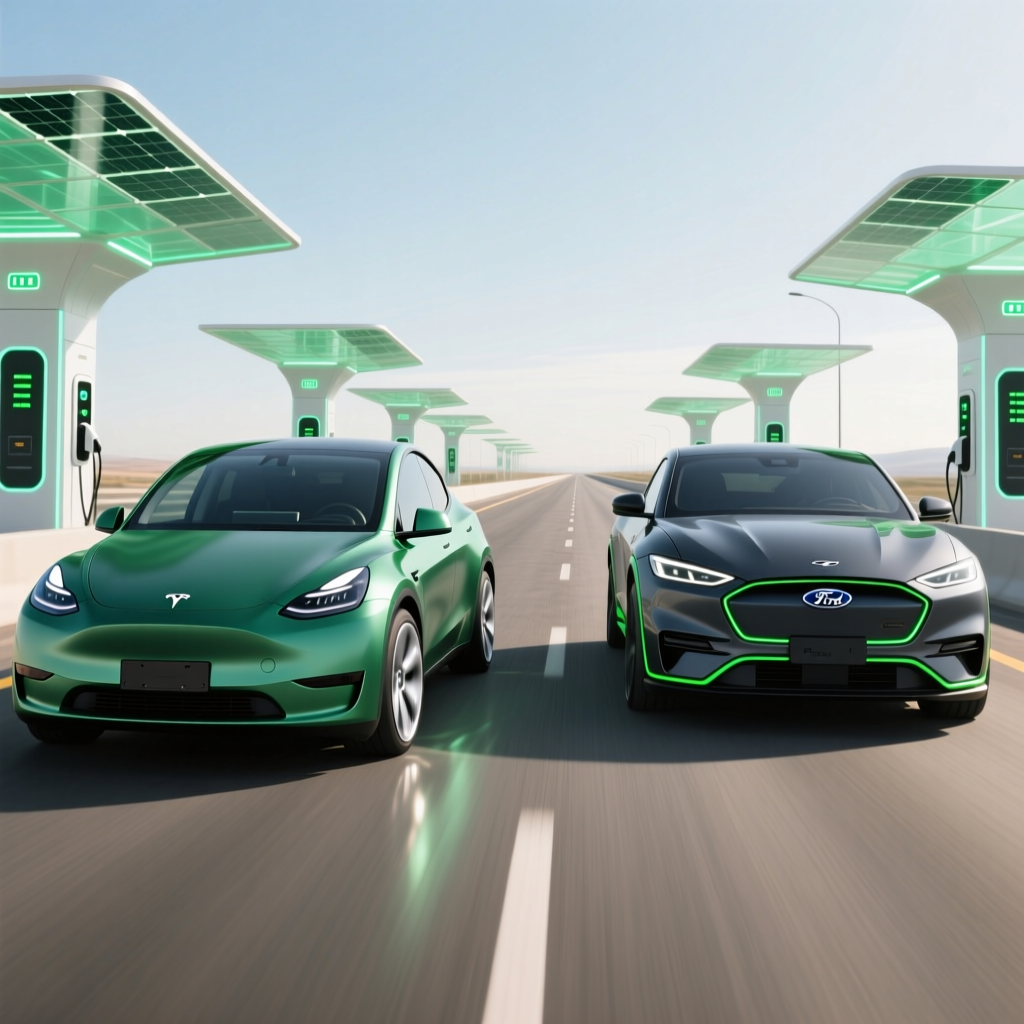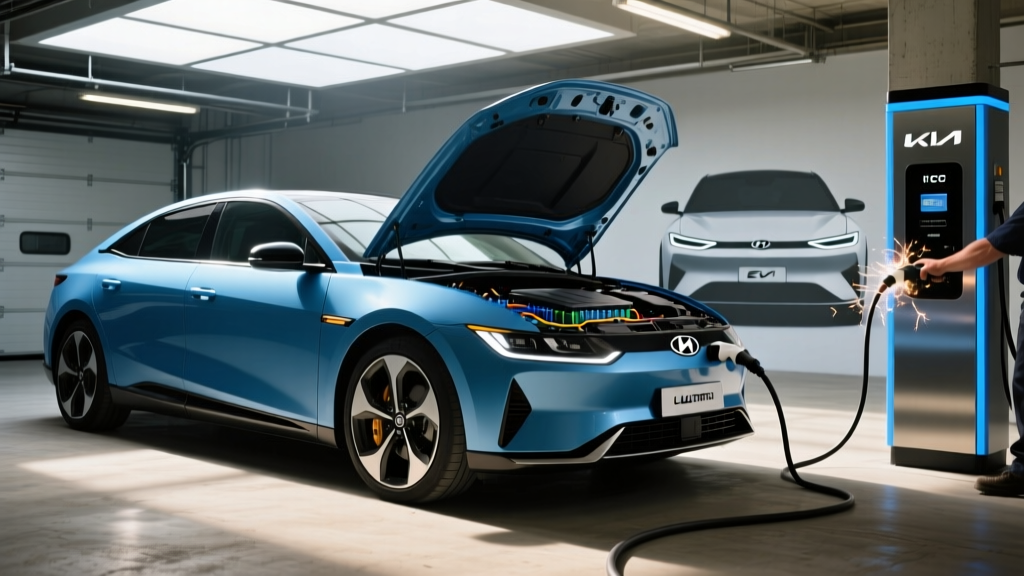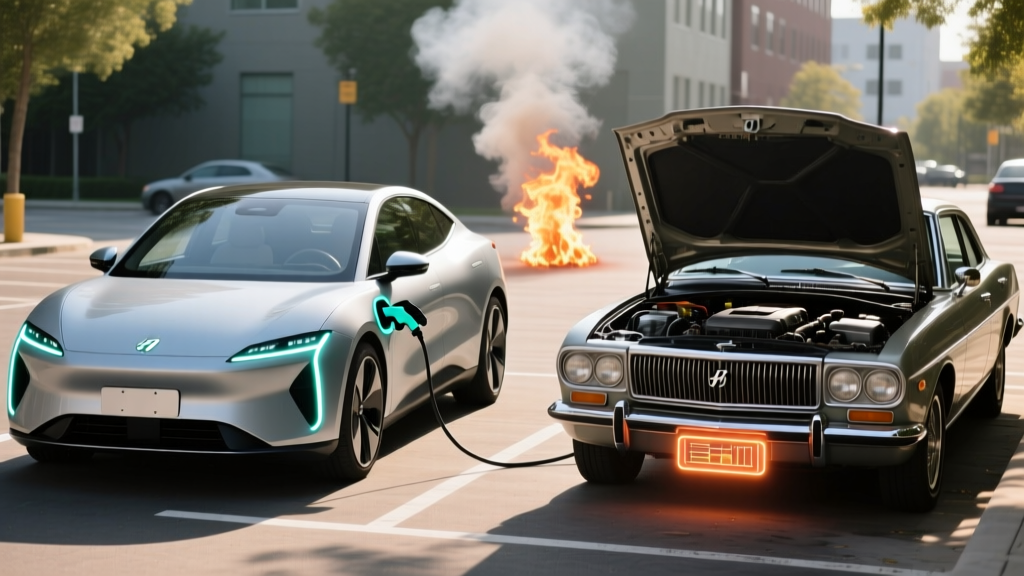
If you've seen viral videos of EVs engulfed in flames, you might assume electric car fires are a widespread crisis. The data tells a different story. Per the National Transportation Safety Board (NTSB) and analysis by the Swedish Civil Contingencies Agency (MSB), internal combustion engine (ICE) vehicles experience fires at a rate roughly 15 to 20 times higher per 100,000 vehicles than battery electric vehicles (BEVs). EV fires are rarer — but when they do occur, they can be more difficult to extinguish due to lithium-ion battery thermal runaway chemistry.
The Bottom Line on Electric Car Fires
Gasoline vehicles catch fire at a significantly higher rate than EVs. However, EV battery fires burn hotter, last longer, and require specialized firefighting techniques. Your actual risk of experiencing any vehicle fire is low regardless of powertrain, but the character of the fire differs fundamentally between the two.
Fire Rates by the Numbers: EV vs Gas vs Hybrid
To make a fair comparison, we need to normalize fire incidents per vehicles on the road. Raw fire counts are misleading because there are over 250 million ICE vehicles in the U.S. compared to roughly 10 million registered BEVs as of early 2026.
| Metric | Battery Electric (BEV) | Gasoline (ICE) | Hybrid / PHEV |
|---|---|---|---|
| Fires per 100K vehicles (annual) | ~25 | ~1,530 | ~3,475 |
| Primary fire source | Traction battery (thermal runaway) | Fuel system, electrical wiring, engine heat | Both fuel system + battery pack |
| Average fire temperature | 1,500–2,700°F (battery cells) | 1,000–1,500°F | Varies by ignition source |
| Typical extinguishing time | 1–8+ hours (may reignite) | 15–45 minutes | 30–90 minutes |
| Reignition risk | High (stranded energy in cells) | Low | Moderate |
Source data drawn from NTSB investigations, NFPA fire incident reports, and the Swedish MSB's widely cited 2023 study. Note: Hybrid/PHEV fire rates appear higher partly because hybrids combine two potential ignition systems and because early-generation hybrid models are aging.
Why Do Electric Car Fires Happen?
EV battery fires almost always trace back to thermal runaway — a chain reaction where a damaged or defective lithium-ion cell overheats, triggers adjacent cells, and creates a self-sustaining fire that generates its own oxygen. Here are the primary triggers:
- Physical damage: Severe underbody impact from road debris, curbs, or collisions that puncture the battery enclosure. This is the most common real-world cause.
- Manufacturing defects: Internal cell shorts from metal particle contamination or separator failures during production. These typically surface within the first few years and are addressed via recalls.
- Electrical abuse: Extreme overcharging or charging system malfunctions — exceedingly rare due to the battery management system (BMS) safeguards in modern EVs.
- Thermal abuse: External fire exposure or extreme ambient heat combined with poor thermal management. Modern liquid-cooled packs make this unlikely.
Notably, the NHTSA has investigated several high-profile EV fire incidents and issued recalls where specific cell defects were identified — such as the Hyundai Kona Electric and Chevrolet Bolt EV recalls in 2020–2021, both of which involved LG Energy Solution cells with manufacturing anomalies. Both were addressed via battery pack replacement or software-limited charge caps.
How EV Makers Engineer Against Battery Fires
Modern EV platforms (2024–2026 model years) incorporate multiple layers of fire prevention that didn't exist in early-generation EVs:
Cell-Level Protections
- Ceramic-coated separators between anode and cathode resist internal shorts at higher temperatures.
- LFP (lithium iron phosphate) chemistry — used in Tesla Model 3 Standard Range, Ford Mustang Mach-E Select, and many Chinese-market EVs — is inherently more thermally stable than NMC (nickel manganese cobalt). LFP cells typically enter thermal runaway at ~270°C vs ~210°C for NMC, and they release far less oxygen when they do.
- Fire-retardant electrolyte additives that suppress flame propagation.
Pack-Level Engineering
- Cell-to-cell barriers: Mica sheets, aerogel insulation, or intumescent materials between cells to prevent thermal propagation. Tesla's structural 4680 pack and GM's Ultium platform both use advanced propagation barriers designed so that a single cell failure does not cascade.
- Armor-plated enclosures: High-strength steel or titanium underbody shields rated to withstand impacts from road debris at highway speeds.
- Venting systems: Pressure-relief valves that direct hot gases away from the passenger cabin.
Software Monitoring
- Battery Management Systems (BMS) continuously monitor individual cell voltage, temperature, and impedance. If an anomaly is detected, the system can isolate affected modules, limit charge/discharge rates, or shut down the pack entirely — often before a driver notices anything wrong.
- Over-the-air (OTA) updates allow automakers to adjust charge limits or thermal thresholds remotely if field data reveals a risk pattern. This is how several potential recall situations have been mitigated proactively.
Myths vs Facts: Common Electric Car Fire Misconceptions
| Myth | Fact |
|---|---|
| "EVs catch fire all the time." | BEVs experience roughly 25 fires per 100K vehicles annually vs ~1,530 for gas cars. EV fires are newsworthy precisely because they're unusual. |
| "You can't put out an EV fire." | Firefighters can extinguish EV fires using large volumes of water (typically 3,000–8,000 gallons vs 500 for an ICE fire). The challenge is duration and reignition risk, not impossibility. |
| "Charging an EV overnight is dangerous." | Modern BMS systems and UL-listed Level 2 chargers (e.g., ChargePoint Home Flex, Tesla Wall Connector) have redundant safety cutoffs. Residential EV charging fires are extremely rare and more often linked to faulty wiring or non-certified equipment than the vehicle itself. |
| "EV fires release uniquely toxic fumes." | All vehicle fires release toxic gases (hydrogen cyanide, carbon monoxide, hydrogen fluoride). EV battery fires do emit HF, but modern cabin isolation and pack venting direct most gases away from occupants. First responders use SCBA gear for all vehicle fires regardless of powertrain. |
| "If an EV is in a crash, it will explode." | NHTSA crash testing and real-world collision data show EV battery fires post-collision are rare. The battery pack's placement low in the chassis and structural protection make it one of the most protected components in a crash. |
Real-World Ownership: What EV Buyers Should Know About Fire Risk
Understanding fire risk in context means looking at your actual ownership experience, not just worst-case scenarios.
Insurance Costs and Fire Coverage
EV insurance premiums run 15–25% higher than comparable ICE vehicles, but this is driven primarily by higher repair costs after collisions (specialized parts, high-voltage safety protocols, ADAS recalibration) — not fire risk. Your comprehensive coverage includes fire damage regardless of cause. Major insurers (State Farm, GEICO, Progressive) do not surcharge specifically for EV fire risk.
Home Charging Safety
If you install a UL-listed Level 2 home charger (240V, 32–48 amps, 7.7–11.5 kW) via a licensed electrician with a permitted installation, your fire risk from charging is negligible. The real home-fire risks come from:
- Using a damaged or uncertified charging cable
- Running a Level 1 charger (120V, 1.4 kW) through an extension cord or undersized outlet
- Outdated home electrical panels (Federal Pacific or Zinsco panels, common in pre-1990 homes, are known fire hazards independent of EV charging)
A proper home charging setup costs $800–$2,200 installed (Level 2 equipment + electrician + permit), and may qualify for the IRS Alternative Fuel Vehicle Refueling Property Credit (30% up to $1,000, subject to eligibility and census-tract requirements).
What to Do If Your EV Is Involved in a Fire
- Exit the vehicle immediately — do not attempt to retrieve belongings.
- Call 911 and explicitly tell the dispatcher it's an electric vehicle (make and model if possible). This lets them dispatch appropriate resources.
- Move at least 50 feet away. Battery fires can vent toxic gases and, in rare cases, eject cell components.
- Do not attempt to extinguish it yourself. Even a garden hose won't deliver the sustained volume needed.
- After the fire is out, follow the tow operator's guidance. The vehicle will typically be stored at a remote lot for 48–72 hours due to reignition risk.
Decision Framework: Should Fire Risk Factor Into Your EV Purchase?
If Fire Safety Is a Top Concern...
Choose an LFP-battery EV if: You want the most thermally stable chemistry available. LFP packs (found in the Tesla Model 3 RWD at ~$38,990, Tesla Model Y RWD, and several Ford and Hyundai trims) resist thermal runaway at higher temperatures and don't release oxygen during decomposition. Trade-off: LFP has ~15% lower energy density than NMC, which translates to slightly less range per kWh — though this gap has narrowed significantly with 2025–2026 cell improvements.
Choose a newer-platform EV if: Vehicles built on dedicated EV architectures (GM Ultium, Hyundai E-GMP, Tesla structural pack) have the latest cell-to-pack propagation barriers. Older "compliance" EVs adapted from ICE platforms may have less sophisticated pack protection.
Don't let fire risk alone prevent an EV purchase if: Your daily driving is under 250 miles, you have access to home or workplace Level 2 charging, and you value the $4,000–$9,000 annual fuel savings (depending on local electricity rates vs gas prices). The statistical risk of experiencing an EV fire is far lower than the risk of an ICE vehicle fire, and the total cost of ownership math strongly favors electric for most drivers.
Consider a hybrid/PHEV instead if: You live in a charging desert, frequently drive 400+ miles in remote areas, or need a single vehicle that handles both city commuting and long road trips without route planning. Models like the Toyota RAV4 Prime PHEV (42 miles electric-only, 94 MPGe combined per fueleconomy.gov, ~$43,690 MSRP) offer electric daily driving with a gas backup — though you're carrying both a fuel system and a battery pack, which means two potential ignition sources.
Frequently Asked Questions
How common are electric car fires compared to gas car fires?
Based on normalized data, gas vehicles experience fires at roughly 15–20× the rate of BEVs per 100,000 vehicles. With approximately 250 million ICE vehicles and ~10 million BEVs on U.S. roads, the raw number of gas car fires dwarfs EV fires by orders of magnitude. EV fires receive disproportionate media attention because they're novel and present unique firefighting challenges.
Which EV models have had fire-related recalls?
Notable fire-related recalls include the Chevrolet Bolt EV/EUV (2021, LG cell defect — batteries replaced, production resumed), Hyundai Kona Electric (2020–2021, LG cell manufacturing issue), and select Porsche Taycan units (2023, sealing issue in battery housing). Most recalls were resolved with full battery pack replacements and extended warranties. Check NHTSA's recall database for any model you're considering.
Can an EV catch fire while parked and not charging?
Yes, but it's extremely rare. A small number of incidents have occurred where a damaged cell entered thermal runaway hours or days after an impact event. This is why insurers and tow operators often quarantine damaged EVs for 48–72 hours post-collision. For undamaged vehicles parked normally, the BMS monitors cell health continuously and will alert you to any anomaly before it becomes dangerous.
Are EV fires harder to put out than gas car fires?
Yes, in terms of time and water volume. A typical EV battery fire may require 3,000–8,000 gallons of water and 1–8 hours of active firefighting, compared to 500 gallons and 15–45 minutes for an ICE fire. The battery cells contain their own oxidizer, so smothering agents (foam, CO2) are less effective. Reignition can occur hours or even days later if residual heat remains in undamaged cells. Fire departments in EV-dense areas have updated training protocols to address this.
Does the federal EV tax credit cover safety-related concerns?
The §30D Clean Vehicle Credit (up to $7,500, subject to MSRP caps, buyer income limits, and battery sourcing requirements per the IRS) is not safety-specific. It applies to qualifying new EVs regardless of fire risk profile. As of 2026, eligibility depends on where battery components and critical minerals are sourced, your modified adjusted gross income ($150K single / $300K joint), and vehicle MSRP limits ($55K for cars, $80K for SUVs/trucks). Point-of-sale transfer is available, letting you apply the credit directly to your purchase price at the dealer.