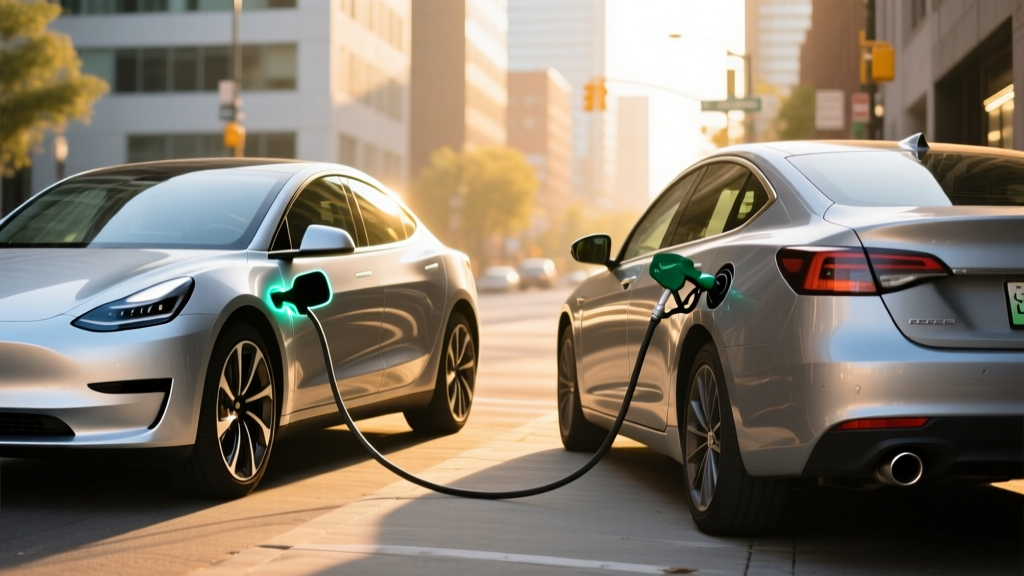
If you've seen viral videos of burning EVs, you might be wondering: are electric cars more prone to fires than gas vehicles? The short answer is no. According to data analyzed by the National Fire Protection Association and AutoinsuranceEZ using NTSB records, gasoline vehicles catch fire at a rate of roughly 1,530 per 100,000 vehicles, while electric vehicles catch fire at approximately 25 per 100,000. Hybrid vehicles actually show the highest fire rate at about 3,475 per 100,000. EV battery fires are rarer but more intense and harder to extinguish when they do occur — which is why they dominate headlines despite being statistically uncommon.
Quick Answer: Electric Car Fire Risk
EV fire rate: ~25 per 100,000 vehicles
Gas car fire rate: ~1,530 per 100,000 vehicles
Hybrid fire rate: ~3,475 per 100,000 vehicles
Bottom line: EVs are far less likely to catch fire than gas or hybrid vehicles. When EV fires do occur, they involve lithium-ion battery thermal runaway, which burns hotter and longer — making them newsworthy despite their rarity.
The Numbers: EV Fires vs. Gas Car Fires by the Data
The fear of an electric car fire is one of the most persistent barriers to EV adoption. But context matters. Let's look at the actual data rather than the headlines.
The most widely cited analysis comes from AutoinsuranceEZ, which cross-referenced data from the National Transportation Safety Board (NTSB), the Bureau of Transportation Statistics, and government recall data. Here's what they found across all vehicle types on U.S. roads:
| Vehicle Type | Fires per 100K Vehicles | Relative Risk |
|---|---|---|
| Hybrid Vehicles | 3,474.5 | Highest |
| Gasoline Vehicles | 1,529.9 | Moderate |
| Electric Vehicles | 25.1 | Lowest |
That means a gas vehicle is roughly 61 times more likely to catch fire than an EV. A hybrid is about 139 times more likely than a pure EV.
Why do hybrids top the list? They combine a gasoline fuel system (with its inherent flammability) with a high-voltage electrical system and battery pack — doubling the potential failure points in a single vehicle.
Why EV Fires Get So Much Attention
If EV fires are so rare, why does it feel like every other week brings a new story about a burning Tesla or Chevy Bolt? Three factors drive the outsized media coverage:
1. Novelty bias. Gas car fires happen hundreds of times per day across the U.S. They're routine — no one writes a headline about a 2014 Honda Civic catching fire in a parking lot. An EV fire is still unusual enough to generate clicks.
2. Thermal runaway intensity. When a lithium-ion battery pack enters thermal runaway, it burns at extremely high temperatures (up to 2,000°F+), can reignite hours or even days after being extinguished, and requires massive amounts of water to cool. Firefighters need specialized training for these incidents. That drama makes compelling footage.
3. Brand association. Tesla, as the most visible EV brand, attracts disproportionate scrutiny. Any Tesla fire becomes international news, regardless of cause.
Common EV Fire Myths vs. Facts
| Myth | Fact |
|---|---|
| "EVs catch fire all the time" | EVs catch fire at ~0.025% the rate of gas cars per 100K vehicles |
| "Charging an EV overnight is dangerous" | Home Level 2 charging is heavily regulated; battery management systems (BMS) monitor every cell during charging |
| "EV fires can't be put out" | They can, but require more water and time; some departments use specialized fire blankets or submersion techniques |
| "A crash always causes an EV fire" | Modern EV battery packs are armored and positioned low; NHTSA crash testing includes specific battery integrity evaluation |
| "All EV batteries are equally fire-prone" | LFP (lithium iron phosphate) chemistry is significantly more thermally stable than NMC (nickel manganese cobalt) |
Battery Chemistry Matters: LFP vs. NMC Fire Risk
Not all EV batteries carry the same thermal runaway risk. The two dominant chemistries in 2026 — LFP (lithium iron phosphate) and NMC (nickel manganese cobalt) — differ substantially in fire behavior.
| Property | LFP (LiFePO4) | NMC (LiNiMnCoO2) |
|---|---|---|
| Thermal runaway onset | ~270°C (518°F) | ~210°C (410°F) |
| Oxygen release during failure | Minimal — does not self-oxidize | Releases oxygen, feeds its own fire |
| Energy density | Lower (~160 Wh/kg cell-level) | Higher (~250 Wh/kg cell-level) |
| Common in 2026 models | Tesla Model 3 RWD, Model Y RWD, BYD, Ford Mustang Mach-E Select LFP trims | Most long-range and performance trims across brands |
| Fire risk profile | Significantly lower thermal runaway probability | Higher energy density = more stored energy to release in failure |
The practical takeaway: if fire risk is a top concern, choosing an LFP-equipped trim (like the Tesla Model 3 Rear-Wheel Drive or standard-range BYD models) provides an additional margin of thermal safety. LFP chemistry's phosphate-iron bond is inherently more stable than NMC's nickel-cobalt structure, and LFP cells don't release oxygen during decomposition — meaning they don't self-feed a fire the way NMC can.
That said, even NMC battery fires in EVs remain extremely rare. Modern packs include multiple layers of protection: cell-level ceramic separators, module-level fire barriers, pack-level armor plating, and sophisticated battery management systems (BMS) that monitor temperature, voltage, and current at the individual cell level hundreds of times per second.
What Causes EV Fires (and How Manufacturers Prevent Them)
When electric car fires do occur, they typically trace back to one of these causes:
Manufacturing defects. The Chevy Bolt recall (2020-2022) is the most prominent example. LG Energy Solution battery cells produced with folded separators or inadequate electrolyte could short-circuit internally, leading to thermal runaway. GM recalled over 140,000 Bolts and replaced battery modules at a cost exceeding $2 billion. The fix worked — post-recall Bolts have not shown elevated fire rates.
Severe crash damage. A high-speed impact that breaches the battery enclosure can cause internal short circuits. This is analogous to a gas car's fuel tank being punctured in a crash. The NHTSA now includes specific battery pack integrity tests in its crash evaluation protocols.
Charging system faults. Extremely rare, but aftermarket or damaged charging equipment that bypasses safety protocols can cause overcharging. The vehicle's BMS and the charger's own safety cutoffs provide redundant protection.
Ground clearance impacts. Running over debris that strikes the underside of the vehicle can damage the battery pack. Most 2026 EVs use steel or aluminum skid plates rated for significant impact energy, but low-clearance sedans remain more vulnerable than crossovers and trucks.
Manufacturers have responded with increasingly robust protections:
- Tesla: Titanium underbody shields added since 2014; cell-level fuses and firewalls between modules
- Hyundai/Kia (E-GMP platform): Battery pack positioned within the wheelbase with structural cross-members for impact protection
- Ford (MEB-derived and GE2 platforms): Liquid cooling channels throughout the pack for thermal management during both driving and charging
- GM (Ultium platform): Wireless BMS reduces wiring-related fault points; cell chemistry optimized for thermal stability
Real Ownership Costs: EV vs. Gas (Including Insurance)
Beyond fire risk, buyers weighing an EV against a gas car need the full cost picture. Insurance premiums for EVs tend to run 15-25% higher than comparable gas vehicles, partly due to higher repair costs after collisions (specialized parts, high-voltage safety protocols, and fewer qualified body shops) — not primarily due to fire risk.
| Cost Category | Tesla Model 3 RWD (EV) | Toyota Camry LE (Gas) |
|---|---|---|
| Base MSRP | $38,990 | $28,400 |
| Federal tax credit (§30D, if eligible) | −$7,500 (point-of-sale) | $0 |
| Effective purchase price | $31,490 | $28,400 |
| Fuel/energy (5 yr, 15K mi/yr, $0.14/kWh home, $3.40/gal) | $3,940 | $8,500 |
| Maintenance (5 yr) | $1,500 | $3,800 |
| Insurance (5 yr avg.) | $9,400 | $7,200 |
| Estimated depreciation (5 yr) | $14,200 | $11,800 |
| Total 5-year cost | $60,530 | $59,700 |
The total cost of ownership is remarkably close when the federal tax credit applies. The EV saves significantly on fuel and maintenance but costs more in insurance and depreciation. Your actual numbers depend heavily on local electricity rates, driving patterns, and whether you qualify for the §30D federal tax credit — which has income caps ($150K single / $300K joint), MSRP caps ($55K sedans / $80K SUVs and trucks), and battery sourcing requirements that change annually.
First-Time EV Buyer Safety Checklist
If you're considering your first EV and fire safety is on your mind, here's a practical framework for evaluating any model:
EV Safety Decision Framework
Choose an LFP battery trim if: You prioritize maximum thermal stability, plan to charge to 100% regularly (LFP tolerates full SoC better), and don't need maximum range.
Choose an NMC battery trim if: You need 300+ miles of EPA range, frequently drive in cold climates (NMC retains more range in freezing temps), or want performance-oriented acceleration.
Check for these safety features on any EV:
- Active battery thermal management (liquid cooling, not just passive air cooling)
- NHTSA 5-star overall crash rating — verify at nhtsa.gov/ratings
- IIHS Top Safety Pick or Top Safety Pick+ designation
- Steel or aluminum underbody armor protecting the battery pack
- OTA (over-the-air) update capability for BMS improvements post-purchase
- No open battery-related recalls on the specific model year (check NHTSA VIN lookup)
For home charging safety:
- Use only UL-listed or ETL-listed Level 2 charging equipment
- Have a licensed electrician install a dedicated 240V circuit (NEMA 14-50 or hardwired)
- Never use extension cords or adapters not rated for continuous EV charging loads
- Install a smoke detector in your garage if you charge indoors
What Firefighters and First Responders Want You to Know
Emergency responders have adapted their protocols for EV fires, and the key differences from gas car fires are worth understanding as an owner:
Water volume. Extinguishing a battery thermal runaway event can require 3,000-8,000 gallons of water, compared to 500-1,000 gallons for a typical gas car fire. This is because lithium-ion cells must be cooled below their thermal runaway threshold, not just deprived of oxygen.
Reignition risk. Damaged battery cells can reignite hours or days after the initial fire appears extinguished. Some fire departments now submerge wrecked EVs in water-filled containers for 24-48 hours post-fire.
Toxic fumes. Burning lithium-ion batteries release hydrogen fluoride (HF) gas and other toxic compounds. First responders use SCBA (self-contained breathing apparatus) for all vehicle fires, but the chemical profile of an EV battery fire is different from burning gasoline and plastics.
Your responsibility as an owner: After any significant collision, even if there's no visible fire or damage, have the vehicle inspected by a qualified EV technician before driving or charging it again. Internal battery damage may not be immediately apparent. Most manufacturers provide emergency response guides specific to each model, available to first responders through the NFPA or manufacturer websites.
Frequently Asked Questions
Are electric cars safe in a crash?
Yes. Modern EVs consistently earn top ratings from both NHTSA and IIHS. The battery pack's low placement gives EVs a lower center of gravity than most gas cars, reducing rollover risk. Structural battery enclosures add rigidity. The Tesla Model Y, Hyundai Ioniq 5, and Ford F-150 Lightning all hold IIHS Top Safety Pick+ or equivalent NHTSA 5-star ratings for their respective model years.
Should I be worried about charging my EV overnight in the garage?
Home Level 2 charging is one of the safest activities you can do with an EV. The vehicle's BMS actively monitors every cell's temperature and voltage throughout the charge session and will halt charging if any parameter exceeds safe limits. Use UL-listed equipment, have a professional install a dedicated circuit, and ensure your garage has a working smoke detector. The statistical risk of a fire during home charging is extraordinarily low.
Do EVs cost more to insure because of fire risk?
Insurance premiums for EVs are typically 15-25% higher than comparable gas vehicles, but this is driven primarily by higher repair costs (specialized parts, high-voltage safety requirements, limited qualified body shops) and higher vehicle purchase prices — not fire risk. EV fire claims are a negligible portion of insurance loss data.
Which EV has the best fire safety record?
There isn't enough model-specific fire incident data publicly available to rank individual EVs by fire rate. What we can say is that vehicles with LFP battery chemistry (Tesla Model 3 RWD, BYD models, certain Ford trims) have an inherent thermal stability advantage. More importantly, any EV with no open battery recalls, liquid-cooled thermal management, and strong crash-test ratings represents a very low fire risk.
What should I do if my EV battery is damaged?
If you experience a significant underbody impact, collision, or notice warning messages about battery faults: pull over safely, exit the vehicle, move at least 50 feet away, and call 911. Do not attempt to drive the vehicle or plug it in. Have it towed to a certified EV service center. Most modern EVs will preemptively shut down the high-voltage system if sensors detect a fault.