Quick Answer: There Is No "Engine" in an Electric Car
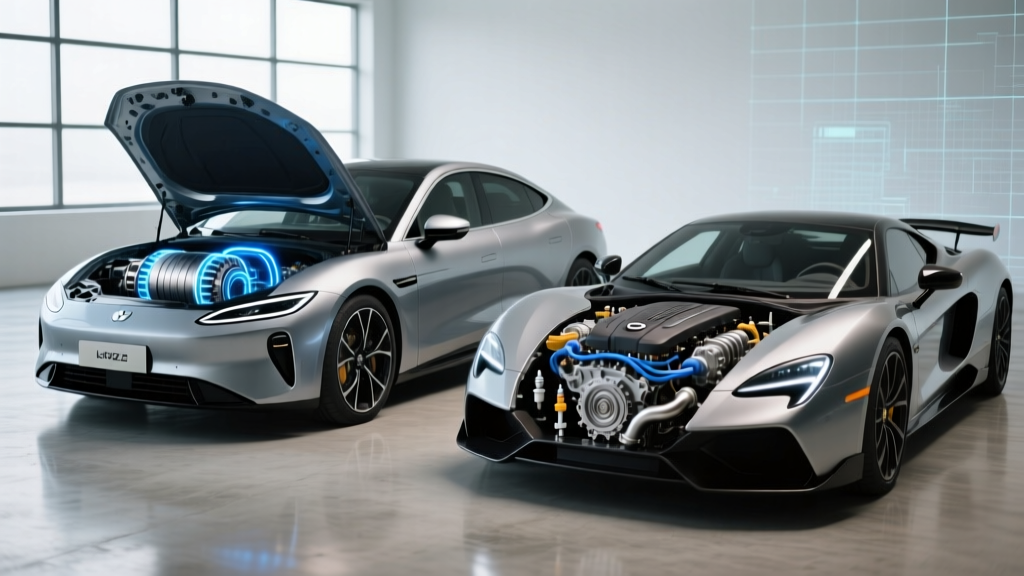
When people search for electric car engine, they're usually asking how an EV's powertrain works compared to a gas car. The short answer: EVs don't have engines — they use electric motors powered by a battery pack. A gas engine burns fuel through hundreds of moving parts; an electric motor converts electrical energy into motion with just one moving part (the rotor). This fundamental difference is why EVs deliver instant torque, need no oil changes, and convert roughly 85–90% of battery energy to motion — versus about 20–30% for gasoline engines, per the U.S. Department of Energy.
How an Electric Car Motor Works (The Basics)
Strip away the marketing, and an EV powertrain has three core components:
- Battery pack — stores energy in kilowatt-hours (kWh). A 2026 Tesla Model Y Long Range, for example, carries roughly 75 kWh of usable energy in an NMC (nickel-manganese-cobalt) pack.
- Inverter — converts the battery's DC (direct current) into AC (alternating current) that the motor needs, and controls motor speed and torque.
- Electric motor — most EVs use either a permanent magnet synchronous motor (PMSM) or an AC induction motor. Both spin using electromagnetic fields rather than combustion.
When you press the accelerator, the inverter draws current from the battery and sends it to the motor. The motor's electromagnetic field pushes the rotor, turning the axle and the wheels. Lift off the pedal, and the motor reverses role — acting as a generator to recapture kinetic energy back into the battery. That's regenerative braking, and it's why EVs can often be driven with one pedal.
By contrast, a gasoline engine compresses a fuel-air mixture, ignites it with a spark plug, and harnesses the resulting explosion to drive pistons, a crankshaft, a transmission, and ultimately the wheels. That chain involves hundreds of moving parts, friction, heat loss, and exhaust.
Electric Motor vs Gas Engine: By the Numbers
Here's a direct comparison using a popular 2026 EV and its closest gas equivalent — the Tesla Model Y Long Range AWD versus the Toyota RAV4 AWD (gas):
| Spec | Tesla Model Y LR AWD (EV) | Toyota RAV4 AWD (Gas) |
|---|---|---|
| Powertrain type | Dual electric motors (PMSM) | 2.5L 4-cyl + 8-speed auto |
| Horsepower | 384 hp | 203 hp |
| Torque | 375 lb-ft (instant) | 184 lb-ft (at 5,000 rpm) |
| 0–60 mph | 4.8 seconds | 8.2 seconds |
| Energy capacity | ~75 kWh (NMC battery) | 14.5-gallon tank |
| EPA range / tank | 320 miles | ~406 miles |
| Efficiency | 122 MPGe combined | 28 MPG combined |
| Moving parts in powertrain | ~20 (motor + inverter) | ~200+ |
| Energy conversion efficiency | ~85–90% | ~20–30% |
| Transmission | Single-speed reduction gear | 8-speed automatic |
Sources: fueleconomy.gov, manufacturer specifications.
The numbers reveal the core trade-off: the EV motor delivers far more power and instant acceleration with dramatically higher efficiency, but the gas car still holds a range and refueling-speed advantage on paper — though the gap narrows when you factor in real-world driving (see below).
Real Costs: EV Motor Ownership vs Gas Engine Maintenance
The "electric car engine" question often masks a cost question. Let's break down a realistic 5-year / 75,000-mile ownership scenario comparing a mid-price EV (like the Hyundai Ioniq 5, ~$45,000 MSRP) to a comparably equipped gas crossover (~$35,000 MSRP). Assumes 15,000 miles/year, $3.40/gallon gas, and $0.14/kWh home electricity.
| Category | EV (Ioniq 5–class) | Gas Crossover |
|---|---|---|
| Purchase price (MSRP) | $45,000 | $35,000 |
| Federal tax credit (§30D) | –$3,750 to –$7,500* | $0 |
| Fuel / electricity (75k mi) | $3,150 (home charging) | $9,000 |
| Maintenance (oil, filters, belts, plugs, brakes) | ~$900 | ~$3,200 |
| Insurance (avg premium) | ~$10,500 | ~$8,250 |
| Tires (EVs wear faster) | $1,600 | $1,200 |
| Estimated 5-yr total | ~$57,350–$60,850 | ~$56,650 |
*§30D credit eligibility depends on MSRP caps, buyer income, and battery sourcing. Check current rules at irs.gov. Point-of-sale transfer is available at participating dealers.
The EV's fuel and maintenance savings are substantial — roughly $8,000 less over five years — but they're partly offset by a higher purchase price, higher insurance premiums (EVs cost 15–25% more to insure on average), and faster tire wear from instant torque and heavier curb weight. With the full $7,500 credit, the EV comes out ahead; with no credit, it's roughly a wash.
Types of Electric Car Motors (And Why It Matters)
Not all EV motors are identical. The two dominant types in 2026 production vehicles:
Permanent Magnet Synchronous Motor (PMSM)
Used in the Tesla Model Y, Hyundai Ioniq 5, Ford Mustang Mach-E, and most Chinese-market EVs. PMSM motors use rare-earth magnets in the rotor, delivering higher efficiency and torque density — ideal for range-focused vehicles. The trade-off: they rely on neodymium and dysprosium, which carry supply-chain and cost risks.
AC Induction Motor
Used in older Tesla Model S/X designs and some heavy-duty applications. No rare-earth magnets — the rotor's magnetic field is induced by the stator. Slightly less efficient at low loads but robust, cheaper to produce, and excellent at high-speed highway driving. Some AWD EVs pair a PMSM on one axle with an induction motor on the other to balance efficiency and cost.
For buyers, the motor type matters less than the resulting specs: look at kW output (power), lb-ft of torque, and the vehicle's efficiency rating in MPGe or kWh/100mi. A well-tuned PMSM in a 2026 Ioniq 5 delivers 168 kW (225 hp) in RWD form and achieves 114 MPGe combined — among the best in its class.
Common Myths About Electric Car Engines, Corrected
| Myth | Fact (with data) |
|---|---|
| "EV motors wear out like gas engines." | Electric motors have one main moving part and no combustion stress. Motors routinely outlast 300,000+ miles. The battery degrades — not the motor. Most 2026 EVs carry an 8-year/100,000-mile battery and powertrain warranty. |
| "EVs are slow." | Electric motors deliver peak torque at 0 RPM. A $45,000 Ioniq 5 hits 0–60 in 5.1 seconds; a $90,000 Tesla Model S Plaid does it in 1.99 seconds. Even economy EVs outpace most gas cars off the line. |
| "EVs are worse in cold weather." | Cold reduces range 15–30% due to battery chemistry and cabin heating loads. But EV motors themselves start instantly in any temperature — no cold cranking, no warm-up idle. A heat pump (standard on most 2026 EVs) recovers much of the heating energy loss. |
| "Replacing an EV motor costs a fortune." | Motor failures are rare. When they occur, replacement runs $3,000–$7,000 — but battery replacement (the real cost concern) is $8,000–$20,000 depending on pack size. Under warranty, both are covered for 8 years / 100,000 miles minimum per federal mandate. |
| "EVs need special maintenance." | EVs need less maintenance: no oil changes, no spark plugs, no timing belts, no exhaust system, and regenerative braking extends brake pad life to 100,000+ miles. You'll still need cabin air filters, brake fluid checks, coolant service, and tire rotations. |
Real-World Ownership: What First-Time EV Buyers Need to Know
Understanding the "electric car engine" is only step one. The ownership experience depends on factors the motor itself can't control:
Home Charging Access Is the Deciding Factor
Charging at home on a Level 2 (240V) outlet at 7–11 kW adds roughly 25–40 miles of range per hour — enough to fully replenish most EVs overnight. But if you live in an apartment without charging access, you'll rely on public DC fast chargers, where costs run $0.30–$0.55/kWh (roughly double home rates) and sessions take 20–40 minutes for a 10–80% charge. Before buying, confirm your electrical panel can support a 40–60 amp circuit — a panel upgrade can add $1,500–$3,500 to your installation cost.
Real-World Range vs EPA Stickers
EPA range is measured under controlled conditions. In practice:
- Highway driving (75+ mph): expect 10–20% less than EPA. Aerodynamic drag scales with the square of speed.
- Cold weather (below 32°F): expect 15–30% reduction. Battery chemistry slows and cabin heating draws power.
- Mountain driving: uphill segments consume heavily, but regen recovers significant energy on descents.
A 320-mile EPA-rated Model Y might deliver 260–280 miles on a 75-mph highway trip in mild weather and 220–240 miles in freezing conditions. Plan road trips around those real numbers, not the sticker.
The Charging Curve Matters More Than Peak kW
Automakers advertise peak DC fast-charging rates — the Ioniq 5 peaks at 240 kW, the Model Y at 250 kW. But that peak only holds between roughly 10–50% state of charge. Above 80%, charging slows dramatically to protect the battery (the "taper"). A realistic 10–80% session takes 18–25 minutes at a capable 350 kW station. Charging from 80–100% can add another 20+ minutes. On road trips, plan shorter stops that stay in the fast-charging sweet spot.
Decision Framework: Should You Buy an EV, Hybrid, or Gas Car?
If-Then EV Buying Guide
- Choose a full EV (BEV) if: you can install a Level 2 charger at home, your daily commute is under 200 miles round-trip, you want minimal maintenance, and you qualify for the §30D federal tax credit (income caps: $150K single / $300K joint; MSRP caps: $55K cars / $80K SUVs and trucks).
- Choose a plug-in hybrid (PHEV) if: you have home charging but frequently drive 300+ miles without stopping, you live in an area with sparse DC fast-charging infrastructure, or you want electric commuting (25–45 miles of EV range) with gas flexibility for road trips.
- Choose a conventional hybrid (HEV) if: you can't charge at home, you want maximum fuel efficiency (45–55 MPG) without plugging in, and your budget doesn't accommodate EV premiums.
- Stick with gas if: you drive under 8,000 miles/year (the fuel savings don't offset the EV price premium), you tow heavy loads regularly (EV range drops 40–50% under towing), or you live in a region with extreme cold and minimal charging infrastructure.
Frequently Asked Questions
Do electric cars have engines or motors?
Electric cars have motors, not engines. An "engine" specifically refers to a machine that converts fuel into mechanical energy through combustion. EVs use electric motors that convert electrical energy from a battery into rotational force using electromagnetic fields. The term "electric car engine" is a colloquial holdover — technically, it's an electric powertrain consisting of a motor, inverter, and battery pack.
How long do electric car motors last?
Electric motors are among the most durable components in any vehicle. With only one main moving part and no combustion, heat cycling, or fluid contamination, EV motors routinely last 300,000+ miles with zero service. The battery pack is the wear item — most 2026 EVs warranty the battery for 8 years or 100,000 miles against degradation below 70% of original capacity. Real-world data from fleet operators shows modern NMC and LFP packs retaining 85–90% capacity at 150,000 miles.
Are electric cars faster than gas cars?
In straight-line acceleration, yes — often significantly. Electric motors deliver maximum torque from 0 RPM, eliminating the lag of a gas engine building revs and a transmission shifting gears. A 2026 Tesla Model 3 Performance (0–60 in 2.9 seconds, $52,990) out-accelerates most gas sports cars costing twice as much. Even mainstream EVs like the Chevrolet Equinox EV (0–60 in ~7.5 seconds) feel quicker than their gas counterparts because the torque is instant and linear at city speeds.
Do electric cars need oil changes?
No. Electric motors don't use engine oil. EVs have no internal combustion, so there are no oil changes, oil filters, spark plugs, timing belts, fuel injectors, catalytic converters, or exhaust systems to maintain. You will still need: cabin air filter replacement (~$50–$100 every 2 years), brake fluid flush (~every 2–3 years), coolant service (~every 5 years), windshield washer fluid, wiper blades, and tire rotations every 5,000–7,500 miles.
What happens if an electric car motor fails?
Motor failure is uncommon — it's statistically far less likely than a gas engine failure. When it does occur outside warranty, replacement costs range from $3,000 to $7,000 including labor, depending on the vehicle. Under the federally mandated 8-year/100,000-mile powertrain warranty (and extended warranties in states like California, which mandate 10 years/150,000 miles for emissions-related EV components), motor replacement is covered at no cost. Most motor issues stem from inverter faults or cooling system failures rather than the motor itself.
Is an electric car cheaper to own than a gas car?
Over 5 years and 75,000 miles, a mid-price EV typically saves $5,000–$8,000 in fuel and maintenance compared to a gas equivalent — but starts $5,000–$15,000 higher in purchase price. The federal §30D tax credit (up to $7,500) can bridge that gap. Insurance costs 15–25% more for EVs on average. The break-even point typically arrives around year 4–6 for drivers covering 12,000+ miles annually with home charging access. Low-mileage drivers may never recoup the premium.