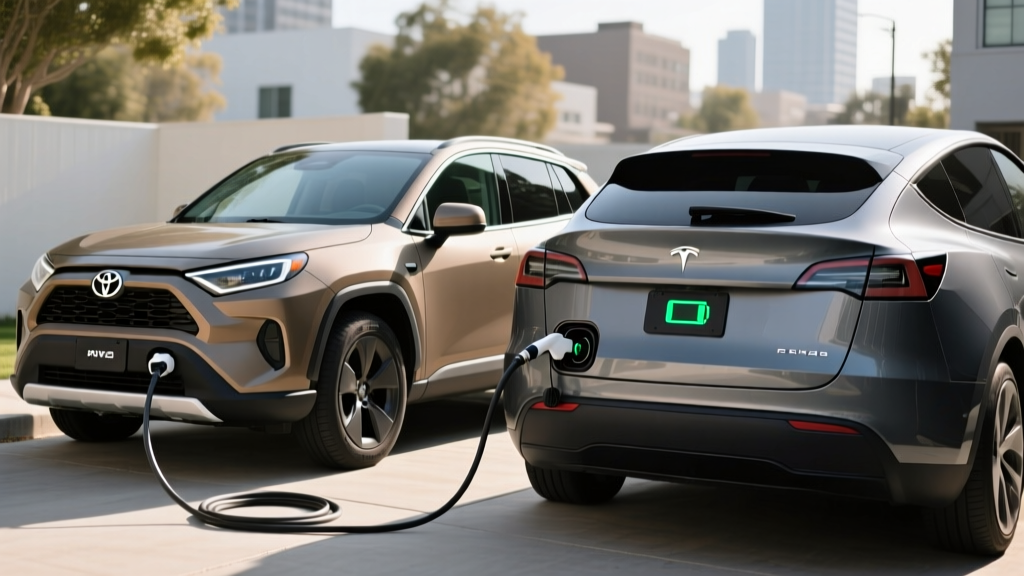
The Core Question: Electric Car Cost Per Mile vs Gas in 2026
For buyers cross-shopping electrified vehicles, the single most practical question isn't 0-60 time or infotainment screen size — it's how much each mile actually costs to drive. The electric car cost per mile vs gas debate often devolves into ideology, but the math is concrete, calculable, and sometimes surprising once you factor in incentives, efficiency, maintenance, and real-world driving conditions.
To ground this comparison in vehicles buyers are actually cross-shopping in 2026, we're putting the 2026 Tesla Model Y Long Range AWD (a battery-electric SUV) against the 2026 Toyota RAV4 Hybrid XLE AWD (a gasoline-electric hybrid). Both seat five, both offer all-wheel drive, both hover around the $35,000–$48,000 price band before incentives, and both are among the best-selling vehicles in their respective categories. But their cost-per-mile profiles diverge sharply depending on how you charge, where you drive, and whether you qualify for federal tax credits.
Side-by-Side Specs: Model Y vs RAV4 Hybrid
| Specification | Tesla Model Y LR AWD | Toyota RAV4 Hybrid XLE AWD |
|---|---|---|
| Powertrain | Dual-motor BEV | 2.5L 4-cyl + 3 electric motors (HEV) |
| Battery / Chemistry | ~78 kWh usable / NMC | 1.6 kWh NiMH (self-charging) |
| Horsepower | 384 hp | 219 hp net |
| 0–60 mph | 4.8 sec | 7.4 sec |
| EPA Range / Efficiency | 320 mi / 122 MPGe (28 kWh/100mi) | 560 mi (14.5 gal) / 39 MPG combined |
| Max DC Fast Charge | 250 kW (peak) | N/A (gasoline only) |
| 10–80% Charge Time | ~27 min (DC fast) | ~3 min (gas station fill-up) |
| Level 2 AC Charge Rate | 11.5 kW (~44 mi/hr) | N/A |
| Cargo Volume (behind 2nd row) | 30.2 cu ft (76.2 cu ft max) | 37.6 cu ft (69.8 cu ft max) |
| Towing Capacity | 3,500 lbs | 1,750 lbs |
| Base MSRP | $44,990 | $35,425 |
| Battery / Powertrain Warranty | 8 yr / 120,000 mi | 10 yr / 150,000 mi (hybrid battery) |
Sources: EPA / fueleconomy.gov, Tesla.com, Toyota.com. Specs reflect 2026 model year where published; carryover figures noted.
Electric Car Cost Per Mile vs Gas: The Real Fueling Math
Fueling cost is where the electric car cost per mile vs gas comparison gets concrete. We'll calculate three scenarios using national averages, then stress-test them with real-world variables.
Baseline Assumptions (2026 National Averages)
- Gasoline: $3.45/gallon (EIA weekly retail average)
- Residential electricity: $0.165/kWh (EIA)
- Public DC fast charging: $0.48/kWh (national blended average across Electrify America, EVgo, Tesla Supercharger)
- Annual mileage: 13,500 miles (FHWA average)
Cost-Per-Mile Breakdown
| Scenario | Model Y (BEV) | RAV4 Hybrid (HEV) | Annual Savings (EV) |
|---|---|---|---|
| 100% home charging (Level 2) | $0.046/mi · $624/yr | $0.088/mi · $1,194/yr | $570/yr |
| 80% home / 20% public DC | $0.055/mi · $743/yr | $0.088/mi · $1,194/yr | $451/yr |
| 100% public DC fast charging | $0.134/mi · $1,814/yr | $0.088/mi · $1,194/yr | −$620/yr (gas wins) |
The takeaway is stark: home charging is the economic linchpin. If you can install a Level 2 home charger and charge overnight at residential rates, the Model Y costs roughly half as much per mile as the RAV4 Hybrid. If you rely entirely on public DC fast charging, the gas hybrid is actually cheaper to fuel.
Price, Tax Credits, and True Purchase Cost
Sticker price alone tells an incomplete story. The IRS §30D federal tax credit can shift the value equation dramatically — but eligibility is conditional and model-specific.
| Cost Factor | Tesla Model Y LR AWD | Toyota RAV4 Hybrid XLE AWD |
|---|---|---|
| Base MSRP | $44,990 | $35,425 |
| Destination / Delivery Fee | $1,390 | $1,395 |
| Federal §30D Tax Credit | Up to $7,500 (if eligible) | $0 (HEV not eligible) |
| Effective Price (w/ full credit) | ~$38,880 | $36,820 |
| Price Gap After Credit | $2,060 (Model Y still higher) | |
- ✅ Vehicle MSRP cap: SUVs must be ≤$80,000 (Model Y qualifies)
- ✅ Buyer income cap: AGI ≤$150K single / $300K joint
- ⚠️ Battery sourcing: Critical minerals and battery components must meet phased-in percentage thresholds from US/FTA countries — verify current-year compliance at purchase on IRS.gov
- ✅ Point-of-sale transfer: Credit can be applied at the dealer as a down-payment reduction (effective 2024+), rather than waiting for tax filing
- ❌ HEVs excluded: RAV4 Hybrid does not qualify — only BEVs, PHEVs, and FCEVs are eligible
Even with the full $7,500 credit, the Model Y starts roughly $2,000 higher than the RAV4 Hybrid. But the credit narrows the gap enough that 5-year ownership costs can flip in the EV's favor — which we'll calculate next.
5-Year Total Cost of Ownership
Here's where the electric car cost per mile vs gas question becomes a complete financial picture. We model 5 years and 67,500 miles of ownership using the "80% home / 20% public" charging scenario, which reflects typical EV owner behavior.
| Cost Category | Model Y LR AWD | RAV4 Hybrid XLE AWD |
|---|---|---|
| Effective Purchase Price (w/ credit) | $38,880 | $36,820 |
| Fueling (5 years) | $3,715 | $5,970 |
| Home Charger Install (Level 2) | $1,200 (one-time) | $0 |
| Maintenance (5 years) | ~$1,100 | ~$2,800 |
| Insurance (5-year avg) | ~$9,500 | ~$7,200 |
| Estimated Depreciation (5 yr) | ~$18,500 | ~$13,200 |
| Federal Tax Credit | −$7,500 | $0 |
| Net 5-Year Cost | ~$56,895 | ~$52,790 |
Insurance estimates based on national averages; individual rates vary significantly by state, age, and driving record. Depreciation figures reflect current resale-value trends from industry data. Maintenance for the Model Y excludes tire rotation, cabin filter, and wiper fluid; RAV4 Hybrid includes oil changes, filter replacements, and transmission fluid service.
The RAV4 Hybrid still wins on 5-year net cost by roughly $4,100, primarily due to lower insurance premiums and stronger resale value. But the gap is far narrower than the $10,000 sticker-price difference would suggest — and it hinges on three variables that differ by buyer:
- Home charging access: Without it, the EV's fueling advantage evaporates.
- Tax credit eligibility: Income or sourcing disqualification widens the gap back to $11,600.
- Insurance market: Tesla insurance premiums vary wildly by state; in some markets, the gap is $100/month, in others $400+.
Category Verdicts
At $0.046–$0.055/mi with home charging, the Model Y costs roughly half what the RAV4 Hybrid requires in gasoline. Over 5 years, that's $2,255 in fuel savings.
Even after the $7,500 federal credit, the RAV4 Hybrid starts ~$2,060 less. Without the credit, the gap widens to ~$9,565.
560-mile range and 3-minute refueling anywhere. The Model Y's 320-mile EPA range (265–285 real-world highway) requires route planning and 25–30 minute charging stops on long trips.
384 hp, 4.8-second 0–60, instant torque, and a low center of gravity from the floor-mounted battery. The RAV4 Hybrid is adequate at 219 hp / 7.4s, but not engaging.
37.6 cu ft behind the second row vs. the Model Y's 30.2 cu ft. The RAV4's cargo area is also more squared and accessible for bulky items.
Over-the-air updates, Supercharger network integration, app-based preconditioning, and available Autopilot (Level 2 driver-assist). Toyota's infotainment is functional but a generation behind.
No oil changes, no spark plugs, no transmission fluid. Estimated $1,100 over 5 years vs. $2,800 for the hybrid. Regenerative braking also extends brake pad life significantly.
Average premiums run $400–$500/year less than the Model Y, varying by state. Over 5 years, that's $2,000–$2,500 in savings.
Charging Network vs Gas Station Reality
The Model Y's biggest practical advantage is access to the Tesla Supercharger network — over 6,500 stations and 60,000+ stalls in North America, consistently rated the most reliable public charging infrastructure. Superchargers deliver up to 250 kW, adding roughly 200 miles in 15 minutes under optimal conditions.
However, the charging curve matters: the Model Y peaks at 250 kW only between roughly 10–30% State of Charge, then tapers progressively. A 10–80% session takes ~27 minutes, not the "15 minutes of range" marketing might imply. Above 80%, charging slows dramatically to protect battery longevity — plan to charge to 80% on road trips and skip the last 20% unless needed.
The RAV4 Hybrid's advantage is infrastructure ubiquity: 150,000+ gas stations in the US, zero route planning, and consistent 3-minute fill-ups regardless of temperature, terrain, or station congestion. For rural drivers, frequent road-trippers, or apartment dwellers without home charging access, this convenience gap is not trivial.
- Model Y: Autopilot and FSD (Supervised) are SAE Level 2 driver-assist systems — not self-driving. The driver must remain attentive with hands on the wheel at all times.
- RAV4 Hybrid: Toyota Safety Sense 3.0 includes adaptive cruise and lane-centering (Level 2), but the hybrid system cannot drive on electric power alone for meaningful distances — it's a self-charging hybrid, not a plug-in.
Decision Framework: Which Should You Choose?
Choose the Tesla Model Y if:
- You have access to home charging (garage, driveway, or workplace Level 2)
- You qualify for the full $7,500 §30D federal tax credit (income and sourcing requirements met)
- Your daily commute is under 200 miles round-trip, making home charging sufficient for 90%+ of driving
- You value performance (384 hp, 4.8s 0–60) and tech-forward features (OTA updates, app control, Supercharger integration)
- You want the lowest per-mile fueling cost and minimal scheduled maintenance
Choose the Toyota RAV4 Hybrid if:
- You live in an apartment or lack reliable home charging access
- You frequently drive 300+ miles in a single day (rural routes, road trips, towing)
- You don't qualify for the federal EV tax credit (income above cap, or sourcing disqualification)
- You prioritize cargo space (37.6 cu ft), lower insurance premiums, and proven long-term resale value
- You want a vehicle with zero charging logistics — fill up anywhere in 3 minutes
Final Recommendation
The electric car cost per mile vs gas comparison doesn't have a universal winner — it has a conditional one. If you can charge at home and qualify for the federal credit, the Model Y delivers a lower cost per mile ($0.046–$0.055 vs $0.088), dramatically lower maintenance, and a more engaging drive. The fueling savings alone recover ~$2,255 over 5 years, partially offsetting higher insurance and the home charger installation cost.
If you can't charge at home, don't qualify for the credit, or regularly drive long distances in areas with sparse charging infrastructure, the RAV4 Hybrid is the more pragmatic and financially predictable choice. Its 39 MPG combined is excellent for a gasoline vehicle, and the total ownership equation stays simpler without charging logistics, credit paperwork, or insurance premiums that vary by ZIP code.
Neither choice is wrong. The right answer depends on your charging access, your tax situation, and your driving patterns — not on whether electricity or gasoline is inherently "better."
Frequently Asked Questions
Is an electric car really cheaper per mile than a gas hybrid?
Yes — but only with home charging. At $0.165/kWh residential electricity, the Model Y costs ~$0.046/mile to fuel. The RAV4 Hybrid at 39 MPG and $3.45/gallon costs ~$0.088/mile. If you rely entirely on public DC fast charging at $0.48/kWh, the EV's cost per mile rises to ~$0.134, making the hybrid cheaper.
Does the Toyota RAV4 Hybrid qualify for any federal tax credit?
No. The IRS §30D credit applies only to plug-in electric vehicles (BEVs and PHEVs) and fuel-cell vehicles. Conventional hybrids like the RAV4 Hybrid that don't plug in are not eligible for any federal purchase incentive. However, some states offer separate rebates — check your state energy office.
How much does it cost to install a Level 2 home charger?
A typical Level 2 home charger installation (48-amp hardwired unit on a 60-amp circuit) costs $800–$2,000 including equipment, electrician labor, and permits. If your home's electrical panel needs an upgrade to 200 amps, add $1,500–$3,500. Always get a quote from a licensed electrician before purchasing equipment.
What happens to EV range in cold weather?
Cold weather reduces EV range by 15–30% depending on temperature and whether you use cabin heating. The Model Y's 320-mile EPA range may drop to 220–250 miles in sub-30°F conditions. The RAV4 Hybrid's range is less affected — expect a 5–10% reduction in winter MPG. Preconditioning the Model Y's battery while plugged in (via the Tesla app) mitigates some cold-weather range loss and improves DC fast-charging speeds.
Which vehicle has lower maintenance costs over 5 years?
The Model Y, by a significant margin. Without oil changes, transmission fluid, spark plugs, or emissions system service, estimated 5-year maintenance is ~$1,100 (cabin air filter, wiper fluid, tire rotations, brake fluid check). The RAV4 Hybrid requires conventional engine maintenance totaling ~$2,800 over the same period. Regenerative braking on the Model Y also extends brake pad life well beyond typical intervals.