Electric Car Comparison: Audi vs BMW – Which EV Brand Wins?
When it comes to premium electric vehicles, few rivalries are as intense as the one between Audi and BMW. Both German automakers have invested billions into electrification, producing lineups that blend luxury, cutting-edge technology, and thrilling performance. But when you line them up side by side, which brand delivers the better electric car experience?
In this comprehensive electric car comparison, we pit Audi's EV lineup — headlined by the e-tron GT family and the Q8 e-tron — against BMW's i-series, including the i4, i5, i7, and iX. We'll examine every dimension that matters to EV buyers: range, pricing, charging speed, performance, interior space, technology, and warranty coverage. Whether you're cross-shopping a sporty sedan or a luxury SUV, this guide will help you decide which badge deserves a spot in your garage.
For individual deep dives, check out our full Audi EV review and our complete BMW EV review. You can also see how both brands stack up in our best luxury electric cars rankings.
Overview: Audi and BMW's Electric Vehicle Lineups
Audi entered the EV space early with the original e-tron SUV, which later evolved into the Q8 e-tron. The brand also developed the stunning e-tron GT grand tourer on the same J1 platform that underpins the Porsche Taycan. Audi's approach prioritizes refined luxury, build quality, and a design language that eases the transition from combustion to electric power.
BMW took a different path. Rather than creating an entirely new EV architecture from scratch, the company developed flexible platforms that accommodate both electric and combustion powertrains. The result is the i4 gran coupe, the i5 sedan, the flagship i7 luxury sedan, and the iX electric SUV. BMW's EVs are known for their engaging driving dynamics, intuitive iDrive infotainment system, and competitive pricing within the luxury segment.
Both brands now offer multiple body styles and price points, making this electric car comparison particularly relevant for buyers shopping in the premium EV space.
Side-by-Side Specification Comparison
Before we dive into the details, here's a quick-reference table comparing key specifications across the most popular models from each brand. All figures reflect EPA estimates and manufacturer data where available.
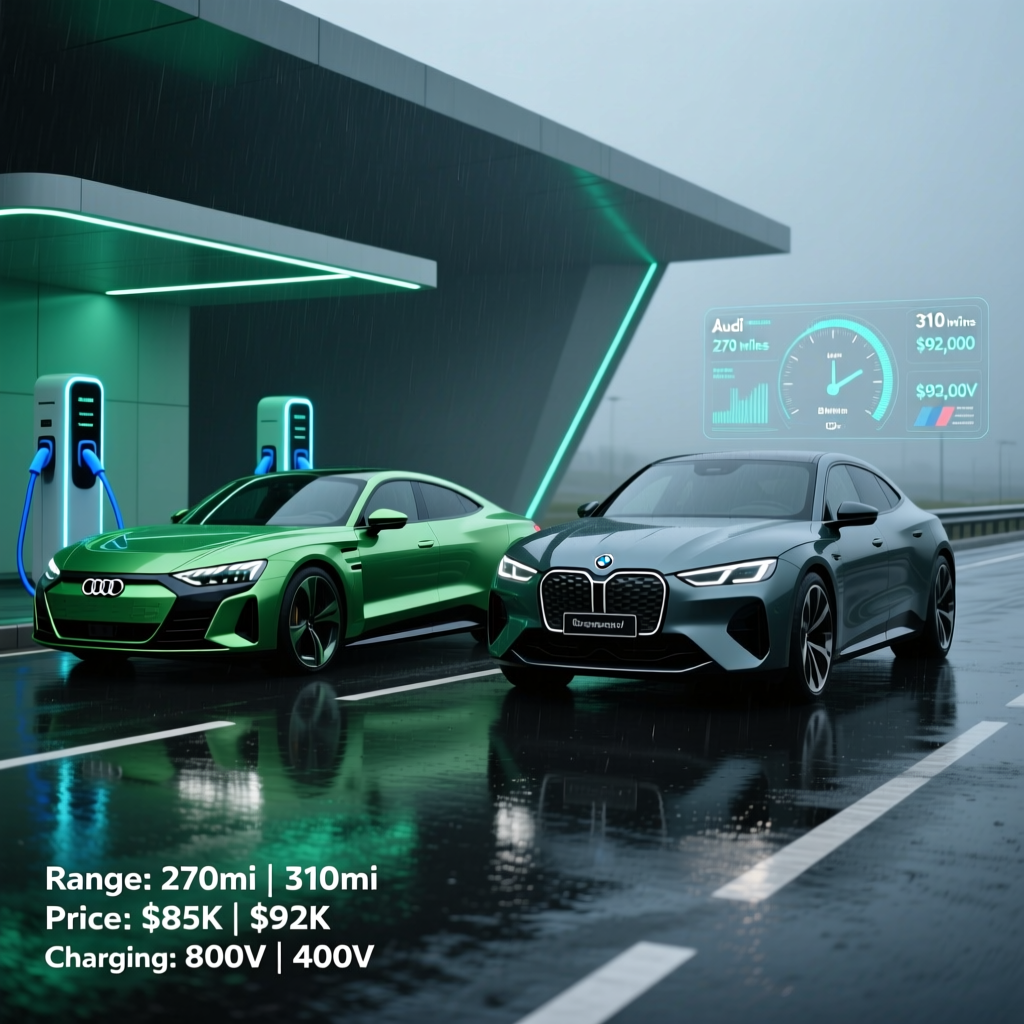
| Specification | Audi e-tron GT | Audi Q8 e-tron | BMW i4 M50 | BMW iX xDrive50 |
|---|---|---|---|---|
| Body Style | Grand Tourer Sedan | Midsize SUV | Gran Coupe | Midsize SUV |
| Drivetrain | AWD (Dual Motor) | AWD (Dual Motor) | AWD (Dual Motor) | AWD (Dual Motor) |
| Horsepower | 522 hp (up to 637 hp RS) | 402 hp | 536 hp | 516 hp |
| EPA Range | 238 miles | 285 miles | 270 miles | 324 miles |
| Battery Capacity | 93.4 kWh (gross) | 114 kWh (gross) | 81.5 kWh (gross) | 111.5 kWh (gross) |
| Max DC Fast Charging | 270 kW | 170 kW | 200 kW | 195 kW |
| 0–60 mph | 3.9 s (RS: 3.1 s) | 5.5 s | 3.7 s | 4.4 s |
| Starting MSRP | ~$106,000 | ~$75,000 | ~$67,000 | ~$87,000 |
Note: Pricing and specifications are approximate and may vary by trim level and market. Always confirm current figures with your local dealer or the manufacturer's website. For the latest data, consult fueleconomy.gov for official EPA ratings.
Range and Efficiency: Which Brand Goes Farther?
Range anxiety remains one of the top concerns for EV buyers, and this electric car comparison reveals meaningful differences between the two brands.
Audi Range Highlights
The Audi Q8 e-tron leads the brand's lineup with an EPA-estimated range of up to 285 miles thanks to its large 114 kWh battery pack. The e-tron GT, despite its larger-than-average battery for a sedan, achieves around 238 miles due to its performance-oriented tuning and wider tires. The RS e-tron GT variant sacrifices a few additional miles for its extra power output.
Audi's efficiency figures tend to fall slightly behind BMW's, largely because Audi prioritizes all-weather capability, standard all-wheel drive, and heavier sound insulation — all of which add weight and consume energy.
BMW Range Highlights
BMW's iX xDrive50 stands out as the range champion in this comparison, delivering an EPA-estimated 324 miles on a single charge. This is thanks to BMW's fifth-generation eDrive technology, which integrates the electric motor, power electronics, and transmission into a compact, efficient unit. The i4 eDrive40 (rear-wheel-drive) can achieve up to 301 miles, while the dual-motor i4 M50 returns approximately 270 miles.
The BMW i5 and i7 sedans also post competitive numbers, with the i5 eDrive40 reaching around 295 miles and the i7 eDrive50 hitting approximately 318 miles, according to EPA data.
Range Verdict
BMW wins the range category in this electric car comparison. Across comparable segments, BMW's EVs consistently deliver 20 to 40 more miles of EPA-estimated range than their Audi counterparts. If maximizing distance per charge is your top priority, BMW holds the edge. That said, Audi's range figures remain perfectly adequate for daily driving and most road trips, especially when paired with the brand's strong charging infrastructure partnerships.
Price and Value: Which Brand Offers More for the Money?
Pricing in the luxury EV segment can climb quickly once you start adding options, but the base MSRP figures tell an important story about each brand's positioning.
Audi Pricing
Audi positions its EVs squarely in the premium-to-luxury space. The Q8 e-tron starts around $75,000, which is competitive for a luxury electric SUV. However, the e-tron GT commands a significant premium, starting near $106,000, with the RS variant pushing well past $140,000. Audi's options packages — particularly for driver assistance, premium audio, and luxury interior materials — can add $10,000 to $20,000 to the final price.
On the positive side, Audi often includes more standard equipment than BMW, including features like adaptive air suspension, matrix-design LED headlights, and premium leather upholstery on mid-level trims.
BMW Pricing
BMW has taken a more aggressive pricing approach. The i4 starts around $55,000 for the eDrive40 variant, making it one of the most accessible luxury electric gran coupes on the market. The i4 M50 begins near $67,000 — a compelling figure for a 536-horsepower electric performance car. The iX xDrive50 starts around $87,000, undercutting many rival luxury electric SUVs.
BMW's options strategy is similar to Audi's in that packages can add up quickly, but the lower starting prices give buyers more flexibility to configure their ideal vehicle without exceeding their budget.
Value Verdict
BMW wins on price and value in this electric car comparison. Lower starting prices across the lineup, combined with strong standard equipment levels, make BMW's EVs more accessible to a broader range of buyers. That said, Audi's higher pricing reflects its more premium positioning and richer standard features in some areas. For a complete look at value, see our best electric SUVs and best electric sedans rankings.
Charging Speed: Who Gets You Back on the Road Faster?
Fast-charging capability is critical for road-trip comfort, and both Audi and BMW have invested heavily in this area.
Audi Charging Performance
The Audi e-tron GT is the charging speed champion for the brand, capable of accepting up to 270 kW on a DC fast charger. Under ideal conditions, Audi claims the e-tron GT can charge from 5% to 80% in approximately 23 minutes. The Q8 e-tron is more modest, with a peak rate of 170 kW, achieving a 10% to 80% charge in roughly 31 minutes.
Audi is also a key participant in the Electrify America network, and e-tron owners often receive complimentary charging credits, which can significantly reduce the cost of public charging.
BMW Charging Performance
BMW's EVs peak between 195 kW and 205 kW depending on the model. The i4 M50 can charge at up to 200 kW, reaching a 10% to 80% state of charge in about 31 minutes. The iX xDrive50 peaks at approximately 195 kW with similar timing. While these figures don't match the e-tron GT's peak rate, they are consistent and reliable across a wide range of charging conditions.
BMW has partnered with Electrify America as well, offering complimentary charging sessions with new vehicle purchases in many markets.
Charging Speed Verdict
Audi takes the charging speed category in this electric car comparison, but with an important caveat: only the e-tron GT achieves the standout 270 kW peak rate. The Q8 e-tron's 170 kW peak actually trails BMW's offerings. If charging speed is a top priority and you're considering the e-tron GT, Audi has a clear advantage. For SUV buyers, BMW's charging performance is slightly better.
Performance and Driving Dynamics
Both Audi and BMW have deep motorsport heritage, and that DNA carries over into their electric vehicles.
Audi Performance
The Audi RS e-tron GT is a genuine supercar killer, launching from 0 to 60 mph in approximately 3.1 seconds with 637 horsepower in boost mode. The standard e-tron GT is hardly slow either, reaching 60 mph in about 3.9 seconds. Audi's legendary quattro all-wheel-drive system provides exceptional traction in all conditions, and the adaptive air suspension delivers a remarkable balance between ride comfort and cornering composure.
The Q8 e-tron is tuned more for comfort than outright performance, with a 0–60 time of around 5.5 seconds. It excels as a refined, quiet cruiser rather than a canyon carver.
BMW Performance
The BMW i4 M50 is the brand's performance flagship among its more accessible models, hitting 60 mph in 3.7 seconds with 536 horsepower. Independent testing by outlets like Car and Driver has confirmed that BMW's acceleration claims are often conservative, with real-world tests sometimes beating factory estimates.
The iX xDrive50 delivers a 4.4-second sprint to 60 mph — impressive for a two-row luxury SUV weighing over 5,500 pounds. BMW's hallmark rear-biased all-wheel-drive system gives its EVs a more engaging, driver-focused feel compared to Audi's more neutral handling character.
Performance Verdict
This category is essentially a tie, with each brand excelling in different dimensions. Audi wins on peak performance with the RS e-tron GT, while BMW offers more engaging driving dynamics across its broader lineup. If you want a thrilling daily driver that rewards spirited driving, BMW's tuning philosophy may resonate more. If you want explosive straight-line speed and all-weather confidence, Audi's quattro system and RS models deliver. For more performance-focused picks, browse our fastest electric cars roundup.
Interior Space, Comfort, and Build Quality
Luxury EV buyers expect premium materials, spacious cabins, and meticulous build quality. Both brands deliver, but with different philosophies.
Audi Interior
Audi's interiors are renowned for their minimalist elegance and exceptional material quality. The e-tron GT features a driver-focused cockpit with a low-slung seating position, high-quality Nappa leather, and Audi's Virtual Cockpit Plus digital instrument cluster. Rear-seat space in the e-tron GT is adequate for adults on shorter trips, though the sloping roofline limits headroom.
The Q8 e-tron offers a more spacious, SUV-appropriate cabin with generous rear legroom, a flat floor (thanks to the dedicated EV architecture), and up to 57 cubic feet of cargo space with the rear seats folded. Audi's fit and finish are among the best in the industry, with tight panel gaps, soft-touch surfaces, and satisfying switchgear throughout.
BMW Interior
BMW's latest interiors are anchored by the Curved Display, which merges a 12.3-inch instrument cluster with a 14.9-inch touchscreen running the iDrive 8.5 infotainment system. The i4 and i5 offer comfortable, well-bolstered sport seats and a practical liftback design that maximizes cargo versatility.
The iX features a strikingly modern cabin with a hexagonal steering wheel, a panoramic glass roof with electrochromic shading, and available Crystal headlights. Rear-seat space is generous, and the flat floor creates an airy, open feeling. Cargo capacity in the iX reaches approximately 77 cubic feet with the rear seats folded — significantly more than the Q8 e-tron.
Interior Verdict
Audi edges ahead on pure material quality and traditional luxury craftsmanship, while BMW offers more innovative design and greater practicality, especially in its SUV models. If you value a serene, traditionally luxurious cabin, Audi is the stronger choice. If you prefer a tech-forward interior with maximum cargo space, BMW's iX and i5 are hard to beat.
Technology and Infotainment
In the luxury EV segment, technology is a major differentiator. Both brands pack their electric vehicles with advanced features, but their approaches differ significantly.
Audi Technology
Audi employs a dual-touchscreen setup in many of its EVs, with an upper screen for navigation and media and a lower screen for climate controls and handwriting recognition. The system is visually stunning and highly customizable, though some users find the touch-sensitive lower panel less intuitive while driving.
Audi's driver assistance suite includes adaptive cruise control with lane guidance, intersection assist, and available remote parking. The brand's Virtual Cockpit remains one of the best digital instrument clusters in the industry, offering configurable layouts with integrated navigation mapping.
BMW Technology
BMW's iDrive system has long been considered the gold standard for luxury infotainment, and the latest iDrive 8.5 iteration continues that tradition. The system features a responsive touchscreen, a rotary controller for those who prefer physical inputs, natural-language voice control, and wireless Apple CarPlay and Android Auto.
BMW's Driving Assistant Professional package offers highway assistant functionality with hands-off capability at speeds up to 85 mph on divided highways (where legally permitted). The iX also offers available augmented-reality navigation, which overlays directional arrows onto a live camera feed of the road ahead.
Technology Verdict
BMW wins the technology category in this electric car comparison. The iDrive system's combination of touchscreen, rotary controller, and voice input gives drivers multiple intuitive ways to interact with the vehicle. Audi's dual-screen setup looks impressive but can be more distracting to use while driving. BMW's advanced driver assistance features also hold a slight edge in real-world usability.
Warranty and Ownership Experience
A strong warranty provides peace of mind, especially when investing in a luxury electric vehicle.
Audi Warranty Coverage
Audi provides a 4-year/50,000-mile limited warranty and a 4-year/50,000-mile powertrain warranty. The high-voltage battery is covered for 8 years or 100,000 miles against defects and excessive capacity degradation (typically defined as falling below 70% of original capacity). Audi also includes 4 years of roadside assistance and, in many markets, complimentary scheduled maintenance for the first year or 10,000 miles.
BMW Warranty Coverage
BMW matches Audi with a 4-year/50,000-mile limited warranty and provides the same 8-year/100,000-mile battery warranty. BMW includes 3 years or 36,000 miles of complimentary scheduled maintenance through its Ultimate Care program, which covers more service visits than Audi's offering. BMW's roadside assistance coverage lasts for 4 years with unlimited mileage.
Ownership Verdict
BMW holds a slight advantage in the ownership experience category. While the core warranty terms are nearly identical, BMW's longer complimentary maintenance program and strong dealer network give it an edge. Both brands offer excellent battery warranties that should reassure buyers concerned about long-term battery health.
Final Verdict: Which Brand Should You Choose?
After examining every dimension of this electric car comparison, the answer depends on your priorities as a buyer. Here's our recommendation by buyer type:
Choose Audi If:
- You want the fastest, most dramatic EV in the room — the RS e-tron GT is a genuine exotic car alternative with everyday usability.
- You value traditional luxury craftsmanship, premium materials, and understated design.
- You live in a region with harsh winters and want the confidence of Audi's quattro all-wheel-drive system with its proven all-weather capability.
- You prioritize the fastest possible DC charging speeds (e-tron GT specifically).
- Build quality and fit-and-finish are your top criteria.
Choose BMW If:
- You want the best range per dollar — BMW's EVs consistently deliver more miles per charge at lower prices.
- You value engaging driving dynamics and a driver-focused experience.
- You prefer the most intuitive, feature-rich infotainment system in the luxury segment.
- You need maximum cargo space and practicality, especially in the iX SUV.
- You want a luxury EV starting under $60,000 (the i4 eDrive40).
Overall Winner
BMW earns a narrow overall victory in this electric car comparison. The brand's combination of superior range, more aggressive pricing, best-in-class infotainment, and engaging driving dynamics makes its EVs the more compelling choice for the majority of luxury EV buyers. However, Audi's advantages in build quality, peak performance (RS e-tron GT), and all-weather capability make it the right choice for a significant segment of buyers.
Still undecided? Explore our best luxury electric cars rankings to see how both brands compare against the full luxury EV field, or read our complete EV buying guide for expert tips on making your final decision.
Frequently Asked Questions
Are Audi or BMW electric cars more reliable?
Both brands have comparable reliability records for their electric vehicles, though long-term data is still limited compared to their combustion-engine counterparts. BMW's simpler platform architecture — shared with conventional models — may offer a slight advantage in serviceability and parts availability. Independent reliability surveys from organizations like J.D. Power tend to show both brands performing near the industry average for premium vehicles. Regular software updates from both manufacturers continue to improve vehicle performance and address issues post-purchase.
Which brand has better charging infrastructure support?
Both Audi and BMW have partnered with Electrify America to offer complimentary charging credits with new EV purchases. However, BMW has also invested in its own BMW Charging network, which aggregates access to multiple charging providers through a single account and app. Both brands support the CCS charging standard and are transitioning to the NACS (Tesla Supercharger) standard in upcoming models. In practice, charging infrastructure access is essentially equal between the two brands, with availability depending more on your region and typical driving routes than on the brand you choose.
Can I save money by choosing a BMW i4 over an Audi e-tron GT?
Absolutely. The BMW i4 starts approximately $40,000 to $50,000 less than the Audi e-tron GT, depending on the trim levels you compare. Even the high-performance i4 M50 undercuts the standard e-tron GT by nearly $40,000 while offering comparable acceleration and more EPA-estimated range. The e-tron GT justifies its premium with its bespoke platform (shared with the Porsche Taycan), more exotic styling, and higher peak charging speeds. If budget is a primary concern, the i4 delivers exceptional value; if you want a halo-car experience, the e-tron GT is worth the investment.
Do Audi and BMW EVs qualify for federal tax credits?
Tax credit eligibility for electric vehicles changes frequently and depends on factors including battery component sourcing, final assembly location, and the buyer's income level. Both Audi and BMW have models that have qualified for partial or full federal tax credits at various points. We recommend checking the latest eligibility information on fueleconomy.gov or consulting with your local dealer for the most current details. Additionally, many states and local utilities offer their own incentives for EV purchases, which can further reduce the effective cost of ownership regardless of which brand you choose.