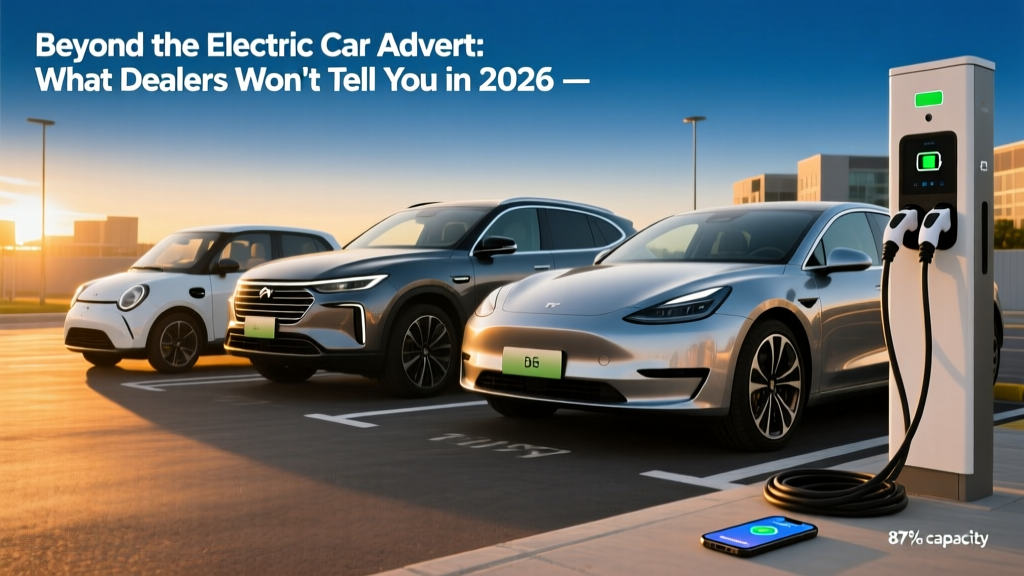
The reality behind the advert: A typical 2026 electric car advert highlights peak EPA range, 0-60 times, and the $7,500 federal tax credit — but omits cold-weather range loss (15-30%), home charger installation costs ($600-$2,200), real-world highway efficiency drops, and the strict income/MSRP/sourcing rules governing the §30D tax credit. Before you sign, verify usable battery kWh, sustained (not peak) DC charge rates, and your actual electricity cost per kWh.
Every electric car advert looks compelling on screen: a silent SUV gliding past mountain scenery with "350 miles of range" splashed across the frame. But between the showroom brochure and your driveway, a lot of critical data gets left out. This guide breaks down what those advertisements don't tell you — with exact numbers, real-world adjustments, and a decision framework to help you buy smart.
Range: The Advert Number vs. Your Actual Miles
Automakers quote the EPA-estimated range prominently because it's the single most searched EV spec. But the EPA test cycle blends city and highway driving at moderate temperatures — conditions that rarely match a 75-mph interstate commute in January.
| Vehicle | EPA Range | Highway (70-75 mph) | Cold Weather (20°F) | Battery (Usable kWh) |
|---|---|---|---|---|
| Tesla Model Y Long Range | 320 mi | ~265-280 mi | ~225-250 mi | 75 kWh (NMC) |
| Hyundai Ioniq 5 Long Range | 303 mi | ~250-270 mi | ~215-240 mi | 77.4 kWh (NMC) |
| Chevrolet Equinox EV 3RS | 319 mi | ~260-275 mi | ~220-245 mi | 85 kWh (NMC) |
| Ford Mustang Mach-E Extended | 320 mi | ~260-280 mi | ~220-250 mi | 91 kWh (NMC) |
| Tesla Model 3 RWD (LFP) | 272 mi | ~225-240 mi | ~190-215 mi | 57.5 kWh (LFP) |
The pattern is consistent: expect 15-20% below EPA range at sustained highway speeds, and 20-30% reduction in freezing temperatures. LFP (lithium iron phosphate) batteries, found in base Tesla Model 3 and some Chinese-market vehicles, suffer slightly more cold-weather loss but offer longer cycle life and can be charged to 100% daily without degradation concerns — a trade-off the advert rarely explains.
The Tax Credit: What the Advert Implies vs. What the IRS Requires
That bold "$7,500 savings" in the electric car advert refers to the federal §30D clean vehicle credit — but eligibility in 2026 depends on a matrix of requirements that vary by buyer, vehicle, and even the origin of the battery's minerals. As of 2026, the credit can be transferred to the dealer at point of sale, effectively reducing your purchase price, but only if you qualify.
- Income caps: Modified AGI must not exceed $150,000 (single), $225,000 (head of household), or $300,000 (joint filers)
- MSRP caps: Vans/SUVs/pickups must have an MSRP at or below $80,000; sedans and other vehicles at or below $55,000
- Battery sourcing: A percentage of critical minerals must be extracted or processed in the US or a free-trade-agreement country, and battery components must not be manufactured by a "foreign entity of concern" (primarily targeting Chinese supply chains)
- North American assembly: Final assembly must occur in North America
- One-time use: You can only claim the credit once every three years per buyer
According to IRS guidance on the §30D credit, the battery-sourcing requirements have tightened annually since 2024. Many vehicles that qualified in prior years may lose partial or full eligibility in 2026 as the critical-minerals and component thresholds increase. Always verify current eligibility on the fueleconomy.gov tax credit lookup tool before relying on the credit in your purchase math.
Total Cost of Ownership: EV vs. Gas vs. Hybrid
The electric car advert loves to compare fuel savings — and they're real — but they're only one line item. Here's a full 5-year/75,000-mile cost comparison using a midsize crossover baseline.
| Cost Category | EV (e.g., Ioniq 5) | Hybrid (e.g., Toyota RAV4 Hybrid) | Gas (e.g., RAV4 AWD) |
|---|---|---|---|
| Purchase Price (after credit) | $39,500 | $35,500 | $33,000 |
| Fuel / Electricity | $3,940 (home charging at $0.14/kWh) | $5,625 (38 MPG, $3.50/gal) | $8,750 (28 MPG, $3.50/gal) |
| Maintenance | $1,200 | $3,000 | $3,800 |
| Insurance (avg. annual × 5) | $9,500 | $7,500 | $7,000 |
| Estimated Depreciation | $18,000 | $14,000 | $13,500 |
| Home Charger Install | $1,200 | — | — |
| 5-Year Total | $73,340 | $65,625 | $66,050 |
| Cost per Mile | $0.98 | $0.88 | $0.88 |
The EV saves substantially on fuel and maintenance — roughly $4,800 less in fuel and $2,600 less in maintenance versus the gas equivalent over five years. But those savings are partially offset by higher insurance premiums (EVs typically cost 15-25% more to insure due to repair complexity and parts costs), faster depreciation on some models, and the upfront charger installation.
Where the EV wins decisively: if you have access to cheap home electricity (under $0.14/kWh), drive mostly city/suburban routes where regenerative braking shines, and plan to keep the vehicle beyond five years — at which point the gas car's maintenance curve steepens while the EV's remains flat.
Charging Reality: What the Advert Doesn't Show You
Adverts show a car plugged in at a gleaming charger with "10-80% in 18 minutes." That figure requires specific conditions: a functioning 350 kW DC fast charger, a battery preconditioned to optimal temperature, and a vehicle capable of sustaining — not just peaking at — high charge rates.
| Level | Power (kW) | Miles Added/Hour | Typical Cost | Best For |
|---|---|---|---|---|
| Level 1 (120V outlet) | 1.2-1.9 kW | 3-5 mi/hr | $0.12-0.18/kWh (home rate) | Overnight top-up, PHEVs, low-mileage drivers |
| Level 2 (240V home) | 7.2-11.5 kW | 25-44 mi/hr | $0.12-0.18/kWh (home rate) | Daily charging, full overnight replenishment |
| DC Fast Charging | 50-350 kW | 150-800+ mi/hr (peak) | $0.30-0.60/kWh (public) | Road trips, quick stops |
The critical concept the advert skips: charge curve taper. A vehicle that "peaks" at 250 kW may only sustain that rate between 10-30% state of charge. From 50-80%, it may taper to 80-120 kW. The 10-80% time is a more honest metric than peak kW alone.
- Hyundai Ioniq 5 (peak 240 kW, 800V architecture): ~18 minutes on a 350 kW charger
- Tesla Model Y (peak 250 kW): ~22-25 minutes on a V3 Supercharger
- Chevrolet Equinox EV (peak 150 kW): ~30-35 minutes on a 150+ kW charger
- Ford Mustang Mach-E (peak 150 kW): ~32-38 minutes on a 150+ kW charger
If you lack home charging access, public DC fast charging at $0.40-0.60/kWh dramatically changes the cost equation. At $0.50/kWh, an Ioniq 5 consuming 30 kWh/100mi costs $0.15/mile — comparable to a 35-MPG hybrid at $3.50/gallon. Home charging is where the economics tip decisively in the EV's favor.
Home Charging Installation: The Hidden Cost
Most electric car adverts assume you'll charge at home — and for good reason, since roughly 80% of EV charging happens in the driveway. But installation costs vary enormously based on your electrical panel, the distance from panel to charger location, and local permit requirements.
| Component | Simple Install | Moderate Install | Complex Install |
|---|---|---|---|
| Level 2 Charger (hardware) | $400-$700 | $400-$700 | $400-$700 |
| Electrical Permit | $50-$150 | $50-$200 | $100-$300 |
| Electrician Labor (240V/50A circuit) | $300-$600 | $600-$1,200 | $1,200-$2,500 |
| Panel Upgrade (if needed, 100A→200A) | — | — | $1,500-$3,500 |
| Total Estimated Cost | $750-$1,450 | $1,050-$2,100 | $3,200-$7,000 |
The "simple install" assumes your electrical panel has spare capacity and the charger location is within 10-15 feet of the panel. The "complex install" reflects older homes needing a 200-amp panel upgrade — a common surprise for first-time EV buyers in homes built before 2000. Always get a licensed electrician's assessment before purchase. Some utilities offer rebates of $250-$1,000 for charger installation; check your local provider.
Common Advert Claims vs. Reality
| What the Advert Says | The Reality |
|---|---|
| "350 miles of range!" | EPA estimate. Expect 260-300 mi highway, 220-260 mi in cold weather. Your driving style, tire choice, and climate control use all affect this. |
| "Charges in 18 minutes!" | 10-80% on a 350 kW charger under ideal conditions. Most public chargers deliver 50-150 kW, making real stops 25-45 minutes. |
| "Save $7,500 with federal tax credit!" | Only if you meet income caps ($150K-$300K MAGI), the vehicle meets MSRP caps, battery sourcing requirements are satisfied, and you haven't claimed the credit in the past 3 years. |
| "Zero maintenance!" | No oil changes, but you'll still replace cabin air filters, brake fluid, wiper blades, tires (EVs wear tires 20-30% faster due to weight and instant torque), and eventually coolant. |
| "Self-driving technology!" | Consumer systems like Autopilot, FSD Supervised, BlueCruise, and Super Cruise are SAE Level 2 — the driver must remain fully engaged and responsible at all times. |
| "$0 fuel costs!" | Home charging at $0.14/kWh costs roughly $0.04-$0.05/mile. Not zero — but 70-80% cheaper than gasoline per mile. |
Battery Longevity: The Question Adverts Dodge
The most common fear among first-time EV buyers is battery replacement cost. Here's what the data actually shows:
Modern NMC and LFP batteries are engineered to retain 70-80% of original capacity after 150,000-200,000 miles. Federal law mandates a minimum battery warranty of 8 years / 100,000 miles (with a capacity retention threshold, typically 60-70% of original). In California and states adopting CARB standards, that warranty extends to 10 years / 150,000 miles.
Real-world degradation data from fleet studies and owner reports suggests most 2023-2026 EVs lose roughly 5-8% capacity in the first 50,000 miles, then degrade at a slower linear rate of 1-2% per year thereafter. A 2026 Ioniq 5 with 77.4 kWh usable might show ~71 kWh usable at 100,000 miles — still delivering roughly 275 miles of EPA-equivalent range.
If a full battery replacement is ever needed out of warranty, costs in 2026 range from $8,000 to $18,000 depending on pack size and chemistry — but this remains rare, affecting fewer than 2-3% of vehicles in the first decade of use, according to NHTSA and manufacturer warranty claim data.
Buy the EV if:
- You can install a Level 2 home charger (or already have 240V access)
- Your daily driving is under 80 miles round-trip
- You qualify for the §30D tax credit (check income, MSRP, and sourcing)
- You live in a region with moderate winters or have garage parking
- You plan to keep the vehicle 5+ years to recoup the higher upfront cost
- Your local electricity rate is under $0.18/kWh
Consider a PHEV instead if:
- You lack reliable home charging (apartment, street parking)
- You regularly drive 300+ miles between charging opportunities
- You live in extreme cold (below 10°F regularly) and can't garage the vehicle
- Your budget is under $35,000 and you need maximum flexibility
Wait or reconsider if:
- You drive over 400 miles weekly on rural routes with sparse DC charging infrastructure
- You cannot confirm §30D eligibility for the specific vehicle and trim you want
- Your electrical panel needs a costly upgrade ($3,000+) and you'll move within 3 years
Frequently Asked Questions
Is the range number in the electric car advert realistic for daily driving?
For mixed city/highway commuting in mild weather, expect 85-95% of the EPA number. For predominantly highway driving at 70-80 mph, expect 75-85%. In sub-freezing temperatures, expect 65-80%. The EPA test is a reasonable baseline but not a guarantee — it's conducted on a dynamometer under controlled conditions that don't account for headwinds, elevation changes, aggressive acceleration, or cabin heating loads.
How do I verify if a specific vehicle qualifies for the $7,500 tax credit?
Check three sources: (1) the fueleconomy.gov credit lookup for vehicle eligibility, (2) the IRS §30D guidance for income and sourcing rules, and (3) the dealer, who should provide a signed IRS Form 15400 at point of sale confirming the vehicle's credit eligibility. Consult a tax professional if your situation involves AMT, business use, or income near the caps.
Do EVs really cost less to maintain than gas cars?
Yes, but the savings are moderate, not dramatic. Expect to save $400-$600 per year on maintenance versus a comparable gas vehicle. You eliminate oil changes, spark plugs, timing belts, and exhaust system repairs. However, EV tires wear faster (heavier vehicle, instant torque), and you'll still need cabin air filters, brake fluid flushes, wiper blades, and eventually brake rotor service (though regenerative braking extends pad life significantly).
What if I live in an apartment and can't charge at home?
Public-only charging is viable but changes the economics. DC fast charging at $0.40-0.60/kWh brings your per-mile fuel cost close to a hybrid's. Check your workplace for Level 2 charging (many offer free or subsidized charging), and use apps like PlugShare or A Better Routeplanner to map reliable chargers near your regular routes. If public charging is your only option, a PHEV may be a more practical and cost-effective choice.
Will the battery need replacing before I sell the car?
Statistically unlikely. Data from high-mileage EV fleets and owner surveys indicates that fewer than 3% of modern EV batteries require full replacement within the first 10 years. The 8-year/100,000-mile federal warranty covers defects and excessive degradation. Most EVs sold new in 2026 will retain 80%+ battery capacity at the 5-year mark under normal use.
How does a PHEV compare to a full EV for someone new to electrified vehicles?
A plug-in hybrid like the Toyota RAV4 Prime (42 miles electric-only range, 38 MPG combined on gas) offers a gentler transition: you charge at home for short commutes and use gas for longer trips with zero range anxiety. The trade-off is you maintain two powertrains (gas engine + electric motor), which means oil changes and more complex maintenance. PHEVs are ideal if you drive under 40 miles daily, can charge at home, but need flexibility for frequent road trips.