Quick Answer: Is an Electric Bus Worth It in 2026?
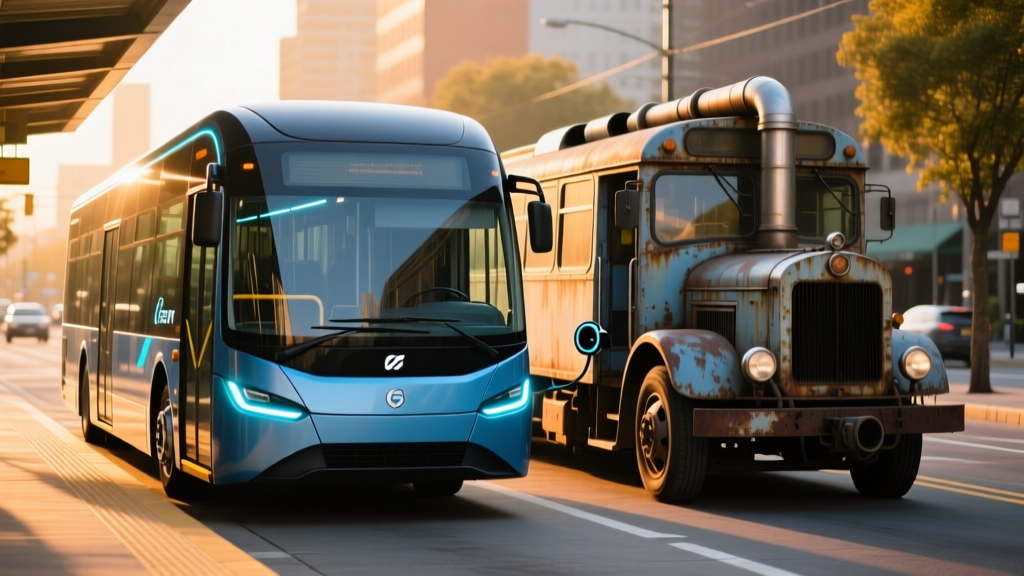
For most transit agencies and school districts, electric buses deliver lower lifetime costs despite a higher sticker price. A standard 40-foot battery-electric transit bus costs $900,000–$1.2 million upfront versus $500,000–$600,000 for a diesel equivalent, but saves $150,000–$400,000 in fuel and maintenance over a 12-year lifecycle. Real-world range sits at 150–250 miles per charge (EPA-rated up to 300+ mi), sufficient for most urban routes averaging 120–180 miles daily. The main barriers remain depot charging infrastructure ($50,000–$150,000+ per charger installed) and cold-weather range loss of 20–40%.
The Electric Bus Market in 2026: Who's Building Them
The zero-emission bus market has matured considerably. Major players in North America now include:
- New Flyer Xcelsior CHARGE NG — 40-ft and 60-ft transit buses with up to 525 kWh NMC battery packs and EPA-rated range up to 300 miles.
- Proterra ZX5 — Available with 440 kWh or 660 kWh battery options; the 660 kWh variant is rated at up to 329 miles.
- BYD K-series (K7M, K8M, K9M, K11M) — LFP (lithium iron phosphate) chemistry, which trades some energy density for longer cycle life and thermal stability. The K9M offers ~250 miles of range with a ~435 kWh pack.
- Blue Bird Vision Electric — The dominant electric school bus, with a ~150 kWh LFP battery and ~120–150 miles of range, targeting the 60–100 mile daily school route.
- Thomas Built Buses Saf-T-Liner C2 Jouley — Powered by Proterra, ~226 kWh battery, ~135 miles range.
Federal funding through the EPA's Clean School Bus Program and the FTA's Low or No Emission Grant Program continues to subsidize the capital cost gap, with awards of up to $375,000 per electric school bus and associated infrastructure in recent rounds.
Electric Bus vs Diesel Bus: The Real Numbers
Fleet procurement decisions come down to total cost of ownership (TCO), not just the purchase price. Here's how a typical 40-foot transit bus compares across a 12-year lifecycle:
| Cost Factor | Electric Bus (BEV) | Diesel Bus | CNG Bus |
|---|---|---|---|
| Purchase Price (base) | $900,000–$1,200,000 | $500,000–$600,000 | $550,000–$650,000 |
| Federal/State Incentives | -$150,000 to -$375,000 | $0 | $0–$50,000 |
| Fuel/Energy Cost (12 yr) | $80,000–$140,000 | $250,000–$400,000 | $200,000–$320,000 |
| Maintenance (12 yr) | $100,000–$160,000 | $200,000–$320,000 | $180,000–$280,000 |
| Charging/Fueling Infrastructure | $75,000–$200,000 (depot charger) | $5,000–$20,000 | $30,000–$80,000 |
| Battery Replacement (mid-life) | $100,000–$180,000 (if needed) | N/A (engine rebuild ~$40k) | N/A |
| Estimated 12-Year TCO | $1.1M–$1.7M | $1.0M–$1.3M | $0.96M–$1.3M |
Key takeaway: Without incentives, electric buses remain more expensive over their lifecycle. With federal and state grants covering $150,000–$375,000 of the purchase price, the TCO flips to parity or advantage for electric — especially in regions with high diesel prices and cheap electricity.
Range, Charging, and the Depot Reality
Range is the most scrutinized spec, but context matters. Most urban transit routes run 120–180 miles per day, and school bus routes average 60–100 miles. A 250-mile rated bus handles these comfortably — until you factor in real-world conditions.
Range: EPA Sticker vs. Reality
| Condition | Impact on Range | Example: 250-mi Rated Bus |
|---|---|---|
| Mild weather, mixed urban | Baseline (EPA rated) | ~230–250 mi actual |
| Highway-heavy route (55+ mph) | -10% to -20% | ~190–225 mi |
| Cold weather (below 25°F) with cabin heating | -25% to -40% | ~150–190 mi |
| Hot weather (above 95°F) with A/C | -10% to -15% | ~210–225 mi |
| Full passenger load + hilly terrain | -10% to -20% | ~190–225 mi |
Charging infrastructure is the hidden cost. Depot charging with a 150 kW DC fast charger (CCS1 connector) can replenish a 440 kWh battery from 20% to 80% in roughly 2.5–3 hours. Overnight depot charging at 50–80 kW Level 2 rates takes 6–10 hours, which aligns well with typical layover schedules. However, installing a single 150 kW depot charger costs $75,000–$200,000 including switchgear, trenching, and utility upgrades — and a 20-bus fleet may need 10–20 chargers plus a potential medium-voltage utility feed upgrade costing $500,000+.
Opportunity charging (pantograph or plug-in at route endpoints) using 300–450 kW chargers can add 60–80% charge in 5–10 minutes, enabling smaller batteries and all-day operation, but each opportunity charger installation runs $300,000–$600,000.
Battery Chemistry: LFP vs NMC in Heavy-Duty Applications
Unlike passenger EVs where NMC (nickel manganese cobalt) dominates for energy density, the bus segment has split:
| Attribute | LFP (Lithium Iron Phosphate) | NMC (Nickel Manganese Cobalt) |
|---|---|---|
| Energy Density | Lower (~160 Wh/kg cell-level) | Higher (~220–260 Wh/kg) |
| Cycle Life | 3,000–6,000+ cycles to 80% SoH | 1,500–3,000 cycles to 80% SoH |
| Thermal Stability | Excellent — less prone to thermal runaway | Good, but requires robust BMS |
| Cost per kWh (2026) | ~$90–$120/kWh at pack level | ~$120–$160/kWh at pack level |
| Cold Performance | Weaker — more range loss below freezing | Better low-temp discharge capability |
| Typical Users | BYD, Blue Bird, some Proterra configs | New Flyer, Proterra high-range |
For a school bus running 80 miles/day in Texas, LFP's lower cost and longer cycle life make it the obvious choice. For a transit bus in Minneapolis running 200 miles/day in winter, NMC's better cold-weather performance and higher energy density may justify the premium.
Battery Degradation and Mid-Life Replacement
Most electric bus manufacturers warrant their batteries to retain 80% capacity (State of Health) over 8–12 years or 200,000–350,000 miles. In practice, NREL (National Renewable Energy Laboratory) fleet data shows most bus battery packs degrade to roughly 75–85% SoH after 6–8 years of daily cycling.
At 80% SoH, a bus with an original 250-mile range now delivers ~200 miles — still viable for many routes. However, agencies planning 12-year vehicle lifecycles should budget for a potential mid-life battery replacement at $100,000–$180,000 (depending on pack size), or plan to cascade older buses to shorter routes as capacity declines.
Common Misconceptions About Electric Buses
| Myth | Fact |
|---|---|
| "Electric buses can't handle cold weather." | Range drops 25–40% in extreme cold, but with proper depot heating, battery preconditioning, and route planning, agencies in Chicago, Minneapolis, and Anchorage operate them year-round. Some specify larger battery packs or opportunity charging to compensate. |
| "They break down more than diesel." | Electric drivetrains have far fewer moving parts. Studies from FTA and fleet operators show electric buses have lower unscheduled maintenance rates, though early-production models from some manufacturers had teething issues with ancillary systems (door mechanisms, HVAC integration). |
| "The grid can't handle depot charging." | A 20-bus depot drawing 3 MW is a real utility planning challenge, but manageable with 12–24 months of advance coordination. Many utilities now offer EV-specific commercial rates and make-ready programs that cover infrastructure to the meter. |
| "Battery replacement makes them uneconomical." | At $100–$180k for a mid-life swap, it's a real cost — but diesel buses need $30,000–$50,000 engine rebuilds at similar intervals, plus ongoing transmission, exhaust aftertreatment (DEF/DPF), and brake wear costs that electric buses largely avoid. |
| "Hydrogen fuel cell buses are a better zero-emission option." | Fuel cell buses offer longer range and faster refueling, but hydrogen fuel costs 2–4× more per mile than electricity, and hydrogen infrastructure costs $1M–$3M per station. As of 2026, battery-electric remains the lower-TCO zero-emission path for most applications. |
Decision Framework: Should Your Fleet Go Electric?
Choose an Electric Bus If:
- Daily route is under 200 miles (or under 150 miles in cold climates) — most standard battery packs handle this without opportunity charging.
- You have depot space for overnight charging and can coordinate utility upgrades on a 12–24 month timeline.
- You qualify for federal/state grants — the EPA Clean School Bus Program, FTA Low-No grants, or state voucher programs (e.g., California's HVIP) can cover $150,000–$375,000 per bus, dramatically closing the cost gap.
- Local electricity rates are below $0.12/kWh (commercial/industrial) — this ensures fuel savings of $0.25–$0.50/mile versus diesel.
- You plan to keep buses 10–12+ years — the longer the ownership period, the more the fuel and maintenance savings offset the higher purchase price.
Stick with Diesel, CNG, or Hybrid If:
- Routes exceed 250 miles daily with no mid-day charging opportunity — current battery technology makes this challenging without very large (heavy, expensive) packs.
- You operate in extreme cold (-20°F or below) on long routes and cannot install opportunity chargers.
- Your depot has no viable path to electrical upgrade (e.g., constrained urban site with no utility capacity and no alternative depot location).
- You need immediate procurement and cannot wait 12–18 months for charging infrastructure buildout and utility coordination.
- You operate intercity/long-haul routes of 300+ miles — this segment is better served by CNG, diesel, or emerging hydrogen fuel cell options.
Frequently Asked Questions
How long does it take to charge an electric bus?
At a 150 kW DC fast charger (CCS1), a 440 kWh battery charges from 10–80% in roughly 2.5–3 hours. Overnight depot charging at 50–80 kW takes 6–10 hours for a full cycle, which aligns with typical 8–10 hour layover windows. Opportunity chargers at 300–450 kW can add 60–80% in 5–10 minutes.
What is the real-world range of an electric transit bus?
EPA-rated ranges of 250–329 miles are achievable in mild weather on mixed urban routes. In practice, expect 200–250 miles in moderate conditions, 150–200 miles in extreme cold (below 25°F), and 190–225 miles on highway-heavy or hilly routes. Always spec battery capacity with a 20–30% buffer above your longest daily route.
How much does an electric school bus cost in 2026?
A Blue Bird Vision Electric or Thomas Jouley typically costs $300,000–$400,000 before incentives, versus $110,000–$130,000 for a diesel equivalent. Federal Clean School Bus Program awards of up to $375,000 (bus + infrastructure) can bring the net cost close to parity with diesel.
Do electric bus batteries need to be replaced?
Most packs are warranted to 80% capacity retention for 8–12 years. Real-world data shows 75–85% SoH at years 6–8. Many agencies plan mid-life replacements ($100,000–$180,000) or cascade buses to shorter routes as capacity declines. LFP chemistry packs typically last longer before hitting the 80% threshold.
Can electric buses tow or handle hilly terrain?
Electric motors produce peak torque from zero RPM, making them excellent on hills — often outperforming diesel on grades. However, sustained climbing drains batteries faster. Agencies in mountainous areas (e.g., Seattle, San Francisco) spec larger battery packs or use opportunity charging to compensate for the 15–25% range penalty of hilly terrain.
What about hydrogen fuel cell buses as an alternative?
Fuel cell buses (e.g., New Flyer XHE40) offer 300+ mile range and 10-minute refueling, but hydrogen fuel costs $8–$15/kg (equivalent to $0.50–$1.00/mile), versus $0.10–$0.20/mile for electricity. Hydrogen station infrastructure costs $1–3 million each. Battery-electric remains the lower-cost zero-emission option for most duty cycles in 2026.