Quick Answer: Is an Electric Bulldozer Worth It in 2026?
For most contractors, the answer is not yet for heavy earthmoving, but increasingly yes for light grading, landscaping, and indoor demolition. Current electric bulldozers (compact to mid-size) carry battery packs ranging from 60–250 kWh, deliver 4–8 hours of light-to-moderate work per charge, and cost 1.8× to 2.5× more upfront than equivalent diesel machines. Fuel and maintenance savings can close that gap in 4–6 years on high-utilization sites, but DC fast-charging infrastructure on temporary jobsites remains the biggest bottleneck.
If you've searched for "electric bulldozer" recently, you've likely seen headlines about zero-emission construction equipment and wondered whether battery-electric earthmovers are ready for real work. As EV analysts who track the full spectrum of electric vehicles — from commuter sedans to commercial fleet equipment — we've compiled the hard numbers on where electric dozers stand in 2026, what they cost to buy and run, and which use cases actually make financial sense today.
What Is an Electric Bulldozer (and What's Actually Available)?
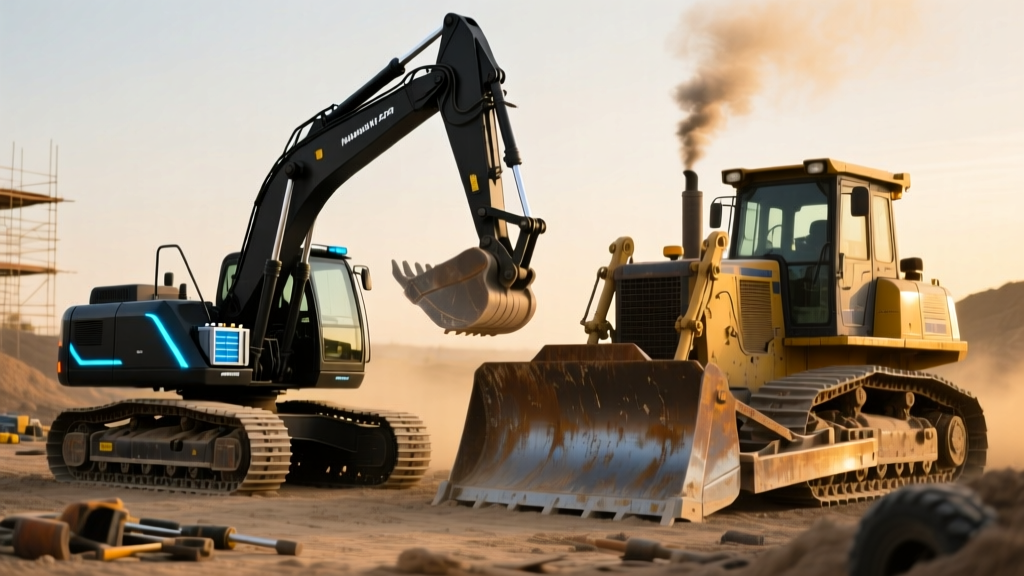
An electric bulldozer replaces the diesel engine with one or more electric motors powered by a lithium-ion battery pack — typically NMC (nickel manganese cobalt) chemistry for energy density in heavy equipment. Unlike highway EVs measured in EPA range miles, electric construction equipment is rated by operating hours per charge and kWh consumed per hour of work.
As of 2026, fully electric bulldozers remain a niche, emerging category. Most available models fall into the compact/mini dozer class (under 15,000 lbs operating weight), aimed at landscaping, indoor demolition, utility trenching, and light grading. Manufacturers like Develon (formerly Doosan), Bobcat, and several Chinese OEMs have announced or shipped compact electric crawler and wheel dozers. Larger Class III dozers (D6/D7 equivalent, 40,000+ lbs) with full battery-electric drivetrains remain in pilot or limited-production stages — Caterpillar and Komatsu have demonstrated prototypes on mining and quarry sites, but these are not yet general-market products.
| Spec | Compact Electric Dozer | Diesel Equivalent |
|---|---|---|
| Battery Capacity | 60–120 kWh (NMC) | N/A |
| Fuel Tank | N/A | 25–40 gal diesel |
| Operating Hours (light/moderate) | 4–8 hrs | 8–12 hrs |
| Motor Output | 40–90 kW (54–120 HP) | 55–95 HP diesel |
| Operating Weight | 7,000–14,000 lbs | 8,000–16,000 lbs |
| Charge Time (Level 2, 19.2 kW) | 4–7 hrs (0–100%) | Refuel: 5 min |
| Charge Time (DC Fast, 50–80 kW) | 45–90 min (10–80%) | N/A |
| Base Price (approx.) | $110,000–$180,000 | $65,000–$95,000 |
Electric Bulldozer vs Diesel: The Cost Breakdown
The purchase-price gap is real, but total cost of ownership (TCO) tells a more nuanced story — especially for contractors running machines 1,500+ hours per year. Below is a 5-year cost model comparing a compact electric dozer against a comparable diesel unit, assuming 1,800 operating hours annually.
| Cost Category | Electric Dozer | Diesel Dozer |
|---|---|---|
| Purchase Price | $145,000 | $78,000 |
| Fuel/Energy (5 yrs) | $13,500 (electricity @ $0.14/kWh) | $48,600 (diesel @ $4.50/gal, 1.2 gal/hr) |
| Maintenance (5 yrs) | $4,200 | $14,500 |
| DEF Fluid / Emissions Service | $0 | $3,200 |
| Insurance (5 yrs) | $9,500 | $7,800 |
| Estimated Resale (Year 5) | -$42,000 | -$32,000 |
| Net 5-Year Cost | $130,200 | $120,100 |
Key takeaway: At 1,800 hours/year, the electric dozer's fuel and maintenance savings (~$45,400 over 5 years) nearly close the $67,000 purchase-price gap. By year 6–7, the electric machine typically reaches cost parity — and pulls ahead from there. At lower utilization (under 800 hrs/yr), the diesel wins on pure economics because the fuel savings aren't large enough to justify the upfront premium.
Note: The federal Commercial Clean Vehicle Credit (§45W) may apply to qualifying electric off-road equipment purchased for business use — up to $40,000 for vehicles with GVWR over 14,000 lbs, subject to domestic battery-sourcing and MSRP requirements. Consult a tax professional to confirm eligibility for your specific equipment and tax situation.
Real-World Operating Considerations
Charging Infrastructure on the Jobsite
This is the single biggest practical barrier. Unlike a highway EV that can pull into an Electrify America or Tesla Supercharger station, a bulldozer on a remote grading site has no DC fast-charging network to rely on. Options include:
- Depot charging (Level 2, 19.2 kW): Adequate for machines that return to a yard nightly. A 100 kWh battery recharges in roughly 5.5 hours from empty — feasible for single-shift operations.
- Portable DC fast chargers: Trailer-mounted 50–80 kW units can be towed to sites, but require a grid connection or a diesel/battery generator — partially defeating the emissions benefit.
- Swappable battery systems: Some OEMs are piloting modular battery packs that swap in 10–15 minutes via a crane or forklift. This is promising but not yet widely standardized.
Cold Weather and Battery Performance
Construction doesn't stop in January. NMC lithium-ion batteries lose 15–30% of usable capacity in sub-freezing temperatures — the same physics that reduce highway EV range in winter. For a dozer rated at 6 hours of runtime in mild conditions, expect 4–5 hours at 20°F. Machines with active thermal management (liquid heating/cooling loops) mitigate this, but draw additional energy from the pack.
Duty Cycle Matters
A dozer pushing heavy clay all day draws far more kWh/hour than one doing light finish grading. Manufacturers typically quote runtime under "moderate" duty cycles. In our analysis of OEM spec sheets and early fleet-operator reports, heavy continuous blade work can cut advertised runtime by 35–45%. Plan your battery capacity for your worst-case day, not your average day.
Common Misconceptions About Electric Bulldozers
| Myth | Fact |
|---|---|
| "Electric dozers don't have enough torque for real earthmoving." | Electric motors deliver peak torque at 0 RPM — often exceeding diesel torque curves at low speeds. The limitation is battery capacity (runtime), not motor capability. |
| "You'll save $7,500 with the EV tax credit." | The §30D credit applies to on-road passenger vehicles. Off-road construction equipment may qualify under §45W (commercial) or §179 expensing, with different rules. Always verify with IRS guidance and a tax professional. |
| "Electric means zero maintenance." | Electric drivetrains eliminate oil changes, fuel filters, and DEF systems, but undercarriage, tracks, blades, hydraulics, and cooling systems still require regular service. Expect ~60–70% fewer scheduled maintenance hours, not zero. |
| "Batteries will need replacing in 3 years." | Industrial NMC packs are typically warrantied for 5 years / 5,000–8,000 operating hours at 70–80% capacity retention. With proper thermal management and avoiding chronic 100% SoC storage, 8–10 year pack life is realistic. |
| "Electric dozers are available in all sizes." | As of 2026, only compact and mini dozers are commercially available in battery-electric form. Large production dozers (D8-class and above) remain diesel or diesel-electric hybrid. |
Decision Framework: Should You Go Electric?
If-Then Guide for Contractors
- Choose electric if: You operate primarily indoors or in emissions-restricted zones (tunnels, warehouses, urban sites with idle-reduction ordinances); your machines return to a depot nightly for Level 2 charging; your duty cycles are light-to-moderate (landscaping, finish grading, backfilling); you run 1,200+ hours/year, making fuel savings substantial.
- Choose diesel if: You work remote sites without grid power; you need 10+ hours of continuous heavy pushing; you operate large-class (D6+) dozers; your annual utilization is under 800 hours, making the upfront premium hard to recoup.
- Consider hybrid/dual-fuel or wait if: You need mid-size dozers (20,000–40,000 lbs) — battery-electric options in this class are expected by 2027–2028 from major OEMs based on current roadmaps.
What First-Time Electric Equipment Buyers Should Know
Transitioning from diesel to electric construction equipment involves operational changes that go beyond the machine itself:
- Audit your electrical service. Adding a 19.2 kW Level 2 charger (or multiple units) to your equipment yard may require a panel upgrade from 200A to 400A three-phase service. Budget $3,000–$12,000 for electrical work, depending on your existing infrastructure and local utility requirements.
- Train operators on SoC management. Unlike a diesel tank, you can't "top off" in five minutes. Operators need to understand State of Charge (SoC) gauges, the impact of aggressive throttle on energy draw, and when to return to the charger. Most electric dozers include regenerative hydraulics that recover energy during blade-lift and deceleration — operators should learn to use these features.
- Negotiate battery warranties explicitly. Confirm the capacity-retention threshold (typically 70–80% at year 5), what constitutes a warranty claim, and whether the OEM provides a prorated or full replacement. Replacement costs for a 100 kWh industrial NMC pack currently run $18,000–$30,000.
- Factor in resale-value uncertainty. The used-electric-equipment market is still forming. Early adopters face greater depreciation risk than proven diesel machines with well-understood rebuild cycles. Some OEMs offer guaranteed buyback programs to mitigate this — ask your dealer.
Where Electric Bulldozer Tech Is Heading
The battery chemistry and charging infrastructure gaps are narrowing. LFP (lithium iron phosphate) batteries, already common in stationary storage and some highway EVs, are being tested in construction equipment for their superior cycle life (3,000–5,000+ cycles vs. 1,500–2,500 for NMC) and lower cost per kWh — albeit at a weight penalty that limits their use in smaller machines. Meanwhile, megawatt-scale charging pilots at mining operations suggest that 200+ kW DC charging for large electric earthmovers is technically feasible, with 10–80% charges in under 30 minutes for 400 kWh packs.
For contractors evaluating capital equipment purchases in 2026, the practical advice is to start with the use cases where electric already wins — indoor work, emissions-sensitive urban sites, depot-based landscaping fleets — and plan your charging infrastructure now, so you're ready as larger machines become available in the next 2–3 model years.
Frequently Asked Questions
How long does an electric bulldozer battery last before replacement?
Most OEMs warranty industrial battery packs for 5 years or 5,000–8,000 operating hours at 70–80% of original capacity. Real-world lifespan with proper thermal management and avoiding sustained 100% SoC storage is typically 8–10 years. Full pack replacement costs range from $18,000 to $30,000 for compact-class machines (60–120 kWh).
Can I charge an electric bulldozer from a standard outlet?
Technically yes, via a 120V Level 1 connection, but at roughly 1.4 kW, charging a 100 kWh battery would take over 70 hours — impractical for any working machine. A 240V Level 2 charger (19.2 kW) is the minimum viable solution, requiring a dedicated circuit installed by a licensed electrician.
Do electric bulldozers qualify for the $7,500 federal EV tax credit?
No. The §30D New Clean Vehicle Credit applies to on-road passenger vehicles under 14,000 lbs GVWR. Off-road construction equipment may qualify for the §45W Commercial Clean Vehicle Credit (up to $40,000 for heavy equipment) or accelerated depreciation under §179. Eligibility depends on battery sourcing, business use, and income — consult a tax professional.
Are electric dozers powerful enough for real grading work?
Compact electric dozers in the 54–120 HP range deliver equivalent or superior low-end torque compared to diesel counterparts, thanks to electric motors' instant torque delivery. They perform well in finish grading, landscaping, backfilling, and light production dozing. The limitation is sustained runtime under heavy load, not power output.
What's the difference between kW and kWh on an electric dozer spec sheet?
kW (kilowatts) measures power — how much energy the motor can draw or the charger can deliver at any instant. Think of it like horsepower. kWh (kilowatt-hours) measures energy capacity — how much total work the battery can store. Think of it like gallons in a fuel tank. A 100 kWh battery running a 25 kW average load will operate for roughly 4 hours.