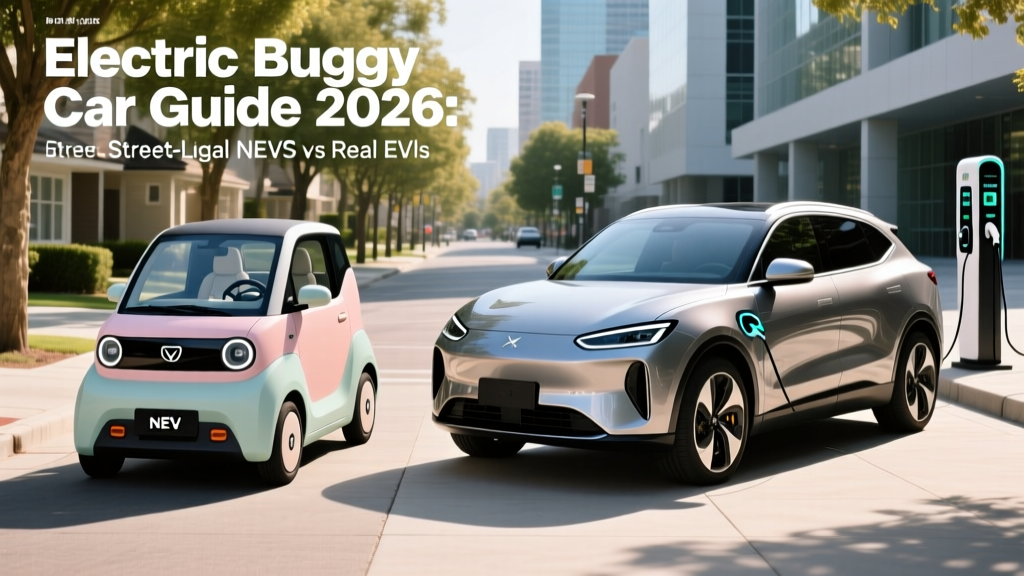
Quick Answer: The term "electric buggy car" covers everything from $8,000 neighborhood electric vehicles (NEVs) capped at 25 mph to $30,000+ highway-capable micro-EVs. If you need to travel on roads posted above 35 mph, carry more than two passengers safely, or drive in mixed traffic, a street-legal NEV/LSV won't cut it—you need a full battery-electric vehicle (BEV). For gated communities, campuses, and short neighborhood errands on low-speed roads, a compliant NEV can work—but most don't qualify for the federal §30D tax credit.
What Exactly Is an "Electric Buggy Car"?
Search "electric buggy car" and you'll find a confusing mix: golf carts, neighborhood electric vehicles (NEVs), low-speed vehicles (LSVs), and compact city EVs. The distinction matters because it determines where you can legally drive, what safety equipment is required, and whether you qualify for any incentives.
Here's how the categories break down under U.S. federal and state regulations:
- Golf Carts: Typically limited to 15–20 mph. Not federally regulated as motor vehicles. Usually restricted to golf courses, private property, or specific local ordinances. No VIN, no title, no insurance requirement in most states.
- Neighborhood Electric Vehicles (NEVs) / Low-Speed Vehicles (LSVs): Federally regulated under FMVSS 500. Top speed between 20–25 mph. Must have headlights, taillights, turn signals, seat belts, and a VIN. Street-legal only on roads posted 35 mph or below (varies by state).
- Micro-EVs / Compact BEVs: Full highway-capable electric vehicles that happen to be small. Examples include the Chevrolet Bolt EV (discontinued after 2023, but used models remain popular), the Nissan Leaf, and imported micro-cars like the Citroën Ami (not U.S.-legal). These meet full FMVSS crash-test and safety standards.
If you're shopping for an electric buggy car for daily transportation, you need to decide which category fits your actual driving—not just the fantasy of zipping to the corner store.
NEV/LSV vs. Full EV: The Numbers That Matter
Let's put concrete 2026 specs side by side so you can see exactly what you're getting at each tier.
| Spec | Typical NEV/LSV (e.g., GEM e6, Club Car) | Compact BEV (2026 Nissan Leaf S) | Midsize BEV (2026 Chevy Equinox EV LT) |
|---|---|---|---|
| Base MSRP | $12,000–$18,000 | $28,140 | $33,600 |
| EPA Range | 30–50 miles (varies; not always EPA-certified) | 149 miles | 319 miles |
| Battery Capacity | 6–15 kWh (often lead-acid in budget models) | 40 kWh usable (NMC) | 85 kWh usable (NMC) |
| Top Speed | 25 mph (federally capped for LSV) | 95 mph | 115 mph |
| 0–60 mph | N/A (won't reach 60) | ~7.4 sec | ~7.9 sec |
| Max DC Fast Charge | None (Level 1/2 only, 1.4–3.3 kW) | 100 kW peak (CHAdeMO) | 150 kW peak (NACS) |
| 10–80% DC Charge Time | N/A | ~44 min (100 kW) | ~20 min (150 kW) |
| Level 2 Charge (0–100%) | 4–8 hours (1.4–3.3 kW) | ~8 hours (6.6 kW) | ~9.5 hours (11.5 kW) |
| Crash-Test Rating | None required (FMVSS 500 exempt) | NHTSA 5-star | NHTSA 5-star (IIHS Top Safety Pick) |
| Airbags | No | Yes (front, side, curtain) | Yes (front, side, curtain) |
| Climate Control | Heater only (some models); no A/C typical | Full HVAC with heat pump | Full HVAC with heat pump |
| Federal §30D Tax Credit | Generally NOT eligible (fails speed/safety criteria) | Up to $3,750 (sourcing-dependent) | Up to $7,500 (if sourcing requirements met) |
| Warranty (Battery) | 1–3 years typical | 8 yr / 100,000 mi | 8 yr / 100,000 mi |
The gap is enormous. A $14,000 NEV gets you 35 miles at 25 mph with zero crash protection. A $33,600 Equinox EV gets you 319 miles of EPA range, DC fast charging, full HVAC, and a 5-star safety rating—and after a potential $7,500 federal credit, the effective price drops to roughly $26,100.
Real Costs: Purchase, Charging, and Maintenance
The sticker price is only the start. Here's a 5-year ownership cost breakdown comparing a typical NEV against a compact BEV and a gas-powered subcompact (the closest conventional alternative to a "buggy car" use case).
| Cost Category (5 Years) | NEV/LSV ($15K) | 2026 Nissan Leaf S ($28,140) | 2026 Honda Civic (Gas Baseline, $24,000) |
|---|---|---|---|
| Purchase Price (after credits) | $15,000 (no federal credit) | ~$24,390 (est. $3,750 credit) | $24,000 |
| Energy/Fuel (30 mi/day, 5 days/wk) | ~$1,460 (electricity, $0.13/kWh) | ~$2,530 (electricity) | ~$5,850 (gas at $3.50/gal, 33 MPG) |
| Maintenance | ~$600 (minimal) | ~$1,200 | ~$3,500 |
| Insurance (avg.) | ~$2,400 (specialty/low-speed policy) | ~$6,500 | ~$5,500 |
| Depreciation (est.) | ~$6,000 (40% over 5 yr) | ~$10,000 (~40%) | ~$9,600 (40%) |
| Total 5-Year Cost | ~$25,460 | ~$44,620 | ~$48,450 |
The NEV wins on pure cost—but only if it actually replaces your transportation needs. If you still need a gas car for highway trips, the NEV becomes an expensive second vehicle rather than a replacement. The Leaf, meanwhile, costs more upfront but can serve as your only car, and it saves roughly $3,800 vs. the Civic over five years despite a higher purchase price.
Charging cost reality check: At the U.S. average residential rate of ~$0.16/kWh (per EIA data), charging a 40 kWh Leaf battery from empty to full costs about $6.40 for 149 miles of range—roughly 4.3 cents per mile. A gas car at 33 MPG and $3.50/gallon burns 10.6 cents per mile. That's a 60% per-mile savings with electric.
The Home Charging Question Most Buyers Skip
Here's what separates happy EV owners from frustrated ones: reliable home charging access. If you can plug in overnight, EV ownership is seamless. If you can't, every trip requires planning.
For NEVs, this is simpler. Most plug into a standard 120V outlet (Level 1) and draw 1.0–1.5 kW, adding roughly 4–6 miles of range per hour. A full charge overnight is trivial. No electrician needed—just a dedicated 15-amp or 20-amp circuit.
For full BEVs, Level 1 charging adds only 3–5 miles per hour, which is inadequate for most drivers. A Level 2 home charger (240V, 7–11.5 kW) adds 25–45 miles per hour and is practically essential. Here's what installation typically costs in 2026:
| Item | Cost Range |
|---|---|
| Level 2 charger hardware (hardwired, 40–48A) | $400–$750 |
| Electrician labor (standard install, same panel) | $500–$1,500 |
| Permit & inspection | $50–$200 |
| Electrical panel upgrade (if needed, 100A→200A) | $1,500–$3,500 |
| Total (no panel upgrade) | $950–$2,450 |
| Total (with panel upgrade) | $2,450–$5,950 |
Apartment/condo dwellers: If you live in multi-unit housing without dedicated parking and a plug, an NEV's low-power charging advantage becomes more relevant—you can often charge from a standard outlet in a garage or carport. But for a full BEV, rely on public charging only if you've verified reliable DC fast chargers within 5–10 minutes of your home and workplace.
Federal Tax Credits: What Actually Applies
A common misconception is that any electric vehicle qualifies for the §30D federal tax credit. That's false, and it's where most "electric buggy car" shoppers get misled.
To qualify for the up-to-$7,500 new clean vehicle credit, a vehicle must meet all of the following in 2026:
- Vehicle classification: Must be a four-wheeled vehicle with a gross vehicle weight rating (GVWR) under 14,000 lbs, purchased for use primarily in the U.S.
- Battery capacity: At least 7 kWh.
- MSRP caps: $80,000 for vans/SUVs/pickups; $55,000 for sedans and other body styles.
- Buyer income caps: AGI ≤ $300,000 (joint), $225,000 (head of household), $150,000 (single).
- Battery component sourcing: A percentage of battery components must be manufactured or assembled in North America (the threshold increases yearly).
- Critical minerals: A percentage of critical minerals must be sourced from the U.S. or a free-trade-agreement country.
Most NEVs fail on multiple counts: some have batteries below 7 kWh, many are not classified as eligible vehicles by the IRS, and the manufacturers rarely go through the certification process. Always verify a specific VIN's eligibility at fueleconomy.gov before purchasing.
For used electric vehicles, the §25E credit offers up to $4,000 (30% of sale price, capped at $4,000) on vehicles priced at $25,000 or less, with lower income caps ($150,000 joint / $75,000 single). This can make a used Nissan Leaf or Chevy Bolt very affordable—often a smarter buy than a new NEV.
Common Myths About Electric Buggy Cars
| Myth | Fact |
|---|---|
| "An NEV is just as safe as a regular car at low speeds." | NEVs lack airbags, crumple zones, and side-impact protection. In a collision with a full-size vehicle—even at 25 mph—injury risk is significantly higher. NHTSA does not crash-test NEVs. |
| "I can drive my NEV on any road." | LSVs are federally limited to roads posted 35 mph or below. Some states allow crossings of higher-speed roads, but sustained travel on 45+ mph roads is illegal and dangerous. |
| "Electric buggies qualify for the $7,500 tax credit." | Most do not. The §30D credit requires minimum battery capacity, MSRP compliance, and manufacturer certification. Always check the IRS qualified vehicles list before buying. |
| "A golf cart conversion to electric is street-legal." | A converted golf cart does not automatically become an LSV. It must meet FMVSS 500 equipment requirements and be certified by the manufacturer. DIY conversions are generally not street-legal. |
| "NEVs cost nothing to maintain." | Lead-acid battery NEVs require battery replacement every 3–5 years at $2,000–$4,000. Lithium-ion NEVs last longer but still need tire, brake, and electrical system service. |
Decision Framework: Should You Buy an NEV or a Full EV?
Choose an NEV/LSV if:
- You live in a gated community, retirement village, or small town where daily trips are under 15 miles on roads posted ≤35 mph.
- You already own a primary vehicle for highway trips and want a low-cost second runabout.
- You can charge from a standard 120V outlet at home.
- You don't need to carry more than 2–4 passengers, and those passengers accept the safety trade-off.
- Your budget is under $18,000 and you accept no federal tax credit.
Choose a compact or midsize BEV if:
- You need to travel on roads above 35 mph or take highway trips of any length.
- You want this to be your only vehicle.
- Safety is a priority—you want airbags, crash-tested structure, and ADAS features like automatic emergency braking.
- You want DC fast charging for road trips (10–80% in 20–45 minutes).
- You qualify for the §30D credit, which can reduce a $33,600 EV to ~$26,100—competitive with many NEVs once you factor in 5-year savings.
- You need year-round climate control (heat pump for winter, A/C for summer).
Choose a PHEV (plug-in hybrid) if:
- You want electric-only driving for short daily commutes (20–40 miles) but need gas-engine range for longer trips.
- You lack reliable home or public charging and need the flexibility of a gas tank as backup.
- Models like the 2026 Toyota RAV4 Prime (42 miles electric, 38 MPG combined) or Hyundai Tucson PHEV (33 miles electric) offer the best of both worlds at $38,000–$44,000 MSRP.
Real-World Ownership Considerations
Cold weather: NEVs with lead-acid batteries lose 30–50% of their already-limited range below freezing. Lithium-ion BEVs lose 20–30% in cold weather but compensate with larger batteries and heat pumps. A 319-mile Equinox EV might deliver ~230 miles in 20°F weather—still vastly more than a 35-mile NEV dropping to 20.
Insurance: NEV insurance is cheaper in absolute terms (~$400–$600/year) but covers far less. If you're in an NEV and get hit by a full-size vehicle, your medical costs may exceed coverage limits. Full BEVs carry standard auto insurance with bodily injury, collision, and comprehensive coverage.
Resale value: The used NEV market is thin and highly local. You may struggle to sell a $14,000 NEV for more than $6,000–$8,000 after three years. Used BEVs from major manufacturers (Nissan, Chevrolet, Hyundai, Tesla) have established resale markets and depreciation data you can actually plan around.
Registration and titling: NEVs are titled and registered differently in every state. Some states require special "low-speed vehicle" plates; others classify them as off-road. Verify your state's DMV requirements before purchasing—some states don't allow NEVs on public roads at all.
Frequently Asked Questions
Can I drive an electric buggy car on the highway?
No. Federally defined NEVs/LSVs are capped at 25 mph and legally restricted to roads posted 35 mph or below. Driving an NEV on a highway is both illegal and extremely dangerous. If you need highway capability, you need a full BEV or PHEV.
Do electric buggy cars qualify for any tax incentives?
Most NEVs do not qualify for the federal §30D new vehicle credit because they lack the required battery capacity, safety certification, or manufacturer participation. However, some states offer separate incentives for low-speed electric vehicles—check your state energy office or DMV. Used compact EVs (Leaf, Bolt) may qualify for the §25E used EV credit of up to $4,000.
How much does it cost to charge an NEV at home?
An NEV with a 10 kWh battery charged at the U.S. average rate of $0.16/kWh costs about $1.60 for a full charge, yielding roughly 35–40 miles of range. That's approximately 4 cents per mile—about 60% less than a 33 MPG gas car at $3.50/gallon.
What's the difference between a golf cart and an NEV?
Golf carts are limited to ~15–20 mph and are not federally regulated as motor vehicles. NEVs (also called LSVs) are federally regulated under FMVSS 500, must reach 20–25 mph, and require headlights, turn signals, seat belts, and a VIN. Golf carts are generally not street-legal without specific local ordinances; NEVs are street-legal on qualifying roads in most states.
Is a used Nissan Leaf or Chevy Bolt a better buy than a new NEV?
For most buyers, yes. A 2022–2024 Nissan Leaf S with 149 miles of EPA range sells for $14,000–$18,000 on the used market—overlapping directly with new NEV pricing. The Leaf offers highway speeds, full safety equipment, DC fast charging, climate control, and eligibility for the §25E used-EV credit (up to $4,000), which can bring the effective price to $10,000–$14,000. The trade-off is that a used Leaf will have higher mileage and may have some battery degradation (typically 5–15% at 3–5 years old).
What should a first-time EV buyer know before purchasing?
Three things matter most: (1) Home charging access—if you can install a Level 2 charger, daily EV life is effortless; if not, map out reliable public chargers first. (2) Real-world range—expect 15–30% less than the EPA sticker on highway trips and in cold weather. (3) Total cost of ownership—EVs have higher upfront prices but lower fuel and maintenance costs; run the numbers over 5 years, not just the sticker price. And always verify federal tax credit eligibility for your specific income, filing status, and the vehicle's VIN before committing.