The Quick Answer: Electric Boogie Boards Aren't EVs
If you've searched for an electric boogie board, here's what you need to know right away: battery-powered bodyboards and electric surfboards exist as recreational water toys, but they are not electric vehicles in the automotive sense. They use small lithium-ion packs (typically 1–5 kWh), run 30–90 minutes per charge, cost $1,500–$8,000+, and have no EPA range rating, federal §30D tax credit eligibility, or road legality. This guide clarifies what these products actually are, how their battery and charging tech compares to real EVs, and why EV shoppers sometimes land on this term.
What Exactly Is an Electric Boogie Board?
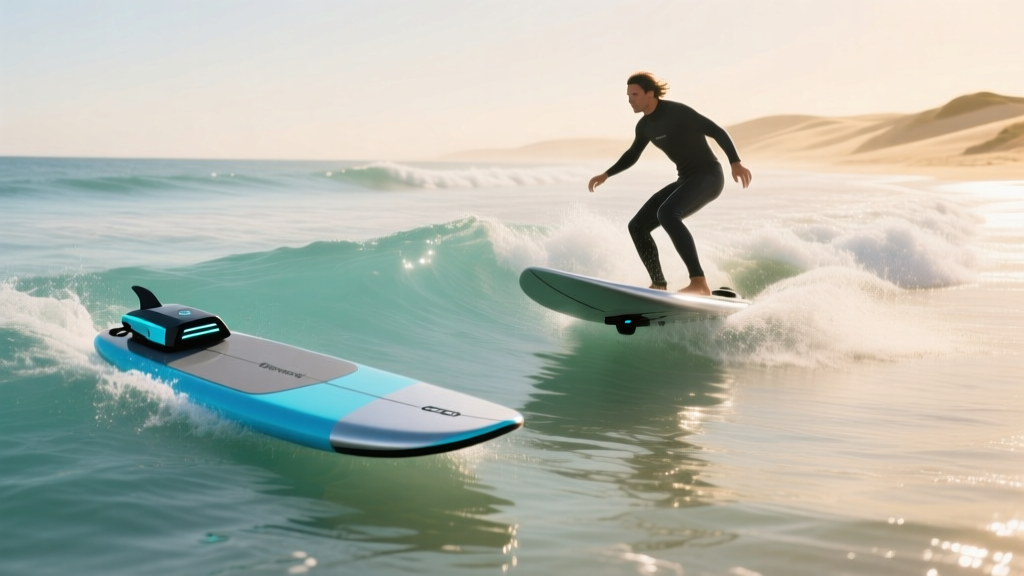
An electric boogie board (sometimes called a motorized bodyboard, eFoil bodyboard, or electric surfboard) is a compact watercraft with an integrated electric motor and battery. Riders lie prone or kneel, using a handheld throttle to propel themselves through waves or flat water. Major brands include brands like Awake, Radinn, and Lampuga, though the market is fragmented with numerous imports.
These devices sit in a gray area between toys and vehicles. They draw on similar lithium-ion cell technology as EVs but at a dramatically smaller scale. Here's how the core specs typically look:
| Spec | Budget Models | Premium Models |
|---|---|---|
| Battery Capacity | 1–2 kWh | 3–5 kWh |
| Chemistry | NMC (lithium-ion) | NMC, some LFP |
| Motor Power | 3–5 kW | 8–15 kW |
| Top Speed | 10–15 mph | 20–35 mph |
| Run Time | 30–45 minutes | 60–90 minutes |
| Charge Time (120V) | 3–5 hours | 4–8 hours |
| Weight | 25–40 lbs | 45–75 lbs |
| Price Range | $1,500–$3,500 | $4,000–$8,000+ |
Why EV Shoppers Search "Electric Boogie Board"
The search term crosses over from the automotive EV world for a few reasons. First, "electric" plus any vehicle-adjacent noun now triggers EV-curious search behavior. Second, some EV owners look for electric accessories to complement an electrified lifestyle — boats, surfboards, even electric coolers. Third, the term occasionally appears as a mis-search for electric skateboard or electric scooter, which are closer to personal EVs.
At AutoEdgeView, our coverage focuses on electrified automobiles — BEVs, PHEVs, and HEVs. Water toys fall outside our core scope. But because the battery and charging concepts overlap, it's worth explaining the tech differences clearly so you don't confuse a $5,000 motorized bodyboard with a $40,000 electric car.
Battery Tech Comparison: Electric Boogie Board vs. Real EVs
The lithium-ion cells in an electric boogie board share chemistry with EV batteries — mostly NMC (nickel manganese cobalt) — but the scale and engineering are worlds apart. Here's a direct comparison:
| Attribute | Electric Boogie Board | Typical BEV (e.g., Tesla Model Y, Hyundai Ioniq 5) |
|---|---|---|
| Battery Capacity | 1–5 kWh | 60–100+ kWh |
| Chemistry | NMC (small-format cells) | NMC or LFP (large-format prismatic/cylindrical) |
| Thermal Management | Passive (air-cooled or none) | Active liquid cooling/heating |
| Battery Warranty | 6–12 months typical | 8 years / 100,000 miles (federal minimum per EPA) |
| Degradation Expectation | Significant after 300–500 cycles | ~10–15% loss over 150,000+ miles |
| Replacement Cost | $500–$1,500 | $5,000–$20,000+ |
| Charging Standard | Proprietary DC charger (included) | NACS, CCS1, or CHAdeMO |
| Fast Charging | No (Level 1 only, 120V AC) | Up to 250–350 kW DC fast charging |
| Federal Tax Credit (§30D) | Not eligible | Up to $7,500 (with MSRP, income, and sourcing requirements per IRS) |
The critical takeaway: an electric boogie board's battery is closer in capacity to a large portable power station than to an EV. There's no thermal management system, no state-of-health monitoring via OBD-II, and no standardized charging connector. You charge it with a proprietary brick plugged into a standard 120V outlet — essentially Level 1 charging in EV terms.
Real Costs: Electric Boogie Board Ownership
If you're seriously considering an electric boogie board, here's what the ownership math actually looks like beyond the sticker price:
| Cost Category | Year 1 | Year 2 | Year 3 | 3-Year Total |
|---|---|---|---|---|
| Purchase Price | $5,500 | — | — | $5,500 |
| Electricity (charging ~100 sessions/yr) | $15 | $15 | $15 | $45 |
| Battery Replacement (if needed) | — | — | $1,000 | $1,000 |
| Accessories (vest, spare prop, case) | $300 | $100 | $100 | $500 |
| Insurance (if available) | $0–$200 | $0–$200 | $0–$200 | $0–$600 |
| Total Estimated | $5,815–$6,015 | $115–$315 | $1,215–$1,415 | $7,045–$7,645 |
Electricity cost is negligible — at roughly 4 kWh per charge and a national average of $0.16/kWh, each session costs about $0.64. The real cost risks are battery degradation (these packs endure high-discharge cycles in saltwater environments, accelerating wear) and the lack of any federal or state purchase incentive.
Common Misconceptions About Electric Boogie Boards
| Myth | Fact |
|---|---|
| "It qualifies for the $7,500 EV tax credit." | No. The §30D credit applies only to qualified plug-in electric vehicles with 4+ wheels, meeting MSRP caps ($55,000 sedans / $80,000 SUVs/trucks), buyer income limits, and battery-sourcing requirements. Watercraft are excluded. |
| "The battery lasts as long as an EV battery." | EV batteries are engineered for 1,000–3,000+ charge cycles with active thermal management. Boogie board batteries, without liquid cooling and with high-discharge use, typically show meaningful degradation after 300–500 cycles. |
| "I can charge it at a public EV station." | Electric boogie boards use proprietary chargers that plug into standard 120V AC outlets. They cannot connect to NACS, CCS1, CHAdeMO, or any public DC fast charger. |
| "It's environmentally zero-impact." | While tailpipe-free, the electricity source matters. If your grid relies on fossil fuels, upstream emissions exist. Additionally, small lithium packs have shorter lifespans and higher per-kWh manufacturing impact than large EV packs. |
| "It's like owning a small EV." | It shares battery chemistry but lacks every EV ownership infrastructure element: no NHTSA safety rating, no standardized charging, no warranty protections comparable to automotive mandates, and no road legality. |
Should You Buy One? A Decision Framework
Electric Boogie Board: Is It Right for You?
- Choose an electric boogie board if: You want motorized wave riding for recreation, have $2,000–$8,000 in discretionary spending, live near water, and understand this is a toy — not a vehicle or investment.
- Choose a traditional (unmotorized) bodyboard if: You want exercise, simplicity, zero maintenance, and a price point under $100.
- Choose to invest in EV ownership instead if: You're researching electrification for transportation. A used EV eligible for the §25E credit (up to $4,000 on vehicles under $25,000) delivers daily utility, fuel savings, and real emissions reduction that a water toy cannot.
- Wait and reconsider if: You don't have reliable access to a 120V outlet near where you'd store and charge the board, or if you expect this to replace any form of transportation.
What First-Time EV Buyers Should Know Instead
If you landed here while beginning your EV research, here's where to redirect your focus for actual electric vehicle ownership:
- Real EV range: Current 2026 BEVs offer 230–400+ miles EPA range. Expect 15–30% less in cold weather or sustained highway driving above 70 mph.
- Home charging: A Level 2 home charger (240V, 7–11.5 kW) adds 25–45 miles of range per hour and costs $500–$2,000 installed, depending on panel capacity and run length.
- Fuel savings: At $0.16/kWh national average and 3–4 mi/kWh efficiency, EV driving costs roughly $0.04–$0.05/mile in electricity vs. $0.12–$0.18/mile for gas at $3.50/gallon and 25–30 MPG.
- Tax credits: The §30D new clean vehicle credit offers up to $7,500, but eligibility depends on MSRP caps, buyer income (AGI limits: $150K single / $300K joint), and battery critical-mineral and component sourcing rules. Check the latest rules at IRS.gov.
- Maintenance: EVs eliminate oil changes, spark plugs, and transmission fluid. Brake wear is significantly reduced thanks to regenerative braking. Budget for tire replacement (EVs are heavier and wear tires faster) and cabin air filters.
Frequently Asked Questions
Are electric boogie boards legal to use anywhere?
Regulations vary by state, county, and even individual beaches. Some jurisdictions classify motorized watercraft separately and may require registration, a boating safety certificate, or restrict use to certain zones. Always check local waterway regulations before purchasing.
Can I charge an electric boogie board from my EV's outlet or V2L feature?
Technically, yes — if your EV has a Vehicle-to-Load (V2L) feature (available on the Hyundai Ioniq 5, Kia EV6, Ford F-150 Lightning, and others), you can plug the boogie board's standard 120V charger into the EV's V2L outlet. The power draw (~0.5–1 kW) is well within V2L limits. However, this is an accessory convenience, not a reason to buy an EV.
How does an electric boogie board's battery degradation compare to an EV?
Much worse. EV batteries benefit from active liquid thermal management, sophisticated BMS (battery management systems), and conservative charge/discharge buffers. An electric boogie board runs its small NMC pack hard — often full-throttle in warm saltwater — with passive or no cooling. Expect 20–30% capacity loss within 2–3 years of regular use, versus roughly 10–15% loss over 8–10 years in a properly maintained EV.
Is there any EV tax credit or incentive for buying an electric boogie board?
No. The federal §30D new clean vehicle credit, the §25E used EV credit, and virtually all state EV incentives apply exclusively to highway-capable motor vehicles with four or more wheels. Electric watercraft, skateboards, scooters, and bicycles do not qualify. Consult a tax professional if you have questions about eligibility for actual EV purchases.
What should I budget for if I want both an EV and an electric boogie board?
Plan for them as entirely separate purchases. A 2026 EV with federal credit eligibility starts around $28,000–$35,000 after incentives (models like the Chevrolet Equity EV or Nissan LEAF). Add $2,000–$8,000 for the boogie board as a discretionary recreation expense. Home Level 2 charger installation ($500–$2,000) should be budgeted for the EV, not the boogie board.