If you've searched for an electric bodyboard recently, you've likely noticed the surge in battery-powered watercraft entering the market in 2026. While this site focuses on electric cars, trucks, and SUVs, the electric bodyboard trend reflects the same lithium-ion revolution powering vehicles like the Tesla Model Y and Hyundai IONIQ 5. Below, we break down what an electric bodyboard actually is, how its battery and charging technology compares to a full-size EV, and whether the ownership math makes sense alongside an electric vehicle purchase.
Quick Answer: Electric Bodyboard at a Glance
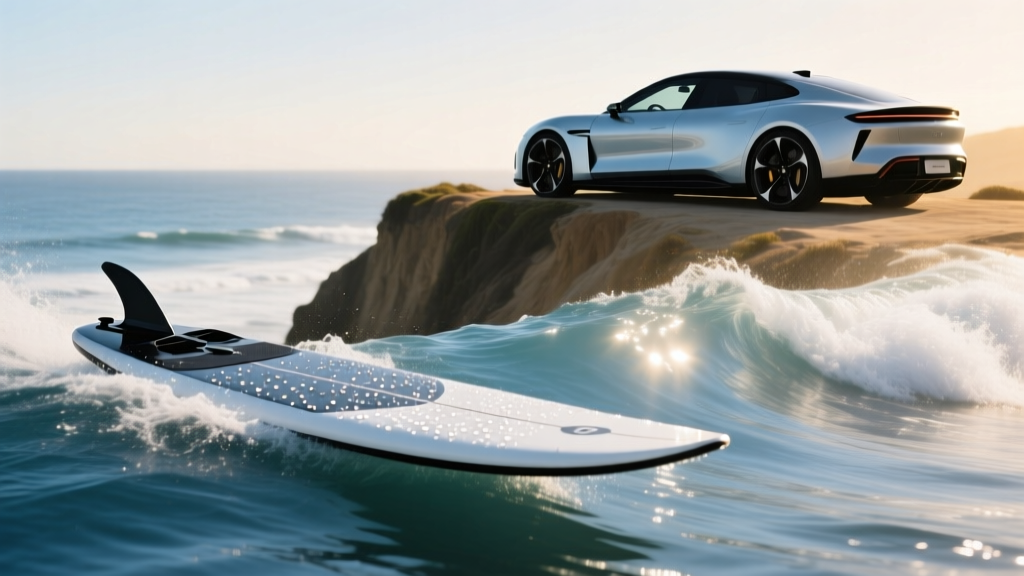
An electric bodyboard is a motorized surfboard-style watercraft powered by a lithium-ion battery pack (typically 1–5 kWh) and a brushless DC motor. Top models in 2026 cost between $3,500 and $12,000, offer 30–60 minutes of ride time, and charge on a standard 120V outlet in 2–4 hours. Unlike a full-size electric vehicle, an electric bodyboard does not qualify for the federal §30D EV tax credit, requires no home electrical upgrades, and uses a fraction of the battery capacity.
What Is an Electric Bodyboard? The Technology Explained
An electric bodyboard replaces wave power with an onboard electric motor and propeller or jet-drive system. The rider lies prone or kneels on the board, using a handheld throttle or wireless remote. The core technology stack mirrors what you'd find in an EV, just scaled down:
- Battery chemistry: Most 2026 electric bodyboards use NMC (nickel manganese cobalt) lithium-ion cells for their high energy density — the same chemistry found in many EVs like the Ford Mustang Mach-E and Volkswagen ID.4. A few budget boards are experimenting with LFP (lithium iron phosphate) for longer cycle life, though at a weight penalty.
- Battery capacity: Typical packs range from 1.5 kWh to 5 kWh. For comparison, the 2026 Chevrolet Equinox EV carries a ~85 kWh usable battery — roughly 17–57 times more energy.
- Motor output: Electric bodyboard motors produce between 3 kW and 15 kW (roughly 4–20 horsepower), propelling riders to speeds of 15–30 mph depending on the model.
- Charging: Nearly all electric bodyboards charge via a proprietary AC adapter plugged into a standard 120V household outlet. Charge times range from 90 minutes to 4 hours. No Level 2 home charger or DC fast charging is involved.
Electric Bodyboard vs. Electric Vehicle: Cost and Technology Comparison
To put the electric bodyboard into perspective for EV-curious buyers, here's a side-by-side comparison against a popular entry-level electric vehicle, the 2026 Nissan LEAF (one of the most affordable new EVs available):
| Attribute | Electric Bodyboard (Premium, 2026) | 2026 Nissan LEAF S (Base EV) |
|---|---|---|
| Purchase Price | $6,000–$12,000 | ~$29,000 MSRP |
| Battery Capacity | 3–5 kWh (NMC) | ~40 kWh usable (NMC) |
| Motor Power | 5–15 kW (7–20 HP) | 110 kW (147 HP) |
| Top Speed | 15–30 mph | ~95 mph (electronically limited) |
| Range / Runtime | 30–60 minutes | EPA est. 149–212 miles (depending on battery option) |
| Charging Time (0–100%) | 1.5–4 hours (120V AC) | ~8 hours (Level 2, 240V); ~40 min (10–80% DCFC at 50 kW) |
| Federal Tax Credit (§30D) | Not eligible | Up to $7,500 (subject to income, MSRP, and sourcing rules per IRS §30D) |
| Annual Maintenance | $100–$300 (impeller, seals, battery storage) | ~$300–$500 (tire rotation, cabin filter, brake fluid) |
| Warranty (Battery) | 1–2 years | 8 years / 100,000 miles |
The takeaway: an electric bodyboard is a recreational accessory with EV-adjacent technology, not a transportation substitute. But if you're already investing in home Level 2 charging for an EV, the electrical infrastructure can serve both — with some planning.
Real Ownership Costs: Electric Bodyboard Breakdown
Here's what a 3-year ownership cycle looks like for a mid-range electric bodyboard priced at $7,500:
| Cost Category | Year 1 | Year 2 | Year 3 | 3-Year Total |
|---|---|---|---|---|
| Purchase Price | $7,500 | — | — | $7,500 |
| Electricity (50 sessions/yr, ~0.5 kWh/session avg, $0.16/kWh) | $4 | $4 | $4 | $12 |
| Maintenance (impeller inspection, O-rings, anti-corrosion) | $150 | $200 | $250 | $600 |
| Insurance (optional, specialty watercraft policy) | $200 | $200 | $200 | $600 |
| Battery Replacement (if needed, typically year 3–5) | — | — | $1,500–$2,500 | $1,500–$2,500 |
| Total | $7,854 | $404 | $2,204–$2,954 | $10,212–$11,212 |
The electricity cost is nearly negligible — under $5 per year. The real expenses are the upfront purchase and eventual battery replacement. Unlike EV traction batteries, which are warranted for 8 years/100,000 miles and designed for thousands of cycles, electric bodyboard packs endure a harsher environment (saltwater, vibration, thermal cycling) and typically last 300–500 full charge cycles before significant degradation.
Common Misconceptions: Myth vs. Fact
| Myth | Fact |
|---|---|
| "Electric bodyboards qualify for the $7,500 EV tax credit." | The IRS §30D credit applies only to new qualified plug-in electric drive motor vehicles with four wheels and a gross vehicle weight under 14,000 lbs. Watercraft do not qualify. |
| "I need a special outlet or charger to charge it." | Nearly all electric bodyboards charge on a standard 120V / 15A household outlet using the included adapter. No electrician or panel upgrade is needed. |
| "The battery will last as long as an EV battery." | EV batteries are engineered for 1,500–3,000+ cycles with sophisticated thermal management. Bodyboard packs lack active cooling and face saltwater exposure — expect 3–5 years of usable life with proper storage. |
| "It's maintenance-free because it's electric." | While there's no oil change or spark plug, electric bodyboards require impeller inspection, drive-seal replacement, corrosion prevention, and proper battery storage (40–60% SoC in cool, dry conditions during off-seasons). |
| "I can use my home EV charger to charge it faster." | Electric bodyboards use proprietary DC or low-voltage AC charging systems. They cannot plug into a J1772, NACS, or CCS connector. Your Level 2 home charger won't help here. |
Charging Your Electric Bodyboard Alongside Your EV: Practical Setup
If you already own an EV and have a Level 2 (240V) home charger installed, you might wonder whether your electric bodyboard can share that infrastructure. In most cases, the answer is no — at least not directly. Here's why and what to do instead:
- Connector mismatch: Level 2 EV chargers use J1772 (or NACS in Tesla and newer vehicles). Electric bodyboards use proprietary barrel connectors, Anderson plugs, or XLR-style charging ports.
- Voltage difference: Your Level 2 charger outputs 240V AC. Most bodyboard chargers expect 120V AC input and convert to the pack's DC voltage internally (typically 36V–72V DC).
- Practical solution: Install a dedicated 120V GFCI-protected outdoor outlet near your charging area. A licensed electrician can add one for $200–$500, depending on wiring distance from the panel. This gives you a safe, weather-rated plug for the bodyboard's included charger without interfering with your EV's Level 2 setup.
- Storage tip: Never store a fully charged (100% SoC) or fully depleted (0% SoC) NMC bodyboard battery for extended periods. For off-season storage, discharge to approximately 50% SoC and store in a cool, dry environment — the same principle that extends EV battery health.
Decision Framework: Should You Buy an Electric Bodyboard?
If-Then Buyer Guide
- Choose an electric bodyboard if: You live near consistent water access (ocean, lake), want motorized wave riding without a tow boat or jetski, have $5,000–$12,000 in discretionary recreation budget, and understand this is a seasonal toy — not a daily driver or commuter tool.
- Hold off if: You're still weighing your first EV purchase and need to allocate budget toward a vehicle, home charger installation ($500–$2,500), or potential electrical panel upgrade ($1,500–$3,500 for a 200A service). Prioritize transportation electrification first — the fuel savings from an EV can eventually fund recreational purchases.
- Consider a used or prior-year model if: You're budget-conscious. 2024–2025 models from established brands often sell at 30–40% discounts as 2026 inventory arrives. Check battery health (ask for a capacity test) before buying used — a pack below 80% original capacity will noticeably reduce runtime.
- Consider an electric surfboard or e-foil instead if: You want stand-up riding or a more versatile platform. Electric foils (e-foils) use similar battery/motor tech but offer a different riding experience and often have larger 4–8 kWh packs for 60–90 minute sessions.
What First-Time EV Buyers Should Know (Whether or Not You Get a Bodyboard)
If the electric bodyboard search has sparked broader interest in EVs, here are the essentials for a first-time electric vehicle buyer in 2026:
- Home charging is king. Over 80% of EV charging happens at home. A Level 2 (240V, 32–48A) home charger adds 25–40 miles of range per hour of charging and costs $500–$2,500 installed, depending on panel capacity and wiring distance. Per fueleconomy.gov, home charging costs average $0.03–$0.05 per mile — roughly one-third the per-mile cost of gasoline.
- EPA range ≠ real-world range. Expect 10–20% less range in sustained highway driving (70+ mph) and 20–40% less in freezing temperatures. A vehicle rated at 300 miles EPA may deliver 240–270 miles on a cold-weather road trip.
- DC fast charging tapers above 80%. A vehicle that peaks at 250 kW may only sustain that rate between 10–50% SoC. The 10–80% time is the useful metric — typically 18–35 minutes for modern 800V-architecture vehicles.
- Tax credits have strings attached. The federal §30D credit of up to $7,500 requires meeting buyer income caps ($150K single / $300K joint), vehicle MSRP caps ($55K sedans / $80K SUVs/trucks/vans), and battery critical-mineral and component sourcing rules. Check the latest eligibility at IRS.gov before assuming you qualify.
- Insurance costs more for EVs. Expect 15–30% higher premiums compared to equivalent gas vehicles, driven by higher repair costs and battery replacement risk. Get quotes before purchasing.
Frequently Asked Questions
Does an electric bodyboard qualify for any EV incentives or tax credits?
No. The federal §30D clean vehicle credit applies exclusively to four-wheeled plug-in electric motor vehicles meeting specific MSRP, income, and battery-sourcing requirements. Electric bodyboards, surfboards, e-foils, and other watercraft are classified as recreational equipment and do not qualify. Some states offer sales-tax exemptions on recreational equipment — check your local rules.
How long does an electric bodyboard battery last before needing replacement?
Most NMC-based bodyboard packs are rated for 300–500 full charge cycles. With 50 sessions per year, that translates to roughly 6–10 years of use before capacity drops below 80%. However, saltwater exposure, improper storage (full charge or full depletion for months), and heat can accelerate degradation. Replacement packs cost $1,500–$3,000 depending on the brand and capacity.
Can I charge an electric bodyboard from my EV's home Level 2 charger?
No. Level 2 EV chargers use 240V AC with J1772 or NACS connectors, while electric bodyboards use proprietary low-voltage DC or 120V AC charging systems. You'll need a standard 120V GFCI outlet — not your EV charger — to power the bodyboard's included adapter.
Is an electric bodyboard worth it compared to a gas-powered jetski?
It depends on your use case. Electric bodyboards are quieter, lighter (30–60 lbs vs. 500+ lbs for a PWC), require no trailer or boat ramp, and cost pennies per session to charge. But they offer far less range/speed than a personal watercraft, carry only one rider, and aren't suited for open ocean or towing. If you want a portable, solo, near-shore experience, a bodyboard makes sense. For open-water recreation with passengers, a gas or electric PWC is more appropriate.
What's the best way to store an electric bodyboard battery during winter?
Store the battery at 40–60% state of charge in a cool, dry place (ideally 50–70°F). Avoid storing at 100% SoC, which accelerates NMC calendar aging, or at 0% SoC, which risks the cells dropping below their safe voltage threshold. Check the charge level every 2–3 months and top up if it falls below 30%.