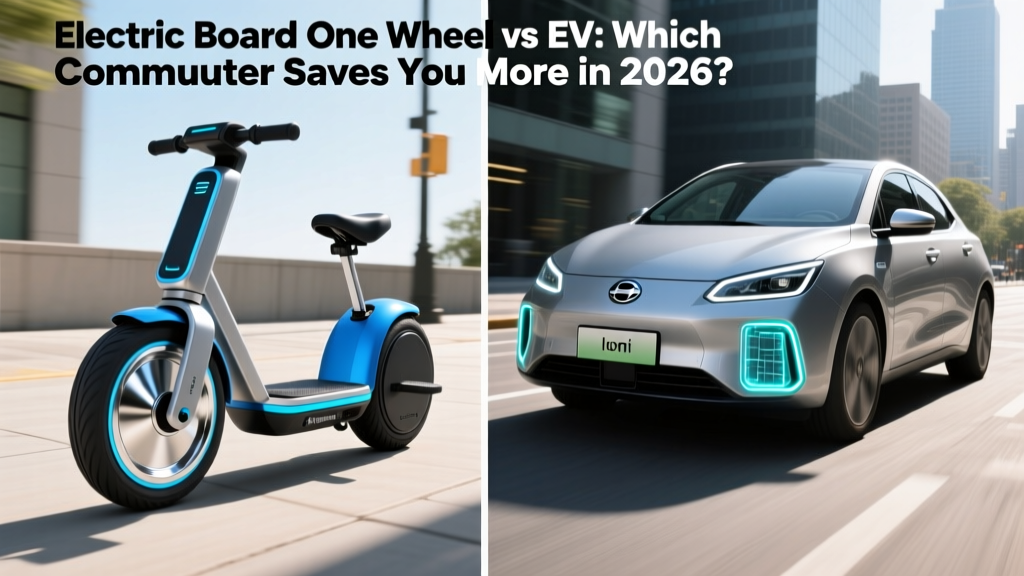
Quick Answer: An electric board one wheel (like the Onewheel GT or FutureFun GT+) costs $1,800–$2,800 upfront, delivers 12–25 miles of real-world range per charge, and costs pennies per mile to operate. A used EV like a 2024 Chevrolet Bolt EV starts around $18,000 after the used-EV tax credit, offers 259 miles of EPA range, and costs roughly $0.04–$0.06 per mile to charge at home. The one-wheel board wins for last-mile commuting under 10 miles round-trip; the EV wins for anything beyond that, bad weather, or carrying passengers and cargo.
If you have searched for "electric board one wheel" recently, you have likely noticed the category exploding with options ranging from $1,200 hobby boards to $3,500 performance models. These self-balancing, single-wheel electric boards promise car-free commuting. But how do they actually compare to buying a full electric vehicle for your daily drive? This guide breaks down the real numbers — cost, range, charging, safety, and ownership practicality — so you can make an informed decision.
What Is an Electric Board One Wheel?
An electric board one wheel is a self-balancing personal electric vehicle (PEV) with a single hub motor embedded in a central wheel, flanked by two footpads. The rider stands sideways, leaning forward to accelerate and back to brake via regenerative deceleration. Popular models in 2026 include:
- Onewheel GT (Future Motion): $2,750 MSRP, 750 Wh battery, ~20–25 mile range, 20 mph top speed
- Onewheel XR Classic: $1,800 MSRP, 324 Wh battery, ~12–15 mile range, 19 mph top speed
- JetFleet H6: $2,200 MSRP, 840 Wh battery, ~22–28 mile range, 24 mph top speed
These boards use lithium-ion NMC (nickel manganese cobalt) battery packs — the same chemistry found in most EVs — though at a dramatically smaller scale. A 750 Wh battery holds roughly 0.75 kWh of energy. For context, the 2026 Tesla Model Y Long Range carries a 78.1 kWh battery — over 100 times more energy storage.
Electric Board One Wheel vs EV: The Cost Comparison
Let us put real numbers side by side. The table below compares the total first-year cost of an electric board one wheel against two popular EVs suitable for commuting.
| Cost Factor | Onewheel GT (Board) | 2026 Chevy Bolt EV (Used w/ Credit) | 2026 Hyundai Ioniq 5 SE (New) |
|---|---|---|---|
| Purchase Price | $2,750 | ~$18,000 (after $4,000 used-EV credit) | $42,600 MSRP |
| Federal Tax Credit | None (not a qualified vehicle) | Up to $4,000 (§25E used-EV credit, income caps apply per IRS) | Up to $7,500 (§30D, subject to MSRP/income/sourcing rules per IRS) |
| Annual "Fuel" (Electricity) | ~$15/yr (0.75 kWh × 250 charges × $0.16/kWh avg) | ~$540/yr (3,500 kWh/yr × $0.16/kWh avg home rate) | ~$560/yr (similar efficiency) |
| Insurance (Annual) | $0–$150 (rider/specialty PEV policy, optional) | ~$1,400–$1,800/yr | ~$1,500–$2,100/yr |
| Maintenance (Annual) | ~$100–$200 (tire, bearing, footpad grip tape) | ~$300–$500 (cabin filter, tire rotation, wiper fluid) | ~$300–$500 |
| Year 1 Total Cost | ~$2,865–$3,100 | ~$19,840–$20,840 | ~$37,160–$39,760 |
The one-wheel board is dramatically cheaper upfront. But the EV provides weather protection, cargo space, passenger capacity, and a 250+ mile range that a board simply cannot match. The question is not which is "better" — it is which fits your commute.
Range, Charging, and Real-World Practicality
Here is where the physics diverge sharply.
Range Reality
An Onewheel GT advertises up to 25 miles of range. In real-world commuting — with hills, headwinds, a 180-pound rider, and speeds near 18 mph — expect 15–20 miles before pushback warnings force you to slow down. Cold weather (below 40°F) reduces that by 20–30%, dropping usable range to 10–15 miles.
A 2026 Chevrolet Bolt EV delivers 259 miles EPA combined. In real-world highway driving at 70 mph, expect 220–235 miles. In freezing weather with the heater on, expect 180–210 miles. That is a fundamentally different capability envelope.
Charging Speeds
| Charging Metric | Onewheel GT (750 Wh) | 2026 Chevy Bolt EV (65 kWh) | 2026 Hyundai Ioniq 5 (77.4 kWh) |
|---|---|---|---|
| Level 1 (120V Wall Outlet) | ~3.5 hours (full, via included charger ~200W) | ~40+ hours (full, 1.4 kW) | ~50+ hours (full, 1.4 kW) |
| Level 2 (240V Home) | N/A (charges from standard outlet) | ~9.5 hours (full, 11.5 kW onboard) | ~7 hours (full, 10.9 kW onboard) |
| DC Fast Charge | Not supported | ~55 kW peak, 10–80% in ~45 min | ~240 kW peak, 10–80% in ~18 min |
| Cost Per Full Charge (Home) | ~$0.12 | ~$10.40 (at $0.16/kWh) | ~$12.38 (at $0.16/kWh) |
The one-wheel board charges from any standard wall outlet in a few hours — a genuine advantage for apartment dwellers who cannot install Level 2 home charging. The EV requires either dedicated Level 2 installation (typically $800–$2,000 for the electrician and equipment, plus potential panel upgrades) or reliance on public charging infrastructure.
Real-World Ownership Considerations
Home charging access: If you rent an apartment without EV charging, the one-wheel board is trivially easy to charge indoors. An EV in the same situation means depending on public Level 2 or DC fast chargers — which adds time, cost ($0.30–$0.50/kWh at public stations), and reliability risk.
Climate: Below 40°F, one-wheel boards lose significant range and become hazardous on wet or icy pavement. An EV's enclosed cabin, heated seats, and traction control make it viable year-round in any US climate.
Driving patterns: If your round-trip commute is under 15 miles on bike-lane-friendly roads, a one-wheel board is viable as a primary commuter. Beyond 15 miles, at highway speeds, or with passengers and cargo, you need a car.
Safety, Insurance, and Legal Realities
This is where many one-wheel board buyers are underinformed.
Injury risk: One-wheel boards carry a genuine risk of "pushback" — when the board's motor reaches its power limit and tilts the footpads up to warn the rider to slow down. Ignoring pushback leads to nosedives at speed. The CPSC issued a recall in 2023 for Onewheel boards following multiple reported injuries and fatalities. Riders should always wear a certified helmet, wrist guards, and knee pads.
Insurance: Most auto insurance policies do not cover PEVs. Specialty rider insurance (like those from Markel or Nationwide's PEV policies) costs $100–$200/year but may have coverage limits. An EV, by contrast, is covered under standard auto insurance with liability, collision, and comprehensive protection.
Legality: One-wheel board legality varies by jurisdiction. Some cities classify them as "electric personal assistive mobility devices" (EPAMDs) and allow them on bike paths and sidewalks. Others restrict them from public roads entirely. Always check local ordinances.
Common Misconceptions: Myth vs Fact
| Myth | Fact |
|---|---|
| "A one-wheel board can replace my car entirely." | Only if your commute is under 10 miles one-way, you live in a mild climate, carry no passengers or cargo, and accept the injury risk. For most Americans, it complements a car — it does not replace one. |
| "EVs are always more expensive to own." | The upfront cost is higher, but a used Bolt EV after the $4,000 §25E credit, combined with $540/year in electricity vs. $1,800/year in gas for an equivalent compact, closes the gap within 3–5 years. |
| "One-wheel boards don't need charging infrastructure." | True for daily use — any 120V outlet works. But you cannot take a one-wheel board on a 200-mile road trip. Its range and speed limitations confine it to local commuting. |
| "EVs lose half their range in winter." | Typical cold-weather range loss is 20–30% for EVs with heat pumps (like the Ioniq 5), and 30–40% for those without. A one-wheel board loses a similar percentage but starts from a much smaller baseline — 20 miles becomes 12. |
Decision Framework: One-Wheel Board or EV?
Choose the Electric Board One Wheel If:
- Your round-trip commute is under 15 miles on protected bike lanes or low-speed roads
- You live in a mild climate (rarely below 40°F or icy)
- You have no home EV charging and cannot install Level 2
- You already own or have access to a car for longer trips, bad weather, and cargo
- Your total transportation budget is under $5,000
Choose an EV If:
- Your commute exceeds 15 miles one-way or includes highway driving
- You live in a region with cold winters, rain, or snow
- You need to carry passengers, groceries, or child seats
- You can install Level 2 home charging or have reliable public chargers nearby
- You want comprehensive insurance, crash safety, and year-round usability
Choose Both If:
- You own an EV for daily driving and long trips, and use a one-wheel board for last-mile transit (parking at a transit lot and riding to the office)
- You live in a multi-vehicle household and want to reduce miles on the EV for short solo errands
First-Time Buyer Checklist: What to Know Before You Buy
If buying a one-wheel board:
- Budget for safety gear: $200–$400 for a certified helmet, wrist guards, knee pads, and a ride-training video course
- Practice for at least 10 hours in an empty parking lot before commuting in traffic
- Register the board with the manufacturer for firmware updates — pushback thresholds are adjustable in-app
- Check your homeowner's or renter's insurance policy for PEV liability coverage
- Never ride above the board's pushback warning threshold — nosedives at 18+ mph cause serious injuries
If buying an EV:
- Verify federal tax credit eligibility: §30D has MSRP caps ($55,000 for sedans, $80,000 for SUVs/trucks), income caps ($150K single / $300K joint), and battery sourcing requirements — check current rules at IRS.gov
- Get a Level 2 home charger quote from a licensed electrician before purchasing — a 240V/48A circuit typically costs $800–$2,000 installed if your panel has capacity
- Check your utility for off-peak EV charging rates — many offer $0.08–$0.12/kWh overnight, cutting fuel costs in half
- Compare insurance quotes before buying — EV premiums average 10–20% higher than equivalent gas cars due to repair costs
- Review battery warranty: most manufacturers guarantee 70% capacity retention for 8 years / 100,000 miles
FAQ: Electric Board One Wheel Ownership
How long does a one-wheel board battery last before replacement?
Most NMC-based one-wheel boards retain 80% capacity after 500–800 full charge cycles. At one charge per day, that is roughly 1.5–2 years before noticeable range loss. Replacement batteries cost $400–$800 depending on the model. By comparison, an EV battery is designed for 1,500–3,000 cycles and typically lasts 10–15 years before reaching 70% capacity.
Can I take a one-wheel board on an airplane?
No. The FAA prohibits lithium-ion batteries over 160 Wh in both carry-on and checked luggage. Most one-wheel boards (324 Wh to 840 Wh) exceed this limit. Ship them via ground freight instead.
Is a one-wheel board faster than an e-bike for commuting?
Top speeds are comparable (18–28 mph for boards vs. 20–28 mph for Class 3 e-bikes). However, e-bikes are generally safer (lower center of gravity, handlebars, conventional brakes), carry cargo more easily, and are legal on more bike paths. A one-wheel board is more portable (fits under a desk) but less versatile.
Do I need a license or registration for a one-wheel board?
In most US states, one-wheel boards classified as EPAMDs do not require a driver's license, registration, or insurance. However, some municipalities restrict where you can ride. Always check local ordinances before commuting on public roads or paths.
What is the total cost of ownership over 3 years?
For an Onewheel GT: ~$2,750 (purchase) + $45 (electricity) + $450 (maintenance/tires) + $300 (optional insurance) + $600 (battery replacement at year 2.5) = ~$4,145 over 3 years. For a used Bolt EV: ~$18,000 (after credit) + $1,620 (electricity) + $1,200 (maintenance) + $4,800 (insurance) = ~$25,620 over 3 years. The board is far cheaper — but it cannot do what a car does.