Quick Answer: Are Electric Bikes More Dangerous Than Motorcycles?
Based on available crash data and vehicle dynamics, electric bicycles (e-bikes) are generally less dangerous than motorcycles in terms of fatality rates per vehicle mile traveled. Motorcycles consistently show fatality rates approximately 24 to 28 times higher than passenger vehicles per NHTSA data, while e-bike fatality data — though still being systematically collected — reflects lower-energy crashes due to speed caps (20–28 mph for most street-legal classes). However, e-bikes introduce unique risks that conventional bicycles don't carry: heavier frames (50–80 lbs vs. 20–30 lbs), faster acceleration than riders expect, and lithium battery fire risk from damaged or uncertified cells. The honest answer is that neither vehicle is "safe" in a collision with a 4,000-lb car — but the physics of lower mass and lower top speed give e-bikes a measurable safety advantage over motorcycles in most urban scenarios.
Understanding the Vehicles: E-Bike Classes vs. Motorcycle Categories
Before comparing safety outcomes, you need to understand what we're actually comparing. The term "electric bike" covers a wide range of vehicles, and lumping them together creates misleading conclusions.
| Vehicle Type | Top Speed | Typical Weight | Power Output | Licensing Required |
|---|---|---|---|---|
| Class 1 E-Bike (pedal-assist) | 20 mph | 45–65 lbs | 250–750W | No |
| Class 2 E-Bike (throttle) | 20 mph | 50–75 lbs | 250–750W | No |
| Class 3 E-Bike (pedal-assist) | 28 mph | 50–80 lbs | 500–750W | Varies by state |
| Electric Moped (unlicensed) | 30–40 mph | 100–180 lbs | 1,500–3,000W | Varies by state |
| Electric Motorcycle (street-legal) | 60–120+ mph | 250–650 lbs | 5–150+ kW | Yes (M endorsement) |
| Gas Motorcycle (typical street) | 80–140+ mph | 300–700 lbs | 15–200+ HP | Yes (M endorsement) |
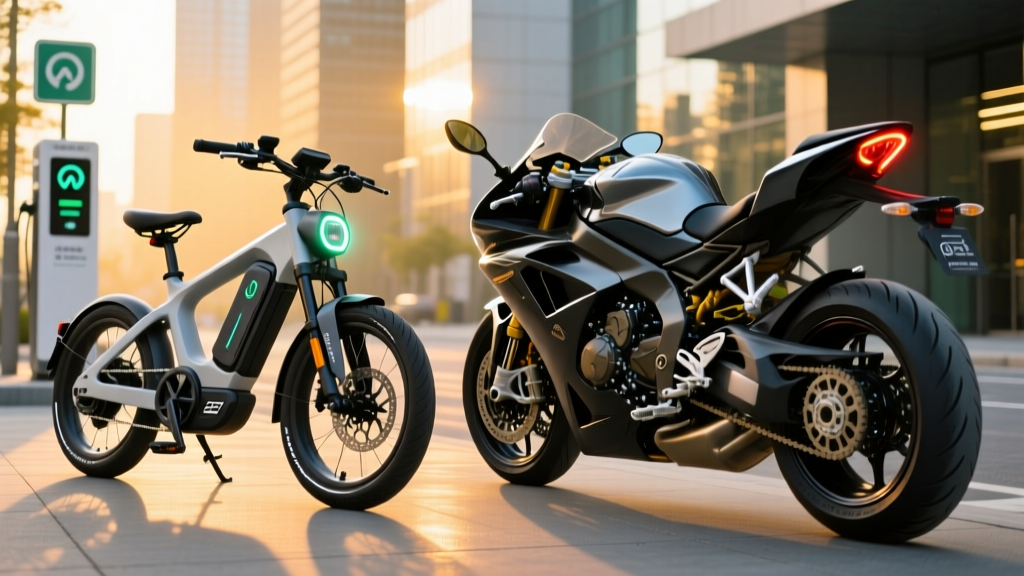
The safety comparison changes dramatically depending on whether you're asking about a 20-mph Class 1 e-bike or a 100-mph Zero SR/F electric motorcycle. Most consumer searches for "electric bike" refer to Classes 1–3 — the bicycle-style vehicles you see on bike lanes and city streets. We'll focus our analysis there, while noting where motorcycle-class EVs change the equation.
Crash and Fatality Data: What the Numbers Actually Show
The most authoritative source for US vehicle safety data is the National Highway Traffic Safety Administration's FARS database. Here's what the data tells us:
Motorcycles (gas and electric combined): NHTSA reports that motorcyclists are approximately 24 times more likely to die in a traffic crash per vehicle mile traveled than passenger car occupants. In 2022 (the most recent fully-published year), 6,614 motorcyclists were killed and approximately 93,000 injured. Motorcycles account for roughly 15% of all traffic fatalities while representing less than 1% of vehicle miles traveled.
E-bikes: Systematic national fatality tracking for e-bikes is still maturing — many jurisdictions classify e-bike crashes under bicycle data. However, emerging data from cities with high e-bike adoption (New York, San Francisco, Portland) indicates:
- E-bike emergency room visits rose approximately 30–40% year-over-year from 2022 to 2024 as adoption surged
- E-bike crashes tend to result in fractures and head injuries at higher rates than conventional bicycle crashes, due to greater mass and speed
- However, fatality rates remain far below motorcycle rates — e-bike fatalities are typically in the dozens nationally per year vs. thousands for motorcycles
The fundamental physics explanation: kinetic energy scales with the square of velocity. A crash at 60 mph (motorcycle) involves 9 times the kinetic energy of a crash at 20 mph (Class 1 e-bike), assuming equal mass. This is the single largest factor in why motorcycle crashes are so much more lethal.
Where E-Bikes Carry Unique Risks Motorcycles Don't
Lower overall danger doesn't mean zero danger. E-bikes introduce specific risk factors that motorcycle riders typically don't face:
Silent Approach and Driver Awareness
Both e-bikes and electric motorcycles are nearly silent at low speeds. For e-bikes operating in bike lanes and at intersections, this means motorists pulling out of driveways or turning right across bike lanes frequently don't hear an approaching e-bike. Motorcycle riders have decades of cultural awareness (and louder exhaust pipes, even if controversial) working in their favor.
Rider Experience and Training Gaps
Motorcycle licensing (M endorsement) requires a skills test and written exam in most US states. There is no equivalent requirement for a Class 1 or 2 e-bike. This means many e-bike riders have never received any formal instruction on:
- Proper braking technique (especially with heavier e-bike frames)
- Intersection positioning and lane visibility
- How to handle a 55-lb bike at 20 mph when a car door opens
Lithium Battery Fire Risk
This is a risk category that neither gas motorcycles nor conventional bicycles share. E-bike lithium-ion batteries — particularly uncertified imports and damaged cells — have caused residential fires in major cities. New York City alone reported over 250 lithium battery fires in 2023, many linked to e-bike and e-scooter batteries charged in apartments. The risk is concentrated in:
- Uncertified batteries lacking UL 2849 certification
- Modified or "refurbished" battery packs
- Charging in confined spaces without fire-rated enclosures
- Physical damage to battery cells from crashes or drops
Quality e-bikes from major manufacturers (Trek, Specialized, Rad Power, Lectric) with UL 2849-certified battery systems present minimal fire risk when charged according to instructions. The danger concentrates in the lowest-cost, unregulated segment of the market.
Weight and Handling at Low Speed
A 65-lb e-bike is substantially harder to control at low speeds than a 22-lb road bike, especially for smaller or older riders. Low-speed tip-overs, mounting/dismounting falls, and loss-of-control incidents when the pedal-assist motor engages unexpectedly are common in e-bike injury reports — injury types that don't appear in motorcycle data because motorcycles are designed around their weight.
Cost of Ownership: E-Bike vs. Motorcycle vs. Gas Car
Safety is one dimension of the purchase decision. For many buyers considering an e-bike, the real question is whether it can replace a car or motorcycle for commuting — and what that costs. Here's a concrete breakdown using 2026 pricing:
| Cost Category | Class 2 E-Bike (Rad Power RadCity 5 Plus) | Electric Motorcycle (Zero S) | Gas Commuter Motorcycle (Honda CB300R) | Compact Gas Car (Honda Civic) |
|---|---|---|---|---|
| Purchase Price | $1,999 | $13,495 | $5,299 | $25,345 |
| Annual Insurance | $0–$200 (renters/homeowners add-on) | $600–$1,200 | $400–$800 | $1,200–$2,400 |
| Annual Fuel/Energy | $15–$40 (electricity) | $80–$150 (electricity) | $400–$700 (gas) | $1,200–$2,000 (gas) |
| Annual Maintenance | $100–$250 (tires, brakes, chain) | $150–$350 | $300–$600 | $500–$1,000 |
| Registration/Licensing | $0 | $100–$300 | $100–$300 | $100–$500 |
| Parking (urban annual) | $0 | $600–$2,400 | $600–$2,400 | $1,200–$4,800 |
| 5-Year Total Cost | $2,750–$4,250 | $18,000–$24,000 | $12,100–$18,100 | $36,345–$50,045 |
The cost differential is stark. Over five years, a commuter e-bike costs roughly $20,000–$45,000 less than a compact car and $10,000–$20,000 less than even a modest gas motorcycle — assuming it can replace those vehicles for your actual commuting needs. That "if" is the critical qualifier.
Real-World Ownership: When an E-Bike Works (and When It Doesn't)
The safety and cost data only matter if the vehicle actually fits your life. Here's where e-bikes succeed and where they fall short compared to motorcycles and cars:
E-Bikes Work Well When:
- Commute distance is under 15 miles one-way — most e-bikes deliver 30–50 miles of real-world range on pedal-assist, with range dropping 15–25% in cold weather (below 40°F) and on sustained hills
- You have secure, indoor storage — both for theft prevention (e-bike theft is rampant; expect to spend $100–$200 on a quality U-lock and GPS tracker) and for safe battery charging
- Your route has bike infrastructure — protected bike lanes, paths, or low-traffic residential streets. An e-bike on a 45-mph arterial road without a shoulder is not safer than a motorcycle
- You live in a moderate climate — rain, ice, and extreme heat significantly reduce both safety and battery range
- You can shower or change at your destination — even with pedal-assist, a 10-mile commute in summer will leave you perspiring
Motorcycles or Cars Are Necessary When:
- Commute exceeds 20 miles on roads with speed limits above 35 mph
- You regularly carry passengers or cargo beyond what panniers or a backpack can handle
- You live in an area with harsh winters where road cycling is impractical for 4+ months
- You need highway-speed travel — e-bikes are legally restricted to 20–28 mph; any route requiring freeway travel demands a motorcycle or car
- You lack secure home charging access — apartment dwellers without ground-floor storage or outlet access face significant friction charging daily
Common Misconceptions About E-Bike and Motorcycle Safety
| Myth | Fact |
|---|---|
| "E-bikes are just bicycles — no safety gear needed." | At 20–28 mph, e-bike crashes produce impact forces similar to moped crashes. A CPSC-certified helmet (ideally NTA-8776 rated for e-bike speeds) is essential. Many experienced riders also wear gloves, knee pads, and high-visibility clothing. |
| "Electric motorcycles are safer than gas because they're quieter." | Quiet operation reduces noise pollution but increases risk of other drivers not noticing you. Many electric motorcycle riders add aftermarket sound generators or rely on headlight modulators to increase conspicuity. |
| "Heavier e-bikes are safer because they're more stable." | Weight helps stability at speed but worsens low-speed handling, increases stopping distance, and makes crash impacts more severe for the rider. A 75-lb e-bike falling on a rider's leg can cause fractures that a 25-lb bicycle would not. |
| "All e-bike batteries are a fire hazard." | UL 2849-certified battery systems from reputable manufacturers have extremely low fire risk. The fire danger concentrates in uncertified, modified, or damaged batteries — primarily from the cheapest market segments and delivery-fleet bikes charged 24/7. |
| "E-bikes are safe for children and inexperienced riders." | Class 2 e-bikes with throttles can accelerate to 20 mph with no pedaling input. Many injury reports involve inexperienced riders who grabbed the throttle unexpectedly. Class 1 (pedal-assist only) is more intuitive for new riders. |
Decision Framework: Which Electrified Two-Wheeler Is Right for You?
If your primary need is...
Urban commuting under 10 miles, no highway: → Class 1 or 2 e-bike. Lowest cost ($1,500–$2,500), no license, lowest crash-energy risk. Prioritize UL-certified battery, hydraulic disc brakes, and integrated lights. Budget $200 for a helmet rated NTA-8776 or MIPS.
Suburban commuting 10–25 miles with some faster roads: → Class 3 e-bike or electric moped. The 28-mph pedal-assist (Class 3) or 30–40 mph moped gives you speed to keep up with traffic on 35-mph roads. Budget $2,500–$5,000. Check your state's licensing requirements for Class 3.
Commuting that includes 45+ mph roads or highways: → Electric motorcycle (Zero, LiveWire, Energica). You need motorcycle-class speed, braking, and visibility. Budget $12,000–$25,000 plus M endorsement and full riding gear ($800–$1,500). No federal §30D tax credit applies to two- or three-wheeled EVs — that credit is limited to four-wheeled vehicles per IRS §30D rules.
Year-round commuting in harsh winters or 30+ mile distances: → Electric car or PHEV. Two-wheeled vehicles of any type have severe practical limitations in ice, snow, and extreme cold. Battery range drops 20–40% below freezing on e-bikes and electric motorcycles alike.
Recreation and weekend riding: → Motorcycle (electric or gas). E-bikes are excellent for trail riding and casual recreation, but if your goal is canyon carving or long-distance touring, a motorcycle is the appropriate tool. Electric motorcycles like the Zero SR/S offer 150+ miles of range (city) and instant torque — but highway range at 70 mph drops to approximately 80–100 miles.
What First-Time E-Bike Buyers Must Know Before Purchasing
If the data above points you toward an e-bike, here are the ownership realities that separate informed buyers from regretful ones:
Battery Chemistry and Longevity
Most quality e-bikes use lithium-ion cells (typically 18650 or 21700 format) in NMC (nickel manganese cobalt) chemistry. Expect a usable battery lifespan of 500–1,000 full charge cycles before capacity drops to 80% of original — roughly 3–7 years of daily commuting. Replacement batteries cost $400–$800 from major manufacturers. Some newer models offer LFP (lithium iron phosphate) chemistry, which trades slightly lower energy density for 2,000+ cycle life and reduced fire risk.
Real-World Range vs. Advertised Range
Manufacturers advertise range based on ideal conditions (flat terrain, light rider, minimal assist, moderate temperature). Real-world range is typically 60–75% of advertised when using higher assist levels, carrying cargo, riding in cold weather, or tackling hills. A bike advertised at "45 miles range" will likely deliver 28–35 miles in mixed real-world commuting on throttle-heavy Class 2 use.
Charging Logistics
E-bike batteries charge on standard 120V household outlets — no special electrical work needed. Typical charge time is 3–6 hours from empty to full using the included charger (2A–4A output). If you're commuting daily, plan to charge nightly the same way you charge a phone. The energy cost is trivial: approximately $0.02–$0.05 per charge at national average electricity rates ($0.17/kWh in 2026).
Insurance and Theft Protection
Standard homeowners or renters insurance may cover e-bike theft, but often with exclusions or low sub-limits ($500–$1,000) for motorized vehicles. Dedicated e-bike insurance policies (from providers like Velosurance or Sunday Insurance) run $100–$300/year and cover theft, crash damage, and liability — worth the cost if your e-bike exceeds $2,000.
Helmet and Safety Gear Budget
Budget at minimum:
- NTA-8776 or MIPS-rated helmet: $80–$200
- High-visibility jacket or vest: $30–$80
- Gloves (full-finger, padded): $25–$60
- Front and rear lights (if not integrated): $40–$100
- U-lock (Sold Secure Gold rated): $60–$120
Total safety gear budget: $235–$560 on top of the bike purchase. This is non-negotiable — the injury data makes clear that e-bike crashes at 20+ mph produce real trauma.
Frequently Asked Questions
Do e-bike riders need a motorcycle license?
For Class 1 and 2 e-bikes (20 mph max), no US state currently requires a motorcycle license. Class 3 e-bikes (28 mph) have varying requirements — some states require a standard driver's license, a few require an M endorsement, and some have no specific requirement. Check your state's DMV or transportation department for current rules, as legislation is actively evolving.
Are electric motorcycles safer than gas motorcycles?
In terms of crash dynamics, electric and gas motorcycles of similar weight and speed present comparable injury risk. Electric motorcycles have a lower center of gravity (battery mounted low in the frame), which aids handling, and lack a fuel tank, eliminating post-crash fire risk. However, their near-silent operation at low speeds may increase the risk of other drivers failing to notice them — a factor that's difficult to isolate in crash data. Neither type is categorically "safer"; rider training and protective gear matter far more than powertrain type.
What is the leading cause of e-bike injuries?
Falls and loss-of-control incidents at low to moderate speed are the most common e-bike injuries presenting at emergency departments — more so than collisions with cars. Contributing factors include the bike's weight (making it harder to catch a tipping bike), unexpected motor engagement on throttle-equipped models, and riders unfamiliar with braking a heavier, faster bicycle. Collisions with motor vehicles, while less frequent, account for the most severe injuries and fatalities.
Can I charge an e-bike battery at my apartment?
Yes, if you have a standard 120V outlet in your unit or a secure area where you can bring the bike or removable battery. However, some apartment buildings and HOAs have begun restricting lithium battery charging in units following fire incidents. Check your lease or building rules. If indoor charging isn't possible, look for buildings offering secure bike storage with charging access — this is becoming more common in cities with high e-bike adoption.
How do e-bike fatality rates compare per mile traveled?
Precise per-mile fatality rates for e-bikes are not yet published at the national level by IIHS or NHTSA in a dedicated category. What we can say from available municipal data and bicycle fatality research: conventional bicycle fatality rates are approximately 0.2–0.3 per 10 million vehicle miles traveled. E-bikes likely fall somewhere between conventional bicycles and motorcycles (5.5 per 10 million VMT) — closer to bicycles for Class 1/2, closer to mopeds for Class 3 and above. The data gap itself is a reason for caution: we don't yet have the large-scale evidence base that decades of motorcycle data provides.
Is the federal EV tax credit available for e-bikes or electric motorcycles?
No. The IRS §30D Clean Vehicle Credit applies only to four-wheeled vehicles with a gross vehicle weight rating under 14,000 lbs. E-bikes and electric motorcycles do not qualify. However, some states and municipalities offer rebates for e-bike purchases — Denver's e-bike rebate program, for example, has offered $300–$1,700 depending on income and bike type. Check your local transportation or sustainability office for current programs.