The Quick Answer: E-Bikes vs Electric Cars
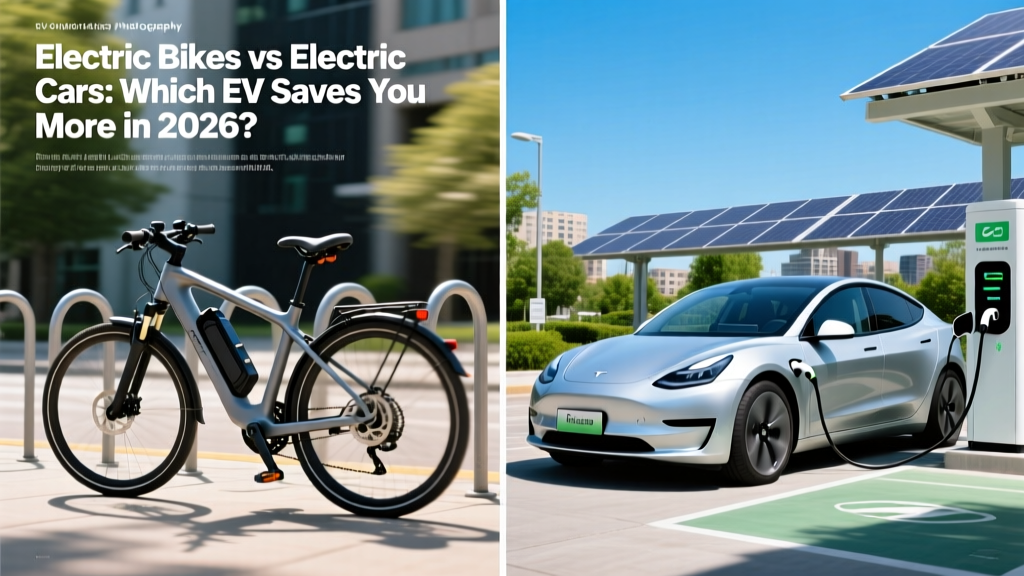
If your primary goal is short-distance urban commuting (under 15 miles round-trip), a quality electric bike costs roughly $1,500–$3,500 upfront, pennies per mile to charge, and avoids insurance, registration, and parking fees entirely. If you need all-weather capability, highway travel, passenger/cargo capacity, or trips beyond 30 miles, an electric car like the 2026 Chevrolet Equinox EV (EPA 319 miles, starting ~$33,600 before incentives) or 2026 Hyundai Ioniq 5 (EPA 318 miles, ~$42,600) delivers practical range with DC fast charging. Many households find the optimal answer is both: an EV for longer trips and an e-bike for daily errands.
Why This Comparison Matters Now
Search interest in "electric bikes electric bikes" continues to surge as commuters weigh every electrified option. But e-bikes and electric cars solve fundamentally different transportation problems. Conflating them leads to poor purchase decisions — buying a $3,000 e-bike when you actually need a highway-capable vehicle, or financing a $45,000 EV when a bike would cover 90% of your trips. This guide breaks down the hard numbers so you can match the vehicle to your actual driving (or riding) patterns.
Purchase Price: The Upfront Reality
The cost gap between e-bikes and electric cars is enormous, and it drives every downstream financial comparison.
| Category | Electric Bike (Quality Commuter) | Electric Car (2026 Entry-Level EV) |
|---|---|---|
| Purchase Price | $1,500 – $4,000 | $29,990 – $45,000 (MSRP) |
| Federal Tax Incentive | None (e-bikes ineligible for §30D) | Up to $7,500 via IRS §30D (income/MSRP/sourcing rules apply) |
| State/Local Rebates | $200 – $1,500 in select cities/states | $0 – $5,000 depending on jurisdiction |
| Registration & Title | $0 in most states (Class 1/2 e-bikes) | $100 – $500/year |
| Sales Tax | Varies; often ~$100–$350 | Varies; often $1,500–$4,000 |
| Effective First-Year Cost | ~$1,600 – $4,500 | ~$25,000 – $42,000 after incentives |
Critical note on the §30D federal tax credit: As of 2026, the IRS clean vehicle credit requires the buyer to meet income caps ($150K single / $300K joint), the vehicle MSRP must not exceed $55,000 for sedans or $80,000 for SUVs/pickups, and battery components and critical minerals must meet phased domestic-sourcing thresholds. The credit can now be transferred to the dealer at point of sale, reducing your purchase price directly. E-bikes do not qualify for §30D — they are not "motor vehicles" under IRS definitions. Always consult a tax professional for your specific eligibility.
Daily Operating Costs: Charging, Fuel, and Maintenance
This is where e-bikes shine brightest — but the gap narrows when you compare an EV to a gas car rather than to an e-bike.
| Metric | E-Bike (20-mile round-trip commute) | 2026 EV (e.g., Equinox EV, 120 MPGe) | Gas Car (30 MPG combined) |
|---|---|---|---|
| Energy/Fuel Cost per Mile | $0.003 – $0.008 | $0.03 – $0.05 (home charging, $0.14/kWh avg) | $0.10 – $0.14 (at $3.20/gal) |
| Annual Fuel/Energy (6,000 mi/yr) | $18 – $48 | $180 – $300 | $600 – $840 |
| Annual Maintenance | $100 – $250 (tires, brake pads, chain) | $300 – $500 (tires, cabin filter, wipers) | $600 – $1,200 (oil, filters, brakes, belts) |
| Insurance (Annual) | $0 – $200 (optional theft/liability) | $1,200 – $2,200 | $1,000 – $1,800 |
| Total Annual Operating Cost | ~$120 – $500 | ~$1,700 – $3,000 | ~$2,200 – $3,800 |
kWh vs kW — a necessary clarification: E-bike batteries are typically 0.4–0.75 kWh (kilowatt-hours, a measure of energy capacity). Electric car batteries range from ~60 kWh to 100+ kWh. Charging power is measured in kW (kilowatts). A standard wall outlet delivers ~1.4 kW; a home Level 2 charger delivers 7–11 kW; DC fast chargers deliver 50–350 kW. E-bikes charge from a standard outlet in 3–6 hours; an EV on Level 2 takes 6–12 hours for a full charge. Never confuse kW (the rate of energy flow) with kWh (the total energy stored).
Range, Weather, and Real-World Limitations
Sticker range tells only part of the story. Here's what actually happens when conditions change.
E-Bike Range Reality
Most commuter e-bikes advertise 40–60 miles of range on a full charge. In real-world riding with pedal-assist level 2 or 3, expect 25–45 usable miles before needing a recharge. Factors that reduce range: hilly terrain (20–30% loss), cold weather below 40°F (15–25% loss), heavy cargo or a passenger, and riding at full throttle without pedaling.
Electric Car Range Reality
The 2026 Chevrolet Equinox EV 3LT carries an 85 kWh (usable) NMC battery with an EPA-estimated 319 miles of range. Real-world highway driving at 70–75 mph typically yields 250–280 miles. In cold weather (below 30°F), expect a 20–30% reduction, dropping effective range to roughly 220–250 miles. Vehicles equipped with a heat pump (standard on the Ioniq 5, optional on some trims of the Equinox) lose less range in cold conditions because they don't rely on resistive heating, which draws heavily from the traction battery.
Charging Speed Comparison
| Metric | E-Bike | 2026 EV (Level 2 Home) | 2026 EV (DC Fast Charge) |
|---|---|---|---|
| Max Charge Rate | ~0.1 – 0.2 kW (wall outlet) | 7.7 – 11.5 kW | 150 – 350 kW peak |
| Full Charge Time (0–100%) | 3 – 6 hours | 7 – 12 hours | Not recommended to 100% |
| 10–80% Charge Time | ~2 – 4 hours | ~5 – 8 hours | 18 – 28 minutes (varies by model) |
| Miles Added per Hour | 8 – 15 miles | 25 – 44 miles | 500 – 1,200 miles/hr (peak) |
Charging curve taper — the real-world catch: EV DC fast charging doesn't sustain peak speed. A vehicle rated at 240 kW peak may only hold that rate from 10–40% State of Charge (SoC), then taper to 150 kW, then 80 kW, then 40 kW above 80%. This is why manufacturers quote 10–80% times rather than 0–100%. E-bikes charge at a steady slow rate, so their charge times are more predictable — just slower overall.
Common Misconceptions, Corrected
| Myth | Fact (with data) |
|---|---|
| "An e-bike can replace my car entirely." | Only if 100% of your trips are under ~30 miles, in fair weather, without passengers or significant cargo. U.S. DOT data shows the average American drives ~37 miles/day, but trip purposes (groceries, school drop-off, medical) often require enclosed vehicles. |
| "EVs are worse for the environment than gas cars because of battery mining." | Lifecycle analyses from Argonne National Laboratory and the ICCT consistently show EVs produce 50–70% fewer lifetime emissions than comparable gas cars, even accounting for battery manufacturing. The grid is getting cleaner every year, widening this gap. |
| "E-bike batteries need replacing every year or two." | Quality e-bike lithium-ion batteries (Samsung, LG, Panasonic cells) are rated for 500–1,000 full charge cycles before dropping to 80% capacity. At typical commuting use, that's 4–8 years before noticeable degradation. Replacement cost: $400–$800. |
| "You need a special electrical panel to charge an EV at home." | Most homes with a 200-amp panel can support a Level 2 charger (requiring a 40–60 amp dedicated circuit) without a panel upgrade. A licensed electrician can confirm. Panel upgrades, when needed, cost $1,500–$3,500. E-bikes need nothing — any standard 120V outlet works. |
| "EVs cost more to insure, so the savings disappear." | EV insurance is typically 10–20% higher than equivalent gas cars (due to higher repair costs and battery replacement risk). On a $35,000 EV, that's roughly $150–$300/year extra. Fuel and maintenance savings of $1,000–$2,000/year far outweigh the insurance premium increase. |
Real-World Ownership: What First-Time Buyers Need to Know
If You're Considering an E-Bike
- Home charging is trivial: Any standard 120V outlet works. No electrician needed. Charge overnight like a laptop.
- Theft is the #1 risk: E-bikes are high-theft targets. Budget $150–$300 for a U-lock and chain, and consider GPS tracking ($5–$10/month). Indoor storage is strongly recommended.
- Class matters: Class 1 (pedal-assist only, 20 mph max) and Class 2 (throttle-equipped, 20 mph) are legal on most bike paths. Class 3 (28 mph pedal-assist) may be restricted from some paths. Check your local regulations.
- Weather limits are real: Rain, ice, and extreme heat make e-bike commuting impractical or unsafe for many riders. Plan for 150–220 riding days per year in most U.S. climates, not 365.
- No federal tax credit: Unlike EVs, e-bikes don't qualify for the §30D credit. Some cities (Denver, Portland) and states offer point-of-sale rebates of $200–$1,500. Check local programs.
If You're Considering an Electric Car
- Home charging access is the dealbreaker: If you can install a Level 2 charger (or already have a 240V outlet like a dryer plug), EV ownership is seamless — wake up to a full "tank" every morning. If you rely solely on public charging, expect higher per-kWh costs ($0.30–$0.55 at DC fast chargers) and inconvenience.
- Level 2 installation costs $500–$2,500: This includes the charger unit ($350–$700 for a quality 48-amp unit like the ChargePoint Home Flex or Emporia Vue) plus electrician labor and permitting. Homes needing a panel upgrade add $1,500–$3,500.
- Plan for road trips: The Tesla Supercharger network (now open to NACS-equipped non-Tesla EVs) and CCS networks like Electrify America cover most interstate corridors. But rural gaps remain. Use A Better Routeplanner or PlugShare to verify coverage on your common routes.
- Cold-weather planning: If you live where winters drop below freezing, preconditioning your EV while plugged in (warming the battery and cabin using grid power, not battery power) recovers 10–15% of cold-weather range loss. Most EVs support scheduled preconditioning via their app.
Decision Framework: Which Is Right for You?
Choose an Electric Bike If:
- Your daily round-trip commute is under 20 miles
- You live in a mild climate or are comfortable riding in rain/cold with proper gear
- You don't regularly carry passengers or more than 20 lbs of cargo
- You want to spend under $4,000 total and avoid insurance/registration
- You have secure indoor storage (garage, apartment hallway, locked bike room)
- You already own or have access to a car for longer trips and bad weather
Choose an Electric Car If:
- You need highway-speed travel, all-weather capability, or regular trips over 30 miles
- You carry passengers (children, carpool) or significant cargo regularly
- You have access to home Level 2 charging (garage, driveway with 240V access)
- Your household drives more than 8,000 miles per year
- You want to eliminate gasoline expenses while retaining go-anywhere flexibility
- You qualify for the §30D federal tax credit (check income caps and vehicle sourcing requirements at irs.gov)
Choose Both If:
- You're a two-vehicle household replacing one gas car with an EV and using an e-bike for short solo trips
- You want to maximize savings: EV for highway/weekend/family trips, e-bike for daily commuting and errands
- This is the highest-value configuration for urban and suburban households — it eliminates most fuel costs while covering every trip type
Frequently Asked Questions
Can I claim the $7,500 federal EV tax credit for an electric bike?
No. The IRS §30D Clean Vehicle Credit applies only to four-wheeled motor vehicles designed for public road use that meet specific battery capacity, MSRP, buyer income, and domestic sourcing requirements. E-bikes are classified as consumer products, not motor vehicles, and are ineligible. Some municipalities offer separate e-bike rebate programs — check your city or state energy office.
How long do e-bike batteries last compared to EV batteries?
E-bike batteries typically last 500–1,000 charge cycles (4–8 years of daily commuting) before degrading to 80% capacity. EV batteries are engineered for longer service: most manufacturers warrant 8 years/100,000 miles with a minimum 70% capacity retention. Real-world data from Recurrent Auto shows most EV batteries retain 90–95% capacity after 100,000 miles. EV battery replacement costs $5,000–$15,000+ depending on the model, while e-bike battery replacement runs $400–$800.
Do I need a license, registration, or insurance for an e-bike?
In most U.S. states, Class 1 and Class 2 e-bikes (20 mph max assisted speed) require no license, registration, or insurance — they're treated like regular bicycles. Class 3 e-bikes (28 mph) may have age restrictions or path limitations depending on your state. Always verify with your state DMV or transportation department. Insurance is optional but recommended for theft coverage on e-bikes over $2,000.
Is it practical to own only an e-bike and no car?
For some urban residents, yes — particularly in cities with strong transit (New York, San Francisco, Chicago, Portland) where you can combine e-bike commuting with rideshare or car rental for occasional long trips. The math works: $3,000 e-bike + $150/month rideshare/car-share budget totals ~$5,000/year vs. $8,000–$12,000/year for car ownership (payment + insurance + fuel + maintenance + parking). But this lifestyle requires trip planning discipline and tolerance for weather inconvenience.
What's the actual cost per mile to charge an EV at home vs. an e-bike?
At the U.S. average residential electricity rate of ~$0.14/kWh: an e-bike with a 0.5 kWh battery costs about $0.07 per full charge, yielding roughly $0.003/mile. An EV with a 75 kWh battery costs about $10.50 for a full charge, yielding roughly $0.03–$0.04/mile (assuming 3–3.5 miles per kWh efficiency). Both are dramatically cheaper than gasoline at $0.10–$0.14/mile. Home charging is the cheapest fueling method for both; public DC fast charging for EVs can cost 2–4× more per kWh.