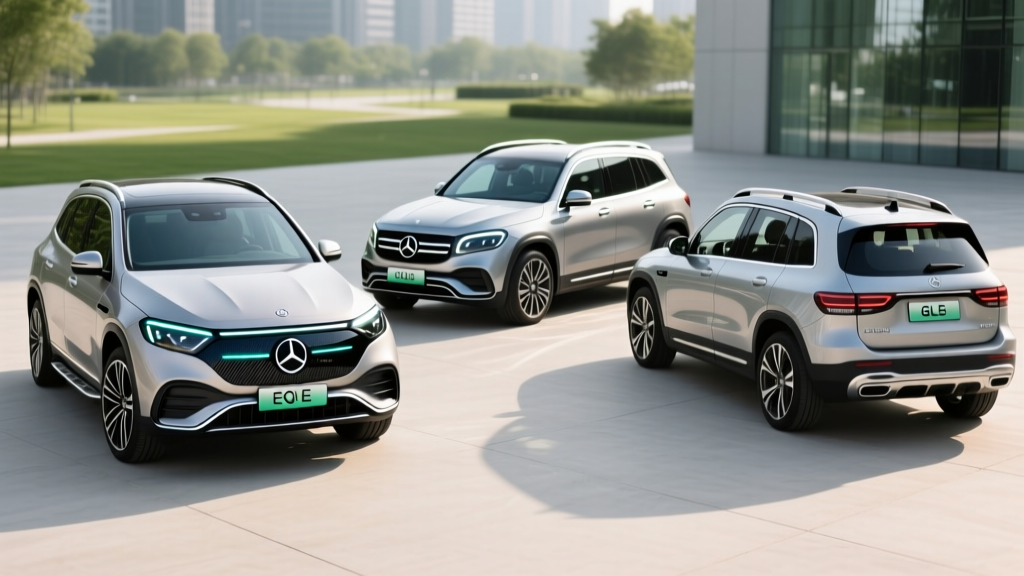
Which electric Benz SUV should you buy in 2026? The Mercedes-Benz EQE SUV (EPA 305 mi, ~$78,000) is the best all-around pick for most luxury EV buyers. Choose the EQS SUV if you need three rows and 305+ miles of range (starting ~$105,550). Pick the EQB 350 4MATIC (~$59,550, 227 mi EPA) as the most affordable entry point with optional third-row seating. None currently qualify for the full $7,500 federal §30D tax credit due to battery-sourcing requirements — always verify current IRS rules before purchasing.
Mercedes-Benz Electric SUV Lineup at a Glance
Mercedes-Benz offers three fully electric SUVs in the U.S. market for the 2026 model year, spanning from the compact EQB to the flagship EQS SUV. Each targets a different buyer profile, and understanding the real-world differences — not just the spec sheets — is critical before committing $60,000 to $120,000+.
| Spec | 2026 EQB 350 4MATIC | 2026 EQE 350+ SUV | 2026 EQS 450+ SUV |
|---|---|---|---|
| EPA Range | 227 mi | 305 mi | 305 mi (est.) |
| Battery (usable) | 66.5 kWh (NMC) | 90.6 kWh (NMC) | 108.4 kWh (NMC) |
| Peak DC Charge Rate | 100 kW | 170 kW | 200 kW |
| 10–80% DC Fast Charge | ~32 min | ~28 min | ~31 min |
| Level 2 Charge Rate | 9.6 kW | 9.6 kW | 9.6 kW |
| Horsepower | 288 hp | 288 hp | 355 hp |
| 0–60 mph | 5.8 sec | 6.4 sec | 5.3 sec |
| MPGe (combined) | 83 MPGe | 87 MPGe | 85 MPGe (est.) |
| Rows / Seats | 2 or 3 / 5–7 | 2 / 5 | 3 / 5–7 |
| Cargo (rear seats up) | 22.0 cu ft | 52.6 cu ft | 84.0 cu ft (2 rows folded) |
| Base MSRP | $59,550 | $77,900 | $105,550 |
| Battery Warranty | 8 yr / 100,000 mi | 8 yr / 100,000 mi | 8 yr / 100,000 mi |
All figures based on manufacturer specifications and EPA data at fueleconomy.gov. Real-world range will vary — see the section below.
Real-World Range vs. EPA Estimates
EPA sticker vs. reality: The EQE 350+ SUV carries a 305-mile EPA rating, but expect approximately 250–275 miles on the highway at 70–75 mph in moderate temperatures. In cold weather (below 30°F), plan for 200–230 miles of usable range due to cabin heating demands and increased battery resistance. The EQS 450+ SUV behaves similarly — its larger 108.4 kWh pack provides a buffer but still loses 15–20% in winter conditions.
The EQB 350's 227-mile EPA figure is the most limiting. Highway driving at sustained speeds drops this to roughly 185–200 miles, and cold weather can push it below 170 miles. This is adequate for daily commuting but requires planning for road trips exceeding 150 miles one-way.
All three models use NMC (nickel manganese cobalt) lithium-ion chemistry, which offers strong energy density but is more temperature-sensitive than LFP (lithium iron phosphate). Mercedes includes a thermal management system with liquid cooling and heating, which helps precondition the battery for fast charging — essential for maintaining charge speed on DC fast chargers.
Charging Speed and Infrastructure
Charging speed is where the EQB falls noticeably behind its stablemates. Its 100 kW peak DC rate means even on a 350 kW Electrify America or Tesla Supercharger (with NACS adapter), you're limited to roughly 100 kW peak, tapering to 50–60 kW above 60% State of Charge. The EQE and EQS SUVs perform better but still don't match the 250+ kW peak rates of Hyundai/Kia's E-GMP platform or Tesla's latest architecture.
| Charging Level | Power (kW) | EQB Miles/Hr | EQE Miles/Hr | EQS Miles/Hr |
|---|---|---|---|---|
| Level 1 (120V outlet) | ~1.4 kW | ~4 mi | ~4 mi | ~4 mi |
| Level 2 (240V, 40A) | 9.6 kW | ~28 mi | ~30 mi | ~28 mi |
| DC Fast (peak) | 100–200 kW | ~200 mi (peak) | ~380 mi (peak) | ~400 mi (peak) |
Key ownership note: These "miles per hour" figures at DC fast chargers represent peak rates sustained for only a portion of the session. The charge curve tapers significantly above 80% SoC to protect battery health. A 10–80% session on the EQE 350+ takes about 28 minutes at a 170+ kW-capable station, but 80–100% can add another 20+ minutes. Plan your road-trip stops around the 10–80% window for efficiency.
Mercedes-Benz has partnered with Tesla to provide Supercharger network access via a NACS adapter, included with new vehicles. This dramatically expands the available fast-charging network beyond Electrify America, EVgo, and ChargePoint. Verify adapter compatibility with your specific model year at your dealer.
Electric Benz SUV vs. Gas and Hybrid Alternatives
How do these electric Mercedes SUVs stack up against their gasoline counterparts and competing hybrids? Here's a data-driven comparison using the mid-size luxury segment:
| Metric | EQE 350+ SUV | GLE 350 (Gas) | GLE 350e (PHEV) |
|---|---|---|---|
| Base MSRP | $77,900 | $62,050 | $70,550 |
| Fuel/Energy Cost (annual, 12k mi) | ~$660 (electricity at $0.14/kWh) | ~$2,400 (gas at $3.50/gal, 22 MPG) | ~$1,350 (blended) |
| EPA Range / Efficiency | 305 mi / 87 MPGe | ~440 mi / 22 MPG combined | 48 mi electric + gas |
| Annual Maintenance (est.) | ~$400 | ~$900 | ~$750 |
| 5-Year Energy + Maintenance | ~$5,300 | ~$16,500 | ~$10,500 |
| Federal Tax Credit (§30D) | $0 (sourcing rules)* | $0 | $0–$3,750* |
*Tax credit eligibility depends on battery component sourcing, critical mineral requirements, buyer income caps, and MSRP limits under IRS §30D. Always verify at irs.gov and consult a tax professional.
The EQE's higher purchase price is offset by dramatically lower running costs. Over five years and 60,000 miles, the energy and maintenance savings total roughly $11,200 vs. the gas GLE. However, depreciation remains a wildcard — luxury EVs have experienced steeper depreciation than gas counterparts in recent years. Factor in potentially higher insurance premiums (typically 10–20% above equivalent gas models for EVs) when calculating your total cost.
Real Costs of Ownership
| Cost Category (5-Year) | EQB 350 4MATIC | EQE 350+ SUV | EQS 450+ SUV |
|---|---|---|---|
| Purchase Price (base) | $59,550 | $77,900 | $105,550 |
| Electricity (12k mi/yr, $0.14/kWh avg) | $3,100 | $2,950 | $3,200 |
| Home Charger Install (Level 2) | $800–$2,500 | $800–$2,500 | $800–$2,500 |
| Maintenance (est.) | $2,000 | $2,000 | $2,200 |
| Insurance (est. premium above gas) | +$3,500 | +$4,500 | +$5,500 |
| Estimated Depreciation | $22,000–$28,000 | $32,000–$40,000 | $48,000–$58,000 |
| 5-Year Total (approx.) | $91,000–$98,000 | $120,000–$130,000 | $165,000–$177,000 |
Home charging is essential for these vehicles. Without access to a Level 2 home charger (240V, 40A or 48A circuit), ownership becomes significantly less convenient. Level 1 charging at ~4 miles per hour means a full EQS charge takes over 24 hours. Budget $1,200–$2,500 for a professional Level 2 installation (charger unit + electrician + permit), or potentially $3,000–$5,000+ if your electrical panel requires a 200A upgrade. Get a quote from a licensed electrician before purchasing.
Common Misconceptions About Mercedes Electric SUVs
| Myth | Fact |
|---|---|
| "All Mercedes EVs get the $7,500 federal tax credit." | As of 2026, none of the Mercedes electric SUVs qualify for the full §30D credit due to battery-sourcing and critical-mineral requirements. Some may qualify for partial credits or the used-EV credit (up to $4,000 on pre-owned models under $25,000). Check fueleconomy.gov for the latest. |
| "The battery will need replacing in 5 years." | Mercedes warranties the high-voltage battery for 8 years / 100,000 miles against capacity loss below 70%. NMC degradation in liquid-cooled packs typically averages 10–15% over 100,000 miles based on industry data. Most owners will never see a battery replacement during ownership. |
| "You can't road-trip an electric Benz SUV." | With Tesla Supercharger access (via NACS adapter) and the Electrify America network, road-tripping is viable — but it requires planning. The EQE's 305-mile range means stops every 200–250 miles at highway speeds. Budget 25–35 minutes per charge stop. |
| "EVs have no maintenance costs." | EVs eliminate oil changes, spark plugs, and transmission fluid, but still require tire rotations, cabin air filters, brake fluid checks, and wiper replacements. Expect roughly $300–$500/year — significantly less than gas, but not zero. |
| "Regenerative braking replaces brake pads entirely." | Regen significantly extends pad life (many EV owners report 80,000+ miles on original pads), but brake fluid still requires flushing every 2–3 years, and pads eventually need replacement. |
First-Time EV Buyer Essentials
If this is your first electric vehicle, the Mercedes-Benz electric SUV lineup demands some specific preparation:
- Confirm home charging access before purchase. A dedicated 240V / 50A or 60A circuit is ideal. If you live in a condo or apartment without dedicated parking and charging, public-charging-only ownership is possible but adds significant time and cost. DC fast charging costs $0.35–$0.50/kWh at most networks — roughly double the home rate.
- Understand kW vs. kWh. kWh (kilowatt-hours) measures battery capacity — how much energy the car stores (like gallons in a gas tank). kW (kilowatts) measures power — how fast energy flows during charging (like gallons-per-minute at a pump). The EQE has a 90.6 kWh battery and accepts up to 170 kW of charging power.
- Precondition before fast charging. Navigate to a DC fast charger using the Mercedes me connect / MBUX navigation system. This activates battery preconditioning — warming or cooling the pack to optimal temperature for maximum charge speed. Without preconditioning, a cold battery may accept only 50–80 kW even at a 350 kW station.
- Install the Mercedes me Charge app and activate Plug & Charge on supported networks. This eliminates the need to swipe a card or use multiple apps at Electrify America and EVgo stations.
- Budget for winter range loss. If your daily commute is 80+ miles round trip and you live in a cold climate, the EQB's 227-mile range may feel tight in January. The EQE and EQS provide more buffer.
Decision Framework: Which Electric Benz SUV Is Right for You?
Choose the EQB 350 4MATIC if:
- Your budget is under $65,000 and you want a Mercedes electric SUV
- Your daily driving is under 100 miles round trip
- You occasionally need a third row for small children
- You primarily charge at home and rarely road-trip beyond 200 miles
Choose the EQE 350+ SUV if:
- You want the best balance of range, space, and value in the lineup
- You take regular road trips and need 300+ mile range
- You want strong cargo capacity (52.6 cu ft) without three rows
- Your budget is $78,000–$95,000 depending on options
Choose the EQS 450+ SUV if:
- You need three rows of adult-capable seating
- You want maximum luxury, technology, and ride comfort
- Your budget exceeds $105,000 and you accept steep depreciation risk
- You value the largest battery (108.4 kWh) for maximum cold-weather buffer
Consider a non-Mercedes alternative if:
- You want faster DC charging (Hyundai Ioniq 5 peaks at 240+ kW, 10–80% in ~18 min)
- You need federal tax credit eligibility (certain GM, Tesla, and Stellantis models qualify in 2026)
- Depreciation risk concerns you — Tesla and Porsche have shown stronger EV residual values
Frequently Asked Questions
Do any Mercedes electric SUVs qualify for the federal tax credit in 2026?
As of early 2026, Mercedes-Benz electric SUVs do not qualify for the full $7,500 §30D new clean vehicle credit due to battery component and critical mineral sourcing requirements that mandate North American manufacturing and free-trade-agreement sourcing. Rules change frequently — verify current eligibility at irs.gov or consult your tax professional before purchase. Some used Mercedes EVs may qualify for the up-to-$4,000 previously-owned clean vehicle credit if the sale price is $25,000 or less and income requirements are met.
How long does it take to fully charge a Mercedes electric SUV at home?
On a Level 2 charger (9.6 kW, 240V/40A): the EQB takes roughly 7 hours from empty to full, the EQE takes about 9.5 hours, and the EQS takes approximately 11.5 hours. Most owners charge overnight and rarely deplete the battery completely — a typical 20–80% daily charge takes 5–7 hours depending on the model.
Can I use Tesla Superchargers with a Mercedes electric SUV?
Yes. Mercedes-Benz provides a NACS (North American Charging Standard) adapter for accessing Tesla's Supercharger network. The adapter is included with new vehicle purchases. You'll need to activate Tesla charging through the Mercedes me Charge system. This gives you access to 25,000+ Supercharger stalls in addition to CCS-based networks like Electrify America and EVgo.
What happens if the battery degrades significantly?
Mercedes-Benz warranties the high-voltage battery for 8 years or 100,000 miles, whichever comes first, against capacity loss below 70% of original capacity. If the battery falls below this threshold within the warranty period, Mercedes will repair or replace it at no cost. Out-of-warranty replacement costs are estimated at $15,000–$30,000+ depending on the model, though most NMC packs with active thermal management retain 85–90% capacity at 100,000 miles based on industry fleet data.
Is the Mercedes MBUX Hyperscreen worth the upgrade?
The Hyperscreen (available on EQE and EQS SUVs) replaces the standard center display with a 56-inch curved glass panel spanning the dashboard. It costs approximately $8,000–$10,000 as part of a package. Functionally, it adds a dedicated passenger entertainment display and a wider navigation view. It's impressive visually but not essential for driving or charging functionality. We recommend experiencing it at a dealer before committing.