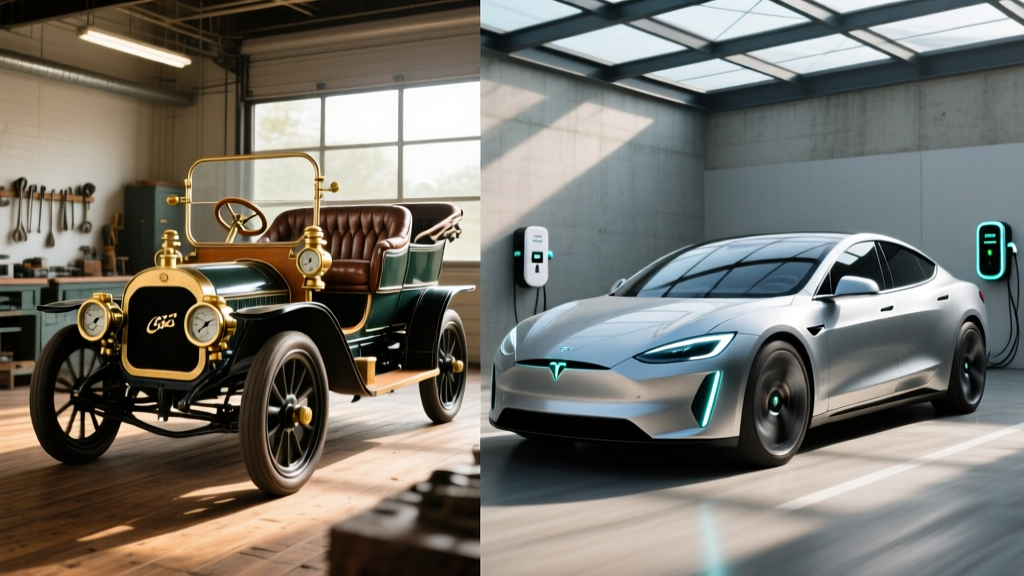
If you've ever searched for early 1900 electric cars and wondered how they stack up against the EVs in showrooms today, the short answer is staggering: a 1902 Baker Electric traveled roughly 50 miles on a 40-mile-per-hour charge with a lead-acid battery weighing over 1,000 pounds, while a 2026 Hyundai Ioniq 6 SE Long Range delivers an EPA-estimated 361 miles from an 77.4 kWh lithium-ion pack that weighs about 960 pounds and charges from 10-80% in roughly 18 minutes at a 350 kW DC fast charger. The century-plus gap between these machines isn't just an engineering footnote—it explains why EVs failed the first time, why they're succeeding now, and what first-time buyers should actually expect from the technology in 2026.
Quick Answer: Early 1900s vs 2026 EVs
1900-era EVs: 30-80 mile range, 15-25 mph top speed, 12+ hour charging, lead-acid batteries, no charging infrastructure, priced at $1,000-$3,000 (roughly $30,000-$90,000 in 2026 dollars). They outsold gas cars in 1900 but lost to cheap gasoline, the electric starter (1912), and mass-produced Model T pricing.
2026 EVs: 200-400+ mile EPA range, 100-200+ mph capability, 15-40 minute DC fast charging, lithium-ion/LFP batteries, 70,000+ public charging ports in the U.S., base pricing from ~$29,000 before incentives. Battery energy density has improved roughly 10x.
The Electric Car That Almost Won: 1900-1915
At the turn of the 20th century, the automobile market was a three-way race between steam, gasoline, and electricity—and electricity was winning with urban buyers. According to the U.S. Department of Energy, roughly 28% of all cars on American roads in 1900 were electric. The Baker Electric, Columbia Electric, and Detroit Electric were the Teslas of their day: quiet, clean, free of hand-crank starting, and favored by physicians and affluent city drivers who never needed to travel far.
But the technology had hard limits that no marketing could overcome:
| Specification | Baker Electric (1902) | Detroit Electric (1910) | 2026 Nissan Leaf S+ (Baseline Modern) |
|---|---|---|---|
| Battery Chemistry | Lead-acid | Lead-acid (later Edison NiFe option) | Lithium-ion (NMC) |
| Battery Weight | ~1,000 lbs | ~1,200 lbs | ~660 lbs |
| Range | ~50 miles @ 15 mph | ~80 miles @ 20 mph | EPA 212 miles |
| Top Speed | ~15 mph | ~20 mph | ~98 mph |
| Recharge Time | 10-15 hours | 8-12 hours | ~10-80% in 35 min (DCFC) |
| Original Price | ~$2,000 | ~$2,800 | $36,190 MSRP (2026) |
| Inflation-Adjusted Price | ~$73,000 | ~$92,000 | $36,190 |
The real killer wasn't range—it was infrastructure and cost. When Henry Ford's Model T dropped to $650 by 1912, Charles Kettering invented the electric starter (eliminating the dangerous hand crank), and gasoline stations proliferated, the electric car's advantages evaporated. By 1920, the early electric car era was effectively over.
What Took So Long? The Battery Density Problem
The single metric that explains the 100-year gap between early 1900 electric cars and modern EVs is energy density—how much electrical energy a battery can store per unit of weight.
- Lead-acid (1900-1990s): ~30-40 Wh/kg
- Nickel-metal hydride (1997-2010, e.g., original Prius, first-gen RAV4 EV): ~60-80 Wh/kg
- NMC lithium-ion (2026 mainstream): ~250-300 Wh/kg at the cell level
- LFP lithium-ion (2026 budget/mid-range): ~170-200 Wh/kg, with longer cycle life
- Solid-state (announced, not yet mass-production): ~400-500 Wh/kg projected
That roughly 8x improvement in energy density is why a 2026 Chevrolet Equinox EV LT can carry a ~85 kWh (usable) battery weighing under 1,000 pounds and deliver an EPA-estimated 319 miles of range, while the 1910 Detroit Electric needed 1,200 pounds of lead-acid to go 80 miles at 20 mph. The physics simply didn't support long-range EVs until lithium-ion commercialization in the 1990s and automotive-scale manufacturing post-2010.
Modern EV Ownership Costs vs Gas and Hybrid: The 2026 Numbers
The reason early 1900 electric cars lost wasn't just technology—it was total cost. In 2026, that equation has flipped for many buyers. Here's a five-year comparison based on current MSRP, EPA efficiency data from fueleconomy.gov, and national average energy prices ($0.17/kWh residential electricity, $3.30/gallon regular unleaded):
| Category | 2026 Tesla Model 3 RWD | 2026 Toyota Camry LE (Gas) | 2026 Toyota Prius LE (HEV) |
|---|---|---|---|
| Base MSRP | $38,990 | $28,855 | $28,550 |
| Federal Tax Credit (§30D) | Up to $7,500* | $0 | $0 |
| Effective Purchase Price | ~$31,490* | $28,855 | $28,550 |
| Fuel/Energy (75k mi) | ~$3,300 (home L2) | ~$8,250 | ~$4,300 |
| Maintenance (5 yr) | ~$1,200 | ~$3,500 | ~$3,200 |
| Insurance (avg 5 yr) | ~$11,500 | ~$8,200 | ~$8,400 |
| 5-Year Total (approx.) | ~$47,490 | ~$48,805 | ~$44,450 |
*Federal §30D credit eligibility depends on buyer income caps ($150k single / $300k joint AGI), vehicle MSRP caps ($55k sedans / $80k SUVs/trucks), battery critical-mineral and component sourcing requirements, and point-of-sale transfer election. Confirm current-year rules at IRS.gov before purchasing.
Two takeaways stand out: (1) EVs now achieve purchase-price parity with mid-size gas sedans after the credit, and (2) the fuel and maintenance savings—roughly $5,000-$7,000 over five years for a home-charging owner—are real and measurable. But insurance costs remain 20-40% higher on average for EVs, a cost that early-1900s electric-car buyers in their horse-and-buggy insurance era never faced.
What First-Time EV Buyers Actually Need to Know in 2026
Unlike 1902, when owning an electric car meant plugging into a home lighting circuit overnight, 2026 EV ownership requires some upfront homework. Here's the non-marketing checklist:
Home Charging Is the Make-or-Break
Over 80% of EV charging happens at home. If you can install a Level 2 (240V, 32-48 amp) home charger—typically $500-$800 for the EVSE plus $800-$2,500 for electrician labor depending on panel capacity—you'll wake up every morning with a full battery and rarely need public charging. Renters, condo dwellers, and street-parkers need to map public Level 2 and DC fast chargers via PlugShare or the automaker's app before buying.
Real-World Range Is Not EPA Range
The EPA test cycle is optimistic for highway driving and cold climates. Expect:
- Highway (70-80 mph): 10-15% below EPA sticker
- Cold weather (below 32°F): 20-35% below EPA, depending on heat-pump availability
- DC fast charging taper: Peak kW applies only between ~10-50% SoC; charging slows dramatically above 80%
NACS vs CCS: The 2026 Connector Reality
As of 2025-2026, nearly every major automaker has adopted the Tesla NACS connector for North American models. CCS1 vehicles can access the Tesla Supercharger network via adapter, but new EVs increasingly ship with native NACS. CHAdeMO is effectively legacy (Nissan Leaf is the last holdout).
Battery Chemistry Matters
Most 2026 EVs use either NMC (nickel-manganese-cobalt, higher energy density, charge to 80% daily recommended) or LFP (lithium iron phosphate, lower density but longer cycle life, can be charged to 100% daily, more cold-sensitive). Your owner's manual will specify—follow it.
Myth vs Fact: Early EVs and Modern EVs
| Myth | Fact |
|---|---|
| "EVs are a new fad." | Electric cars predate gasoline cars. The first practical EV was built in the 1890s; they held land-speed records before 1900. |
| "Early 1900 electric cars had similar range issues to today." | No—1900 EVs had 50-mile range with 12-hour charging. 2026 EVs have 250-400 mile range with 15-40 minute DCFC. The scale of the problem is fundamentally different. |
| "EV batteries need replacing every few years." | 2026 battery warranties are federally mandated at minimum 8 years/100,000 miles. Real-world data shows most NMC/LFP packs retain 85-90% capacity at 150,000 miles. |
| "EVs are worse for the environment." | Even on coal-heavy grids, lifecycle emissions for EVs are lower than ICE vehicles per the Union of Concerned Scientists and EPA analysis. The gap widens yearly as the grid decarbonizes. |
| "You can't road-trip an EV." | With the 2026 Supercharger network (25,000+ stalls), Electrify America, and EVgo, 300-mile road trips require one 20-minute stop. Planning apps handle this automatically. |
Decision Framework: Should You Buy an EV, Hybrid, or Stick with Gas?
If-Then EV Buying Guide (2026)
- IF you have home charging access AND drive under 300 miles/day: A BEV like the 2026 Chevy Equinox EV ($33,600, EPA 319 mi) or Tesla Model 3 ($38,990, EPA 363 mi) will save you $4,000-$7,000 over five years vs gas.
- IF you lack home charging AND your area has reliable DCFC networks: A BEV is still viable, but budget extra time and ~$0.35-$0.50/kWh public charging rates.
- IF you frequently drive 400+ miles, tow heavy, or live in extreme cold without a garage: A PHEV like the 2026 Toyota RAV4 Prime (42 mi electric-only, 38 mpg combined after) or HEV like the Prius (57 mpg combined) is the pragmatic choice.
- IF you live in a rural charging desert: Wait, or choose a hybrid. Public charging infrastructure in rural America is still catching up.
- IF you want lowest upfront cost regardless of fuel: A gas Camry or Corolla still wins on sticker price, but loses on 5-year total cost.
What Early 1900 EV Owners Would Recognize in 2026
Ironically, several traits of the 1902 Baker Electric are still EV selling points today: quiet operation, instant torque from a standstill (no transmission lag), minimal routine maintenance (no oil changes, no spark plugs, fewer moving parts), and home "refueling." What has changed is everything that made early 1900 electric cars a niche product—range, charging speed, price, and infrastructure. The century-long gap wasn't about the concept; it was about the chemistry.
For buyers cross-shopping in 2026, the question isn't whether electric propulsion works—it's been working since 1890. The question is whether your home, your commute, your climate, and your budget align with today's lithium-ion reality. For most suburban and urban drivers with home charging access, the math now clearly favors electric. For long-haul, rural, or apartment-dwelling drivers, hybrids remain the bridge technology that early 1900s engineers could only have dreamed of.
Frequently Asked Questions
Why did electric cars disappear after 1900?
Three factors converged by 1915: Ford's mass-produced Model T dropped gas-car prices to $650, the electric starter eliminated the dangerous hand crank, and rural gasoline infrastructure expanded. Electric cars, still priced around $2,000-$3,000 with 50-mile range, lost their urban advantage.
What was the range of a 1900 electric car?
Most early 1900 electric cars had a real-world range of 30-80 miles at speeds of 15-20 mph. The 1910 Detroit Electric Model 47 claimed up to 80 miles under ideal conditions. That's roughly the same as a 2026 PHEV's electric-only range, but the 1910 version took 12 hours to recharge.
Are 2026 EV batteries really better than lead-acid?
Dramatically so. Modern lithium-ion cells store 6-8x more energy per kilogram than lead-acid, can be fast-charged in minutes rather than hours, and last 1,500-3,000+ charge cycles before significant degradation. The federal warranty minimum is 8 years/100,000 miles for capacity retention.
Is a 2026 EV cheaper to own than a gas car?
Over five years and 75,000 miles, a federally credit-eligible EV charged at home typically costs $1,000-$5,000 less than an equivalent gas sedan when factoring fuel, maintenance, and purchase incentives. Insurance is the one category where EVs still cost 20-40% more on average.
Can I buy a modern car inspired by early 1900 electric cars?
Not directly, though the classic-car EV conversion market is growing. Companies like EV West and Legacy Classic Trucks retrofit vintage bodies with modern lithium-ion drivetrains, combining 1900-era aesthetics with 2026 performance—but at six-figure prices.