The Short Answer on "Drifting Board Electric"
If you've seen viral clips of a drifting board electric device — a motorized skateboard or hoverboard-style platform modified for powerslides — you're looking at a recreational toy, not a vehicle. These boards typically cost $400–$1,800, top out at 15–30 mph, carry 8–15 miles of range on small lithium packs (often 0.2–1.0 kWh), and are not street-legal for road use. They have no EPA rating, no NHTSA safety certification, no airbags, and no crash structure. For anyone researching actual transportation, a used or new battery-electric vehicle (BEV) delivers 250–350+ miles of EPA range, highway capability, climate control, and federal tax-credit eligibility that a drift board simply cannot touch.
The phrase "drifting board electric" has been climbing search trends thanks to social-media clips of riders sliding electric longboards through parking lots. It's entertaining content, and for a weekend hobby it's a legitimate product category. But searchers landing on that keyword often conflate these boards with real electric vehicles. This guide draws a hard line between the two and gives you the numbers you need if your actual goal is buying a car that plugs in.
What a Drifting Board Electric Device Actually Is (and Isn't)
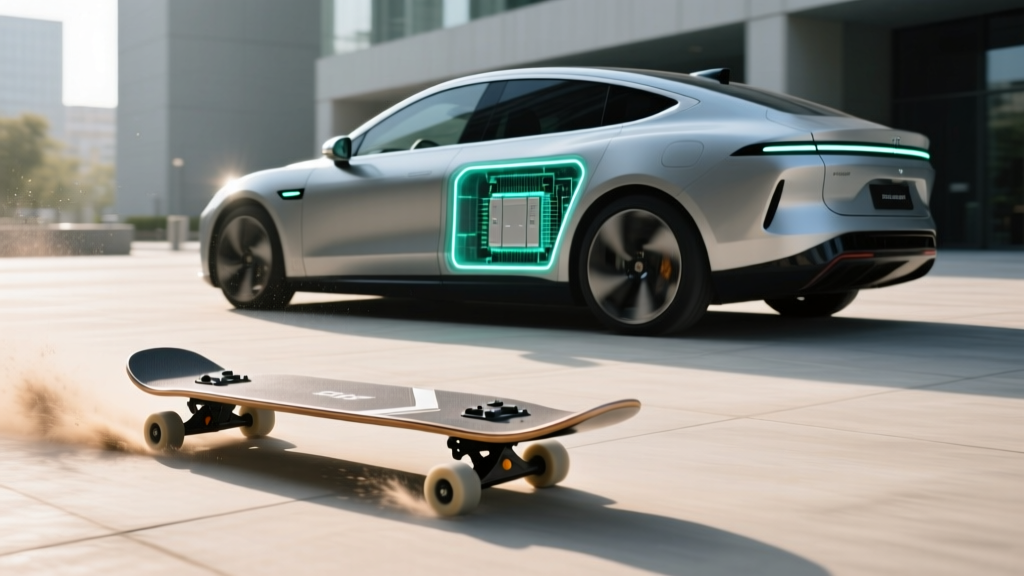
A drifting board is usually an electric longboard or one-wheel-style platform with soft, low-durometer wheels and a rear-bias motor setup that lets the rider break traction on command. Typical 2026 specs for a hobby-grade board:
- Motor: 1,000–3,000 watts (peak), single or dual hub/belt drive
- Battery: 0.3–1.2 kWh lithium-ion (often 10S or 12S packs, 36V–50V nominal)
- Range: 8–18 miles real-world, heavily dependent on rider weight and slide frequency
- Top speed: 20–35 mph, governed by ESC settings
- Charge time: 1.5–4 hours on a dedicated charger (no Level 2, no DC fast charge)
- Price: $600–$2,200 for reputable brands; Amazon knockoffs start lower
That's a fun toy. It is also categorically outside anything covered by NHTSA, the EPA's fueleconomy.gov database, or the IRS's §30D clean-vehicle credit. It has no VIN, no title, no insurance product worth the name, and no legal right to operate on public roads in most U.S. jurisdictions.
Stacked Up: Drift Board vs. an Affordable 2026 EV
To make the comparison concrete, here's the drift board lined up against the most accessible new BEV in the U.S. market for 2026 — the Chevrolet Bolt EV (refreshed generation), a common first-time EV buyer benchmark.
| Spec | Drift Board (typical) | 2026 Chevrolet Bolt EV (2LT) |
|---|---|---|
| MSRP | $1,200 (hobby-grade) | ~$28,900 before credit |
| Battery capacity | ~0.7 kWh | 65 kWh usable (NMC) |
| EPA range | Not rated (~12 mi real) | 259 mi (EPA) |
| Real-world highway range | N/A — not highway-legal | ~230 mi (70 mph, 70°F) |
| Cold-weather range (20°F) | ~6–8 mi | ~195 mi w/ heat pump preconditioning |
| Top speed | 30 mph | 93 mph (governed) |
| 0–60 mph | N/A | ~7.0 sec |
| Max charge rate | ~0.3 kW (wall charger) | 115 kW DC peak, 11.5 kW Level 2 |
| 10–80% charge time | ~2.5 hr (0–100%) | ~30 min (DC fast) |
| Safety certification | None | NHTSA 5-star, IIHS Top Safety Pick |
| Federal tax credit | $0 | Up to $7,500 (§30D, subject to income/MSRP/sourcing) |
The Bolt isn't exotic — it's the low bar for a real EV. Even at that bar, the gap in capability is enormous.
Real Ownership Costs: 5-Year Breakdown
Let's assume you're choosing between three options for a 15-mile-each-way commute: the drift board (if you could legally and safely ride it), a 35-MPG compact gas car, and the Bolt EV with home Level 2 charging.
| Cost (5 years, 75,000 mi) | Drift Board* | Gas Car (35 MPG) | 2026 Bolt EV |
|---|---|---|---|
| Purchase (net of credit) | $1,200 | $26,000 | $21,400 (after $7,500) |
| Energy/fuel | $190 (electric) | $7,500 ($3.50/gal) | $2,250 ($0.14/kWh avg) |
| Maintenance | $400 (belts, wheels, bearings) | $3,800 | $900 |
| Insurance | $0 (not insurable as vehicle) | $7,500 | $8,400 |
| Registration/tax | $0 | $1,500 | $1,800 |
| Total 5-yr | $1,790 | $46,300 | $34,750 |
*Drift board numbers assume zero medical costs, zero legal exposure, and fair-weather riding only. In reality, a single ER visit for a wrist fracture can exceed the Bolt's entire 5-year energy spend.
The honest takeaway: an EV is dramatically cheaper to run than gas, but it's still a car purchase. The drift board is cheap because it isn't transportation infrastructure — it's a toy. Comparing their total costs is like comparing a Peloton to a bicycle commute.
First-Time EV Buyer: What Actually Matters
If your search for "drifting board electric" was really the start of a broader EV curiosity, here are the four decisions that will shape your ownership more than any spec sheet:
- Can you charge at home? A Level 2 (240V) home install runs $800–$2,200 for equipment plus $600–$2,500 for electrician labor, depending on panel capacity. If you have a garage or driveway with panel access, home charging makes an EV the cheapest thing you'll ever "fuel." If you're in an apartment with no charger access, a PHEV (plug-in hybrid) like the Toyota Prius Prime (44 mi electric-only, 52 MPG combined after depletion) is a more realistic bridge.
- What's your real range need — not your fantasy road trip? 95% of U.S. drivers cover under 40 miles per day. A 259-mile EPA-rated EV covers a week of commuting with buffer. Don't pay a $15,000 premium for a 400-mile pack you'll never use.
- What's your climate? LFP (lithium iron phosphate) batteries — used in base Tesla Model 3 RWD and some Ford Mustang Mach-E trims — tolerate daily 100% charges and last longer, but lose more range in sub-freezing weather (often 30–40% at 10°F). NMC chemistries hold cold-weather range better but prefer 80% daily charge limits.
- Tax-credit eligibility isn't automatic. The §30D credit has income caps ($150k single / $300k joint), MSRP caps ($55k cars / $80k SUVs and trucks), and strict battery-mineral and assembly sourcing rules that shift yearly. Confirm on IRS.gov before you sign anything, and ask the dealer about point-of-sale transfer if you want the credit applied at purchase rather than on your tax return.
Myths vs. Facts — For Boards and Cars Alike
| Myth | Fact |
|---|---|
| "An electric drift board is basically a micro-EV." | It has no VIN, no safety certification, no road legality, and no crash protection. It's a motorized toy. |
| "EVs always cost more than gas cars long-term." | For a home-charging commuter, a 2026 Bolt EV saves roughly $5,000–$8,000 over 5 years vs. a comparable gas compact, even after higher insurance. |
| "EV batteries need replacing every 5 years." | Modern NMC and LFP packs routinely retain 85–92% capacity at 150,000 miles. Federal law mandates an 8-year/100,000-mile battery warranty (10 years in CARB states). |
| "You can't road-trip an EV." | The Tesla Supercharger and Electrify America networks cover U.S. interstates comprehensively. A 10–80% DC fast charge on a modern BEV takes 18–35 minutes. |
| "Cold weather kills EV range entirely." | Cold reduces range 20–40% depending on chemistry and heat-pump use. Preconditioning the battery while plugged in recovers much of that loss. |
Decision Framework: Should You Buy a Drift Board, an EV, or Something Else?
- Choose the drift board if: you want a weekend hobby toy for private-property use, have $1,000–$2,000 in disposable income, and already have a real car for actual transportation.
- Choose a BEV (Bolt, Model 3, Ioniq 6, Equinox EV) if: you have home or workplace Level 2 charging access, commute under 80 miles round-trip, want the lowest per-mile operating cost, and qualify for at least part of the §30D credit.
- Choose a PHEV (Prius Prime, RAV4 Prime, Tucson PHEV) if: you lack reliable home charging, take frequent long road trips, or live in an area with sparse DC fast-charging infrastructure.
- Stick with gas (or wait) if: you live in a charging desert, drive over 25,000 miles/year mostly on rural highways, or your budget can't absorb the EV upfront premium even after credits.
Frequently Asked Questions
Is a drifting board electric device street-legal?
Almost never. Most U.S. states classify motorized skateboards and one-wheels as off-road recreational devices. They cannot be registered, insured, or operated on public roads or most bike paths. Check your local DMV, but assume the answer is no.
Why does "drifting board electric" show up near EV content?
Social-media algorithms cluster anything with "electric" together. Search engines then surface EV reviews, e-scooters, and drift boards on the same results page. The products share chemistry (lithium batteries) and little else.
Do any EVs actually drift?
Yes — high-performance dual-motor EVs like the Tesla Model 3 Performance, Hyundai Ioniq 5 N, and Ford Mustang Mach-E GT have dedicated "drift modes" that bias torque to the rear axle. These are closed-course track features on $50,000+ cars, not commuter functions, and they chew through tires at an alarming rate.
What's the cheapest legitimate EV I can buy in 2026?
The Chevrolet Bolt EV starts around $28,900 and, for eligible buyers, the §30D point-of-sale credit can bring the effective price under $22,000. The used-EV credit (§25E) offers up to $4,000 on qualifying pre-owned BEVs priced under $25,000.
Should I buy a drift board as a gift?
Only for a recipient who understands the safety exposure: full PPE (helmet, wrist guards, knee pads), private-property use, and zero expectation of road legality. For a commuter gift, a transit pass or a contribution toward an EV down payment is more practical.
Bottom line: the drifting board electric trend is real entertainment and a legitimate hobby product, but it sits in a completely different category from electric vehicles. If your goal is cutting commute costs, eliminating tailpipe emissions, or accessing federal tax credits, you need a VIN, four wheels, and an EPA window sticker — not a deck with wheels and a Bluetooth ESC.