Quick Answer: Do Electric Mowers Need Oil?
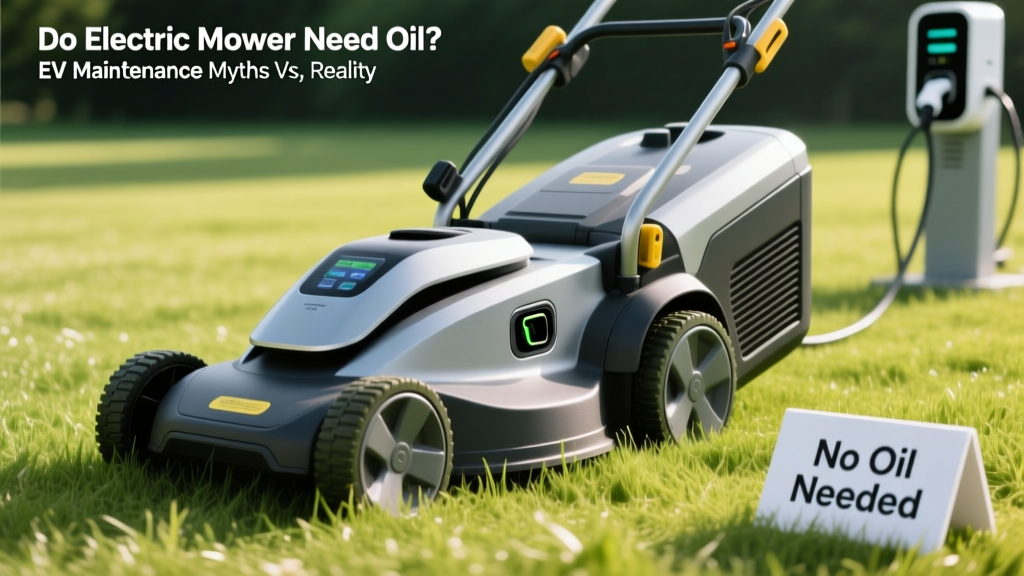
No. Electric mowers — whether battery-powered lawn equipment or full-size electric vehicles — do not need oil. They have no internal combustion engine, no pistons, no crankcase, and therefore no engine oil to change. This is one of the biggest maintenance advantages of going electric, whether you're talking about a 56V EGO cordless mower for your yard or a Tesla Model Y for your commute. The electric motor uses sealed bearings and requires zero lubrication from the owner.
If you've landed here wondering "do electric mowers need oil," you're likely either switching from gas yard equipment or starting to explore the broader world of electric vehicles. The answer connects to a much larger conversation about what you actually maintain — and what you permanently eliminate — when you go electric. Let's break down the real maintenance picture, the cost savings, and the misconceptions that still trip up first-time EV buyers in 2026.
The No-Oil Advantage: From Lawn to Driveway
The reason an electric mower doesn't need oil is simple physics. A gas mower uses a small internal combustion engine (ICE) with pistons, valves, and a crankshaft — all metal parts that require oil film lubrication to prevent seizure. An electric mower uses a brushless DC motor with a rotor spinning inside a stator, supported by sealed ball bearings. There's no combustion, no heat from burning fuel, and no need for oil.
This same principle scales up to full-size electric vehicles. A battery-electric vehicle (BEV) like the Hyundai Ioniq 5 or Ford Mustang Mach-E replaces a 200+ part engine with an electric motor that has roughly 20 moving parts. The result is a dramatically simplified maintenance schedule.
Here's what a typical gas car owner deals with annually versus an EV owner:
| Maintenance Item | Gas Car | Battery EV |
|---|---|---|
| Engine oil changes | Every 5,000–7,500 mi ($40–$80 each) | Never — no engine oil |
| Oil filter replacement | With every oil change | Never |
| Transmission fluid | Every 30,000–60,000 mi | Single-speed reducer: check/replace ~60,000 mi |
| Spark plugs | Every 30,000–100,000 mi ($100–$400) | Never — no spark ignition |
| Air filter (engine) | Every 15,000–30,000 mi | Cabin air filter only (~$25–$50) |
| Brake pads | Every 25,000–50,000 mi | Every 80,000–150,000+ mi (regen braking) |
| Exhaust/muffler | Repairs/replacement common | Never — no exhaust system |
| Coolant flush | Every 30,000–50,000 mi | Every 5–7 years (battery thermal system) |
| Estimated annual maintenance cost | $900–$1,200 | $300–$500 |
According to fueleconomy.gov, EVs eliminate the majority of routine powertrain maintenance that gas car owners take for granted. The U.S. Department of Energy estimates that EV maintenance costs run roughly $0.061 per mile compared to $0.101 per mile for gasoline vehicles — a savings of about $600 per year for a driver covering 15,000 miles.
Real Costs: EV vs. Gas Over 5 Years of Ownership
Maintenance savings are just one piece of the ownership equation. Let's look at the full 5-year cost picture for a popular 2026 EV — the Tesla Model Y Long Range — versus a comparable gas crossover like the Toyota RAV4 (gas, not hybrid). We'll use 15,000 miles/year, national average electricity and fuel prices, and current 2026 data.
| Cost Category (5 Years / 75,000 mi) | 2026 Tesla Model Y LR | 2026 Toyota RAV4 LE (Gas) |
|---|---|---|
| Purchase price (MSRP) | $44,990 | $30,445 |
| Federal tax credit (§30D, if eligible) | −$3,750 to −$7,500* | $0 |
| Effective purchase price | ~$37,490–$41,240 | $30,445 |
| Fuel/energy cost (75,000 mi) | ~$3,375 (home L2 @ $0.14/kWh) | ~$8,440 (@ $3.40/gal, 30 MPG) |
| Maintenance (5 years) | ~$1,750 | ~$5,250 |
| Insurance (5 years, avg) | ~$11,500 | ~$8,250 |
| Estimated depreciation | ~$18,000 | ~$13,700 |
| Total 5-year cost | ~$68,865–$72,615 | ~$66,085 |
*The IRS §30D federal tax credit ranges up to $7,500 but depends on battery component sourcing, critical mineral requirements, buyer income caps ($150K single / $300K joint), and MSRP caps ($55K for cars, $80K for SUVs/trucks). Point-of-sale transfer is available at participating dealers. Rules are subject to change — consult a tax professional and check current IRS guidance.
The takeaway: EVs cost more upfront but claw back the difference through dramatically lower fuel and maintenance costs. The break-even point typically falls between years 3 and 5, depending on your local electricity rate, driving volume, and tax credit eligibility. Insurance remains the one area where EVs still carry a premium — roughly 15–30% higher than comparable gas vehicles due to higher repair costs after collisions.
7 EV Myths vs. Facts: What First-Time Buyers Get Wrong
The "do electric mowers need oil" question is just the tip of the iceberg. Misconceptions about EV ownership persist even as the technology matures. Here's a fact-checked breakdown of the most common myths we hear from readers:
| Myth | Fact |
|---|---|
| "EVs need oil changes like gas cars." | False. No engine = no oil. The reduction gear uses a small amount of gear fluid, typically checked at 60K+ miles. |
| "EV batteries need replacing every 5 years." | False. Modern NMC and LFP batteries are warrantied for 8 years / 100,000 miles (10 years in CARB states like California). Real-world data shows ~10–15% degradation at 150,000 miles. |
| "You'll get stranded — the range isn't enough." | Misleading. The median 2026 EV has 270–330 miles of EPA range. The average American drives 37 miles/day (FHWA data). Most charging happens at home overnight. |
| "EVs are worse in cold weather." | Partially true. Expect 20–30% range loss in sub-freezing temps due to battery chemistry and cabin heating. Preconditioning and heat pumps (standard on most 2026 models) mitigate this significantly. |
| "Charging takes hours." | Depends on level. Level 2 home charging adds ~25–40 miles per hour of charging. DC fast charging at 150–250 kW can add 10–80% in 18–25 minutes. You mostly charge while sleeping or shopping. |
| "EVs are bad for the environment because of batteries." | Context needed. Manufacturing an EV creates more upfront emissions, but over a 150,000-mile lifetime, an EV produces 50–70% fewer lifecycle emissions than a gas car, even on a coal-heavy grid (Union of Concerned Scientists data). |
| "You can't tow or haul with an EV." | Outdated. The 2026 Ford F-150 Lightning tows up to 10,000 lbs. The Rivian R1T tows 11,000 lbs. Range drops ~30–40% while towing — that's the real tradeoff. |
What EV Owners Actually Maintain (It's a Short List)
So if there's no oil, no spark plugs, and no exhaust — what do you actually maintain on an EV? The list is refreshingly short:
- Tires: EVs are heavier (battery weight) and produce instant torque, which accelerates tire wear. Expect to replace tires every 25,000–40,000 miles. Budget $800–$1,400 for a set of EV-optimized tires (e.g., Michelin Pilot Sport EV, Hankook iON). Rotate every 5,000–7,500 miles.
- Windshield washer fluid: Yes, you still need this. Top it up seasonally.
- Cabin air filter: Replace every 15,000–20,000 miles or annually. Cost: $20–$50 for the part.
- Brake fluid: Check every 2–3 years. Regenerative braking means your friction brakes rarely engage, but the hydraulic system still needs fluid integrity checks.
- Wiper blades: Same as any car — every 6–12 months.
- Battery coolant: Most manufacturers specify a check or flush at 5–7 years or 100,000 miles. This maintains the thermal management system that protects battery health.
- 12V auxiliary battery: EVs still have a small 12V battery for electronics. It typically lasts 3–5 years and costs $150–$250 to replace.
That's it. No oil, no belts, no timing chains, no catalytic converters, no O2 sensors. The simplicity is the point.
Charging at Home: The Make-or-Break Ownership Factor
Here's the ownership reality that separates happy EV owners from frustrated ones: home charging access. If you can charge at home, an EV is the most convenient vehicle you'll ever own — you wake up every morning with a "full tank." If you can't, public charging becomes your primary refueling method, and that's where friction enters.
Level 1 (120V standard outlet): Adds 3–5 miles of range per hour. Fine for PHEVs with 30–40 miles of electric range or BEVs if you drive under 40 miles/day. Cost: $0 for equipment if you use the included mobile charger.
Level 2 (240V, like a dryer outlet): Adds 25–44 miles per hour depending on amperage (32A–48A). This is the sweet spot for daily home charging. A full overnight charge for a 300-mile EV takes 7–10 hours.
Here's what a typical Level 2 home installation costs in 2026:
| Cost Component | Typical Range |
|---|---|
| Level 2 charger hardware (40A–48A) | $350–$700 |
| Electrician labor (240V circuit run) | $500–$2,000 |
| Electrical panel upgrade (if needed, 100A→200A) | $1,500–$3,500 |
| Permit and inspection | $50–$250 |
| Total (no panel upgrade) | $900–$2,950 |
| Total (with panel upgrade) | $2,400–$6,450 |
The IRS Residential Clean Energy Credit (25C) covers 30% of home charging equipment and installation costs, up to $1,000. Check your state and utility for additional rebates — many utilities offer $200–$500 rebates on Level 2 chargers.
If you live in an apartment, condo, or street-parking situation without home charging access, consider these alternatives before buying a BEV:
- Check if your workplace offers Level 2 charging (increasingly common in 2026)
- Map public DC fast chargers near your regular routes (Electrify America, EVgo, Tesla Supercharger)
- Consider a PHEV instead — you get 30–45 miles of electric range for daily commuting with a gas engine for longer trips, eliminating range and charging-access concerns entirely
Decision Framework: Should You Buy an EV, PHEV, or Stick with Gas?
Choose a Battery EV (BEV) If:
- You have reliable home or workplace Level 2 charging access
- Your daily driving is under 80 miles round-trip (covers 90%+ of Americans)
- You take road trips fewer than 5 times per year (or don't mind 20–30 minute DC fast charge stops)
- You want the lowest per-mile operating cost and minimal maintenance
- You qualify for the §30D federal tax credit or state incentives that narrow the upfront price gap
Choose a Plug-In Hybrid (PHEV) If:
- You lack consistent home charging but can plug in occasionally
- You regularly drive 200+ miles in a single day and don't want to plan around chargers
- You want electric commuting (30–45 mi range) with gas flexibility for road trips
- You live in a region with extreme cold that significantly impacts BEV range
- Examples: 2026 Toyota RAV4 Prime (42 mi EV range, 38 MPG combined), Chrysler Pacifica Hybrid (32 mi EV range)
Stick with a Gas Vehicle (for now) If:
- You have no home or workplace charging access and limited public infrastructure in your area
- You regularly tow heavy loads over long distances (towing crushes EV range by 30–40%)
- Your budget is strictly under $28,000 and you need a new vehicle (the used EV market is more accessible at this price point)
- You drive fewer than 5,000 miles per year — the fuel savings won't offset the EV price premium in a reasonable timeframe
What First-Time EV Buyers Must Know Before Signing
If you're ready to make the switch, here are the practical realities that no brochure will tell you:
1. Real-world range is not EPA range. The EPA estimate assumes a mix of city and highway driving at moderate temperatures. On a pure highway trip at 75 mph, expect 85–90% of EPA range. In freezing weather with the heater on, expect 70–80%. A 310-mile EPA rating might deliver 240 miles on a cold winter highway run. Plan accordingly.
2. Charging speed matters more than battery size. A vehicle with a 75 kWh battery that charges at 250 kW peak (like the Hyundai Ioniq 5) will spend less time at chargers than a vehicle with a 100 kWh battery limited to 150 kW. Look at the 10–80% charge time, not just the battery capacity. The Ioniq 5 does 10–80% in approximately 18 minutes on a 350 kW charger.
3. kW and kWh are not the same thing. This trips up more new EV owners than any other concept. kWh (kilowatt-hours) measures energy — think of it as the "gallons in your tank." A 77 kWh battery holds 77 kWh of energy. kW (kilowatts) measures power — think of it as the "flow rate of the pump." A 150 kW DC fast charger delivers energy at 150 kilowatts. Higher kW = faster charging. Higher kWh = more range.
4. The charge curve is real. EVs don't charge at peak speed the entire session. Charging is fastest between 10–50% State of Charge (SoC) and tapers significantly above 80%. This is why manufacturers quote 10–80% times. Charging from 80–100% can take as long as the 10–80% portion. On road trips, the optimal strategy is to charge to 80% and go — don't wait for 100%.
5. Preconditioning is your friend. Most modern EVs let you precondition the battery (warm it to optimal temperature) before a fast-charging stop or before your morning commute. This maximizes charging speed and protects battery longevity. If your EV offers scheduled preconditioning, use it — especially in cold weather.
6. Check your insurance before buying. EV insurance premiums run 15–30% higher on average. Get quotes from your insurer for the specific EV model before committing. Some insurers offer EV-specific discounts.
FAQ: Electric Vehicle Maintenance & Ownership
Do electric cars need oil changes?
No. Battery-electric vehicles have no internal combustion engine and therefore no engine oil. The single-speed reduction gearbox contains a small amount of gear oil that may be inspected or replaced around 60,000–100,000 miles, but this is a rare and inexpensive service.
Do electric mowers need oil?
No. Battery-electric lawn mowers use brushless electric motors with sealed bearings. There is no engine oil, no gas, and no oil filter. The only maintenance is blade sharpening, battery care (store indoors in winter), and occasional cleaning.
How long do EV batteries last?
Federal law mandates that EV batteries carry a warranty of at least 8 years / 100,000 miles (10 years / 150,000 miles in CARB states). Real-world data from fleet operators shows modern NMC and LFP batteries retaining 85–90% of original capacity at 150,000 miles. Many EVs are still running on original batteries well past 200,000 miles. Full battery replacement costs $8,000–$20,000 depending on the vehicle, but this is rarely needed within a typical ownership period.
Is it cheaper to charge an EV at home or use gas?
Home charging is dramatically cheaper. At the national average electricity rate of ~$0.16/kWh and an EV efficiency of 3.5 miles/kWh, your "fuel" cost is about $0.046 per mile. A gas car getting 28 MPG at $3.40/gallon costs $0.121 per mile — roughly 2.6× more. Over 15,000 miles/year, home charging saves about $1,125 annually versus gas.
What happens if my EV runs out of charge on the road?
The same thing that happens if a gas car runs out of fuel — you're stranded until you get energy. However, EVs provide extensive range warnings, low-battery navigation to the nearest charger, and in some cases (like Tesla) automatic rerouting to a Supercharger when range gets low. Roadside assistance services and some tow companies now offer mobile EV charging. The real solution is trip planning — the same skill gas car drivers use in remote areas.
Do EVs last as long as gas cars?
There's no mechanical reason an EV can't last 200,000+ miles. The electric motor has far fewer wear components than a gas engine. The limiting factor is battery degradation and economics — at some point, the vehicle's value may not justify a battery replacement. However, with modern batteries showing 10–15% degradation at 150,000 miles, longevity is increasingly a non-issue.