The Short Answer: Yes — But It Depends on How You Charge
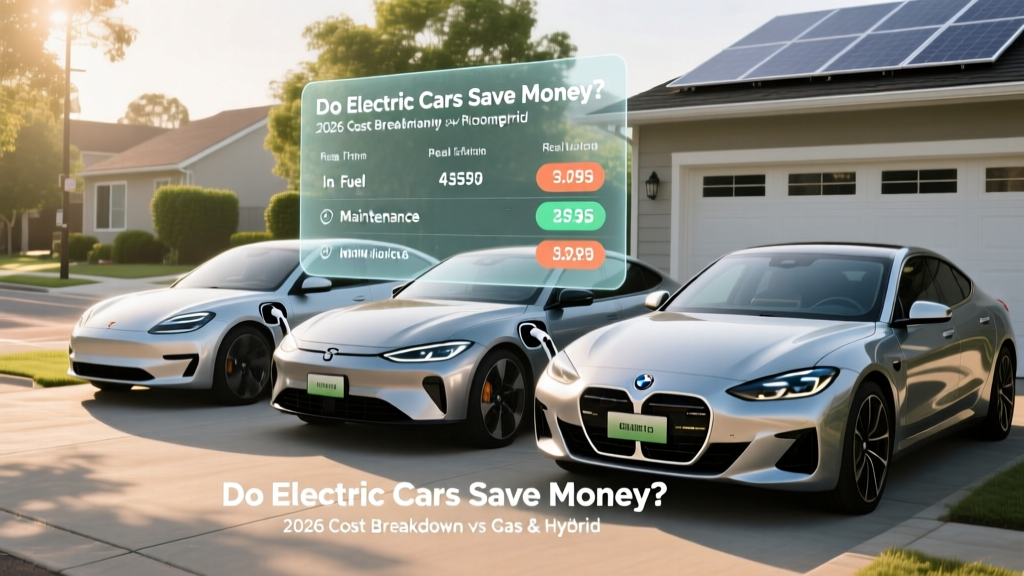
Electric cars save most buyers money over time, but not automatically. A 2026 EV with home Level 2 charging typically costs $600–$1,200 less per year to operate than a comparable gas car, primarily through lower fuel and maintenance costs. However, the savings hinge on three variables: whether you can charge at home, what your local electricity rate is, and whether you qualify for the federal §30D tax credit (up to $7,500 at point of sale). Buyers who rely exclusively on public DC fast charging, live in states with high electricity rates, or purchase EVs priced above the MSRP cap may find the math tighter — or even negative — compared to a fuel-efficient hybrid. Below, we run the real numbers.
Purchase Price: The Upfront Gap Is Narrowing
The average transaction price for a new EV in early 2026 hovers around $47,000, compared to roughly $42,000 for a new gas vehicle. That $5,000 gap sounds significant, but it compresses quickly with incentives.
The federal §30D clean vehicle credit provides up to $7,500 — and as of 2024, it can be transferred to the dealer at point of sale, reducing your out-of-pocket cost immediately. But eligibility is not universal. Here is the 2026 checklist:
- MSRP caps: $80,000 for SUVs, vans, and pickups; $55,000 for sedans and other body styles
- Buyer income caps: $300,000 joint / $225,000 head of household / $150,000 single (modified AGI)
- Battery sourcing: Critical minerals and battery components must meet escalating domestic-content thresholds — percentages increase each year through 2029 (source: IRS §30D rules)
- Assembly: Final assembly must occur in North America
- FEOC restriction: Vehicles with battery components from a "foreign entity of concern" are disqualified
Not every EV qualifies for the full credit. Some popular models qualify for $3,750 (partial critical-mineral compliance), while others qualify for $0 due to sourcing or MSRP issues. Always verify current eligibility on fueleconomy.gov before assuming the discount applies.
Charging vs. Fueling: Where the Real Savings Live
This is where EVs make or break the financial case. The cost-per-mile gap between electricity and gasoline is substantial — but varies enormously by how and where you charge.
| Energy Source | Cost Per Unit | Cost Per Mile* | Annual Cost (12,000 mi) |
|---|---|---|---|
| Home Level 2 (national avg. $0.16/kWh) | $0.16/kWh | $0.048 | $576 |
| Home Level 2 (California avg. $0.30/kWh) | $0.30/kWh | $0.090 | $1,080 |
| Home Level 2 (off-peak TOU rate $0.09/kWh) | $0.09/kWh | $0.027 | $324 |
| Public DC fast charging ($0.48/kWh avg.) | $0.48/kWh | $0.144 | $1,728 |
| Gasoline (28 MPG avg. at $3.40/gal) | $3.40/gal | $0.121 | $1,457 |
| Hybrid (52 MPG combined at $3.40/gal) | $3.40/gal | $0.065 | $785 |
*Based on 3.0 miles per kWh average EV efficiency. Actual varies by model, climate, and driving style.
The data is clear: home charging on a reasonable electricity rate is 2–5× cheaper per mile than gasoline. A driver in the Midwest paying $0.14/kWh and driving a Tesla Model 3 (26 kWh/100mi combined per EPA data) would spend roughly $504/year on electricity — versus $1,457 fueling a 28 MPG gas sedan. That is a $953 annual fuel savings.
But notice the DC fast charging row. If you cannot charge at home and rely on networks like Electrify America or EVgo at $0.40–$0.55/kWh, your "fuel" cost can actually exceed gasoline. This is the single biggest mistake first-time EV buyers make: purchasing an EV without a home-charging plan.
Maintenance Costs: Fewer Moving Parts, Fewer Bills
EVs eliminate oil changes, spark plugs, timing belts, exhaust systems, and multi-speed transmissions. Regenerative braking also extends brake pad life significantly — many EV owners report original brake pads at 80,000+ miles.
According to a Consumer Reports analysis, EV owners spend approximately $0.061 per mile on maintenance over the vehicle's life, compared to $0.101 per mile for gas vehicles. Over 100,000 miles, that is a $4,000 maintenance savings.
What you will still pay for:
- Tires: EVs are heavier and deliver instant torque, wearing tires 15–25% faster. Budget $200–$400 more per tire set.
- Cabin air filter: Replacement every 15,000–20,000 miles (~$30–$60)
- Wiper fluid, wiper blades, brake fluid: Same as any car
- Coolant flush: Battery thermal management systems require periodic service (typically every 5 years)
The battery itself is covered by federal mandate for at least 8 years/100,000 miles (10 years/150,000 miles in CARB states like California). Most modern LFP and NMC packs show 10–15% degradation at 150,000 miles — rarely requiring full replacement within typical ownership periods.
Insurance: The Cost Premium You Should Budget For
EV insurance premiums run 15–25% higher than equivalent gas vehicles on average, driven by higher repair costs (specialized body shops, battery safety protocols) and elevated vehicle values. For a 2026 Hyundai Ioniq 5 or Tesla Model Y, expect annual premiums of $1,800–$2,600 depending on your profile, compared to $1,400–$2,100 for a comparably priced gas crossover.
That adds $300–$600/year to your EV ownership cost — a real figure that partially offsets fuel and maintenance savings. Shop quotes before purchasing; some insurers now offer EV-specific discounts.
5-Year Total Cost of Ownership: EV vs. Gas vs. Hybrid
Here is a realistic 5-year / 60,000-mile TCO comparison for a mid-size crossover buyer. The EV assumes home Level 2 charging at $0.16/kWh, the gas car averages 28 MPG, and the hybrid achieves 52 MPG. Gas at $3.40/gallon.
| Cost Category | EV (e.g., 2026 Ioniq 5 SEL, ~$46,000 MSRP) | Gas Crossover (28 MPG, ~$38,000) | Hybrid (52 MPG, ~$36,000) |
|---|---|---|---|
| Purchase price (after incentives) | $38,500 (est. $7,500 §30D credit) | $38,000 | $36,000 |
| Fuel / electricity (5 yrs) | $2,880 | $7,286 | $3,923 |
| Maintenance (5 yrs) | $1,830 | $3,030 | $2,700 |
| Insurance (5 yrs) | $11,000 | $8,500 | $8,800 |
| Depreciation (est. 5 yrs) | $18,000 | $16,500 | $14,500 |
| Total 5-Year TCO | $72,210 | $73,316 | $65,923 |
Key takeaways from this comparison:
- EV vs. Gas: The EV wins by roughly $1,100 over 5 years — but only because the $7,500 tax credit bridges the purchase-price gap. Without the credit, the gas car is cheaper in this scenario.
- EV vs. Hybrid: The hybrid wins by $6,300 due to lower purchase price, lower insurance, and lower depreciation. Hybrids remain the strongest pure-economics play for buyers without home charging.
- Depreciation note: EV depreciation has been volatile. Some models (Tesla Model 3, Model Y) have seen steeper drops due to price cuts; others (Toyota bZ4X, Hyundai Ioniq 5) hold value better. Check current resale data for your specific model.
Real-World Ownership Factors That Change the Math
Spreadsheet projections assume uniform conditions. Real life does not. These variables materially shift whether an EV saves you money:
Home Charging Access
If you own a home with a garage or driveway, a Level 2 home charger installation costs $500–$2,500 (equipment plus electrician). If your electrical panel needs an upgrade from 100A to 200A, add $1,500–$3,500. This is a one-time cost that unlocks the cheapest "fuel" in transportation. Apartment dwellers and street-parkers who rely entirely on public charging face costs that can rival or exceed gasoline.
Climate and Cold-Weather Range Loss
EVs lose 20–35% of their EPA-rated range in sustained sub-freezing temperatures due to battery chemistry limitations and cabin heating demands. A 310-mile EPA rating becomes 200–250 miles in a Minnesota January. This does not cost you more money directly, but it means more charging sessions on road trips — and potentially more reliance on expensive public chargers.
Heat pumps (standard on many 2026 models including Hyundai/Kia/Genesis and Tesla) mitigate this loss to roughly 15–25%. If you live where winters regularly drop below 25°F, prioritize a model with a heat pump.
Driving Patterns
EVs are most efficient in city driving where regenerative braking recovers energy. Highway-heavy commuters (70+ mph sustained) see 15–20% lower efficiency than the EPA combined rating. If your daily commute is 200+ highway miles round-trip, you will charge more frequently and may need a larger-battery model.
State and Local Incentives
Beyond the federal §30D credit, many states offer additional rebates — California's CVRP, Colorado's $5,000 credit, and various utility-company rebates for home charger installation. These can add $1,000–$5,000 in savings but vary by jurisdiction. Check your state energy office and local utility for current programs.
Common EV Money Myths — Corrected
| Myth | Fact |
|---|---|
| "EV batteries need replacing every few years at $20,000." | Modern NMC and LFP packs are warrantied for 8 years/100,000 miles minimum. Real-world data shows 85–90% capacity retention at 150,000 miles. Full replacement is rare within typical ownership. |
| "Electricity is free, so EVs cost nothing to fuel." | Home charging is cheap ($0.03–$0.09/mi), not free. Public DC fast charging can cost $0.12–$0.18/mi — sometimes more than gas. |
| "Every EV qualifies for the $7,500 tax credit." | Eligibility depends on MSRP caps, buyer income, battery sourcing, and North American assembly. Many popular models qualify for partial credit or none at all. Verify at fueleconomy.gov. |
| "EVs save money no matter how you charge." | Exclusive public fast-charging at $0.48+/kWh can cost more per mile than a fuel-efficient hybrid. Home charging is where the savings materialize. |
| "EVs are maintenance-free." | Tires wear faster, cabin filters need replacement, and coolant systems require service. Maintenance is lower — not zero. |
Decision Framework: Will an EV Save YOU Money?
Choose an EV if:
- You have access to home charging (garage, driveway, or employer-provided)
- Your local electricity rate is below $0.25/kWh (or you can access off-peak TOU rates)
- You qualify for the full or partial §30D federal tax credit
- You drive 10,000–15,000+ miles annually (higher mileage amplifies fuel savings)
- Your daily commute is under 80 miles round-trip (covers most errands on a single charge)
Choose a hybrid (HEV/PHEV) if:
- You live in an apartment or park on the street with no reliable charging access
- You regularly drive 300+ miles in cold weather or remote areas with sparse charging infrastructure
- Your budget is under $35,000 and you cannot absorb the EV price premium even after incentives
- You want maximum fuel savings with zero lifestyle adjustment
Wait or reconsider if:
- You rely entirely on public DC fast charging and your local rates exceed $0.45/kWh
- You do not qualify for the §30D credit (income or vehicle MSRP exceeds caps) and the EV costs $10,000+ more than a comparable gas or hybrid option
- Your annual mileage is below 6,000 miles — fuel savings will not offset the purchase premium within a reasonable timeframe
Frequently Asked Questions
What is the cheapest way to charge an EV at home?
Install a Level 2 (240V) home charger rated at 32–48 amps and enroll in your utility's time-of-use (TOU) plan. Charging overnight during off-peak hours (typically 10 PM–6 AM) at $0.07–$0.12/kWh yields fuel costs of $0.02–$0.04 per mile — roughly one-quarter the cost of gasoline. A Level 2 charger adds 25–44 miles of range per hour of charging, easily covering daily needs overnight.
Do electric cars save money on insurance?
No — EV insurance premiums are typically 15–25% higher than equivalent gas vehicles. This is due to higher repair costs (specialized training, battery safety protocols, fewer qualified body shops) and higher vehicle values. Budget an extra $300–$600/year compared to a gas car in the same class. Some insurers offer EV-specific policies or discounts, so compare quotes.
How long until an EV pays for itself vs. a gas car?
With the $7,500 federal tax credit and home charging, many EVs break even with a comparably equipped gas car within 2–4 years through fuel and maintenance savings. Without the tax credit, the payback period extends to 5–8 years depending on mileage and electricity rates. Higher annual mileage shortens the payback period.
Is a plug-in hybrid (PHEV) a better financial choice than a full EV?
A PHEV like the Toyota RAV4 Prime (42 miles electric-only, 38 MPG combined after battery depletion) offers strong economics for buyers who want electric commuting without range anxiety. You save on fuel for short daily trips while retaining a gas engine for road trips. The trade-off: you maintain two powertrains (oil changes, spark plugs, plus battery), and PHEV batteries are smaller (typically 14–22 kWh) with shorter electric-only range. If 90% of your driving is under 40 miles and you can charge at home, a full EV saves more. If you frequently drive 200+ miles, a PHEV may be the better hedge.
What happens if I need to replace the EV battery out of warranty?
Out-of-warranty battery replacement costs range from $5,000 to $20,000+ depending on the model and pack size. However, this scenario is uncommon for modern EVs. Data from long-term fleet studies and manufacturer reports indicate most 2020+ battery packs retain 85–92% of original capacity at 150,000 miles. LFP chemistry packs (used in standard-range Tesla Model 3/Y, some BYD models) tend to degrade even slower, with projections of 90%+ retention at 200,000 miles. Before the warranty period, monitor your battery's State of Health (SoH) through the vehicle's app or OBD-II tools.