The Short Answer: Do Electric Cars Need Servicing?
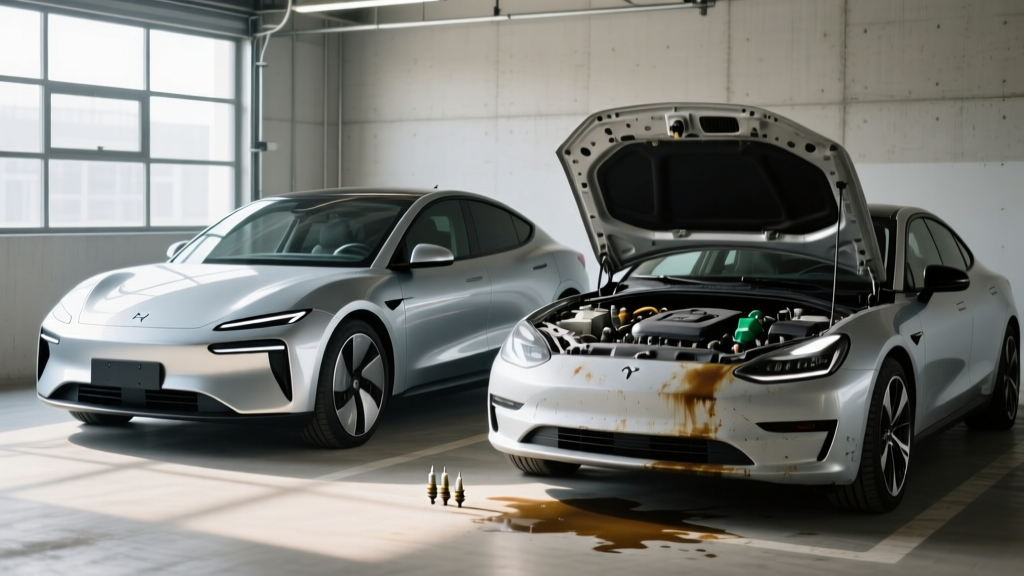
Yes — electric cars need servicing, but significantly less than gas-powered vehicles. Expect to spend $300–$500 per year on routine EV maintenance compared to $900–$1,400 per year for a comparable internal combustion engine (ICE) car. EVs eliminate oil changes, spark plugs, timing belts, catalytic converters, and exhaust system repairs. What remains: tire rotations, cabin air filter replacements, brake fluid checks, coolant top-offs, and wiper blades. The U.S. Department of Energy estimates EV maintenance costs average $0.061 per mile versus $0.101 per mile for gasoline vehicles — a roughly 40% savings over the life of the vehicle.
What Maintenance Does an Electric Car Actually Require?
EV powertrains are mechanically simple compared to gas engines. An electric motor has roughly 20 moving parts; a four-cylinder gasoline engine has over 2,000. That simplicity translates directly into fewer scheduled service visits. Here is what a typical 2025–2026 EV owner should budget for:
| Service Item | Interval | Estimated Cost | Notes |
|---|---|---|---|
| Tire rotation | Every 5,000–7,500 mi | $35–$60 | EVs wear tires ~20% faster due to weight and instant torque |
| Cabin air filter | Every 15,000–20,000 mi | $30–$70 | HEPA filters (Tesla, Rivian) cost more |
| Brake fluid inspection | Every 2 years / 30,000 mi | $40–$80 | Brake pads rarely need replacement before 100k+ mi due to regen |
| Battery coolant check | Every 4–5 years | $50–$120 | Some models require flush at 100,000 mi |
| Windshield wipers | Every 12 months | $20–$45 | Same as any vehicle |
| Washer fluid | As needed | $5–$10 | — |
| 12V battery replacement | Every 3–5 years | $150–$300 | Yes, EVs still have a 12V auxiliary battery for accessories |
| Reduction gear fluid | Every 60,000–100,000 mi (varies) | $80–$150 | Often labeled "lifetime" — check owner's manual |
A critical ownership note: tires are the single biggest recurring maintenance cost on an EV. Electric vehicles are heavy — a Tesla Model Y weighs approximately 4,400 lbs, and a Ford F-150 Lightning tips the scales at over 6,000 lbs. Combined with instant torque delivery, this means expect to replace tires every 25,000–40,000 miles rather than the 40,000–60,000 miles typical for gas cars. Budget $800–$1,400 for a set of four EV-rated tires (such as Michelin Pilot Sport EV or Hankook iON evo).
EV vs Gas Car Maintenance: The Real Cost Comparison
To put hard numbers on the servicing gap, here is a five-year cost projection assuming 15,000 miles driven annually (75,000 miles total). We compare a 2026 Hyundai Ioniq 6 SE (BEV) against a 2026 Toyota Camry LE (gas):
| Cost Category | 2026 Hyundai Ioniq 6 SE (EV) | 2026 Toyota Camry LE (Gas) |
|---|---|---|
| Oil changes | $0 | $450–$600 (every 7,500 mi × 10) |
| Tire rotations | $300–$500 | $250–$400 |
| Tire replacement | $1,600–$2,800 (2 sets) | $800–$1,200 (1 set) |
| Brake pads | $0–$200 (rarely needed) | $300–$600 (1–2 sets) |
| Cabin air filter | $120–$200 | $120–$200 |
| Engine air filter | $0 | $80–$120 |
| Spark plugs | $0 | $200–$400 |
| Coolant service | $50–$120 | $100–$200 |
| Transmission fluid | $0–$150 | $150–$250 |
| Wiper blades + washer fluid | $120–$200 | $120–$200 |
| 12V battery | $150–$300 | $150–$300 |
| 5-Year Total | $2,340–$4,470 | $2,720–$4,870 |
The raw maintenance totals look closer than you might expect — largely because EV tire costs are higher. However, the real savings emerge when you factor in fuel. According to fueleconomy.gov, the Ioniq 6 SE achieves 140 MPGe combined and costs roughly $550/year to charge (at $0.16/kWh national average), while the Camry LE at 32 MPG combined costs approximately $1,650/year in gasoline (at $3.30/gallon). Over five years, fuel savings alone total $5,500+, dwarfing the maintenance differential.
What About the Battery — Will I Need a $20,000 Replacement?
This is the number-one fear among prospective EV buyers, and it deserves a direct, data-backed answer. Modern EV batteries (2023–2026 model years) are engineered to last the life of the vehicle. Here is what the data shows:
- Federal warranty mandate: All EVs sold in the U.S. must carry a battery warranty of at least 8 years / 100,000 miles (10 years / 150,000 miles in CARB states like California, New York, and Massachusetts). This covers capacity loss below 70% of original.
- Real-world degradation data: Analysis of Tesla fleet data by Recurrent Auto shows that most EV batteries lose approximately 5–10% capacity in the first 50,000 miles, then degrade very slowly — typically retaining 85–92% capacity at 150,000 miles.
- LFP chemistry advantage: Vehicles using lithium iron phosphate (LFP) batteries — including the Tesla Model 3 RWD, Model Y RWD, and Ford Mustang Mach-E Select — show even slower degradation, with many owners reporting less than 5% loss over 100,000 miles.
- Out-of-warranty replacement cost: If a battery does need replacement after the warranty period, expect $5,000–$15,000 depending on the pack size and chemistry, with costs declining roughly 8–12% per year as manufacturing scales.
The bottom line: battery replacement is statistically rare on modern EVs. According to data compiled by IIHS and consumer surveys, fewer than 2% of EVs from 2018–2023 have required a full battery pack replacement outside of recall campaigns. For a 2026 buyer, the battery is the least likely component to need servicing.
Common EV Servicing Myths — Fact vs Fiction
| Myth | Fact |
|---|---|
| "EVs are maintenance-free" | False. Tires, wipers, cabin filters, brake fluid, coolant, and the 12V battery all need attention. Expect 1–2 service visits per year. |
| "The battery will need replacing every few years" | False. Modern NMC and LFP packs are warrantied for 8–10 years and routinely last 150,000–200,000+ miles with gradual (not cliff-like) degradation. |
| "EV brakes wear out faster because of the weight" | False. Regenerative braking handles 80–90% of deceleration, meaning brake pads often last 100,000–150,000 miles — 2–3× longer than gas cars. |
| "Dealers will try to sell me unnecessary EV services" | Partially true. Some dealers recommend cabin filter changes or "EV inspections" at inflated prices. Stick to your owner's manual schedule and get quotes from independent EV-aware shops. |
| "I need special EV-certified mechanics" | Misleading. Routine work (tires, wipers, filters) can be done at any shop. High-voltage system work requires EV-certified technicians, but those repairs are rare and covered under warranty. |
| "EVs don't need any fluid changes" | False. Most EVs use battery thermal management coolant, reduction gear lubricant, brake fluid, and windshield washer fluid. Coolant and brake fluid still need periodic service. |
Real-World Ownership Considerations That Affect Servicing
Your actual maintenance experience depends heavily on how and where you drive. A few practical realities to plan for:
Home Charging Access
If you have access to Level 2 home charging (a 240V outlet or hardwired station delivering 7–11 kW), your EV will spend most of its life charging in the optimal 20–80% state-of-charge window, which minimizes battery stress. Owners who rely exclusively on DC fast charging (50–350 kW public stations) may see slightly accelerated battery degradation — though modern thermal management systems have largely mitigated this. A Level 2 home charger installation costs $500–$2,000 depending on your electrical panel capacity, per data from the Department of Energy.
Cold Climate Impacts
EV owners in northern states (Minnesota, Michigan, Maine) should budget for two additional realities: winter tires ($600–$1,200 per set) and cabin heater energy consumption that can reduce range by 20–35% in sub-freezing temperatures. Vehicles equipped with a heat pump — standard on the Hyundai Ioniq 5/6, Tesla Model Y, and BMW i4 — recover some of this loss. Cold climates also accelerate 12V battery wear.
Driving Patterns
High-mileage drivers (20,000+ miles/year) will hit tire replacement intervals faster and may see brake fluid service come due sooner. Low-mileage drivers (under 8,000 miles/year) should still rotate tires every 12 months and check brake fluid every 2 years regardless of mileage — brake fluid absorbs moisture over time.
Your Decision Framework: Is an EV Right for Your Maintenance Budget?
Choose an EV if:
- You want to eliminate oil changes, spark plugs, timing belts, and emissions system repairs permanently
- You have access to home or workplace Level 2 charging (reduces reliance on public infrastructure)
- You drive 10,000–20,000 miles per year (maximizing fuel savings relative to upfront cost)
- You prefer predictable, lower annual maintenance spending (~$300–$500/year)
- You plan to keep the vehicle 5+ years (capturing full fuel/maintenance savings and riding out any early depreciation)
Choose a Hybrid (HEV/PHEV) if:
- You cannot install a home charger and lack reliable workplace charging
- You regularly drive 300+ miles in rural areas with sparse DC fast-charging coverage
- You want lower maintenance than a gas car but aren't ready to commit to full electric
- Your budget is under $30,000 and you need maximum range flexibility (PHEVs like the Toyota Prius Prime offer 44 mi electric + 600+ mi gas range)
Stick with Gas (for now) if:
- You live in an apartment without charging access and public charging infrastructure in your area is limited
- You tow heavy loads frequently (trailers over 5,000 lbs) — EV towing range drops 40–50%
- Your annual mileage is under 5,000 miles (fuel savings won't offset the EV price premium)
What First-Time EV Buyers Should Know About Servicing
If you are transitioning from a gas car to your first EV, here is a practical checklist to set expectations:
- Read your owner's manual maintenance schedule before your dealer visit. Dealers sometimes add "recommended" services not in the factory schedule. The Hyundai Ioniq 6 manual, for example, lists just five recurring items for the first 60,000 miles.
- Budget for EV-rated tires from day one. Do not replace worn EV tires with standard all-season tires — you will lose range, increase road noise, and may compromise wet-weather grip on a heavy vehicle.
- Understand your battery warranty terms. Know the capacity retention threshold (usually 70%), the mileage limit, and whether your state qualifies for extended CARB coverage.
- Use the manufacturer app to monitor battery State of Health (SoH). Tesla, Hyundai, Ford, and BMW all provide battery health metrics in their companion apps. Check quarterly.
- Find an independent EV-aware mechanic before you need one. While routine work is simple, you want a trusted shop that understands high-voltage safety protocols for any out-of-warranty work.
- Do not ignore the 12V battery. A dead 12V battery will brick your EV just as effectively as a dead gas car battery — you won't be able to start the vehicle, even if the main traction battery is full. Replace it proactively every 3–4 years.
Frequently Asked Questions
How often do electric cars need to be serviced?
Most EVs need 1–2 service visits per year for tire rotation, cabin filter replacement, and fluid inspections. Compare this to 3–4 visits for a gas car that needs oil changes every 5,000–7,500 miles. Always follow your specific model's owner's manual rather than dealer upsells.
Do electric cars need oil changes?
No. EVs have no internal combustion engine and therefore no engine oil. The electric motor and single-speed reduction gear use sealed lubricants that typically do not require changes for 60,000–100,000+ miles, if at all.
Why do EV tires wear out faster?
Two factors: weight and torque. EVs are 500–1,500 lbs heavier than comparable gas cars due to the battery pack, and electric motors deliver maximum torque from zero RPM. This combination accelerates tread wear, particularly on the driven axle. Expect 25,000–40,000 miles per set versus 40,000–60,000 miles for gas vehicles.
Is EV insurance more expensive?
Generally yes — EV insurance premiums run 10–25% higher than equivalent gas cars, primarily because collision repair costs are higher (specialized parts, high-voltage safety protocols, and fewer qualified body shops). Average full-coverage EV insurance is $2,000–$2,800/year depending on the model and your driving record. Shop quotes from Geico, Progressive, and EV-specialty insurers like Plug In America partners.
What happens if my EV battery fails after the warranty expires?
Out-of-warranty battery replacements cost $5,000–$15,000 depending on pack size and chemistry, though prices are declining annually. However, complete battery failure is rare — most EVs experience gradual capacity loss rather than sudden failure. Many owners at 150,000+ miles still report 85–90% of original range. Third-party battery repair shops (like Electrified Garage) can also replace individual modules for $1,500–$4,000 rather than the full pack.
Do I need to worry about the §30D federal tax credit for my EV purchase?
If you are buying new, the IRS §30D clean vehicle credit offers up to $7,500 — but eligibility depends on your income (AGI caps: $150K single / $300K joint), the vehicle's MSRP (under $55K for cars, $80K for SUVs/trucks), battery component sourcing requirements, and whether the automaker has hit any phase-out thresholds. As of 2026, point-of-sale transfer is available, meaning you can apply the credit as a down payment reduction at the dealer. Consult a tax professional for your specific situation.