The Quick Answer: Electric Cars and Catalytic Converters
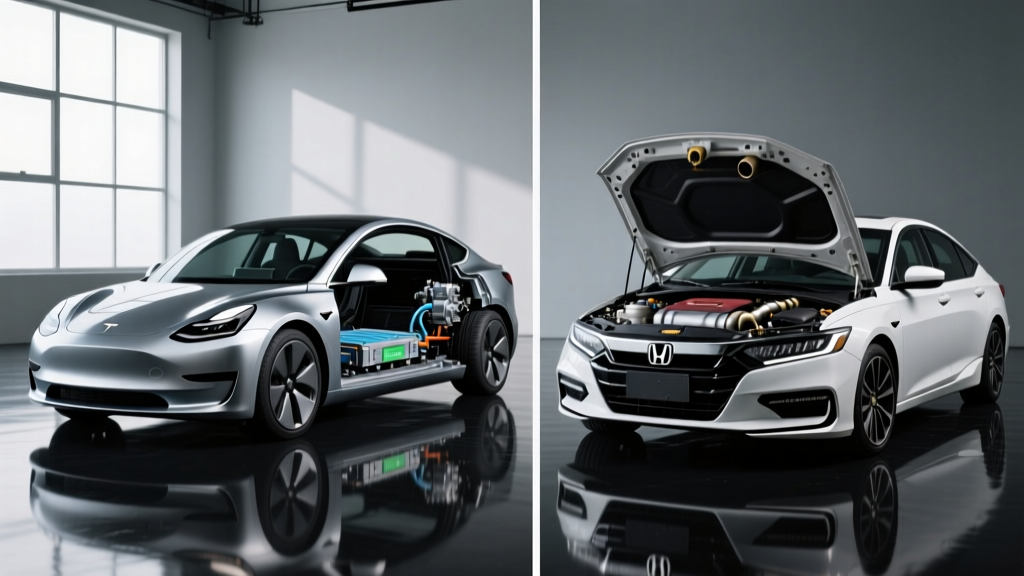
No, battery electric vehicles (BEVs) do not have catalytic converters. A catalytic converter is an emissions-control device that sits in a gasoline or diesel vehicle's exhaust system, converting harmful combustion byproducts — carbon monoxide (CO), nitrogen oxides (NOx), and unburned hydrocarbons — into less harmful gases before they exit the tailpipe.
Because a BEV has no internal combustion engine, it produces no tailpipe emissions whatsoever. No combustion means no exhaust system, no muffler, no oxygen sensors, and no catalytic converter. This is one of the most fundamental mechanical differences between a battery electric vehicle and a conventional gas car.
Important caveat: Hybrid vehicles (HEVs) and plug-in hybrids (PHEVs) do have catalytic converters, because they still carry a gasoline engine that burns fuel and produces exhaust.
Why Gas Cars Need Catalytic Converters (and EVs Don't)
To understand why EVs skip this component entirely, it helps to look at what a catalytic converter actually does. Inside a typical gasoline engine, fuel and air mix, compress, and ignite. That controlled explosion produces mechanical energy to move the car — but also generates several pollutants regulated by the EPA under the Clean Air Act:
- Carbon monoxide (CO) — a toxic, odorless gas
- Nitrogen oxides (NOx) — contributors to smog and acid rain
- Hydrocarbons (HC) — unburned fuel vapors
A catalytic converter uses precious metals — typically platinum, palladium, and rhodium — as catalysts to trigger chemical reactions that convert these pollutants into carbon dioxide (CO₂), nitrogen (N₂), and water vapor (H₂O). Since 1975, federal law has required catalytic converters on all gasoline-powered passenger vehicles sold in the United States.
A battery electric vehicle like the Tesla Model Y, Hyundai Ioniq 5, or Ford Mustang Mach-E generates motion using electric motors powered by a lithium-ion battery pack. The chemistry inside an electric motor involves electromagnetic force, not combustion. There is simply no exhaust gas to treat. According to fueleconomy.gov, BEVs produce zero direct tailpipe emissions.
EV vs Hybrid vs Gas: Emissions Equipment Compared
Not every electrified vehicle eliminates the catalytic converter. Here's how the powertrain types break down:
| Vehicle Type | Has Catalytic Converter? | Tailpipe Emissions? | Example 2026 Models |
|---|---|---|---|
| Battery Electric (BEV) | No | None | Tesla Model Y, Chevy Equinox EV, Hyundai Ioniq 5 |
| Plug-in Hybrid (PHEV) | Yes | Yes (when gas engine runs) | Toyota RAV4 Prime, Jeep Wrangler 4xe |
| Hybrid (HEV) | Yes | Yes | Toyota Prius, Honda CR-V Hybrid |
| Gasoline (ICE) | Yes | Yes | Toyota Camry (gas), Honda Civic (gas) |
Extended-range electric vehicles (EREVs) like the BMW i3 REx (discontinued) or the upcoming Ramcharger also carry a gasoline generator and therefore include a catalytic converter, even though the gas engine never directly drives the wheels.
The bottom line: if the vehicle burns any gasoline or diesel under any operating condition, it has a catalytic converter. Only pure BEVs eliminate it entirely.
The Catalytic Converter Theft Problem — and Why EV Owners Avoid It
Catalytic converter theft has been a persistent and expensive problem for gas-car owners. Thieves target them because the precious metals inside — platinum, palladium, and rhodium — can be sold to scrap recyclers for $50 to $300+ per unit, sometimes more depending on metal market prices.
According to the National Insurance Crime Bureau (NICB), catalytic converter thefts surged dramatically between 2019 and 2022, with hundreds of thousands of reported claims. Replacement costs for a stolen catalytic converter typically run $1,000 to $3,000+ including parts and labor, depending on the vehicle.
BEV owners are completely insulated from this problem. There is nothing to steal because the component doesn't exist on the vehicle. This is a small but real ownership-cost advantage that rarely appears in spec sheets but matters if you live in an area where catalytic converter theft is common.
What Emissions Equipment Do Electric Cars Actually Have?
While BEVs lack an exhaust system, they aren't entirely without emissions-related engineering. Here's what an electric car does have:
- Battery thermal management system — liquid cooling/heating loops that keep the battery pack within optimal temperature range (typically 20–40°C) for performance and longevity
- Cabin air filtration — many EVs include HEPA-grade filters (Tesla's "Bioweapon Defense Mode," Hyundai's EcoAir) that clean incoming air, though this is for occupant health, not emissions compliance
- Refrigerant systems — the heat pump and A/C compressor use refrigerants (often R-1234yf or R-134a) that are regulated for greenhouse gas potential; proper servicing matters for environmental compliance
- Brake dust and tire particulates — EVs still produce non-exhaust particulate matter from brake wear (though regenerative braking significantly reduces this) and tire abrasion
It's also worth noting that while a BEV produces zero tailpipe emissions, the electricity used to charge it may come from power plants that burn fossil fuels. The upstream emissions profile depends entirely on your local grid mix. In regions with heavy renewable or nuclear generation (e.g., the Pacific Northwest, upstate New York), the lifecycle emissions advantage of a BEV over a gas car is enormous. In coal-heavy grids, the advantage still exists but narrows. The Union of Concerned Scientists maintains a detailed lifecycle emissions analysis showing that in every U.S. region, a BEV produces lower total greenhouse gas emissions than a comparable gasoline car.
Real Cost Comparison: EV vs Gas Maintenance and Ownership
Eliminating the catalytic converter is just one piece of a broader maintenance-cost advantage for BEVs. Without an internal combustion engine, EVs skip oil changes, spark plugs, timing belts, fuel injectors, oxygen sensors, exhaust manifolds, mufflers, and — yes — catalytic converters.
| Maintenance Item | Gas Car (5-Year Cost) | BEV (5-Year Cost) | Notes |
|---|---|---|---|
| Oil changes | $350–$600 | $0 | EVs have no engine oil |
| Catalytic converter replacement | $0–$3,000 | $0 | Rare under warranty, but theft or failure = big bill |
| Exhaust system repairs | $200–$800 | $0 | No muffler, pipes, or O₂ sensors on BEVs |
| Spark plugs / ignition | $150–$400 | $0 | Not applicable to electric motors |
| Brake pads | $400–$800 | $100–$300 | Regen braking extends pad life 2–3× |
| Coolant / transmission fluid | $150–$300 | $100–$200 | EVs still have thermal management fluid |
| Estimated 5-yr maintenance total | $1,250–$2,900 | $200–$500 | Source: AAA, Consumer Reports estimates |
The U.S. Department of Energy has noted that BEV maintenance costs are roughly half those of comparable gasoline vehicles over the life of the car. Consumer Reports estimated lifetime maintenance savings of approximately $4,600 to $9,200 for an EV compared to a gas car.
Charging Cost vs. Fuel Cost
For a 2026 Hyundai Ioniq 5 (84 kWh usable battery, 310 miles EPA range), a full charge at the national average residential electricity rate of ~$0.17/kWh costs about $14.28 — or roughly $0.046 per mile.
For a comparable gas crossover getting 28 MPG combined at $3.30/gallon, fuel cost is approximately $0.118 per mile. Over 15,000 miles per year, that's a fuel savings of roughly $1,080 annually for the EV — or $5,400 over five years.
DC fast charging at public stations costs more, typically $0.30–$0.50/kWh depending on the network and time of day. Road-trippers who rely heavily on DC fast charging will see their per-mile cost rise to roughly $0.09–$0.15/mile, which narrows (but generally doesn't eliminate) the cost gap with gasoline.
Common Misconceptions About EVs and Emissions
| Myth | Fact |
|---|---|
| "EVs still have tailpipes, so they must have catalytic converters." | BEVs have no tailpipe at all. Some models have a small vent for cabin pressure equalization, but it is not an exhaust. |
| "EVs are worse for the environment because of battery mining." | Battery production does carry an environmental cost, but lifecycle analyses consistently show BEVs produce fewer total emissions than gas cars over their operational life — typically breaking even within 6,000–20,000 miles of driving, depending on the grid. See UCS analysis. |
| "Hybrids are just as clean as EVs." | HEVs and PHEVs still burn gasoline and require catalytic converters. PHEVs can run emission-free on short trips in EV mode, but the gas engine engages for longer drives, producing tailpipe emissions. |
| "EVs don't need any emissions testing." | True in practice. Most U.S. states exempt BEVs from smog/emissions inspections because there's nothing to test. PHEVs and HEVs may still require periodic emissions checks depending on state law. |
| "EV motors produce zero pollution of any kind." | BEVs produce zero tailpipe emissions, but tire wear and brake dust still generate particulate matter. Regenerative braking significantly reduces (but doesn't eliminate) brake dust. |
First-Time EV Buyer Considerations Beyond the Powertrain
Knowing that a BEV eliminates the catalytic converter and exhaust system is useful context, but first-time EV buyers need to weigh several practical factors that affect daily ownership:
Home Charging Access
The single biggest ownership advantage comes from Level 2 home charging. A 240V Level 2 charger (typically 7.7–11.5 kW) can add 25–44 miles of range per hour, meaning most drivers wake up to a full battery every morning. Installation costs range from $500–$2,500 depending on panel capacity and wiring distance. If your electrical panel is at capacity, a panel upgrade to 200A can add $1,500–$3,500.
Cold-Weather Range Loss
Lithium-ion batteries lose efficiency in cold temperatures. Expect 15–30% range reduction in freezing conditions (below 32°F), with the worst losses occurring in short-trip, stop-and-go driving where the cabin heater runs constantly. A 310-mile EPA-rated EV might deliver 220–260 miles in a Midwestern winter. Heat pump equipped models (standard on many 2026 EVs from Hyundai, Tesla, BMW) reduce this penalty by roughly 5–10%.
Federal Tax Credit Eligibility
The IRS §30D Clean Vehicle Credit offers up to $7,500 for qualifying new BEVs, but eligibility depends on multiple factors: buyer income caps ($150K single / $300K joint), vehicle MSRP caps ($55K for cars / $80K for SUVs and trucks), and battery critical-mineral and component sourcing requirements that have tightened significantly. As of 2026, point-of-sale transfer is available, meaning the credit can be applied as a down-payment reduction at the dealer rather than waiting for a tax refund. Always verify current eligibility on irs.gov and consult a tax professional before relying on the credit in your purchase budget.
Insurance Costs
EV insurance premiums are typically 10–25% higher than equivalent gas cars, driven by higher repair costs (specialized body shops, battery-pack replacement risk) and higher vehicle purchase prices. Shop quotes from multiple carriers — some insurers now offer EV-specific policies with battery coverage riders.
Decision Framework: Should You Go Full BEV, PHEV, or Stick with Gas?
Choose a BEV (no catalytic converter, zero tailpipe emissions) if:
- You have reliable home Level 2 charging access (garage or driveway with 240V)
- Your daily driving is under 250 miles round-trip
- You want the lowest ongoing maintenance and fuel costs
- You live in an area with moderate winters, or you accept cold-weather range trade-offs
- You want to eliminate catalytic converter theft risk entirely
Choose a PHEV (has catalytic converter, but can drive emission-free on short trips) if:
- You lack reliable home charging but still want some electric-only driving
- You frequently take road trips exceeding 300+ miles into areas with sparse DC fast-charging infrastructure
- You want an electric commute (typically 25–45 miles EV range) with a gas backup for longer drives
- You're not ready to fully commit to a charging routine
Stick with a gas car or HEV if:
- You have no access to any form of EV charging (no home, no workplace, limited public infrastructure)
- You regularly tow heavy loads over long distances (towing drastically reduces EV range by 30–50%)
- Your budget is tightly constrained and you need the lowest possible purchase price today
Frequently Asked Questions
Can an EV ever need a catalytic converter replacement?
No. A pure battery electric vehicle does not have a catalytic converter at any point in its lifespan. The component simply doesn't exist on the vehicle. You'll never face a catalytic converter repair bill or theft risk with a BEV.
Do Tesla vehicles have catalytic converters?
No. All Tesla models (Model 3, Model Y, Model S, Model X) are battery electric vehicles with no internal combustion engine and no exhaust system. They do not have catalytic converters.
Do plug-in hybrids like the RAV4 Prime have catalytic converters?
Yes. The Toyota RAV4 Prime and all other PHEVs include a gasoline engine that produces exhaust emissions. They are equipped with catalytic converters just like conventional gas cars.
Will I need an emissions test with an electric car?
In most U.S. states, BEVs are exempt from periodic smog and emissions inspections because they produce no tailpipe emissions. Check your state DMV requirements, but in practice, EV owners skip this step entirely.
Are EVs truly zero-emission vehicles?
BEVs are zero tailpipe emission vehicles. However, upstream emissions from electricity generation vary by region. Tire and brake particulate matter are also non-zero. On a lifecycle basis, BEVs still produce substantially fewer greenhouse gas emissions than gas cars in every U.S. region, per Department of Energy and UCS analyses.
What about hydrogen fuel cell vehicles — do they have catalytic converters?
Hydrogen fuel cell electric vehicles (FCEVs) like the Toyota Mirai do not have traditional catalytic converters. Fuel cells produce electricity through a chemical reaction between hydrogen and oxygen, emitting only water vapor. However, some FCEVs include small catalytic elements to manage trace byproducts — the system is fundamentally different from an ICE catalytic converter.