Tesla's 2026 Lineup: Which Model Fits Your Life?
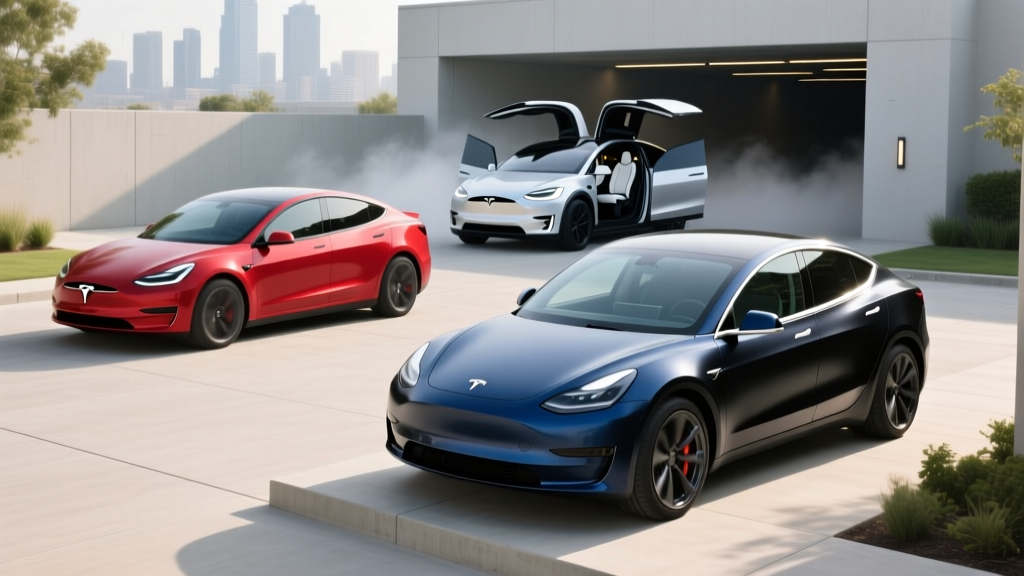
Tesla's current U.S. lineup spans four vehicles with wildly different price points, capabilities, and use cases. The Model 3 sedan starts under $40,000 and targets efficiency-minded commuters. The Model Y crossover dominates sales charts with cargo flexibility. The Model S and Model X occupy the premium tier with performance figures that embarrass supercars. But spec sheets only tell part of the story.
This comparison breaks down the real differences between Tesla models using EPA data, real-world range testing, charging curves, ownership costs, and 2026 federal tax credit eligibility. Every figure below reflects the current 2026 model year.
Side-by-Side Spec Table: All Four Tesla Models
Before diving into category verdicts, here are the hard numbers. All figures reflect the most popular or best-value trim for each model. Battery chemistry noted where confirmed by Tesla.
| Spec | Model 3 Long Range AWD | Model Y Long Range AWD | Model S Long Range | Model X Long Range |
|---|---|---|---|---|
| EPA Range | 363 mi | 320 mi | 402 mi | 335 mi |
| Battery (usable, est.) | ~75 kWh (NMC) | ~75 kWh (NMC) | ~95 kWh (NMC) | ~95 kWh (NMC) |
| Peak DC Fast Charge | 250 kW | 250 kW | 250 kW | 250 kW |
| 10–80% DC Charge Time | ~27 min | ~27 min | ~30 min | ~31 min |
| Level 2 Charge Rate | 11.5 kW (44 mi/hr) | 11.5 kW (44 mi/hr) | 11.5 kW (44 mi/hr) | 11.5 kW (44 mi/hr) |
| 0–60 mph | 4.2 sec | 4.8 sec | 3.1 sec | 3.8 sec |
| Horsepower | 346 hp | 384 hp | 670 hp | 670 hp |
| EPA Efficiency (MPGe) | 134 MPGe | 122 MPGe | 120 MPGe | 109 MPGe |
| Cargo Volume | 23 cu ft (trunk+frunk) | 76 cu ft (rear folded) | 28 cu ft (trunk+frunk) | 88 cu ft (rear folded) |
| Towing Capacity | Not rated | 3,500 lbs | Not rated | 5,000 lbs |
| Base MSRP | $42,380 | $46,380 | $79,990 | $84,990 |
| Battery/Drive Unit Warranty | 8 yr / 120,000 mi | 8 yr / 120,000 mi | 8 yr / 150,000 mi | 8 yr / 150,000 mi |
Sources: EPA / fueleconomy.gov, Tesla Model S specs, Tesla Model 3 specs.
Range & Efficiency: Which Tesla Goes Farthest?
The Model S Long Range claims the EPA range crown at 402 miles — the highest of any current Tesla and among the highest of any production EV sold in the U.S. That figure comes from a larger ~95 kWh battery pack and a remarkably low drag coefficient of 0.208 Cd.
But raw range isn't the whole efficiency story. The Model 3 Long Range achieves 134 MPGe combined, making it the most energy-efficient Tesla by a wide margin. It uses roughly 25 kWh per 100 miles, compared to the Model X's ~31 kWh per 100 miles. Over a year of 12,000 miles, that difference translates to roughly $90–$130 in electricity savings (depending on your local kWh rate).
The Model Y sits in the middle — its taller, boxier crossover shape creates more aerodynamic drag than the Model 3's sedan profile, costing it about 12 MPGe on the combined cycle. The Model X, with its heavy falcon-wing door mechanisms and large frontal area, trails all four in efficiency.
Charging Speed & Network Access
All four current Tesla models peak at 250 kW on DC fast charging via the North American Charging Standard (NACS) connector. Tesla pioneered this connector, and it's now being adopted industry-wide — meaning Tesla owners have native access to the Supercharger network without adapters.
At 250 kW peak, the Model 3 and Model Y add roughly 200 miles of range in 15 minutes under ideal conditions (battery preconditioned, ambient temperature 60–80°F, V3 or V4 Supercharger stall available). However, peak rate is not sustained rate. The charge curve tapers significantly above 50% state of charge (SoC), and by 80% SoC, you're pulling closer to 60–80 kW. This is why Tesla's 10–80% times (~27–31 minutes) are the more honest metric.
The Model S and Model X take slightly longer to charge from 10–80% despite similar peak rates because their larger ~95 kWh packs need more total energy to fill. On a road trip, you'll spend 3–4 extra minutes at each stop compared to a Model 3.
| Charging Level | Power | Miles of Range Added per Hour | Typical Use |
|---|---|---|---|
| Level 1 (120V) | ~1.4 kW | ~4–5 mi/hr | Emergency / overnight trickle |
| Level 2 (240V, 48A) | 11.5 kW | ~44 mi/hr | Home daily charging |
| DC Fast (V3 Supercharger) | Up to 250 kW | ~1,000+ mi/hr (peak) | Road trips, 10–80% in ~27–31 min |
Network advantage: Tesla's Supercharger network remains the most reliable public charging infrastructure in the U.S., with over 20,000 stalls nationally and uptime consistently above 95%. Non-Tesla EVs gained limited Supercharger access starting in 2024, but Tesla owners still get priority pricing and seamless plug-and-charge integration — no app fumbling or payment failures at the stall.
Performance & Driving Dynamics
If straight-line acceleration is your metric, the Model S is untouchable in this lineup. Its 670 hp dual-motor setup delivers a 3.1-second 0–60 mph time in Long Range trim — and the Plaid variant (1,020 hp, 1.99 sec 0–60) exists in a different performance universe entirely.
But performance isn't just drag-strip numbers. The Model 3 Highland refresh (introduced for the 2024 model year and carried into 2026) brought meaningful improvements: a quieter cabin, retuned suspension with better compliance over rough pavement, ventilated front seats, and ambient lighting. It's the most refined driving experience Tesla currently offers on a per-dollar basis.
The Model Y received a similar Juniper refresh for the 2025 model year with comparable NVH and suspension improvements. It rides slightly higher than the Model 3, which aids ingress/egress and visibility, but its taller center of gravity means more body roll in corners.
The Model X drives surprisingly well for its size, but its 5,000+ lb curb weight is noticeable in transitions. The Model S remains the best grand tourer in the lineup — planted at highway speeds, quiet, and comfortable over long distances.
Price, Tax Credits & Total Cost of Ownership
This is where the differences between Tesla models become most consequential for buyers. The gap between the Model 3 and Model S isn't just $37,000 in MSRP — it's also a difference in federal tax credit eligibility that widens the effective price gap further.
| Cost Factor | Model 3 LR AWD | Model Y LR AWD | Model S LR | Model X LR |
|---|---|---|---|---|
| Base MSRP | $42,380 | $46,380 | $79,990 | $84,990 |
| Federal §30D Credit Eligibility | Up to $7,500* | Up to $7,500* | $0 (over MSRP cap) | $0 (over MSRP cap) |
| Effective Price After Max Credit | ~$34,880 | ~$38,880 | $79,990 | $84,990 |
| MSRP Cap for §30D (SUVs/vans) | $55,000 (sedan) | $80,000 (SUV) | $55,000 (sedan) — fails | $80,000 (SUV) — fails |
| Est. Annual Electricity Cost (12k mi) | ~$540 | ~$600 | ~$610 | ~$680 |
| Est. Annual Insurance | ~$1,800–$2,200 | ~$1,900–$2,400 | ~$2,800–$3,500 | ~$3,000–$3,800 |
| 5-Year Est. Total Cost of Ownership | ~$52,000–$56,000 | ~$57,000–$62,000 | ~$100,000–$108,000 | ~$108,000–$116,000 |
*§30D credit requires meeting buyer income caps ($150K single / $300K joint), battery critical-mineral and component sourcing thresholds, and point-of-sale transfer. MSRP caps: $55,000 for sedans, $80,000 for SUVs/vans/pickups. The Model S at $79,990 exceeds the sedan cap; the Model X at $84,990 exceeds the SUV cap. Verify current eligibility at IRS.gov §30D. Rules subject to change.
Insurance reality: Teslas carry higher insurance premiums than comparable non-electric vehicles due to costly battery replacement, aluminum body repair complexity, and limited third-party body shop availability. The Model S and X are significantly more expensive to insure — often 50–70% more than the Model 3. Always pull a quote before committing.
Maintenance: All four models share Tesla's minimal maintenance philosophy — no oil changes, no spark plugs, cabin air filter replacement every 2–3 years, tire rotation every 6,250 miles, and brake fluid checks. Expect $300–$500/year in scheduled maintenance across the lineup. The Model X's falcon-wing door mechanisms add a unique potential repair cost that owners of older X models have flagged.
Tech, Autopilot & Interior
All four models share Tesla's core software platform: a 15.4-inch center touchscreen (Model 3/Y) or 17-inch center screen plus a rear passenger screen (Model S/X), over-the-air updates, and the same Autopilot hardware suite (HW4/AI5 cameras and processing).
FSD (Supervised) costs $8,000 as a one-time purchase or $99/month as of 2026. It adds automatic lane changes, traffic light and stop sign recognition, and city street navigation. Its real-world performance varies enormously by geography — well-mapped urban areas with clear lane markings see better results than rural or construction-heavy roads.
Interior quality diverges sharply between the tiers. The Model 3 and Model Y use Tesla's minimalist approach: no instrument cluster, no physical stalks (turn signals are steering-wheel buttons on post-refresh models), and a single screen for everything. The refreshed Model 3 Highland and Model Y Juniper added ventilated seats, ambient lighting, power-folding rear seats (Model Y), and improved sound insulation. The Model S and X add a yoke or round steering wheel option, a secondary rear touchscreen, premium audio with more speakers, and genuine wood or aluminum trim.
Cargo, Practicality & Daily Use
The Model Y is Tesla's best-selling vehicle for a reason: it offers 76 cubic feet of cargo volume with the rear seats folded, a power liftgate, and available third-row seats (though the third row is best suited for small children). It's rated to tow 3,500 lbs — enough for a small utility trailer or a pair of dirt bikes.
The Model 3 is a traditional sedan with a trunk (23 cu ft including the frunk). It can't tow, and its trunk opening is narrower than a hatchback. For two people or a small family that doesn't need bulk cargo space, it's perfectly adequate. For anyone regularly hauling furniture, camping gear, or dogs, the Model Y's hatchback design is a significant upgrade.
The Model X offers the most cargo space (88 cu ft folded) and a 5,000-lb tow rating — genuinely useful for boat or horse-trailer duty. Its falcon-wing rear doors open upward, which is helpful in tight parking spaces for loading children into car seats, but the mechanism adds weight and complexity.
The Model S has a conventional sedan trunk (28 cu ft with frunk) and no tow rating. It's the least practical of the four for cargo-heavy lifestyles.
Decision Framework: Which Tesla Should You Buy?
Choose the Model 3 Long Range if:
- You commute solo or with one passenger and don't need bulk cargo space
- You want the lowest purchase price after the $7,500 federal credit
- Efficiency (MPGe) and lowest cost-per-mile matter to you
- You prefer a sedan's driving dynamics and lower ride height
Choose the Model Y Long Range if:
- You need hatchback cargo flexibility, available third-row seating, or towing (3,500 lbs)
- You're a family of 3–5 and need easy car-seat access
- You still want §30D tax credit eligibility (SUV MSRP cap: $80K)
- You want higher seating position and better outward visibility
Choose the Model S Long Range if:
- You want 400+ miles of EPA range and 3.1-second 0–60 performance
- Premium interior materials, rear passenger screen, and grand-touring comfort are priorities
- Tax credit ineligibility doesn't change your budget calculus at this price point
- You want the most refined, quiet Tesla driving experience
Choose the Model X Long Range if:
- You need three usable rows, maximum cargo volume (88 cu ft), and 5,000-lb towing
- Falcon-wing doors genuinely help your car-seat-loading routine
- You want Model S performance in a family hauler
- Budget is flexible above $85,000 and insurance premiums don't deter you
Frequently Asked Questions
Do all Tesla models qualify for the $7,500 federal tax credit?
No. Under current IRS §30D rules, sedans must have an MSRP at or below $55,000 and SUVs/vans/pickups at or below $80,000. The Model 3 and Model Y fall under their respective caps and can qualify (subject to income limits, battery sourcing rules, and point-of-sale transfer). The Model S ($79,990 sedan) exceeds the $55,000 sedan cap, and the Model X ($84,990 SUV) exceeds the $80,000 SUV cap — neither qualifies. Always verify at IRS.gov before purchasing.
Which Tesla has the best real-world highway range?
The Model S Long Range delivers the best real-world highway range at approximately 340–360 miles at 75 mph in moderate temperatures. The Model 3 Long Range follows at ~300–320 miles. In cold weather (below 32°F), subtract 15–30% from these figures across all models.
Is the Tesla Supercharger network really better than other charging networks?
By reliability metrics, yes. Tesla's Supercharger network consistently reports 95%+ uptime, and the plug-and-charge experience eliminates app and payment friction. Networks like Electrify America and EVgo have improved but still experience higher stall-outage rates and connector compatibility issues. Tesla's native NACS connector is now becoming the industry standard, which will eventually benefit all EVs.
How long do Tesla batteries last?
Tesla warranties its battery packs for 8 years / 120,000 miles (Model 3/Y) or 8 years / 150,000 miles (Model S/X), guaranteeing at least 70% capacity retention. Real-world data from high-mileage Tesla owners suggests most NMC packs retain 85–90% capacity at 100,000 miles when charged primarily to 80–90% on Level 2 and DC fast-charged only for road trips. Full replacement costs range from $12,000–$20,000 depending on model, though most owners never need one.
Can I charge a Tesla at home on a standard 120V outlet?
Yes, but slowly. Level 1 charging on a standard 120V/15A outlet delivers roughly 1.4 kW — about 4–5 miles of range per hour. For a daily commute of 30–40 miles, this can work if you plug in every night. For faster home charging, a 240V Level 2 installation (Tesla Wall Connector or equivalent at 48A/11.5 kW) adds ~44 miles per hour and is strongly recommended. Installation typically costs $500–$2,000 depending on your electrical panel and run distance — consult a licensed electrician for a site-specific quote.
What's the biggest difference between Tesla Autopilot and FSD?
Autopilot (included on all models) provides adaptive cruise control and lane-keeping on highways. Full Self-Driving (Supervised), available for $8,000 or $99/month, adds automatic lane changes, navigate-on-autopilot for highway interchanges, traffic light and stop sign recognition, and city street steering. Both are SAE Level 2 systems requiring full driver attention. Neither is autonomous. FSD performance varies significantly by road type, weather, and geographic area.