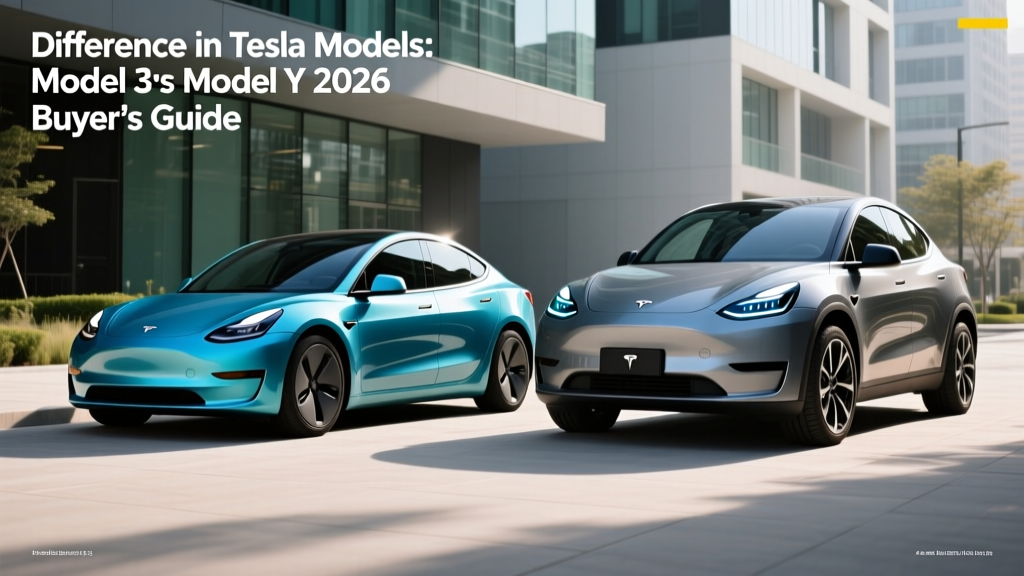
If you're narrowing your EV shortlist to Tesla, you're almost certainly staring at the same crossroads thousands of buyers face every month: the Model 3 sedan or the Model Y crossover. On paper, they share DNA — similar battery architectures, the same Supercharger network access, and overlapping software features. In practice, the difference in Tesla models 3 and Y comes down to real-world range, interior volume, charging behavior, and how federal tax credits apply to each trim in 2026.
This head-to-head uses current 2026 model-year specs, EPA data, and real-world ownership variables to map every meaningful gap between the two. We'll declare a winner in each category, but the final verdict depends entirely on how you drive, where you charge, and what you haul.
Side-by-Side Specs: 2026 Tesla Model 3 vs Model Y
Before the narrative analysis, here are the hard numbers. All figures reflect the Long Range AWD trims, the volume sellers for both nameplates, plus the Performance variants where noted. Battery chemistry for both Long Range models is NMC (nickel manganese cobalt), chosen for its higher energy density; the base RWD trims use LFP (lithium iron phosphate) chemistry, which we address later.
| Specification | Model 3 Long Range AWD | Model Y Long Range AWD |
|---|---|---|
| EPA Range | 363 miles | 320 miles |
| Battery (usable) | 79 kWh (NMC) | 78.1 kWh (NMC) |
| Peak DC Fast Charge | 250 kW | 250 kW |
| 10–80% DC Fast Charge | ~27 min | ~27 min |
| Level 2 Charge Rate | 11.5 kW (44 mi/hr) | 11.5 kW (44 mi/hr) |
| 0–60 mph | 4.2 seconds | 4.8 seconds |
| Horsepower | 384 hp | 384 hp |
| Efficiency (MPGe combined) | 132 MPGe | 122 MPGe |
| Cargo Volume (rear seats up) | 23 cu ft (trunk + frunk) | 72 cu ft (rear + frunk) |
| Base MSRP (Long Range AWD) | $47,740 | $50,240 |
| Battery/Drive Unit Warranty | 8 yr / 120,000 mi | 8 yr / 120,000 mi |
Sources: EPA fueleconomy.gov, Tesla Model S specs (cross-referenced with Model 3/Y configurator).
Range and Efficiency: Where the Sedan Pulls Ahead
The Model 3 Long Range holds a 43-mile EPA advantage over the Model Y Long Range — 363 vs. 320 miles. That gap is not an accident of marketing; it's physics. The Model 3 is roughly 300 pounds lighter and has a lower, sleeker drag coefficient (Cd ~0.23 vs the Model Y's ~0.24), which compounds at highway speeds where aerodynamic drag dominates energy consumption.
EPA range assumes a mix of city and highway driving at moderate temperatures. Expect the Model 3 Long Range to deliver roughly 290–310 miles on a sustained 75 mph highway trip in fair weather, and the Model Y Long Range about 255–275 miles under the same conditions. In freezing temperatures (below 32°F), both vehicles will lose 20–30% of range due to battery resistance and cabin heating demands, even with Tesla's standard heat pump. Plan road-trip charging stops accordingly.
Efficiency tells the same story. The Model 3's 132 MPGe combined translates to roughly 25 kWh per 100 miles, while the Model Y sips about 27–28 kWh per 100 miles. Over 15,000 annual miles and at a national average electricity rate of $0.16/kWh, the Model 3 saves approximately $45–$60 per year in energy costs — modest, but it compounds over ownership.
43 more EPA miles, lighter weight, and better MPGe. For road-trippers and high-mileage commuters, this is the clearer pick.
Charging Speed and Network Access
On DC fast charging, the two models are essentially identical in hardware. Both peak at 250 kW on V3 Superchargers and both complete a 10–80% session in approximately 27 minutes. However, the Model 3's slightly smaller usable battery (79 kWh vs 78.1 kWh — a negligible difference) and lighter curb weight mean it sustains peak charge rates marginally longer in warm conditions, shaving roughly 1–2 minutes off a highway stop.
Where the real charging difference emerges is the charge curve taper. Both vehicles follow Tesla's typical NMC curve: peak rate holds from roughly 10–45% state of charge, then steps down to ~150 kW through 65%, and drops further to ~75 kW from 65–80%. If you're the type of driver who charges to 90%+ at Superchargers, expect the 80–100% top-off to add another 20–25 minutes on either vehicle. The practical takeaway: plan stops around the 10–80% window for optimal time efficiency.
Both models use the native NACS (North American Charging Standard) connector, granting seamless access to Tesla's Supercharger network — currently the most reliable DC fast-charging network in the U.S. by uptime metrics. Neither vehicle requires an adapter for Tesla stations, and both can use CCS-equipped public chargers (Electrify America, EVgo) with the Tesla CCS adapter, though at reduced speeds due to handshake protocols.
Level 2 home charging is also identical: both accept 11.5 kW on a 48-amp circuit, adding roughly 44 miles of range per hour. A full overnight charge from 20% to 80% takes about 5 hours on either model, easily covering daily driving needs.
Identical peak rates, identical charge curves, identical network access. No meaningful difference for charging behavior.
Performance and Driving Dynamics
The Model 3 Long Range AWD hits 60 mph in 4.2 seconds with 384 hp, while the Model Y Long Range AWD does it in 4.8 seconds with the same powertrain output. The 0.6-second gap comes down to weight — the Model Y carries roughly 300 additional pounds and sits higher, which also affects cornering composure.
On twisty roads and during lane changes, the Model 3's lower center of gravity gives it a noticeably sportier character. The Model Y's taller ride height and softer suspension tuning prioritize comfort and ease of entry, which many crossover buyers prefer. If you value driving engagement — sharp turn-in, minimal body roll — the Model 3 is the driver's car. If you value a commanding seating position and a smoother ride over rough pavement, the Model Y wins the daily comfort test.
For those wanting maximum performance, the Model 3 Performance (3.1 seconds to 60 mph, ~$54,990) and Model Y Performance (3.5 seconds, ~$55,990) both exist, but they carry an energy-efficiency penalty and typically do not qualify for the full federal tax credit due to MSRP and battery-sourcing considerations.
Faster acceleration, lower center of gravity, more engaging handling. The Model Y trades sportiness for ride comfort.
Interior Space, Cargo, and Practicality
This is where the Model Y decisively separates itself. With 72 cubic feet of total cargo volume (rear seats folded, including the front trunk), the Model Y functions as a legitimate family hauler. Even with rear seats upright, you get roughly 30 cu ft behind the second row — enough for a full week of groceries, two large suitcases, or a stroller without folding anything down.
The Model 3 offers 23 cu ft total (trunk plus frunk). It's adequate for two adults' luggage on a weekend trip, but it cannot swallow bulky items like furniture, large dog crates, or camping gear without creative packing. The Model 3's trunk opening is also narrower, limiting what fits through the gap.
Passenger space favors the Model Y as well. Rear headroom is 2.5 inches greater, and rear legroom is about 1.5 inches more generous — a meaningful difference for taller passengers on longer trips. The Model Y's elevated hip point also makes entry and exit easier for older adults and for installing child seats without excessive bending.
Both vehicles share the same minimalist interior architecture: a 15.4-inch center touchscreen, no physical instrument cluster, and Tesla's latest HW4 Autopilot hardware. Build quality has improved substantially since the 2023 Highland (Model 3) and Juniper (Model Y) refreshes, with ventilated front seats, ambient lighting, and improved sound insulation on Long Range trims.
3× the cargo space, easier entry, more rear-seat room. For families, pet owners, or anyone hauling gear, the Model Y is the obvious choice.
Pricing and Federal Tax Credit Eligibility
The Model 3 Long Range AWD starts at $47,740 (including destination), while the Model Y Long Range AWD begins at $50,240. That's a $2,500 gap before any incentives — but the federal IRS §30D tax credit can dramatically alter the math.
- Credit amount: Up to $7,500, split into $3,750 for battery components (North American manufacturing) and $3,750 for critical minerals (sourced from U.S. or FTA partners).
- MSRP caps: Sedans (Model 3) must be ≤$55,000; SUVs/trucks/vans (Model Y) must be ≤$80,000.
- Buyer income caps: AGI ≤$150,000 (single), ≤$225,000 (head of household), ≤$300,000 (joint).
- Point-of-sale transfer: Eligible buyers can apply the credit as an immediate price reduction at the dealer, rather than waiting for tax filing.
- Foreign entity of concern (FEOC) rules: Battery components and critical minerals cannot be sourced from prohibited entities (primarily Chinese supply chains). This rule has tightened annually since 2024.
For 2026, the Model 3 Long Range AWD at $47,740 clears the $55,000 sedan MSRP cap comfortably. The Model Y at $50,240 clears the $80,000 SUV cap with even more room. Both vehicles have historically qualified for the full or partial credit depending on battery-sourcing compliance in the given quarter. Tesla's U.S.-built vehicles (Fremont and Austin factories) benefit from domestic assembly, but the critical-minerals and battery-component sourcing requirements mean eligibility can shift quarter to quarter.
Best-case scenario: If both models qualify for the full $7,500 credit and you meet income requirements, the effective prices become approximately $40,240 for the Model 3 and $42,740 for the Model Y — still a $2,500 gap, but now in a range where both are competitive with mid-tier gas crossovers.
Worst-case scenario: If battery-sourcing rules disqualify one model in a given quarter (which has happened intermittently since 2024), the affected model jumps to full MSRP. Always confirm eligibility at the time of purchase — Tesla's website and the IRS maintain updated qualification lists.
Lower base price and better efficiency. But the Model Y's SUV MSRP cap headroom provides more flexibility if you add options or choose higher trims.
Ownership Costs: Insurance, Maintenance, and Depreciation
Insurance premiums for Tesla vehicles remain above the industry average due to higher repair costs (aluminum body panels, integrated sensor suites, and specialized glass). Based on national averages for a 35-year-old driver with a clean record:
- Model 3 Long Range: ~$1,800–$2,400/year
- Model Y Long Range: ~$1,900–$2,600/year
The Model Y carries a slight insurance premium due to its higher replacement cost and marginally higher collision claim frequency. However, Tesla's own insurance product (available in most states) uses real-time driving data and can reduce premiums by 15–30% for safe drivers — worth requesting a quote from both Tesla Insurance and traditional carriers.
Maintenance costs are nearly identical and remarkably low for both vehicles. There's no engine oil, no transmission fluid, no spark plugs. The primary recurring expenses are:
- Cabin air filter: ~$50–$80 every 2 years
- Tire rotation: ~$50 every 6,250 miles (EVs wear tires faster due to instant torque and heavier weight)
- Brake fluid check: every 2 years (regenerative braking means pad replacement is rare, often beyond 100,000 miles)
- Wiper blades and washer fluid: as needed
Depreciation is the largest hidden cost. Tesla vehicles experienced steeper-than-average depreciation in 2023–2024 due to aggressive price cuts and increased competition. As of 2026, the Model 3 and Model Y retain approximately 55–60% of value after 3 years — below the Toyota RAV4 Hybrid but comparable to luxury-brand EVs. The Model Y holds value marginally better due to stronger used-market demand for crossovers.
Lower insurance, lower energy cost, and similar maintenance. The Model Y's better residual value partially offsets its higher running costs.
Tech, Autopilot, and Software
Both vehicles ship with Tesla's Basic Autopilot (SAE Level 2) — adaptive cruise control and lane-centering on highways. This is a driver-assistance system, not self-driving. You must keep your hands on the wheel and eyes on the road at all times.
Tesla's Autopilot and FSD (Supervised) are SAE Level 2 systems. The driver is fully responsible for vehicle operation. True self-driving (Level 4) is currently only available through commercial robotaxi services like Waymo in limited geographic zones. Never treat Level 2 as hands-free or eyes-free.
The optional Full Self-Driving (Supervised) package ($8,000 as of 2026) adds automatic lane changes, traffic light and stop sign recognition, and navigate-on-autopilot for highway interchanges. FSD capability is identical between the two models — same HW4 cameras, same neural network, same subscription option ($99/month). Neither model offers a meaningful tech advantage over the other.
Infotainment is also shared: 15.4-inch touchscreen, over-the-air updates, integrated navigation with real-time Supercharger routing, Spotify/Apple Music streaming, and a phone-as-key system. The Model 3 Highland refresh (2024+) and Model Y Juniper refresh (2025+) brought rear-seat touchscreens and ventilated seats to both vehicles, narrowing any generational gap.
Identical Autopilot hardware, identical software, identical infotainment. No advantage for either model.
Decision Framework: Which Tesla Should You Buy?
Choose the Model 3 Long Range if:
- You commute 40+ miles daily and want maximum range per charge
- You take frequent road trips and want fewer Supercharger stops
- You prioritize driving dynamics and a sportier feel
- You don't regularly carry more than two passengers or bulky cargo
- You want the lowest purchase price and energy cost in the Tesla lineup
Choose the Model Y Long Range if:
- You have children, pets, or regularly haul gear (strollers, bikes, luggage)
- You need easy entry/exit for older passengers or child-seat installation
- You prefer a higher seating position and crossover ride comfort
- Cargo flexibility matters more than squeezing out every mile of range
- You value slightly better resale value in the used crossover market
Final Recommendation
The difference in Tesla models 3 and Y is not about one being objectively better — it's about matching the vehicle to your life. The Model 3 Long Range is the efficiency and value play: more range, lower price, better MPGe, and sharper handling. It's the right EV for commuters, road-trippers, and buyers who don't need crossover utility.
The Model Y Long Range is the practicality play: vastly more cargo room, easier access, and family-friendly space — at the cost of ~43 miles of range and ~$2,500 in base price. For households with kids, dogs, or active lifestyles, the Model Y's utility justifies the trade-offs without question.
Both vehicles share the same excellent Supercharger network access, the same Autopilot/FSD capabilities, the same battery warranty (8 years/120,000 miles), and the same over-the-air update pipeline. Your decision should rest on three questions: How far do you drive daily? How much stuff do you carry? And does the $2,500 price gap (before tax credits) matter to your budget? Answer those, and the right Tesla becomes obvious.
Frequently Asked Questions
Is the Model Y just a taller Model 3?
Structurally, they share the same platform and many components, but the Model Y has a longer wheelbase, different rear suspension tuning, a hatchback rear opening, and an optional (discontinued for 2026) third-row seat. The driving experience, interior volume, and cargo capacity are meaningfully different.
Which Tesla model qualifies for the $7,500 tax credit in 2026?
Both the Model 3 and Model Y can qualify, but eligibility depends on battery-sourcing compliance (FEOC rules), your income (AGI caps), and the vehicle's MSRP. The Model 3 must stay under the $55,000 sedan cap; the Model Y under the $80,000 SUV cap. Check IRS.gov for the current quarter's qualification list before purchasing.
Do the Model 3 and Model Y use the same battery?
The Long Range AWD versions use very similar NMC battery packs (~78–79 kWh usable), but they are not identical part numbers. The base RWD models use LFP (lithium iron phosphate) chemistry, which is heavier but offers longer cycle life and can be charged to 100% daily without degradation concerns.
Which model charges faster at Superchargers?
Both peak at 250 kW and complete a 10–80% charge in approximately 27 minutes. There is no meaningful charging-speed difference between the two. Charging speed depends more on battery temperature (preconditioning matters), state of charge, and Supercharger generation (V3 vs V4 stalls).
Is FSD worth it on either model?
FSD (Supervised) at $8,000 or $99/month is a personal decision. It's a Level 2 driver-assist system — you remain fully responsible. Most owners find Basic Autopilot (included) sufficient for highway driving. FSD's value proposition depends on how much you value features like automatic lane changes and city-street navigation assist, which remain in active development.
How does cold weather affect range on each model?
Both vehicles include a heat pump, which reduces but does not eliminate cold-weather range loss. Expect 20–30% range reduction in sustained sub-freezing temperatures. The Model 3's higher baseline range means it retains more absolute miles in cold weather (~255 mi vs ~225 mi for the Model Y in freezing highway conditions).