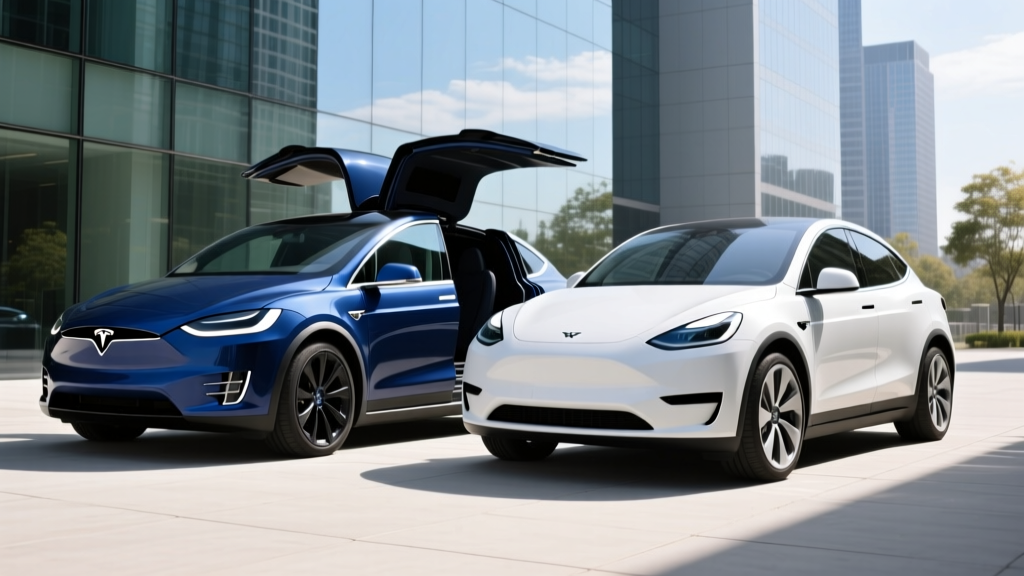
The Tesla Model X and Model Y share a brand, a charging network, and a minimalist interior philosophy — but they serve fundamentally different buyers. The Model Y is a compact luxury crossover aimed at efficiency-minded families and commuters. The Model X is a full-size flagship SUV with falcon-wing doors, optional third-row seating, and a price tag that can exceed $100,000. If you're researching the difference between Tesla X and Y, the short answer is scale: the X gives you more space, more power, and more prestige; the Y gives you more value, more efficiency, and easier daily usability.
Below, we break down every spec that matters — from real-world range and charging curves to tax-credit eligibility and five-year ownership costs — so you can match the right Tesla to your actual driving life.
Side-by-Side Specs: Tesla Model X vs Model Y at a Glance
| Spec | 2026 Tesla Model X (Long Range) | 2026 Tesla Model Y (Long Range AWD) |
|---|---|---|
| EPA Range | 335 mi | 320 mi |
| Battery (usable) | ~95 kWh (NMC) | ~75 kWh (NMC) |
| Efficiency (MPGe combined) | 102 MPGe | 122 MPGe |
| Peak DC Fast Charge | 250 kW | 250 kW |
| 10–80% DC Charge Time | ~30 min | ~25 min |
| Level 2 Charge Rate | 11.5 kW (44 mi/hr) | 11.5 kW (48 mi/hr) |
| 0–60 mph | 3.8 sec | 4.8 sec |
| Horsepower | 670 hp | 384 hp |
| Cargo (behind 2nd row) | 37.1 cu ft (88.1 cu ft max) | 30.2 cu ft (72.1 cu ft max) |
| Seating | 5, 6, or 7 passengers | 5 passengers (7 optional) |
| Towing Capacity | 5,000 lbs | 3,500 lbs |
| Base MSRP | $79,990 | $44,990 |
| Battery & Drive Warranty | 8 yr / 150,000 mi | 8 yr / 120,000 mi |
Sources: fueleconomy.gov, Tesla.com 2026 spec sheets. Real-world range will vary — see below.
Real-World Range and Efficiency: Where the Numbers Diverge
Model X: EPA 335 mi; expect ~280–300 mi on highway trips at 70+ mph, and ~230–260 mi in freezing temperatures with cabin heat.
Model Y: EPA 320 mi; expect ~270–290 mi highway, and ~220–250 mi in deep cold.
On paper, the Model X wins by 15 miles. In practice, the Model Y is the more efficient vehicle. Its smaller battery, lighter curb weight (~4,400 lbs vs. ~5,200 lbs), and lower drag profile mean it uses less energy per mile — roughly 28 kWh/100 mi for the Y versus 33 kWh/100 mi for the X.
That efficiency gap compounds on road trips. At a Supercharger, the Model Y's smaller battery fills faster proportionally, and its lower consumption means each kWh of charge buys more miles. On a 500-mile trip, you'll likely make the same number of stops in either vehicle, but the Y spends less time plugged in per stop.
Both vehicles benefit from Tesla's excellent heat pump, which minimizes cold-weather range loss compared to older EVs using resistive heaters. Still, plan for a 20–30% range reduction in sustained sub-freezing driving — physics doesn't negotiate.
Charging Speed and the Supercharger Advantage
Both the Model X and Model Y peak at 250 kW on V3 Superchargers. However, the charge curve — how power tapers as the battery fills — differs because of battery size.
The Model Y's ~75 kWh pack hits its peak rate and holds it through a wider state-of-charge window relative to total capacity, reaching 10–80% in roughly 25 minutes. The Model X's ~95 kWh pack sustains peak power longer in absolute terms but needs to push more total energy, taking about 30 minutes for the same 10–80% session.
Both use the NACS connector natively, giving you full access to the Tesla Supercharger network — the most reliable and geographically complete DC fast-charging network in the US, with over 6,000 stalls nationwide. This is a significant ownership advantage over non-Tesla EVs that rely on CCS networks like Electrify America or EVgo, where uptime and plug availability remain inconsistent in many regions.
For home Level 2 charging, both accept 11.5 kW on a 48-amp circuit (hardwired, 60-amp breaker). The Y recovers about 48 miles of range per hour of charging; the X, being less efficient, recovers about 44. A full overnight charge from 20% restores either vehicle by morning.
Category Verdicts: Who Wins Where
Despite 15 fewer EPA miles, the Y's superior MPGe (122 vs. 102) and lower kWh/100mi make it cheaper to fuel and marginally better on road trips.
Same 250 kW peak, but the Y's smaller battery reaches 80% roughly 5 minutes sooner.
670 hp and a 3.8-second 0–60 demolish the Y's 4.8 seconds. The Plaid variant (not compared here) drops to 2.5 seconds.
37.1 cu ft behind the second row, available third row for 7 passengers, and a powered frunk. The Y is practical but compact.
At $35,000 less before incentives, the Y delivers 96% of the X's range at 56% of the price.
Identical 15.4-inch touchscreen, same FSD (Supervised) capability, same OTA update cadence. Both run Tesla's latest software stack.
Price, Tax Credits, and What You'll Actually Pay
| Cost Factor | Model X Long Range | Model Y Long Range AWD |
|---|---|---|
| Base MSRP | $79,990 | $44,990 |
| Federal §30D Tax Credit | Not eligible (MSRP exceeds $80,000 SUV cap) | Up to $7,500 (if income & sourcing requirements met) |
| Effective Starting Price | $79,990 | ~$37,490 (with full credit) |
| Typical Add-ons (FSD, paint, wheels) | +$8,000–$15,000 | +$2,000–$8,000 |
This is where the comparison tilts hard. Under current IRS §30D rules, the Model X's base MSRP of $79,990 pushes right against the $80,000 SUV cap — and any single option or destination charge can push it over, eliminating the $7,500 credit entirely. Even when it squeaks under, the buyer must meet income caps ($300,000 joint / $150,000 individual AGI) and the vehicle must satisfy critical-mineral and battery-component sourcing requirements that shift annually.
The Model Y, at $44,990, clears the $80,000 SUV MSRP cap with enormous room. Eligible buyers can apply the full $7,500 as a point-of-sale rebate, dropping the effective price to roughly $37,490 before state incentives. That's a staggering $42,500 gap between the two vehicles after credits.
Important: Tax credit eligibility depends on your specific income, the vehicle's battery sourcing compliance in the purchase year, and whether you have sufficient tax liability (for non-point-of-sale claims). Consult a tax professional and check the latest IRS guidance before relying on credit amounts.
Five-Year Ownership Cost Breakdown
| Category (5 years / 75,000 mi) | Model X | Model Y |
|---|---|---|
| Energy (electricity at $0.16/kWh avg) | ~$3,960 | ~$3,360 |
| Insurance (national avg) | ~$14,500 | ~$9,500 |
| Maintenance (tires, cabin filter, fluid) | ~$2,800 | ~$2,200 |
| Estimated Depreciation | ~$32,000 | ~$16,000 |
| Total 5-Year Cost | ~$53,260 | ~$31,060 |
The Model X costs roughly $22,000 more to own over five years, driven primarily by higher insurance premiums (the X's repair costs and MSRP push rates up), steeper depreciation on a larger purchase price, and slightly higher energy consumption. Neither vehicle requires oil changes, spark plugs, or transmission service — EV powertrain maintenance is limited to tire rotations, cabin air filters, wiper fluid, and brake fluid checks.
Tire costs are worth noting: the Model X's heavier weight and wider tires (265/45R20 standard) mean replacement sets cost $1,200–$1,600 versus $900–$1,200 for the Model Y's 255/45R19 rubber. Expect 30,000–40,000 miles per set on either vehicle with normal driving.
Key Differences Beyond the Spec Sheet
Falcon-Wing Doors vs. Conventional Liftgate
The Model X's signature falcon-wing rear doors open vertically, making third-row access dramatically easier in tight parking spaces and simplifying car-seat installation. They're genuinely useful — but add mechanical complexity and have been a source of seal and sensor complaints in earlier model years. The Model Y's conventional hatch is boring and bulletproof.
Ride Quality and Suspension
The Model X uses adaptive air suspension with automatic ride-height adjustment — it lowers at highway speed for efficiency and raises for rough roads or loading. The Model Y uses conventional coil springs. The X rides noticeably better over broken pavement and absorbs highway expansion joints with composure the Y can't match.
Towing
If you tow, the Model X's 5,000-lb capacity handles a small camper or dual-axle utility trailer. The Model Y's 3,500-lb limit restricts you to light trailers and bike racks. Towing cuts range roughly in half for either vehicle — plan charging stops accordingly.
Autopilot and FSD (Supervised)
Both vehicles offer Tesla Autopilot (standard) and Full Self-Driving Supervised ($8,000 option or $99/month). These are SAE Level 2 driver-assistance systems. You must keep your hands on the wheel and eyes on the road at all times. Neither vehicle drives itself. Only Level 4 services like Waymo operate without a human driver in geofenced areas.
Functionally, both vehicles receive identical FSD updates simultaneously. There is no autonomy advantage to buying the Model X.
Decision Framework: Which Tesla Fits Your Life?
Choose the Model X if:
- You regularly carry 5+ passengers and need genuine third-row usability
- You tow a trailer in the 3,500–5,000 lb range
- You want adaptive air suspension and a quieter, more premium ride
- You value falcon-wing doors for car-seat access or tight-space loading
- Budget is flexible and the $35,000+ premium over the Y doesn't constrain you
Choose the Model Y if:
- You're a household of 1–4 people with occasional cargo needs
- You want maximum efficiency and lowest cost per mile
- Federal tax credit eligibility matters to your purchase math
- You prefer a smaller footprint for urban parking and garage fitment
- You want 95% of the Tesla experience — Supercharger access, OTA updates, FSD — at roughly half the price
Final Recommendation
For the vast majority of EV buyers, the Model Y is the rational choice. It delivers excellent real-world range, access to the best charging network in the country, strong performance, and practical cargo space — all at a price that unlocks the full federal tax credit and keeps five-year ownership costs manageable. It is the best-selling vehicle in the world for a reason.
The Model X earns its premium only if your life demands what it uniquely offers: three-row seating, serious towing capacity, air suspension comfort, and the sheer presence of a flagship. If those features solve real problems for you, the X delivers them without compromise. If they don't, you're paying $35,000+ extra for size and prestige you won't use daily.
Test-drive both back-to-back. Load your car seats into the X's falcon-wing opening. Fold the Y's seats flat and check if your stroller and groceries fit. The right answer becomes obvious when you stop comparing specs and start comparing your Tuesday morning.
Frequently Asked Questions
Is the Tesla Model X worth the extra cost over the Model Y?
Only if you need three-row seating, 5,000-lb towing, or adaptive air suspension. For families of four or fewer who don't tow, the Model Y delivers nearly identical tech and range at roughly half the total cost of ownership.
Do both the Model X and Model Y qualify for the $7,500 federal tax credit?
The Model Y generally qualifies, as its MSRP is well under the $80,000 SUV cap. The Model X sits at the edge of the cap and may lose eligibility depending on options and destination charges. Both require the buyer to meet IRS income limits and the vehicle to satisfy battery-sourcing rules. Always verify on irs.gov before purchasing.
Which Tesla is cheaper to insure?
The Model Y, typically by $4,000–$5,000 over five years. The X's higher MSRP, more expensive body panels (especially the falcon-wing doors), and costlier suspension components drive higher premiums. Get quotes from your insurer for both before deciding.
Can the Model Y fit a third row like the Model X?
Tesla has offered an optional third row for the Model Y in some markets, but it's extremely tight — suitable only for small children on short trips. The Model X's third row accommodates adults on longer journeys and is far easier to access thanks to the falcon-wing doors.
Which has better Supercharger access?
Identical. Both use the NACS connector natively and access the full Tesla Supercharger network. No adapter is needed, and both precondition the battery automatically when you navigate to a Supercharger.
How does cold weather affect each vehicle?
Expect 20–30% range loss in sustained sub-freezing temperatures for both vehicles. The Model X's larger battery gives it a slightly bigger absolute range buffer, but the Y's heat pump is equally effective. Preconditioning while plugged in mitigates much of the loss for daily commutes.