How Does a Diesel-Electric Train Work? The Quick Answer
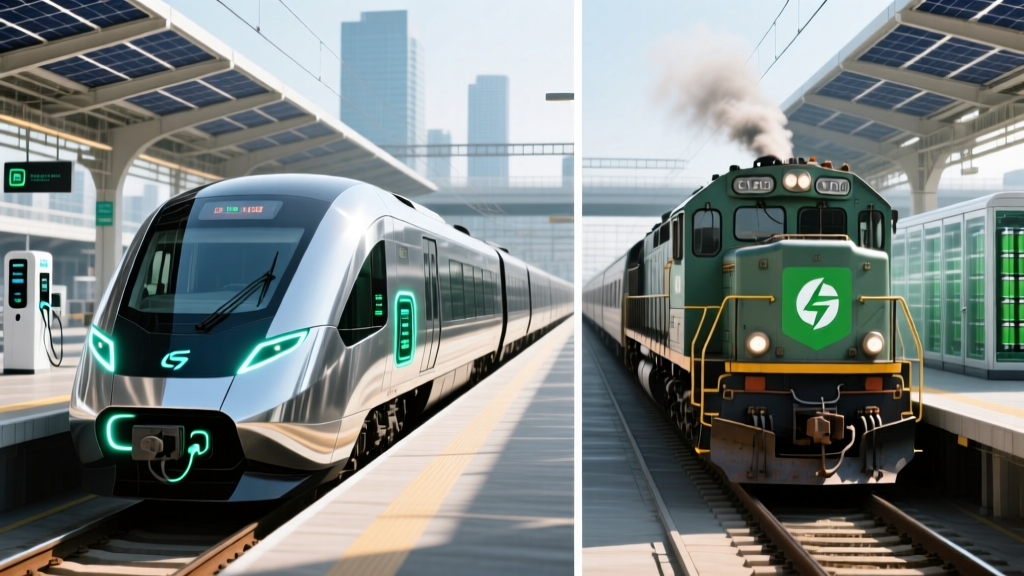
A diesel-electric locomotive is essentially a series-hybrid vehicle — the same architecture found in plug-in hybrids like the Toyota RAV4 Prime, just at massive scale. A diesel engine (the "prime mover") spins an alternator or generator to produce electricity. That electricity feeds traction motors mounted on the axles, which turn the wheels. There is no mechanical connection between the diesel engine and the wheels. The engine runs at its most efficient RPM regardless of train speed, while the electric traction motors deliver maximum torque from zero RPM — exactly the principle that makes battery-electric vehicles so efficient at acceleration.
Modern locomotives like the GE Evolution Series or EMD SD70MAC produce 4,000–4,400 horsepower from a diesel engine displacing 7–12 liters, generating roughly 3,000 kW of electrical power to feed six AC traction motors. That's the output of about 30 Tesla Superchargers, all generated onboard.
If you've searched "how does a diesel electric train work" while researching electric vehicle powertrains, you've stumbled onto one of the most instructive comparisons in transportation engineering. The diesel-electric locomotive solved the same problem that modern EVs and PHEVs address: how to use electric motors for propulsion while managing energy generation and storage. Understanding this 100-year-old technology clarifies why series-hybrid architectures, range-extended EVs, and battery-electric drivetrains each have distinct roles in 2026.
The Diesel-Electric Drivetrain: A 100-Year Series Hybrid
The first successful diesel-electric locomotives entered service in the 1920s. The architecture was radical then and remains conceptually identical today:
- Diesel engine (prime mover): Burns fuel to create rotational energy. Runs at a constant or near-constant RPM for peak thermal efficiency — typically 35–40% in modern units.
- Main alternator/generator: Converts mechanical rotation into electrical current. Modern units produce AC, which is then rectified and inverted for traction motor control.
- Traction motors: Electric motors (one per axle, typically six on a standard locomotive) that convert electrical energy into mechanical rotation at the wheels. These deliver peak torque at zero RPM — the same characteristic that gives a Tesla Model S Plaid its 1.99-second 0–60 time.
- Dynamic braking: When slowing, traction motors reverse function and become generators, converting kinetic energy back into electricity. In older locomotives, this energy is dissipated as heat through resistor grids. In modern units with regenerative capability, some energy can be stored or fed back to other locomotives in the consist.
The critical insight: the diesel engine never drives the wheels directly. It exists solely to generate electricity. This decoupling of power generation from propulsion is the defining feature of a series hybrid — and it's the same principle behind the BMW i3 REx, the Chevrolet Volt (series mode), and upcoming range-extended EVs from manufacturers like Mazda and Nissan.
Diesel-Electric Train Specs vs. Modern EV Powertrains
The scale difference is enormous, but the engineering parallels are striking. Here's how a modern freight locomotive stacks up against representative 2026 EVs and PHEVs:
| Specification | GE Evolution Series Locomotive | 2026 Tesla Model Y LR AWD | 2026 Toyota RAV4 Prime PHEV |
|---|---|---|---|
| Powertrain type | Series hybrid (diesel-electric) | Battery electric (BEV) | Series-parallel PHEV |
| Total system output | ~4,400 HP (3,280 kW) | 384 HP (286 kW) | 302 HP (225 kW) combined |
| Energy source | Diesel fuel (2,900-gal tank) | 75 kWh NMC battery | 18.1 kWh battery + 2.5L gas engine |
| Traction motors | 6× AC motors (one per axle) | 2× AC permanent magnet | 2× AC motors (front/rear) |
| Peak torque at wheels | ~157,000 lb-ft (tractive effort) | ~3,500 lb-ft (est. at wheels) | ~2,800 lb-ft (est. at wheels) |
| Energy efficiency | ~35–40% (thermal to motion) | ~77–85% (battery to motion) | ~42 MPGe electric / 38 MPG gas |
| Regenerative braking | Yes (dynamic braking, mostly heat) | Yes (up to ~100 kW regen) | Yes (moderate regen) |
| 0–60 mph | Not applicable (heavy freight) | 5.0 seconds | 5.7 seconds |
The locomotive's tractive effort figure dwarfs passenger vehicles because a fully loaded freight train can weigh 18,000–20,000 tons. But the efficiency story favors EVs: a battery-electric drivetrain converts 77–85% of stored energy into motion at the wheels, while a diesel-electric locomotive converts only 35–40% of the diesel fuel's chemical energy into forward motion. The rest is lost as heat, noise, and exhaust.
Why Trains Use Diesel-Electric (And Why Cars Don't)
Given that battery-electric drivetrains are more efficient, why do locomotives still burn diesel? The answer reveals the core constraints that every EV buyer should understand:
Energy Density: Diesel Fuel vs. Lithium-Ion Batteries
Diesel fuel contains approximately 36.6 kWh of energy per gallon. A locomotive carrying 2,900 gallons stores roughly 106,000 kWh of chemical energy. Even accounting for the 35–40% thermal efficiency, that's ~37,000–42,000 kWh of usable propulsion energy.
A 2026 Tesla Model Y Long Range carries a 75 kWh battery with roughly 70 kWh usable. That's 500× less energy than a locomotive's fuel tank, in a package weighing 1,000 lbs versus the locomotive's 20,000+ lbs of diesel.
Current lithium-ion battery energy density sits at roughly 250–300 Wh/kg at the cell level. Diesel fuel delivers 12,000 Wh/kg — a 40× advantage. This is why battery-electric semi trucks like the Tesla Semi (500-mile range, ~900 kWh battery, ~17,000 lb battery weight) remain impractical for many long-haul routes, and why rail hasn't gone fully electric outside of overhead-wire corridors.
The Weight Problem Scales Differently
In a passenger EV, adding battery weight increases energy consumption — a heavier car needs more kWh per mile. But a locomotive pulling 150 loaded coal cars barely notices the weight of its own powerplant. The train's total mass is so enormous that the locomotive's 420,000-lb weight is a rounding error. This is why diesel-electric works for rail but battery-electric works better for passenger cars: the vehicle-to-payload weight ratio is completely different.
What Diesel-Electric Tech Means for Your EV Purchase Decision
The diesel-electric locomotive is a masterclass in solving the range problem with onboard fuel generation. That same problem — how to go far without relying on fixed charging infrastructure — drives three distinct powertrain choices for 2026 car buyers:
| If your situation is... | Then choose... | Why |
|---|---|---|
| Home Level 2 charging available, daily commute under 60 miles, occasional road trips under 300 miles | Battery EV (BEV) — e.g., Hyundai Ioniq 5, Tesla Model Y | Lowest cost per mile (~$0.04/mi home charging vs $0.12/mi gas), minimal maintenance, 250–320 mi EPA range covers 95% of driving |
| No reliable home charging, frequent 400+ mile trips, rural driving with sparse DC fast chargers | PHEV — e.g., Toyota RAV4 Prime, Jeep Wrangler 4xe | 42–50 miles electric-only for daily driving (series-hybrid mode like a locomotive), gas engine for long range, no range anxiety |
| Short daily commute, no road trips, budget-conscious, urban environment | BEV with smaller battery — e.g., Chevrolet Equinox EV LT1, Nissan Leaf | Lower purchase price ($28,000–$33,000), 200–250 mi range sufficient, federal tax credit can bring effective price under $25,000 |
| Tow-heavy, cold climate, no home charging, remote area | HEV or PHEV — e.g., Ford Maverick Hybrid, Toyota Tacoma i-FORCE MAX | Cold weather doesn't reduce range as severely as BEV, towing doesn't crater range, fuel available everywhere |
Real Costs: EV vs. Gas vs. Hybrid Ownership in 2026
The locomotive analogy clarifies one thing: generating your own electricity onboard (whether from diesel or gasoline) is less efficient than storing it in a battery charged from the grid. Here's what that efficiency gap means in dollars over 5 years and 75,000 miles:
| Cost Category | 2026 Tesla Model Y LR ($44,990 MSRP) | 2026 Toyota RAV4 Prime ($43,690 MSRP) | 2026 Toyota RAV4 Gas LE ($30,440 MSRP) |
|---|---|---|---|
| Purchase price (before incentives) | $44,990 | $43,690 | $30,440 |
| Federal tax credit (§30D, if eligible) | –$7,500 (point-of-sale) | –$7,500 (point-of-sale) | $0 |
| Effective purchase price | $37,490 | $36,190 | $30,440 |
| Fuel/energy cost (75,000 mi) | $2,625 (home charging at $0.14/kWh, 3.5 mi/kWh) | $4,200 (mixed electric/gas driving) | $8,330 (30 MPG combined, $3.33/gal) |
| Maintenance (5 yr) | $1,500 (tire rotations, cabin filter, fluid top-off) | $3,200 (oil changes + EV system checks) | $3,800 (oil, filters, brakes, spark plugs) |
| Insurance (5 yr avg) | $9,500 ($1,900/yr avg) | $7,800 ($1,560/yr avg) | $7,200 ($1,440/yr avg) |
| 5-year total cost of ownership | $51,115 | $51,390 | $49,770 |
| Cost per mile (all-in) | $0.68 | $0.69 | $0.66 |
The BEV and PHEV achieve near-parity with the gas vehicle on total cost despite higher purchase prices, driven by dramatically lower fuel and maintenance costs. The gap widens further if gas prices rise or if your utility offers off-peak EV charging rates (as low as $0.06–$0.08/kWh in some markets). According to fueleconomy.gov, EVs convert 77% of grid energy to wheel motion, while gasoline vehicles convert only 12–30%.
Key caveat on the §30D tax credit: Eligibility depends on MSRP caps ($55,000 for sedans, $80,000 for SUVs/trucks), buyer income limits ($150,000 single / $300,000 joint AGI), and battery critical-mineral and component sourcing requirements that tighten annually. As of 2026, fewer models qualify than in prior years. Always verify current eligibility at IRS.gov before purchasing, and confirm with a tax professional. The credit can now be transferred to the dealer at point of sale, reducing your out-of-pocket cost immediately rather than waiting for tax filing.
Common Misconceptions: Diesel-Electric Trains and EVs
| Myth | Fact |
|---|---|
| "Diesel-electric trains are electric vehicles, so they're zero-emission." | They burn thousands of gallons of diesel. The electric drivetrain improves efficiency but doesn't eliminate emissions. True zero-emission rail requires overhead catenary wires (like Amtrak's Northeast Corridor) or hydrogen fuel cells (being piloted by BNSF and CPKC). |
| "EVs are basically the same as diesel-electric trains — they just use batteries instead of a generator." | The drivetrain concept is similar (electric motors at the wheels), but a BEV has no onboard generator. A PHEV in series mode (like the RAV4 Prime in EV-only depleted mode) is the true automotive analog to a diesel-electric locomotive. |
| "If diesel-electric is good enough for trains, why don't all cars use it?" | Weight and scale. A locomotive's diesel generator weighs 20+ tons in a 200-ton vehicle. Putting a diesel generator in a 4,000-lb car adds 300–500 lbs of dead weight when running on battery — that's why PHEVs (which carry both systems) get lower MPGe than pure BEVs. |
| "Regenerative braking on trains works just like EVs." | Partially true. Modern locomotives use dynamic braking, which converts kinetic energy to electricity — but most dissipate it as heat through resistor grids rather than storing it. Battery-electric and hybrid locomotives (like the Wabtec FLXDrive) now store this energy, similar to EV regen. |
| "EVs can't match the torque of a diesel-electric locomotive." | Correct in absolute terms — a locomotive produces 157,000+ lb-ft of tractive effort. But pound-for-pound, EVs are more torque-dense. A Tesla Model S Plaid produces roughly 1,050 lb-ft from motors weighing under 200 lbs total. |
Where Rail Electrification and EVs Are Heading
The rail industry is actively pursuing zero-emission alternatives to diesel-electric powertrains, and the solutions mirror what's happening in passenger vehicles:
- Battery-electric locomotives: Wabtec's FLXDrive prototype carries a 7 MWh battery (roughly 93× a Tesla Model Y battery) and has demonstrated 30% fuel reduction in yard and mainline testing. Full battery-electric operation is viable for short-haul and yard switching but not yet for 1,500-mile freight runs.
- Hydrogen fuel cell locomotives: CPKC and CSX are testing hydrogen-powered units that generate electricity via fuel cells — essentially replacing the diesel engine with a hydrogen stack. This mirrors Toyota's approach with the Mirai passenger vehicle.
- Catenary electrification: Overhead wires power trains directly, as on Amtrak's Northeast Corridor. This is the rail equivalent of an EV charging while driving — unlimited range, zero onboard emissions, but requiring massive infrastructure investment.
For passenger EVs, the trajectory points toward solid-state batteries (expected in limited production by 2028–2029 from Toyota and Samsung SDI) that promise 400–500 Wh/kg energy density — roughly double current cells. That could push a midsize SUV past 450 miles of EPA range while reducing battery weight by 30%, narrowing the gap with the energy-density advantage that keeps diesel in locomotives.
Frequently Asked Questions
Is a diesel-electric locomotive considered a hybrid vehicle?
Yes — specifically, it's a series hybrid. The diesel engine generates electricity but never mechanically drives the wheels. This is the same architecture used by the original Chevrolet Volt in series mode and the BMW i3 with Range Extender. The SAE classifies any vehicle with both an internal combustion engine and electric traction motors as a hybrid, regardless of fuel type.
How efficient is a diesel-electric train compared to a battery-electric car?
A modern diesel-electric locomotive achieves roughly 35–40% thermal efficiency (diesel chemical energy to wheel motion). A battery-electric car achieves 77–85% efficiency from grid to wheels. However, locomotives move freight at roughly 470 ton-miles per gallon — meaning one gallon of diesel moves one ton of freight 470 miles. Per ton-mile, rail freight is the most efficient land transport mode, even with the diesel penalty.
Why don't we just electrify all train lines like we do with EVs?
Cost. Electrifying a rail corridor with overhead catenary wires runs $5–15 million per mile. The U.S. has roughly 140,000 miles of freight rail — full electrification would cost $700 billion to $2.1 trillion. In contrast, Europe and Asia have extensively electrified rail (Switzerland: 100%, Japan: ~75%), but their networks are shorter and more passenger-focused. For the U.S., battery-electric and hydrogen locomotives offer a path to decarbonization without the infrastructure cost.
Can a diesel-electric train run on biodiesel or renewable diesel?
Yes. Most modern diesel-electric locomotives can run on B20 biodiesel blends (20% biodiesel, 80% petroleum diesel) without modification. Renewable diesel (HVO, or hydrotreated vegetable oil) is a drop-in replacement that can reduce lifecycle carbon emissions by 50–80%. Union Pacific and BNSF have conducted extensive renewable diesel testing. This is analogous to how some PHEVs can run on E85 ethanol blends in their combustion engines.
What's the closest car equivalent to a diesel-electric train?
The series-hybrid PHEV — specifically vehicles that can operate with the engine solely generating electricity rather than driving the wheels. The 2026 Toyota RAV4 Prime, when its battery is depleted, operates in a mode where the 2.5L engine generates electricity for the traction motors, closely mirroring locomotive architecture. The Nissan e-Power system (available in the X-Trail in some markets) is a pure series hybrid: the gas engine never touches the wheels.
Understanding how diesel-electric trains work illuminates why electric motors dominate both rail and road transportation: instant torque, precise control, and high efficiency at the point of use. The difference is energy storage. Trains carry diesel because batteries can't yet store enough energy for 20,000-ton loads over 1,500 miles. Passenger cars carry batteries because 4,000-lb vehicles need far less energy, and the grid provides cheap, clean fueling at home. Both are electric vehicles — they've just solved the energy problem differently.