If you own or are shopping for an electric vehicle, understanding the three tiers of EV charging — and specifically how DC charging fits into your routine — is the single most important thing you can learn before plugging in. DC fast charging is what makes road trips viable. Home Level 2 charging is what makes daily ownership effortless. And confusing kW (power, or how fast energy flows) with kWh (energy, or how much your battery holds) is the fastest way to make a bad equipment purchase.
This guide breaks down every charging tier with exact numbers: kilowatt rates, miles added per hour, 10–80% charge times for common battery sizes, real installation costs including panel upgrades, and what you'll actually pay per mile versus a gas car. Data reflects 2026 model-year vehicles and current utility rates.
The Three Charging Levels: Speeds and Range Added Per Hour
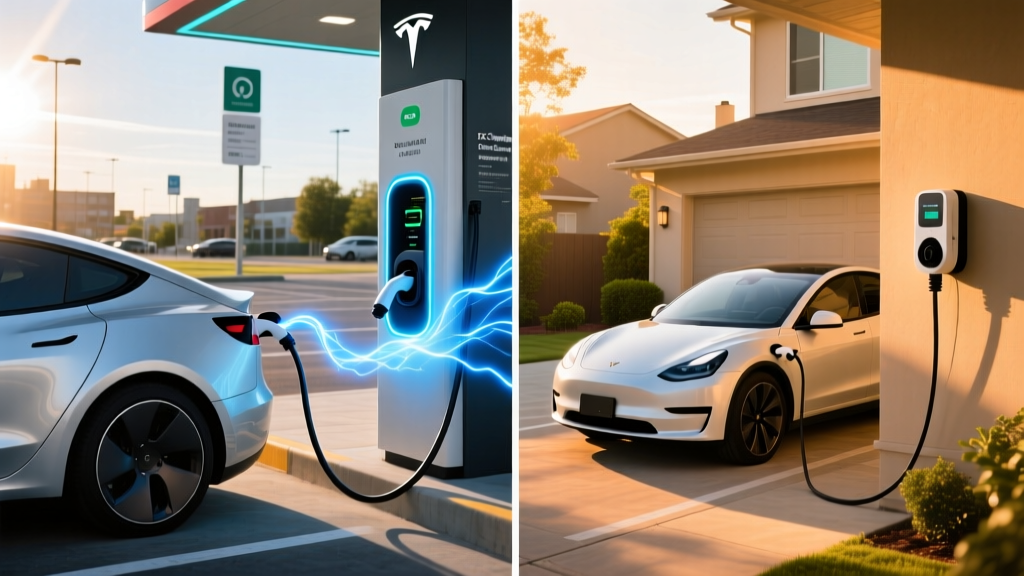
Every EV sold in the U.S. can accept power at one or more of three charging levels. The critical distinction is between AC charging (Level 1 and Level 2), where the car's onboard charger converts household alternating current to DC for the battery, and DC fast charging, which bypasses the onboard charger entirely and feeds direct current straight to the battery pack at much higher power.
| Level | Voltage | Typical Power (kW) | Miles of Range Added Per Hour | Primary Use Case |
|---|---|---|---|---|
| Level 1 | 120V AC | 1.0–1.4 kW | 3–5 mi/hr | Overnight top-ups, PHEVs, low-mileage drivers |
| Level 2 | 240V AC | 3.3–19.2 kW | 12–75 mi/hr | Daily home and workplace charging |
| DC Fast Charging | 200–900V DC | 50–350 kW | 150–1,200+ mi/hr (peak) | Road trips, quick top-ups, fleet operations |
A few real-world caveats: the "miles per hour" figure for DC charging represents peak rate at a low state of charge (SoC). Above roughly 80% SoC, charging speed tapers dramatically to protect battery health — which is why you'll see manufacturers quote 10–80% times rather than 0–100%. A vehicle peaking at 240 kW may sustain that rate for only 10–15 minutes before dropping to 100 kW or less. And ambient temperature matters: in cold weather (below 40°F), expect DC charging speeds to drop 20–40% unless your vehicle actively preconditioned the battery on the way to the charger.
DC Charging Explained: How Fast Can You Really Charge?
DC fast charging stations deliver power at voltages and amperages far beyond what any home electrical system provides. Current public networks offer chargers ranging from 50 kW legacy units to 350 kW ultra-fast stations. In 2026, Electrify America, EVgo, and Tesla Superchargers are deploying increasing numbers of 350 kW stalls, though your vehicle's maximum acceptance rate determines whether you can actually use that capacity.
Here's what 10–80% DC fast charging looks like for several popular 2026 EVs with common battery sizes:
| Vehicle | Battery (kWh usable) | Peak DC Rate (kW) | 10–80% Time (min) | Connector |
|---|---|---|---|---|
| Tesla Model Y (Long Range) | 75 | 250 | ~22 | NACS |
| Hyundai Ioniq 5 (Long Range) | 77.4 | 238 | ~18 | NACS (2026+) |
| Ford F-150 Lightning (Extended) | 131 | 170 | ~41 | NACS (2026+) |
| Chevrolet Equinox EV (RS) | 85 | 190 | ~24 | NACS (2026+) |
| Nissan Ariya (e-4ORCE) | 87 | 130 | ~35 | CCS1 |
Source: fueleconomy.gov and manufacturer press specifications.
Home Charger Installation: Electrical Requirements and Real Costs
Most EV owners do 80% or more of their charging at home on a Level 2 (240V) circuit. The installation cost varies enormously depending on your home's electrical panel capacity, the distance from panel to charger location, and local permit requirements.
Standard electrical requirements for a Level 2 home charger:
- Circuit: Dedicated 240V circuit, typically 40A or 50A (supports 32A or 40A continuous charging, respectively — the National Electrical Code requires circuits rated 125% above continuous load)
- Wire gauge: 6 AWG copper for 50A circuits; 8 AWG for 40A (may vary by run length)
- Panel capacity: Most homes with 200A service can accommodate a 40–50A EV circuit. Homes with 100A service or heavy existing loads (electric heat, tankless water heaters) may need a panel upgrade to 200A
- GFCI protection: 2026 NEC requires GFCI protection for all EV charging outlets (not required for hardwired installations, which is why many electricians recommend hardwiring)
- Permit: Required in most jurisdictions; typically $50–$200 depending on locality
| Component | Simple Install (panel nearby) | Complex Install (long run or panel upgrade) |
|---|---|---|
| Level 2 Charger Equipment | $300–$700 | $300–$700 |
| Electrician Labor | $400–$800 | $1,200–$3,000 |
| Electrical Permit | $50–$150 | $100–$250 |
| Panel Upgrade (if needed) | $0 | $1,500–$4,000 |
| Conduit / Wiring Materials | $50–$150 | $200–$600 |
| Total Estimated Cost | $800–$1,800 | $3,300–$8,550 |
IRS §30D Alternative Fuel Refueling Property Credit
The federal tax credit under IRS §30C covers 30% of home EV charger equipment and installation costs, up to $1,000. Eligibility requires installation at your primary residence in a qualifying census tract (many suburban and rural areas qualify; most dense urban tracts do not). Consult a tax professional to confirm your eligibility — this credit is non-refundable and subject to income tax liability.
Connector Compatibility: NACS, CCS1, CHAdeMO, and Adapters
As of 2026, the North American EV charging connector landscape has consolidated significantly around NACS (the Tesla-designed standard now formalized as SAE J3400). Most major automakers — Ford, GM, Hyundai, Kia, Rivian, Volvo, BMW, and others — have transitioned to NACS ports on new vehicles. CCS1 remains on some carryover models, and CHAdeMO is effectively legacy (Nissan Ariya switched to CCS; the Leaf was the last major CHAdeMO vehicle and has been discontinued).
| Connector | Brands Using It (2026) | DC Fast Charging Networks | Adapter Needed? |
|---|---|---|---|
| NACS (J3400) | Tesla, Ford, GM, Hyundai, Kia, Rivian, Volvo, BMW, Mercedes, Nissan (new models) | Tesla Supercharger, Electrify America (NACS stalls), EVgo, ChargePoint | CCS-to-NACS adapter for legacy CCS stations (~$200–$250) |
| CCS1 | Some 2025 carryover models, Volkswagen ID.4 (select trims), Porsche Taycan | Electrify America, EVgo, ChargePoint | NACS-to-CCS adapter for Tesla Superchargers (~$200–$250) |
| CHAdeMO | Legacy only (no new 2026 models) | Declining availability | No reliable adapter to NACS/CCS for DC charging |
Practical advice: If you're buying a 2026 EV, prioritize a vehicle with a native NACS port. The Tesla Supercharger network remains the most reliable DC fast charging network in the U.S. by uptime and coverage, per J.D. Power EV charging satisfaction studies. A CCS1 vehicle can access Superchargers with an adapter, but adapter availability and compatibility vary — confirm before relying on it for road trips.
Cost to Charge: Per-Mile Pricing vs. Gasoline
The cost advantage of electric driving depends entirely on where and when you charge. Home charging on off-peak utility rates delivers the lowest per-mile cost. Public DC fast charging can approach or exceed the cost of gasoline in some markets.
| Charging Scenario | Rate ($/kWh) | Cost Per Mile* | Annual Fuel Cost (12,000 mi) |
|---|---|---|---|
| Home Level 2 — Off-Peak Utility Rate | $0.08–$0.14 | $0.024–$0.042 | $288–$504 |
| Home Level 2 — Standard Residential Rate | $0.15–$0.22 | $0.045–$0.066 | $540–$792 |
| Public Level 2 (ChargePoint, etc.) | $0.25–$0.49 | $0.075–$0.147 | $900–$1,764 |
| DC Fast Charging (Electrify America, EVgo) | $0.35–$0.65 | $0.105–$0.195 | $1,260–$2,340 |
| Tesla Supercharger (varies by location) | $0.25–$0.40 | $0.075–$0.120 | $900–$1,440 |
| Gasoline (25 MPG avg, $3.40/gal) | — | $0.136 | $1,632 |
*EV cost per mile calculated at 3.0 miles per kWh (typical efficiency for a midsize crossover EV like the Hyundai Ioniq 5 or Tesla Model Y). Actual efficiency varies by vehicle, driving style, and temperature. Source: fueleconomy.gov.
Recommended Home Level 2 Chargers for 2026
Below are four well-regarded Level 2 home chargers available in 2026, spanning budget to premium. All support 240V operation and come with NACS connectors (CCS1 versions available for carryover vehicles).
Tesla Wall Connector
- Power Output: Up to 11.5 kW (48A on 60A circuit)
- Connector: NACS native
- Cable Length: 24 ft
- Smart Features: Wi-Fi, OTA updates, power sharing between units, Tesla app integration
- Price: ~$475
- Best For: Tesla owners and NACS-vehicle households wanting maximum power
ChargePoint Home Flex
- Power Output: Up to 12 kW (50A on 60A circuit); configurable down to 16A
- Connector: NACS (2026 model); CCS1 adapter included
- Cable Length: 23 ft
- Smart Features: Wi-Fi, ChargePoint app scheduling, Alexa integration, amperage adjustable via app
- Price: ~$650
- Best For: Multi-EV households needing flexible amperage for older panels
Emporia Vue Smart EV Charger
- Power Output: Up to 11.5 kW (48A on 60A circuit)
- Connector: NACS
- Cable Length: 24 ft
- Smart Features: Wi-Fi, energy monitoring, solar integration (pairs with Emporia Vue panel monitor), scheduled charging
- Price: ~$399
- Best For: Budget-conscious buyers who want smart features and solar pairing
Grizzl-E Smart
- Power Output: Up to 10 kW (40A on 50A circuit)
- Connector: NACS (J1772 version also available)
- Cable Length: 24 ft
- Smart Features: Wi-Fi, app scheduling, OCPP compatibility for utility demand-response programs
- Price: ~$449
- Best For: Cold-climate owners — rated to -40°F, ruggedized outdoor enclosure
Hardwire vs. plug: All units above are available in hardwired or NEMA 14-50 plug-in versions. Hardwiring eliminates the NEC GFCI breaker requirement (saving $50–$100 on the breaker itself) and is generally more reliable for outdoor installations. Plug-in versions offer portability if you move. We recommend hardwiring for any permanent outdoor installation.
Safety, Electrical Code, and Outdoor Installation Considerations
EV charging draws significant continuous current for hours at a time — far longer than most household appliances. Proper installation isn't optional; it's a fire safety issue.
- Dedicated circuit: Your EV charger must be on its own dedicated circuit — never shared with other appliances. A 40A charger requires a 50A breaker; a 48A charger requires a 60A breaker.
- GFCI protection: The 2023 NEC (adopted in most jurisdictions by 2026) requires GFCI protection on all receptacles used for EV charging. This does not apply to hardwired installations, which is another reason electricians often recommend hardwiring.
- Outdoor rating: If your charger is mounted outdoors or in an unsealed garage, confirm it carries a NEMA 4 (or IP65+) weather resistance rating. All four chargers recommended above are outdoor-rated.
- Cable management: A 24-foot cable on the ground in a garage or driveway is a trip hazard and accelerates cable jacket wear. Use a wall-mounted cable organizer or retractor.
- Utility notification: Many utilities require or request notification when you install an EV charger, as it adds significant load to your local transformer. Some offer time-of-use (TOU) rate plans that dramatically reduce off-peak charging costs — often $0.06–$0.10/kWh overnight.
- Load management: If your panel is near capacity but a full upgrade is cost-prohibitive, consider a smart charger with load management (like the Emporia or ChargePoint Flex) that dynamically reduces charging amperage when other household loads are high.
Frequently Asked Questions
How much does it cost to install a home EV charger?
For a straightforward installation with a 200A panel and the charger located near the electrical panel, expect $800–$1,800 total (equipment, electrician, permit, materials). If your home needs a panel upgrade from 100A to 200A, or the charger location is far from the panel requiring long conduit runs, costs can reach $3,300–$8,550. Always get a load calculation and itemized quote from a licensed electrician before purchasing equipment.
How fast will each charging level add range?
Level 1 (120V) adds roughly 3–5 miles per hour — adequate for plug-in hybrids with small batteries or EV drivers covering fewer than 30 miles daily. Level 2 (240V) at 48A adds approximately 35–45 miles per hour for a typical crossover EV, fully replenishing most batteries overnight. DC fast charging at peak rate can add 150–200+ miles in 15–20 minutes, though speed tapers significantly above 80% SoC.
Which connector/charger is compatible with my EV?
For 2026 models, most new EVs from Tesla, Ford, GM, Hyundai, Kia, Rivian, Volvo, and BMW use the NACS connector. Some 2025 carryover models still have CCS1. CHAdeMO is no longer used on new vehicles. Check your vehicle's charge port — if it's the smaller, slimmer NACS port, you need a NACS home charger. If it's CCS1, you can use a CCS1 charger or a NACS charger with an adapter. For DC fast charging on road trips, NACS vehicles access Tesla Superchargers natively, while CCS1 vehicles require a NACS-to-CCS adapter for Supercharger access.
How much does charging cost per mile vs. gas?
At home on off-peak utility rates ($0.08–$0.14/kWh), an average EV costs $0.024–$0.042 per mile to drive — roughly 70–80% less than a 25 MPG gas car at $3.40/gallon ($0.136/mile). On standard residential rates ($0.15–$0.22/kWh), EV cost rises to $0.045–$0.066/mile, still 50–65% cheaper. Public DC fast charging at $0.35–$0.65/kWh costs $0.105–$0.195/mile, which can equal or exceed gasoline. The economics strongly favor home charging.
What electrical upgrades might I need?
The most common upgrade is a panel capacity increase from 100A to 200A service, costing $1,500–$4,000. You may also need: a new 240V circuit with appropriate wire gauge and breaker ($400–$800 in labor and materials); a GFCI breaker if using a plug-in receptacle ($50–$100 additional); and potentially a whole-home energy management system or smart panel if your utility requires load management. Homes built after 2000 with 200A service rarely need a panel upgrade for a single 40–50A EV circuit.